


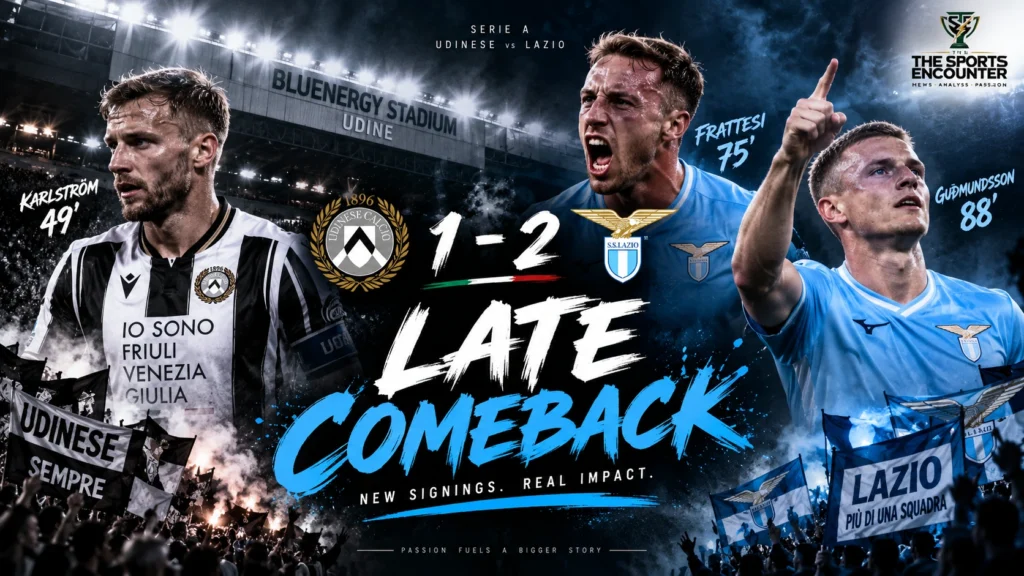
UDINE, Italy: Jesper Karlström gave Udinese the lead shortly after halftime and, for more than 25 minutes, it looked capable of becoming another early-season result built on discipline, defensive organization and patience.
Then Lazio’s summer changed the match.
Davide Frattesi equalized in the 75th minute before Albert Guðmundsson completed a 2-1 comeback in the 88th, giving Gennaro Gattuso’s side three important Serie A points at the Bluenergy Stadium on Monday night.
The timing could hardly have been more appropriate.
Frattesi and Guðmundsson were both presented by Lazio only days before the game as part of a late transfer-window push designed to add energy, goals and greater attacking variety to a squad that had looked too predictable last season.
Against Udinese, both newcomers delivered almost immediately.
Lazio finished with 62% possession, 18 shots and eight corners, spending long periods controlling territory and trying to move Udinese’s defensive block.
The hosts were much more efficient with their limited attacking opportunities, putting six of their 10 shots on target and taking the lead through Karlström in the 49th minute.
That gave Kosta Runjaić’s team a genuine chance to build on an encouraging opening month.
Instead, Lazio’s bench and late-game pressure changed everything.
Frattesi brought them level.
Guðmundsson provided the winner.
Lazio leave Udine in third place, while Udinese drop to 10th after suffering their first league defeat of the season.
Udinese 1-2 Lazio: Match at a Glance
| Detail | Udinese | Lazio |
|---|---|---|
| Final score | 1 | 2 |
| Goals | Jesper Karlström 49′ | Davide Frattesi 75′, Albert Guðmundsson 88′ |
| Shots | 10 | 18 |
| Shots on target | 6 | 5 |
| Possession | 38% | 62% |
| Passes | 373 | 549 |
| Pass accuracy | 80% | 88% |
| Fouls | 14 | 9 |
| Yellow cards | 5 | 1 |
| Corners | 2 | 8 |
Lazio’s official match page confirms Gattuso started Frattesi in midfield, while Guðmundsson began among the substitutes.
Karlström Gave Udinese the Reward Their Discipline Deserved
Udinese entered the evening with a clear idea of how they wanted the game to look.
Runjaić did not ask his side to compete with Lazio for possession.
He wanted compact spacing, defensive patience and enough direct threat to punish the visitors when transitions appeared.
That approach reflected the growth the coach and technical staff had been discussing before kickoff.
Udinese technical director Gökhan Inler said before the match that the club wanted to continue the work developed over the previous two seasons rather than allow early results to distort expectations.
The first half supported that approach.
Lazio had more of the ball, but Udinese remained difficult to open consistently.
Then Karlström struck four minutes after the interval.
Karlström’s Goal Added Another Layer to His Strong Start
The captain has become increasingly important to Udinese’s early-season structure.
His influence was already visible in the club’s recent Coppa Italia victory over Venezia, when he spoke publicly about the importance of competing across both league and cup football.
Udinese’s official post-match reaction after beating Venezia highlighted Karlström’s role in maintaining focus and consistency during a demanding opening stretch.
Against Lazio, he moved from leadership to direct scoring impact.
The 49th-minute goal gave Udinese control of the scoreboard and forced Gattuso to change how aggressively Lazio attacked the final half hour.
Lazio’s Response Was Built Around the Exact Problem Frattesi Was Signed to Solve
Frattesi arrived from Inter because Lazio needed a midfielder who attacks the penalty area aggressively.
The Sports Encounter’s Serie A 2026-27 season preview identified that trait before the season began.
Lazio finished ninth last year and often looked short of midfield penetration.
They could circulate possession.
They did not consistently turn midfield control into enough bodies arriving around the box.
Frattesi changes that.
He is not a midfielder who waits behind the attack and distributes from distance.
His strongest work often comes from arriving after the first line has already occupied defenders.
That type of movement is particularly useful against compact teams such as Udinese.
In the 75th minute, Lazio finally got the reward.
Frattesi’s First Major Lazio Moment Arrived Quickly
The equalizer was important for more than the score.
Frattesi had been officially presented by Lazio only days earlier alongside Josip Šutalo, Andrea Pinamonti and Guðmundsson.
The club’s presentation of its new signings underlined how much of Lazio’s late transfer strategy centered on adding experienced Serie A players who could contribute immediately.
Frattesi did not need a settling-in period to influence this match.
His goal changed the pressure.
At 1-0, Udinese were protecting a win.
At 1-1, they were suddenly trying to survive a Lazio side with momentum.
Guðmundsson Completed the Transfer-Window Narrative
Guðmundsson’s 88th-minute winner gave the night an almost perfect transfer-window storyline for Lazio.
The Iceland international had started on the bench.
By the final minutes, he was deciding the match.
This is the type of attacking depth Gattuso lacked when the season began.
Substitutes matter most when they change the geometry of a game rather than simply replace tired players.
Guðmundsson can operate centrally, drift between lines and attack spaces that become available when opponents are already fatigued.
That profile became particularly valuable after Frattesi’s equalizer forced Udinese to defend deeper.
Three minutes remained when Guðmundsson found the decisive goal.
Lazio’s 18 Shots Show Why the Comeback Was Not Accidental
The late goals created drama.
The underlying pressure had been building much earlier.
| Attacking Measure | Udinese | Lazio |
|---|---|---|
| Total shots | 10 | 18 |
| Shots on target | 6 | 5 |
| Possession | 38% | 62% |
| Passes | 373 | 549 |
| Pass accuracy | 80% | 88% |
| Corners | 2 | 8 |
Lazio attempted eight more shots and won six more corners.
That territorial advantage eventually became important because Udinese had to defend repeated phases rather than isolated attacks.
The interesting statistical contradiction is shots on target.
Udinese actually finished with six, one more than Lazio.
That tells us the hosts were more efficient at turning limited attacks into attempts that required intervention.
Lazio were less precise across the match but more decisive when the score demanded it.
Udinese’s Six Shots on Target Explain Why Lazio Never Had Complete Control
Possession alone does not describe how dangerous Udinese remained.
Six shots on target from 10 attempts is a strong accuracy rate.
Runjaić’s team repeatedly showed that it could move from defensive structure into meaningful attacking positions without requiring long possession sequences.
This had already been part of Udinese’s identity on opening weekend.
The Sports Encounter’s Serie A Matchday 1 analysis covered their 1-1 draw with Como, where Udinese again showed an ability to remain competitive without dominating the ball.
That pattern remains useful.
The problem on Monday was game management after taking the lead.
Udinese Had Already Shown They Could Win Difficult Games
The defeat should not erase a positive early-season body of work.
Udinese began with the draw against Como.
They then won 3-2 away at Monza.
They followed that with a 2-1 Coppa Italia victory over Venezia.
The club entered the Lazio match with confidence and continuity.
Runjaić had also warned before kickoff that the team was still not operating at 100% after an intense preseason.
The official pre-match comments from Runjaić framed the opening weeks as part of a longer development process rather than a finished product.
Monday supported that view.
Udinese competed well enough to lead Lazio.
They were not yet experienced enough in the final phase to protect it.
Gattuso Needed This Kind of Victory More Than a Routine Win
Lazio’s new season began under unusual pressure.
Gattuso inherited a side that had finished outside Europe and had already suffered an embarrassing Coppa Italia exit against second-tier Mantova before the league began.
The Sports Encounter’s season preview argued that Lazio’s biggest requirement was emotional and tactical energy around a stale core.
This match supplied exactly that type of evidence.
Lazio were behind away from home.
They did not collapse into rushed crossing or isolated attacks.
They continued controlling territory.
Gattuso used the bench.
The new signings decided the result.
That is far more valuable than another comfortable home win because it gives the squad evidence that the new structure can solve adversity.
Frattesi’s Goal Also Changes the Meaning of Lazio’s Midfield Competition
Competition for places often sounds abstract until a player produces a decisive moment.
Frattesi’s equalizer increases pressure throughout Lazio’s midfield group.
Kenneth Taylor, Reda Belahyane and the younger options now know the new arrival is capable of directly influencing matches through goals.
This is particularly important because Lazio’s midfield needed greater attacking production.
Frattesi provides it without forcing Gattuso to sacrifice central structure.
His late runs are an additional layer rather than a replacement for build-up control.
Guðmundsson Gives Gattuso a Different Kind of Attacking Option
Lazio’s forward group contains several players with different profiles.
Andrea Pinamonti can occupy center-backs.
Mattia Zaccagni attacks from wide positions.
Gustav Isaksen can stretch the field.
Guðmundsson provides something less rigid.
He can move between midfield and attack, receive in crowded spaces and appear in areas opponents struggle to assign to one defender.
That flexibility became more valuable as Udinese tired.
The winner was therefore not simply a case of a substitute scoring.
It showed how Gattuso can change Lazio’s attacking shape without making a full structural change.
Lazio Move Into Third and Strengthen Their European Argument
The result moves Lazio into third place after Matchday 3.
That position is significant because the club entered the campaign trying to rebuild after finishing ninth last season.
The top of Serie A has already become crowded.
Inter and Roma have started strongly.
Como remain one of the most interesting early-season teams.
Juventus and Milan have also collected important points.
The Sports Encounter’s complete Matchday 3 analysis showed how quickly the leading pack has begun taking shape.
Lazio’s win in Udine adds another team to that conversation.
Serie A’s Early Table Is Already Rewarding Teams That Finish Strong
Several matches across the first three rounds have been decided late.
Atalanta beat Bologna through Lazar Samardžić’s 96th-minute winner despite being second-best for long stretches.
The Sports Encounter’s analysis of that 1-0 result highlighted how little possession matters if a team remains alive long enough to take the decisive moment.
Lazio produced a related lesson.
They had more possession and more shots than Udinese but still needed to remain patient until the final 15 minutes.
Frattesi and Guðmundsson then converted that pressure into the outcome.
Lazio’s Comeback Looks Better When Compared With Fiorentina’s Collapse
Serie A has already shown how differently teams respond after taking or losing a lead.
Fiorentina led Torino on Matchday 3 before conceding twice late and losing 2-1.
The Sports Encounter’s Fiorentina-Torino analysis showed how a match can turn when substitutions and finishing quality favor one side late.
Lazio were on the opposite side of that equation.
Gattuso’s substitutions added threat.
The new arrivals executed.
Udinese lost control.
Udinese’s Next Test Could Be Even Harder
Udinese travel to face Inter at San Siro on September 14.
The club’s official September schedule confirms the trip to the defending champions before a home game against Cagliari.
The challenge now is psychological as much as tactical.
Udinese had a strong result within reach.
They lost it late.
Runjaić needs the team to carry the first 74 minutes forward without carrying the final 15 emotionally.
Lazio Now Have to Prove This Was a Pattern, Not a Transfer-Window High
Late wins create momentum quickly.
They can also exaggerate progress.
Lazio’s next performances will determine whether the Udinese comeback represents genuine improvement or simply one night when two new signings delivered exceptional timing.
Gattuso’s project needs repeatability.
Can Frattesi keep reaching scoring positions?
Can Guðmundsson consistently change games?
Can Lazio turn possession into more clear chances earlier rather than waiting until the final quarter?
Those are the questions that matter now.
The Broader Serie A Race Is Becoming More Competitive
Lazio’s recovery adds further depth to an already interesting early table.
Como have followed last season’s Champions League qualification with another strong start, including a 4-1 win at Genoa.
The Sports Encounter’s analysis of Como’s rise showed why clubs outside the traditional giants are becoming increasingly difficult to dismiss.
That makes every comeback win more valuable.
Lazio are not competing only with Inter, Milan, Juventus, Roma and Napoli for European places.
They are competing with a wider group whose floor has improved.
TSE Analysis: Lazio’s Summer Signings Won the Exact Match They Were Bought to Change
This result is easy to summarize through two names.
Frattesi.
Guðmundsson.
That simplicity should not hide why their goals matter so much.
Lazio spent much of the summer trying to solve a structural problem rather than simply collect bigger names.
The team needed more midfield penetration.
Frattesi provides it.
The attack needed another player capable of operating between fixed positions.
Guðmundsson provides that.
Both scored in the first meaningful away test after their arrival.
The match itself followed a pattern Lazio have struggled with in recent seasons.
They controlled possession.
The opponent remained dangerous.
They fell behind.
The game became increasingly uncomfortable.
The previous version of Lazio might have spent the final half hour forcing attacks and hoping pressure eventually produced something.
This version had new tools.
Frattesi equalized.
Guðmundsson won it.
Udinese deserve credit for how well they competed.
Karlström’s goal rewarded a disciplined performance, and six shots on target show the hosts were more dangerous than 38% possession suggests.
The final result still belongs to Lazio because they found two decisive actions after falling behind.
Gattuso needed evidence that his summer rebuild could change difficult matches.
Udine gave him the first convincing proof.
Frequently Asked Questions
What was the Udinese vs Lazio score?
Lazio defeated Udinese 2-1 in Serie A Matchday 3 on September 7, 2026.
Who scored for Udinese?
Jesper Karlström gave Udinese the lead in the 49th minute.
Who scored for Lazio?
Davide Frattesi equalized in the 75th minute before Albert Guðmundsson scored the winner in the 88th.
How much possession did Lazio have?
Lazio finished with 62% possession compared with Udinese’s 38%.
How many shots did Lazio have?
Lazio attempted 18 shots and put five on target.
How many shots did Udinese have?
Udinese attempted 10 shots and put six on target.
Where are Lazio in Serie A after the win?
Lazio moved into third place following the 2-1 victory in Udine.
Where are Udinese in the table?
Udinese dropped to 10th after suffering their first league defeat of the season.
Who do Udinese play next?
Udinese travel to face Inter at San Siro on September 14.
Why is Davide Frattesi important to Lazio?
Frattesi gives Lazio a midfielder who attacks the penalty area aggressively and adds goals from deeper positions, an area the squad lacked consistently last season.