


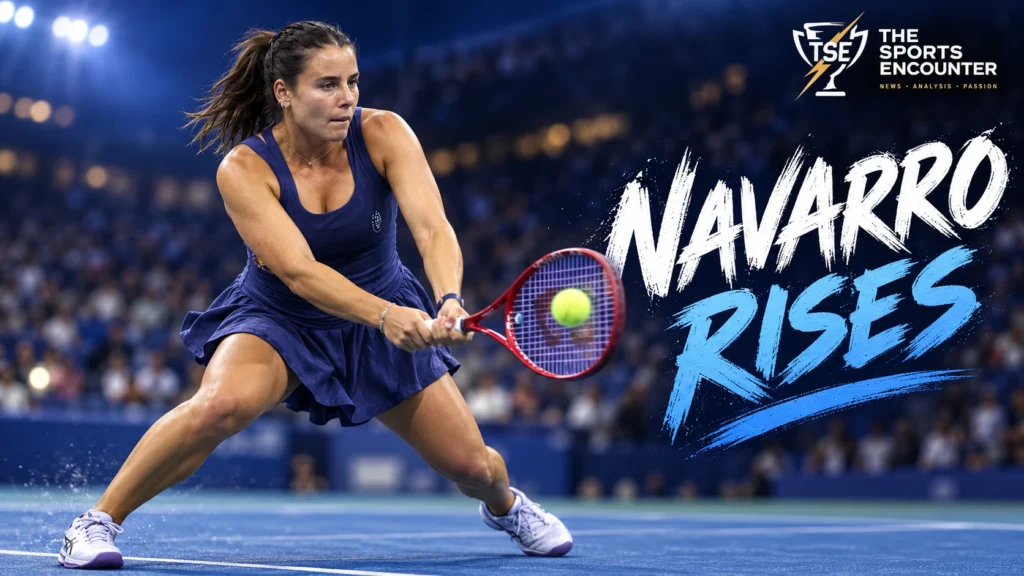
NEW YORK: Emma Navarro entered Sunday night carrying a small piece of unfinished business against Anna Kalinskaya.
She left Arthur Ashe Stadium with it settled.
The No. 26 seed defeated Kalinskaya 6-4, 6-2 to reach the 2026 US Open quarterfinals, overturning an 0-2 career record against the Russian and extending a New York run that has become cleaner and more convincing with every round.
Her reward is another familiar opponent.
This one presents a considerably larger problem.
Jessica Pegula awaits in an all-American quarterfinal after defeating Sorana Cirstea 6-3, 6-4 earlier Sunday. Pegula leads Navarro 4-0 in their career head-to-head and beat her as recently as Cincinnati three weeks ago.
What happened next: Pegula later beat Navarro in the quarterfinal to reach the US Open semifinals. Read The Sports Encounter’s Pegula vs Navarro quarterfinal result and analysis.
That creates the real story behind Navarro’s progress.
She has just removed one opponent she had never beaten.
To reach her second US Open semifinal in three years, she must immediately do it again.
The matchup also guarantees an American woman in the semifinals and sends two players with very different current trajectories into a quarterfinal carrying much more history than their rankings suggest.
Pegula is World No. 3, a former US Open finalist and still mathematically alive in the race for the WTA World No. 1 ranking.
Navarro entered New York ranked No. 27 after a season that included illness, a ranking slide and a gradual rebuild. Four victories later, she is back where her international breakthrough accelerated two years ago.
For continuing tournament coverage, analysis and results, visit The Sports Encounter Tennis Hub.
Emma Navarro vs Anna Kalinskaya: US Open 2026 Result
| Player | Seed | Set 1 | Set 2 | Result |
|---|---|---|---|---|
| Emma Navarro | 26 | 6 | 6 | Winner |
| Anna Kalinskaya | 21 | 4 | 2 | Eliminated |
The result is confirmed by the official US Open women’s singles draw, which now places Navarro opposite Pegula in the quarterfinals.
Navarro Did More Than Reverse a 0-2 Head-to-Head
Kalinskaya had beaten Navarro twice before Sunday.
Their most recent meeting came earlier this season in Doha, where Kalinskaya won 7-5, 2-6, 6-2.
That history mattered because both players arrived in the fourth round with evidence that New York suited them.
Kalinskaya had finally broken through the US Open third-round barrier by defeating No. 9 seed Elina Svitolina 6-3, 2-6, 6-3. She had previously reached the third round in each of the previous two years without advancing farther.
Navarro had already produced one of the women’s draw’s most significant upsets by defeating No. 7 seed Karolina Muchova 6-3, 7-5.
The pre-match expectation was therefore a close contest between a clean ball-striker and an American player whose movement, patience and willingness to make opponents hit another ball have historically worked well in New York.
The match never became as complicated as that forecast suggested.
Navarro took the first set 6-4.
She then expanded the advantage rather than allowing Kalinskaya to reset.
The second set finished 6-2.
That difference is important because Navarro’s first two matches of this US Open had required three sets.
Navarro’s Tournament Is Becoming More Efficient as the Opposition Gets Better
| Round | Opponent | Score | Match Pattern |
|---|---|---|---|
| Round 1 | Lois Boisson | 7-6(8), 6-7(1), 6-3 | Three-set battle disrupted by rain |
| Round 2 | Caty McNally | 3-6, 6-2, 6-3 | Recovered after losing first set |
| Round 3 | Karolina Muchova | 6-3, 7-5 | Straight-sets upset of No. 7 seed |
| Round of 16 | Anna Kalinskaya | 6-4, 6-2 | First career win over Kalinskaya |
The progression is one of the most interesting parts of Navarro’s tournament.
Her supposedly easier matches were the ones that required recovery work.
Rain interrupted her opening match against Boisson overnight, and Navarro eventually needed a third set after originally being close to a straight-sets victory. Our analysis of the US Open’s rain-disrupted opening week identified Navarro as perhaps the clearest example of how uneven scheduling conditions were affecting players.
Round 2 presented another problem.
McNally won the opening set 6-3 before Navarro stabilized the match and took the next two 6-2, 6-3.
Since then, she has not dropped a set.
Muchova had reached the Wimbledon final and entered New York as the No. 7 seed.
Kalinskaya had just eliminated Svitolina.
Navarro handled both in two sets.
That is a healthier tournament trajectory than simply counting four victories.
Her tennis is becoming less expensive as the draw becomes more difficult.
The Muchova Victory Changed How Navarro’s US Open Should Be Viewed
The third round was the moment Navarro’s run stopped looking like another respectable appearance and began resembling something more serious.
Muchova entered that match carrying the kind of résumé that normally creates hesitation in an opponent.
She had reached back-to-back US Open semifinals in 2024 and 2025, made the Wimbledon final earlier this summer and climbed into the elite end of the WTA rankings.
Navarro beat her 6-3, 7-5.
The result came through movement and discomfort rather than overwhelming power.
Muchova later acknowledged that Navarro repeatedly made the exchanges difficult and prevented her from finding the clean rhythm she wanted.
That matters before Pegula because Navarro’s quarterfinal opponent is one of the best players in women’s tennis at denying opponents time.
Pegula takes the ball early, redirects pace efficiently and rarely requires elaborate preparation to change direction.
Navarro’s job will be to prevent those exchanges from settling into Pegula’s preferred tempo.
Jessica Pegula Is the Wall Navarro Has Never Broken
If Kalinskaya represented unfinished business, Pegula represents a recurring problem.
They have played four times.
Pegula has won four times.
| Year | Tournament | Surface | Winner | Score |
|---|---|---|---|---|
| 2024 | Miami | Hard | Jessica Pegula | 7-6(1), 6-3 |
| 2025 | Bad Homburg | Grass | Jessica Pegula | 6-4, 1-6, 6-3 |
| 2025 | Beijing | Hard | Jessica Pegula | 6-7(2), 6-2, 6-1 |
| 2026 | Cincinnati | Hard | Jessica Pegula | 7-5, 6-2 |
The most recent result is the most useful.
Pegula defeated Navarro 7-5, 6-2 in Cincinnati on August 17.
The Sports Encounter’s Cincinnati analysis noted at the time that Pegula had improved to 4-0 against Navarro and had gradually removed the American’s ability to disturb her rhythm after a competitive opening set.
The official WTA match record from Cincinnati confirms the 7-5, 6-2 result.
That match took place only three weeks before this quarterfinal.
Neither player therefore needs much video work to understand what the other wants to do.
Why Pegula Has Controlled This Matchup
Navarro’s greatest strengths usually become more valuable as rallies lengthen.
She moves efficiently, changes defensive positions quickly and rarely appears uncomfortable being asked to hit several additional balls before an opportunity develops.
Pegula’s game attacks that comfort zone.
Her compact preparation allows her to redirect pace early, particularly from the backhand side, and she often takes time away without needing the kind of visibly explosive swing associated with bigger hitters.
That can force Navarro into defending before she has established the neutral rally she prefers.
Navarro needs to change where the rally begins
The solution is unlikely to be simply playing more aggressively.
Trying to outhit Pegula from ordinary baseline positions risks giving the World No. 3 exactly the pace she likes to redirect.
Navarro instead needs to vary the height, depth and direction of the opening exchanges enough to prevent Pegula from stepping immediately into predictable patterns.
That means returning with depth, changing direction earlier when the opportunity is genuine and being willing to bring Pegula forward rather than playing every important point through the same baseline geometry.
Pegula will want to shorten Navarro’s decision time
Pegula’s best periods against Navarro have come when she controls the first two meaningful shots of the rally.
If the serve creates a neutral return and the next groundstroke lands deep, Navarro can spend the remainder of the point reacting.
New York’s quicker hard courts make that pattern particularly dangerous.
Navarro’s 2026 Season Makes This Quarterfinal More Significant Than Her Ranking Suggests
Navarro entered the tournament ranked No. 27.
That number does not fully describe the season she has had.
She finished 2025 at No. 15 but slid to No. 39 during a difficult first half of 2026.
Illness forced her to miss both the Miami Open and the Charleston tournament in her hometown.
She eventually rebuilt momentum by winning Strasbourg in May, her first title in 15 months, before reaching the Nottingham final during the grass season.
The US Open has now provided the clearest evidence that the recovery is no longer simply about ranking repair.
She is beating players who entered the tournament with stronger recent Grand Slam résumés.
Muchova was one.
Kalinskaya was another opponent Navarro had never previously solved.
Pegula represents the next level.
New York Has Always Meant More to Navarro Than an Ordinary Major
Navarro’s best Grand Slam result came here in 2024.
She reached the semifinals after defeating fellow American Coco Gauff during the run, establishing herself as one of the country’s leading young players.
The semifinal became a reference point for what her game could look like when confidence, movement and hard-court timing aligned.
The two seasons since have not followed a straight upward line.
That is precisely why another US Open quarterfinal carries weight.
This is not simply a return to a familiar round.
It is evidence that the 2024 run was not a one-time accident created by a favorable fortnight.
Our broader US Open 2026 preview identified Navarro as part of a deep American group underneath the headline contenders. She has now moved beyond that supporting role.
Pegula Arrives With Different Pressure
Pegula’s quarterfinal contains stakes Navarro does not carry.
The 32-year-old is still chasing her first Grand Slam singles title.
She reached the 2024 US Open final before losing to Aryna Sabalenka and returned to the semifinals in 2025.
Earlier this year she also reached the Australian Open semifinals.
The pattern is no longer about proving she can survive the second week of a major.
The question is whether she can finish one.
Her summer provided plenty of high-level preparation.
Pegula reached the Washington final, where Alexandra Eala completed a dramatic comeback to beat her. The Sports Encounter covered that result in our analysis of Eala’s breakthrough title.
Toronto produced disappointment when Pegula exited earlier than expected, part of the changing WTA landscape examined in our National Bank Open Round-of-16 report.
Cincinnati then provided the strongest response.
Pegula beat Navarro, survived Sorana Cirstea in three sets, defeated Amanda Anisimova despite a physical concern and then beat Iga Swiatek before losing to Coco Gauff in the final.
Our Cincinnati quarterfinal analysis showed how Pegula survived an injury scare and a deciding-set tiebreak against Anisimova.
The complete closing-week picture was covered in our Cincinnati women’s final analysis, where Pegula’s run was more significant than the championship loss alone suggested.
Pegula’s World No. 1 Dream Now Runs Through Navarro
The quarterfinal also intersects with the WTA ranking race.
Pegula remains mathematically capable of becoming World No. 1 after the US Open.
Her route requires two things.
She must win the title.
Elena Rybakina must lose before reaching the semifinals.
Pegula cannot control the Rybakina part.
Navarro can control whether the rest of the equation survives.
If Navarro wins their quarterfinal, Pegula’s first opportunity to reach World No. 1 disappears immediately.
That gives the matchup another layer.
Navarro is playing for a semifinal.
Pegula is playing for the semifinal, the Grand Slam title and potentially the top ranking in women’s tennis.
The All-American Label Does Not Mean the Matchup Is Comfortable
American tennis has had an unusually strong presence in the second week.
Ten Americans reached the fourth round across the men’s and women’s draws.
Navarro beating Kalinskaya and Pegula beating Cirstea now guarantee at least one American woman in the semifinals.
That is good news for the home audience.
It does not make the quarterfinal emotionally easy.
These players know one another well.
They share the same tour, the same national-team environment and many of the same North American tournaments.
The Cincinnati meeting happened less than a month ago.
The familiarity removes mystery.
It also removes excuses.
Navarro Has Already Changed One Matchup in New York
This may be the most useful psychological point she carries into the quarterfinal.
Before Sunday, Kalinskaya had beaten Navarro every time they played.
Navarro did not need five sets of tennis, luck or physical collapse from the opponent to change that history.
She won 6-4, 6-2.
Pegula’s 4-0 record is stronger evidence than Kalinskaya’s previous 2-0 advantage.
It remains history rather than destiny.
Navarro has just reminded herself of the difference.
How Navarro Reached the Quarterfinal After a Difficult Opening Week
The context of the first four rounds also explains why this run feels different from a simple upset sequence.
Navarro’s tournament began in chaos.
Rain forced her opening match against Boisson across two days.
McNally then took the first set in Round 2 before another weather delay interrupted the contest.
By the time Navarro reached Muchova, she had already dealt with schedule disruption, a three-set escape and two different recovery windows.
The early conditions were detailed in our US Open qualifying and draw report and later in our broader analysis of how rain changed the tournament’s opening week.
What followed was the opposite.
She beat Muchova in two.
She beat Kalinskaya in two.
That is exactly the trajectory a player wants before entering a major quarterfinal.
Navarro vs Pegula: What the Numbers Say Before the Quarterfinal
| Category | Emma Navarro | Jessica Pegula |
|---|---|---|
| US Open seed | No. 26 | No. 3 |
| Current ranking entering tournament | No. 27 | No. 3 |
| Best US Open result | Semifinal, 2024 | Final, 2024 |
| 2026 US Open sets lost | 2 | 1 |
| Career H2H | 0 wins | 4 wins |
| Most recent meeting | Pegula won 7-5, 6-2 in Cincinnati, August 2026 | |
| Quarterfinal stakes | Second US Open semifinal | Third straight deep New York run, first major title and No. 1 bid |
The Winner Will Enter a Very Different Kind of Semifinal
A place in the semifinal also places either Navarro or Pegula within one match of the championship.
The other quarterfinal in their section features World No. 1 Aryna Sabalenka against Wimbledon champion Linda Noskova.
That means the American survivor will not simply be rewarded with a deeper run.
Another major champion-level test is likely waiting immediately afterward.
The women’s draw therefore leaves little room for a player to build slowly from this point.
Navarro has already shown she can remove a higher seed.
Pegula has shown throughout the summer that she can beat elite opponents in consecutive rounds.
Tuesday will determine which profile survives.
The Sports Encounter Verdict
Emma Navarro’s victory over Anna Kalinskaya should not be reduced to the fact that she reached another US Open quarterfinal.
The more useful detail is how her tournament has changed.
She needed three sets to survive each of the first two rounds.
Then the opposition became stronger and Navarro became cleaner.
Karolina Muchova went out in straight sets.
Anna Kalinskaya followed in straight sets.
The second victory also ended a personal matchup she had never previously solved.
That makes Jessica Pegula an almost perfectly timed examination.
Pegula has beaten Navarro four times.
She beat her three weeks ago.
She knows how to take time away from Navarro’s defensive strengths and has more experience in the final stages of New York than almost anyone left in the draw.
Navarro does not need to pretend those facts do not exist.
She needs to use Sunday night’s result correctly.
An 0-2 head-to-head against Kalinskaya existed when the players walked onto Arthur Ashe Stadium.
It did not win Kalinskaya a single set.
Now another unfavorable history sits in front of Navarro.
This one is 0-4.
If she changes it too, the 2026 US Open stops being another comeback story.
It becomes a genuine championship run.
Frequently Asked Questions
Did Emma Navarro beat Anna Kalinskaya at the 2026 US Open?
Yes. Emma Navarro defeated Anna Kalinskaya 6-4, 6-2 in the fourth round to reach the women’s singles quarterfinals.
Who will Emma Navarro play next at the US Open?
Navarro will face fellow American Jessica Pegula in the quarterfinals.
What was the Emma Navarro vs Anna Kalinskaya score?
Navarro won in straight sets, 6-4, 6-2.
Had Emma Navarro beaten Anna Kalinskaya before?
No. Kalinskaya led their head-to-head 2-0 before the US Open match. Navarro’s victory was her first against Kalinskaya.
What is Jessica Pegula’s record against Emma Navarro?
Pegula leads their career head-to-head 4-0.
When did Pegula and Navarro last play?
They last met at the 2026 Cincinnati Open, where Pegula won 7-5, 6-2.
Has Emma Navarro reached a US Open semifinal before?
Yes. Navarro reached the semifinals at the 2024 US Open, which remains her best Grand Slam singles result.
What is Jessica Pegula’s best US Open result?
Pegula reached the women’s singles final in 2024 and returned to the semifinals in 2025.
Can Jessica Pegula still become World No. 1?
Yes. Pegula must win the US Open title and Elena Rybakina must lose before reaching the semifinals.
Is an American woman guaranteed to reach the US Open semifinals?
Yes. Because Navarro and Pegula meet in the quarterfinals, one American woman is guaranteed a semifinal place.