


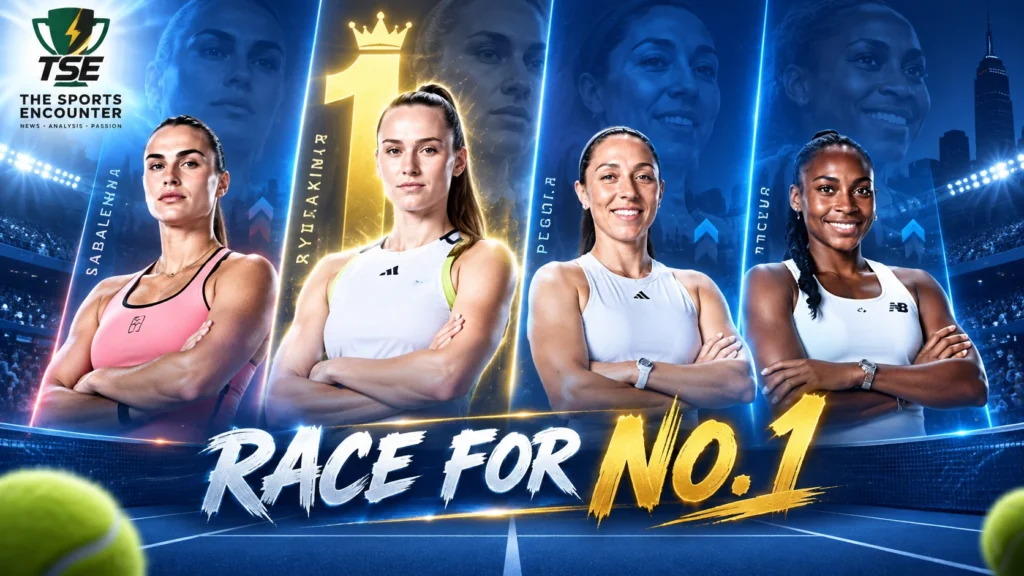
NEW YORK: The graphic appearing on US Open television coverage makes the women’s World No. 1 battle look wonderfully simple.
Aryna Sabalenka. Elena Rybakina. Jessica Pegula. Coco Gauff.
Four women, one ranking, and a series of possibilities that will be decided during the second week in New York.
The mathematics tell a more revealing story.
This is technically a four-player race for the No. 1 position in the PIF WTA Rankings. In practical terms, however, Elena Rybakina controls almost everything that happens next.
Rybakina does not need to win the US Open. She does not even need to reach the final. If she reaches the semifinals, the World No. 1 ranking is hers regardless of what Sabalenka, Pegula or Gauff accomplish.
Sabalenka, meanwhile, is the reigning World No. 1 and two-time defending US Open champion, yet she cannot guarantee keeping the ranking through her own result alone. She must win the title and Rybakina must lose before the semifinals.
Pegula and Gauff face the same equation. Each must become US Open champion and each needs Rybakina eliminated before the final four.
That imbalance is what makes this ranking battle far more interesting than a conventional points race.
What happened next: Rybakina beat Zheng Qinwen to reach the US Open semifinals and clinched the World No. 1 ranking. She then defeated Coco Gauff and Aryna Sabalenka to win the US Open title, before the ranking became official in the WTA standings. The scenarios below explain exactly why her route to No. 1 was so much stronger than those of Sabalenka, Pegula and Gauff.
The player currently ranked No. 2 has the clearest route to No. 1. The woman already holding the top ranking must win another Grand Slam just to have a chance of keeping it.
For readers following the tournament from the opening week, The Sports Encounter Tennis Hub brings together our Grand Slam reports, match analysis, player features and wider US Open coverage.
Coverage cutoff: This explainer reflects the WTA No. 1 race after Aryna Sabalenka defeated Taylor Townsend to reach the quarterfinals and Linda Noskova advanced to meet her. Jessica Pegula’s Round-of-16 match against Sorana Cirstea, Elena Rybakina’s meeting with Naomi Osaka and Coco Gauff’s match against Iva Jovic had not been completed at this cutoff.
WTA No. 1 Race at a Glance
| Player | Current WTA Rank | Published Ranking Points | What She Needs |
|---|---|---|---|
| Aryna Sabalenka | No. 1 | 8,575 | Win US Open and Rybakina must lose before semifinals |
| Elena Rybakina | No. 2 | 8,141 | Reach semifinals to guarantee No. 1; can also become No. 1 earlier depending on other results |
| Jessica Pegula | No. 3 | 7,265 | Win US Open and Rybakina must lose before semifinals |
| Coco Gauff | No. 4 | 6,704 | Win US Open and Rybakina must lose before semifinals |
The current published points come from the official PIF WTA singles rankings. The WTA’s own US Open No. 1 ranking breakdown confirms the four qualification scenarios.
The First Thing to Understand: WTA Rankings Are Rolling, Not a Season Scoreboard
Sabalenka currently leads Rybakina by 434 ranking points.
Looking only at that number makes the situation confusing. How can Sabalenka be ahead and still need to win the US Open while Rybakina can secure No. 1 merely by reaching the semifinals?
The explanation lies in the WTA’s rolling 52-week ranking system.
Players do not simply accumulate points indefinitely. Results from the corresponding period one year earlier eventually fall away and are replaced by new results.
That creates a particularly severe problem for Sabalenka at this US Open.
She won the tournament in 2025.
That means she is defending 2,000 ranking points.
Rybakina reached only the fourth round last year, so she is defending 240.
Gauff also lost in the fourth round and is defending 240.
Pegula reached the semifinals, meaning 780 points are coming off her total before being replaced by her 2026 result.
The 2025 points each contender is defending
| Player | 2025 US Open Result | Points Being Defended |
|---|---|---|
| Aryna Sabalenka | Champion | 2,000 |
| Elena Rybakina | Round of 16 | 240 |
| Jessica Pegula | Semifinal | 780 |
| Coco Gauff | Round of 16 | 240 |
This is the mechanism that turns a 434-point Sabalenka lead into a Rybakina advantage once the old US Open points are stripped out.
The Sports Encounter Calculation: What the Race Looks Like After the 2025 Points Come Off
The table below is not an official live WTA ranking. It is a straightforward rollover calculation using the WTA’s published rankings and the points each player earned at the 2025 US Open.
| Player | Published Points | 2025 US Open Points Removed | Rollover Base Before 2026 US Open Points |
|---|---|---|---|
| Aryna Sabalenka | 8,575 | -2,000 | 6,575 |
| Elena Rybakina | 8,141 | -240 | 7,901 |
| Jessica Pegula | 7,265 | -780 | 6,485 |
| Coco Gauff | 6,704 | -240 | 6,464 |
That is the hidden table underneath the television graphic.
Once the old US Open results are removed, Rybakina effectively begins the 2026 replacement calculation at 7,901 points.
Sabalenka falls to 6,575.
The apparent 434-point deficit has turned into an effective 1,326-point advantage for Rybakina before this year’s US Open points are inserted.
This does not mean the official rankings currently list Rybakina first. They do not. Sabalenka remains World No. 1 while the tournament is being played.
It explains why the post-US Open calculation strongly favors Rybakina.
Why a Rybakina Semifinal Ends the Debate
Grand Slam ranking points rise sharply during the closing rounds.
| US Open Finish | WTA Ranking Points |
|---|---|
| Round of 16 | 240 |
| Quarterfinal | 430 |
| Semifinal | 780 |
| Final | 1,300 |
| Champion | 2,000 |
Add 780 semifinal points to Rybakina’s 7,901 rollover base and she reaches a projected 8,681 points.
That figure is untouchable.
Sabalenka’s maximum possible post-US Open total is 8,575, and she can reach it only by winning the title.
Pegula’s maximum is 8,485.
Gauff’s maximum is 8,464.
Therefore, if Rybakina reaches the semifinal:
- Sabalenka cannot remain No. 1 even by winning the championship.
- Pegula cannot become No. 1 even by winning the championship.
- Gauff cannot become No. 1 even by winning the championship.
That is why Rybakina’s semifinal qualification would settle the ranking battle before championship weekend begins.
Rybakina’s Projected Ranking at Every Remaining Stage
| Rybakina’s US Open Result | 2026 Points Earned | Projected Post-US Open Total | No. 1 Situation |
|---|---|---|---|
| Loses Round of 16 | 240 | 8,141 | Can still become No. 1 if Sabalenka, Pegula and Gauff do not win title |
| Loses Quarterfinal | 430 | 8,331 | Can still become No. 1 if Sabalenka, Pegula and Gauff do not win title |
| Loses Semifinal | 780 | 8,681 | Guaranteed World No. 1 |
| Loses Final | 1,300 | 9,201 | Guaranteed World No. 1 |
| Wins Title | 2,000 | 9,901 | Guaranteed World No. 1 |
This table explains why Rybakina is the pivot of the entire race.
She can lose before the semifinals and still finish No. 1.
The other three cannot lose at all.
What Sabalenka Must Do to Stay World No. 1
Sabalenka’s scenario is much harsher than the current ranking might suggest.
She must win the US Open.
Anything less eliminates her from the No. 1 calculation.
Her projected totals demonstrate why:
| Sabalenka Finish | Projected Post-US Open Total |
|---|---|
| Quarterfinal | 7,005 |
| Semifinal | 7,355 |
| Finalist | 7,875 |
| Champion | 8,575 |
Even reaching another US Open final would leave Sabalenka on approximately 7,875 points.
Rybakina would have at least 8,141 if she lost in the Round of 16 because she would simply replace last year’s 240 points with another 240.
Sabalenka therefore needs all 2,000 champion’s points.
She also needs Rybakina stopped in either the fourth round or quarterfinals.
The stakes are amplified by history.
Sabalenka is chasing a third consecutive US Open title. Her current tournament run has already reached the quarterfinals after a 6-4, 6-3 victory over Taylor Townsend, extending her New York winning streak to 17 matches.
Her next opponent is Wimbledon champion Linda Noskova, with the latest bracket available through the official US Open women’s singles draw.
Our Cincinnati analysis of Sabalenka’s loss to Sara Bejlek showed how vulnerable the World No. 1 position had already become during the final tournament before New York.
Now the requirement is unforgiving. Sabalenka can win every remaining match and still lose the ranking if Rybakina reaches the semifinals.
The 100-Week Milestone Hanging Over Sabalenka’s Title Defense
The ranking equation carries another layer that has little to do with the trophy itself.
By the end of the US Open, Sabalenka will have spent 99 consecutive weeks at World No. 1 and 107 weeks at No. 1 overall.
If she remains on top when the post-US Open rankings are released, she will reach 100 consecutive weeks as World No. 1.
That creates a remarkable condition.
Sabalenka may have to complete a US Open three-peat merely to give herself a chance to reach a ranking milestone that looked almost inevitable a few months ago.
Her title defense was already one of the central themes in our US Open 2026 tournament preview. The ranking race has now made every Sabalenka match carry consequences beyond the championship.
Why Rybakina’s No. 1 Challenge Is Not Just a Rankings Technicality
It would be easy to describe Rybakina’s advantage as the product of Sabalenka losing 2,000 defending points.
That would explain the mathematics without explaining the season.
Rybakina entered the US Open as No. 1 on the Race to the WTA Finals leaderboard, which measures results accumulated during the current season rather than the rolling 52-week rankings used to determine the official World No. 1.
She has earned that position through one of the strongest seasons on the women’s tour.
Rybakina won the Australian Open, defeating Sabalenka in the final for her second Grand Slam title. She continued accumulating major hard-court results during the North American swing and reached the Toronto final after defeating Gauff in three sets.
The Sports Encounter followed that run closely, including Rybakina’s comeback victory over Gauff in Toronto.
Her summer did contain a significant warning before the US Open. A left ankle problem forced her to retire during her Cincinnati quarterfinal, ending another opportunity to overtake Sabalenka before New York. Our Cincinnati report examined how the injury halted that No. 1 push.
She arrived at Flushing Meadows healthy enough to win three matches and reach the fourth round.
That matters because the ranking system may be about to formalize something the 2026 season race has already been suggesting: Rybakina has accumulated the strongest body of work over the current campaign.
Naomi Osaka Now Holds Enormous Influence Over the Ranking Race
Rybakina’s fourth-round opponent makes the next stage particularly dangerous.
Naomi Osaka is a two-time US Open champion and one of the few players in the draw capable of matching Rybakina’s first-strike power from both the serve and baseline.
This is not simply another Round-of-16 match.
If Osaka beats Rybakina, the No. 1 race immediately opens for Sabalenka, Pegula and Gauff, provided they can win the tournament.
If Rybakina beats Osaka, she moves into the quarterfinals with a projected 8,331 points and will be only one victory away from guaranteeing the ranking.
Her quarterfinal would effectively become a match for World No. 1.
The matchup also carries recent history. Rybakina defeated Osaka in a three-set Toronto thriller after recovering from a set and a break down, a match covered during The Sports Encounter’s National Bank Open semifinal qualification report.
Jessica Pegula’s Path: Win Her First Major and Become No. 1
Pegula’s equation contains no room for strategic calculation.
She needs the US Open title.
If Rybakina loses before the semifinals and Pegula wins the championship, Pegula would finish with a projected 8,485 points and become World No. 1 for the first time.
That would combine two career breakthroughs in the same afternoon: a first Grand Slam singles title and a first No. 1 ranking.
Pegula entered New York in excellent hard-court form. She reached the Cincinnati final after defeating several dangerous opponents before losing to Gauff.
The wider significance of that tournament was examined in our Cincinnati women’s final analysis, which identified Pegula as one of the leading players carrying genuine momentum into New York.
She has already survived a serious scare at this US Open, recovering from a 6-1 first-set defeat against Leylah Fernandez to win in three sets and reach the fourth round.
Her next obstacle is Sorana Cirstea.
Pegula cannot control what Rybakina does against Osaka. She can control whether she remains alive long enough for the mathematics to matter.
Coco Gauff Can Turn a Cincinnati Run Into the Biggest Ranking Jump of Her Career
Gauff’s route is mathematically identical to Pegula’s.
She must win the US Open and Rybakina must lose before the semifinals.
Her maximum projected ranking total is 8,464 points.
That would be enough to overtake Rybakina if the Kazakhstani exits in either the Round of 16 or quarterfinals.
Like Pegula and Rybakina, Gauff has never been World No. 1.
She enters the decisive stage with perhaps the strongest immediate winning momentum of the four contenders.
Gauff won Cincinnati immediately before the US Open and carried a nine-match winning streak into the fourth round in New York.
That Cincinnati title was more important than another trophy. Our analysis of Gauff’s Cincinnati championship showed how her level improved through the closing rounds and why her title changed the women’s US Open conversation.
She now faces Iva Jovic, one of the tournament’s most impressive young players.
For Gauff, every remaining match has become both a title match and a ranking match.
What Happens if Rybakina Loses to Osaka?
This is probably the most important scenario for fans trying to understand the television graphic.
If Rybakina loses in the Round of 16, she would finish the US Open with the same 240 points she earned in 2025.
Her projected post-tournament total would therefore remain approximately 8,141.
At that point:
- Sabalenka could overtake her by winning the title and reaching 8,575.
- Pegula could overtake her by winning the title and reaching 8,485.
- Gauff could overtake her by winning the title and reaching 8,464.
If somebody else wins the US Open, Rybakina becomes World No. 1.
That last sentence is what makes the race unusual.
Rybakina could lose her next match and still become No. 1 without lifting the trophy if Sabalenka, Pegula and Gauff all fail to win the championship.
What if Rybakina Reaches the Quarterfinal but Loses There?
The same fundamental situation remains.
A quarterfinal result would give Rybakina 430 points and move her projected total to approximately 8,331.
That would still leave all three rivals capable of overtaking her by winning the title:
| Player | Projected Total if US Open Champion |
|---|---|
| Aryna Sabalenka | 8,575 |
| Jessica Pegula | 8,485 |
| Coco Gauff | 8,464 |
| Elena Rybakina after QF loss | 8,331 |
Once Rybakina wins that quarterfinal, however, the arithmetic changes permanently.
Her semifinal points take her to 8,681.
No one can catch her.
Why the Official Ranking and the 2026 Race Tell Different Stories
There are two leaderboards that frequently create confusion during a ranking battle.
The PIF WTA Rankings
This is the official rolling ranking used for World No. 1, tournament seeding and player ranking positions. It incorporates eligible results across approximately the previous 52 weeks.
The Race to the WTA Finals
This measures points earned during the current calendar season and determines qualification for the season-ending championship.
Sabalenka leads the official WTA rankings.
Rybakina entered the US Open leading the 2026 Race.
That distinction gives the New York ranking battle an unusually logical underlying story.
If Rybakina takes No. 1 after the US Open, the rolling ranking will effectively be moving closer to what the current-season results have already shown.
The Four-Way Graphic Hides an Unequal Race
The television graphic is correct.
Four players can finish this US Open as World No. 1.
They do not possess four equal paths.
| Player | Must Win US Open? | Needs Help From Rybakina? | Controls Own No. 1 Destiny? |
|---|---|---|---|
| Elena Rybakina | No | No | Yes, by reaching SF |
| Aryna Sabalenka | Yes | Yes | No |
| Jessica Pegula | Yes | Yes | No |
| Coco Gauff | Yes | Yes | No |
This is the central point most quick ranking graphics cannot fully communicate.
Sabalenka owns the No. 1 ranking.
Rybakina owns the strongest position in the race to decide who has it next.
How the US Open Draw Could Settle the Ranking Before the Final
Sabalenka is already through to the quarterfinals against Noskova.
Pegula still has to negotiate Cirstea.
Rybakina has Osaka waiting in the fourth round.
Gauff faces Jovic.
The order of those matches matters because the ranking pressure can change before some contenders return to the court.
A Rybakina defeat would immediately tell Sabalenka, Pegula and Gauff that winning the championship can deliver No. 1.
A Rybakina quarterfinal victory would do the opposite. It would eliminate the ranking component for everyone else before the tournament even reaches its final weekend.
The second week therefore contains two competitions operating simultaneously.
There is the visible race for the US Open trophy.
Underneath it sits a ranking race whose decisive match may not be the final.
How We Reached This Point
The women’s North American hard-court season has repeatedly threatened Sabalenka’s hold on No. 1.
Rybakina came close to overtaking her before the US Open but was stopped by injury in Cincinnati.
Sabalenka herself was eliminated by Sara Bejlek, a result covered in our Cincinnati Round-of-16 report.
Pegula reached the Cincinnati final.
Gauff won it.
Rybakina arrived in New York with the year’s strongest Race position.
All four then survived the opening rounds of a US Open that had already lost several major names, as documented in our US Open tournament analysis after the early upsets and weather disruptions.
The structure of the women’s draw itself was set before the tournament began, when Sabalenka and Pegula landed in the top half while Rybakina and Gauff were placed in the bottom half. Our US Open draw-day report tracked those routes when the championship picture first took shape.
The Sports Encounter Verdict: The Ranking Belongs to Sabalenka, but the Race Belongs to Rybakina
The simplest way to understand the WTA World No. 1 debate is to separate possession from control.
Sabalenka possesses the ranking.
She has earned that position through nearly two years of extraordinary consistency and is approaching 100 consecutive weeks at the top.
She is also trying to become a three-time defending US Open champion.
Yet the ranking mathematics have reached a point where even those achievements cannot give her complete control.
Rybakina has it.
A semifinal appearance settles the race in her favor.
A quarterfinal defeat still leaves her with a realistic route to No. 1.
Even a Round-of-16 defeat would not eliminate her unless Sabalenka, Pegula or Gauff goes on to win the championship.
Pegula and Gauff face the opposite reality. They have no fallback route. Their first World No. 1 ranking requires the biggest title available in American tennis.
That is what makes this more than a technical rankings story.
Sabalenka is trying to protect an era.
Rybakina is trying to turn the strongest season-long challenge into the top ranking.
Pegula and Gauff are chasing a career first that can arrive only through a Grand Slam championship.
Four names appear on the graphic.
One player controls the equation.
Until someone stops Elena Rybakina before the semifinals, every path to World No. 1 runs through her.
Frequently Asked Questions About the WTA No. 1 Race
Who is the current WTA World No. 1?
Aryna Sabalenka is currently ranked World No. 1 with 8,575 published ranking points, ahead of Elena Rybakina on 8,141.
Can Elena Rybakina become World No. 1 at the 2026 US Open?
Yes. Rybakina will guarantee the World No. 1 ranking if she reaches the US Open semifinals. She can also become No. 1 without reaching the semifinals if Sabalenka, Pegula and Gauff all fail to win the title.
Does Rybakina need to win the US Open to become No. 1?
No. Rybakina is the only one of the four contenders who does not need the championship. A semifinal appearance guarantees her the top ranking.
What does Aryna Sabalenka need to remain World No. 1?
Sabalenka must win the 2026 US Open and Elena Rybakina must lose before reaching the semifinals.
Can Jessica Pegula become World No. 1?
Yes. Pegula must win the US Open and Rybakina must lose in either the Round of 16 or quarterfinals. It would be Pegula’s first World No. 1 ranking.
Can Coco Gauff become World No. 1?
Yes. Gauff must win the US Open and Rybakina must be eliminated before the semifinals. Gauff has never previously held the No. 1 singles ranking.
Why is Sabalenka in danger of losing No. 1 despite currently leading Rybakina?
Sabalenka is defending 2,000 points from winning the 2025 US Open, while Rybakina is defending only 240 points from a Round-of-16 result. When those old results roll off, Rybakina gains a major advantage in the replacement calculation.
What happens if Rybakina loses to Naomi Osaka?
Rybakina would remain around 8,141 projected post-US Open points. Sabalenka, Pegula or Gauff could then overtake her by winning the tournament. If none of those three wins the title, Rybakina would still become World No. 1.
What is the difference between the WTA rankings and the Race to the WTA Finals?
The official WTA rankings use results across a rolling 52-week period. The Race to the WTA Finals counts points from the current season. Sabalenka leads the official ranking, while Rybakina entered the US Open leading the 2026 Race.
When will the new WTA No. 1 ranking become official?
The outcome will be reflected when the post-US Open PIF WTA Rankings are released after the tournament. The identity of the next No. 1 could be mathematically decided earlier if Rybakina reaches the semifinals.