


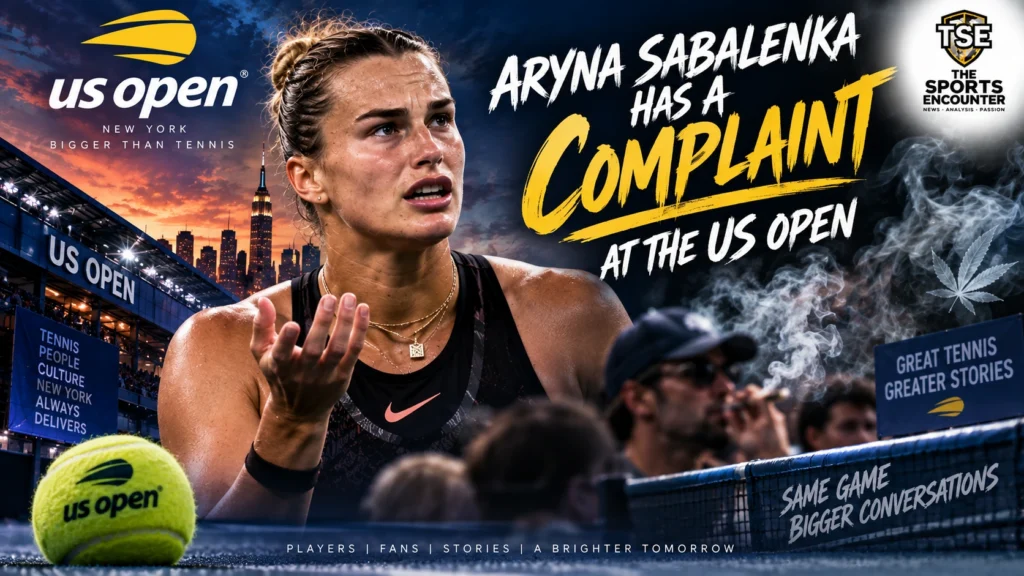
NEW YORK, September 4, 2026: Aryna Sabalenka has spent the opening week of the US Open dealing comfortably with opponents, expectations and the pressure of chasing a third consecutive title.
On Friday, something far less conventional briefly interrupted her rhythm.
The world No. 1 complained to the chair umpire about a strong smell of marijuana during her third-round match against Kamilla Rakhimova at Louis Armstrong Stadium, saying the odor was difficult to handle while trying to compete at full concentration.
Sabalenka still won 6-3, 6-4 and moved into the Round of 16, where she will face American Taylor Townsend. The incident did not change the result, but it produced one of the more unusual discussions of the tournament because the US Open operates a smoke-free venue while sitting inside a part of New York where activity outside the grounds cannot always be controlled.
No spectator was identified as smoking inside the tennis center, and nobody was removed over the incident.
The USTA said it remained vigilant in enforcing the smoke-free environment at the Billie Jean King National Tennis Center but acknowledged that it cannot control everything taking place beyond the tournament grounds.
Sabalenka’s complaint therefore leaves the US Open with an awkward problem. The tournament can police behavior inside the gates. Wind, surrounding parkland and activity outside those gates are considerably harder to regulate.
For Sabalenka, the matter was frustrating rather than decisive. She recovered, defeated Rakhimova and continued a title defense that began with a straight-sets victory over Camila Osorio and then accelerated with a dominant second-round performance.
Aryna Sabalenka vs Kamilla Rakhimova: Match at a Glance
| Match Detail | Information |
|---|---|
| Tournament | US Open 2026 |
| Round | Women’s Singles, Round 3 |
| Venue | Louis Armstrong Stadium, New York |
| Result | Aryna Sabalenka beat Kamilla Rakhimova 6-3, 6-4 |
| Sabalenka seed | No. 1 |
| Key interruption | Sabalenka complained about a strong marijuana odor while serving |
| Next opponent | Taylor Townsend |
| US Open objective | Third consecutive women’s singles title |
What Happened During Sabalenka’s Match?
The moment came early.
Sabalenka was serving in the third game when she prepared to begin a point, tossed the ball and then allowed it to drop instead of completing the serve.
She reset and tried again.
The same thing happened.
Something was clearly interfering with her preparation, and Sabalenka eventually walked toward the chair umpire to explain the problem.
She later said the marijuana smell was unusually strong and that she could not determine whether it was coming directly from the crowd or being carried into the stadium by the wind.
Her concern was practical rather than moral.
Sabalenka made clear afterward that what people choose to do away from the court is their own business. Her objection was having the smell reach a professional tennis court while she was trying to serve and compete.
That distinction matters.
This was not a player entering a wider debate about marijuana laws. It was a player asking for the competition environment around her match to remain as controlled as possible.
The US Open Is Officially Smoke-Free
The tournament’s own regulations support Sabalenka’s expectation.
The official US Open Code of Conduct prohibits spectators from smoking, vaping or using electronic smoking devices within the facility.
The tournament’s prohibited-items policy also bars illegal substances from being brought onto the grounds.
The practical difficulty on Friday was enforcement.
Tournament officials did not find a spectator smoking inside the venue. That meant there was nobody to warn or remove.
The USTA’s position was that the tennis center remains smoke-free and that security and guest-services staff will intervene when they become aware of prohibited smoking.
What they cannot guarantee is that air entering the grounds will remain unaffected by activity elsewhere around Flushing Meadows.
The Source of the Smell Was Never Confirmed
That is the most important detail to preserve.
There is no verified evidence that somebody sitting inside Louis Armstrong Stadium was smoking marijuana.
Sabalenka herself did not claim to know the source.
She suggested it could have come from the crowd or from outside because of the wind.
The distinction protects the story from becoming something it is not.
This is a confirmed complaint about an odor.
It is not a confirmed case of a spectator openly smoking courtside.
Why a Smell Can Matter More Than It Sounds
Elite tennis depends heavily on routine.
Players bounce the ball a certain number of times. They regulate breathing. They reset their grip. They control the timing between points and build familiar sequences around serves, returns and changeovers.
Serving is particularly sensitive because the player initiates everything.
Visual movement, crowd noise, unexpected sounds and other sensory distractions can interrupt the sequence before the ball is struck.
Sabalenka’s reaction showed that the odor was strong enough to break that routine twice.
She recovered quickly, but the larger point remains relevant for tournament organizers.
A controlled sporting environment is about more than keeping spectators quiet during serves.
Lighting, sound, movement, temperature, air flow and unexpected distractions all shape how players experience a match.
Sabalenka Still Had to Solve a Much Tougher Tennis Problem
The marijuana episode became the unusual headline, but Rakhimova provided the more persistent challenge.
Sabalenka won the first set 6-3 before being pushed considerably harder in the second.
The second set lasted 54 minutes, which was one minute longer than Sabalenka’s entire second-round match.
That is a useful measure of how much more demanding Friday became.
Sabalenka praised Rakhimova afterward for forcing her to raise her level.
Rakhimova had entered the match after eliminating No. 27 seed Barbora Krejcikova earlier in the tournament and had already shown she was capable of disrupting more established opponents.
Sabalenka handled the challenge without dropping a set.
Her US Open Has Become Progressively More Demanding
Sabalenka arrived in Round 3 after one of the cleanest starts among the leading women.
She defeated Camila Osorio in straight sets to begin her title defense, a performance covered in The Sports Encounter’s opening report on Sabalenka and Carlos Alcaraz.
She then dismantled Polina Iatcenko 6-1, 6-1 in Round 2.
The Sports Encounter’s full first-week US Open analysis noted that Sabalenka had dropped only seven games through her first two matches and appeared to be moving through New York with considerably less physical stress than several other contenders.
Rakhimova changed that pattern slightly.
| Round | Opponent | Result |
|---|---|---|
| Round 1 | Camila Osorio | Won in straight sets |
| Round 2 | Polina Iatcenko | 6-1, 6-1 |
| Round 3 | Kamilla Rakhimova | 6-3, 6-4 |
The third round demanded more problem-solving, more time on court and an unusual interruption.
Sabalenka still left without surrendering a set.
The Complaint Fits an Already Unusual US Open
This tournament has rarely settled into a conventional rhythm.
Rain repeatedly disrupted qualifying and the opening rounds.
First-round matches were still being completed while other players were already reaching Round 3.
Novak Djokovic suffered a major opening-round defeat.
Jannik Sinner withdrew before the tournament because of injury.
Several seeded players departed early.
The full picture was documented in our analysis of the rain, exits and changing title race.
Even when the weather finally became less dominant, New York found another way to remind players that Grand Slam tennis here is rarely sterile.
New York Has Always Been Part of the US Open Experience
The US Open is different from many major tennis events because the tournament has never been isolated from its city.
Aircraft pass overhead.
Trains move nearby.
Crowds are louder than at many other Grand Slams.
Music, food, movement and city noise form part of the atmosphere.
Players who thrive in New York often speak about feeding off that energy rather than trying to remove themselves from it.
That energy has limits.
A player can enjoy a loud stadium and still expect the competition area to respect basic venue rules.
Sabalenka’s complaint sits exactly at that intersection.
This Is Not the First Time a Player Has Raised the Issue
The situation is not entirely new.
Nick Kyrgios and Maria Sakkari have both complained about marijuana odors during previous US Open matches.
Those earlier incidents are relevant because they show that Friday was not a completely isolated occurrence.
The recurring nature of the issue makes the source question harder rather than easier.
If tournament security repeatedly finds no one smoking within the facility, officials have limited options when the odor originates elsewhere.
The USTA can enforce conduct rules within its controlled footprint.
It cannot place a roof over Flushing Meadows.
Sabalenka Eventually Found the Funny Side
Her frustration did not last into the post-match press conference.
Sabalenka later joked about whether spectators might have been trying to slow things down because her matches had been moving too quickly.
The humor was consistent with how she has increasingly handled unexpected moments during the later phase of her career.
Earlier versions of Sabalenka could become visibly frustrated when matches moved outside the expected rhythm.
The current version is far better at separating annoyance from performance.
Friday was another example.
She complained.
The issue was not immediately solved.
She kept playing.
She won.
That Emotional Control Is Part of Why She Is Chasing History
Sabalenka entered New York trying to win a third consecutive US Open women’s singles title.
No woman has achieved that since Serena Williams won three straight championships from 2012 through 2014.
The historical target was one of the central themes in The Sports Encounter’s complete US Open 2026 curtain-raiser.
Her path was also examined after the draw in our analysis of Sabalenka’s route through the women’s bracket.
A third title requires more than superior ball striking.
Grand Slam champions eventually face bad weather, awkward opponents, long matches, hostile crowds, scheduling disruption or moments nobody anticipated.
Friday’s problem happened to involve the air around Louis Armstrong Stadium.
Taylor Townsend Is a Much Bigger Concern Now
Sabalenka can leave the marijuana complaint behind because the tennis challenge immediately becomes more serious.
Taylor Townsend awaits in the Round of 16.
The American defeated No. 15 seed Diana Shnaider 6-2, 6-7(3), 6-3 to reach the fourth round for the second consecutive year.
Townsend entered the tournament playing some of the best serving tennis of her career.
In Round 2, she defeated Taylah Preston 6-1, 6-1 while winning every one of her 23 first-serve points.
The official US Open profile of Townsend’s serving form showed how dangerous she has become in short points.
Sabalenka will therefore move from an unusual environmental distraction into a matchup against a confident left-hander with a strong serve and a home crowd behind her.
Townsend Has Reasons to Believe She Can Make This Difficult
Townsend has already reached the US Open Round of 16 multiple times and has become increasingly comfortable on major New York courts.
She has also developed into one of the world’s best doubles players, giving her superior instincts around the net and more willingness than many modern singles players to shorten points by moving forward.
That creates an interesting stylistic contrast.
Sabalenka will want to control exchanges through first-strike power.
Townsend can change height, direction and court positioning more frequently.
Sabalenka remains the clear favorite.
The matchup is far more complicated than the ranking gap alone suggests.
Sabalenka Has Already Experienced One Unexpected US Open Exit
Her singles campaign has been highly controlled so far, but her New York tournament did include one earlier surprise.
Sabalenka and Novak Djokovic entered the redesigned mixed doubles event as the top seeds and were eliminated by Katerina Siniakova and Henry Patten.
The Sports Encounter’s analysis of that mixed doubles upset showed how specialist movement and partnership instincts overcame superstar singles credentials.
It was another reminder that nothing at this US Open has been entirely straightforward.
Her Cincinnati Exit Also Makes This Run More Interesting
Sabalenka did not arrive in New York carrying perfect form.
Sara Bejlek stunned her 7-6(7), 6-4 in the Cincinnati round of 16, one of the biggest results of the pre-US Open swing.
That defeat is covered in The Sports Encounter’s Cincinnati knockout-round report.
The response in New York has been considerably sharper.
Sabalenka has avoided dropping a set through three rounds and has managed each type of test differently.
Why This Story Matters Beyond the Joke
The marijuana angle naturally attracts attention because it is unusual.
The serious question underneath it concerns competition standards.
Professional tournaments invest heavily in creating consistent playing conditions.
Courts are measured.
Balls are standardized.
Officials enforce time rules.
Security manages crowd behavior.
Players expect distractions that can reasonably be controlled to be controlled.
The difficulty in New York is that an outdoor venue remains connected to its surrounding environment.
The US Open can prohibit smoking.
It can remove people who violate the rule.
It cannot guarantee that every smell reaching an outdoor stadium began inside its security perimeter.
Sabalenka’s complaint exposes that limitation unusually clearly.
The Sports Encounter Verdict
Aryna Sabalenka had a legitimate reason to raise the issue.
The US Open also appears to have enforced the part of the problem it could reasonably control.
No spectator was caught smoking inside the venue, no one was removed, and the tournament maintains an explicit smoke-free policy.
That leaves the hardest part unresolved.
If the odor came from outside the grounds and was carried toward Louis Armstrong Stadium by the wind, there may have been very little tournament officials could do in that moment.
What Sabalenka could control was her response.
She stopped twice.
She spoke to the umpire.
She reset.
Then she beat Rakhimova 6-3, 6-4.
The complaint will generate headlines because of its unusual subject.
The tennis story remains more important.
Sabalenka is into the Round of 16 without dropping a set, her bid for a third consecutive US Open title remains alive, and Taylor Townsend now represents a far more meaningful obstacle than anything drifting through the New York air.
Follow the latest US Open results, player stories and Grand Slam analysis through The Sports Encounter Tennis Hub.
Frequently Asked Questions
What was Aryna Sabalenka’s complaint at the US Open?
Sabalenka complained about a strong smell of marijuana while serving during her third-round match against Kamilla Rakhimova at Louis Armstrong Stadium.
Did marijuana smoke stop Sabalenka’s match?
The match was briefly interrupted while Sabalenka spoke to the chair umpire, but play continued and she completed the match.
Was anyone caught smoking marijuana at the US Open?
No spectator was identified as smoking and nobody was ejected in connection with Sabalenka’s complaint.
Is smoking allowed at the US Open?
No. The US Open Code of Conduct prohibits smoking, vaping and electronic smoking devices within the tournament facility.
Did Aryna Sabalenka beat Kamilla Rakhimova?
Yes. Sabalenka won 6-3, 6-4 to reach the fourth round.
Who does Aryna Sabalenka play next?
Sabalenka faces American Taylor Townsend in the Round of 16.
Has Sabalenka lost a set at the 2026 US Open?
No. Sabalenka has advanced through her first three singles matches without dropping a set.
Is Aryna Sabalenka the defending US Open champion?
Yes. Sabalenka has won the last two US Open women’s singles titles and is attempting to win a third consecutive championship.
When was the last women’s US Open three-peat?
Serena Williams won three consecutive US Open women’s singles titles from 2012 through 2014.
Have other tennis players complained about marijuana smells at the US Open?
Yes. Nick Kyrgios and Maria Sakkari are among players who have raised similar complaints during previous tournaments in New York.