Connect with us
Ruben Santos | The Sports Encounter

Published

on

Coverage cutoff: All completed main-draw singles action through the end of Wednesday, September 2, before Day 5 begins in New York.

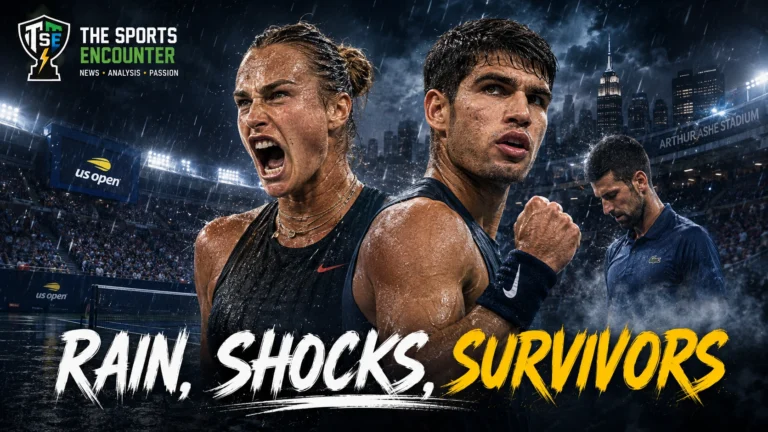
The 2026 US Open has already lost Novak Djokovic, Arthur Fils, Belinda Bencic, Andrey Rublev, Brandon Nakashima and several other major names, while repeated rain delays have divided the tournament into very different scheduling experiences. Aryna Sabalenka, Carlos Alcaraz, Jessica Pegula, Ben Shelton, Daniil Medvedev and Frances Tiafoe have reached Round 3 from the first half of the draw, while Naomi Osaka, Coco Gauff, Elena Rybakina, Taylor Fritz, Alexander Zverev, Iga Swiatek, Mirra Andreeva and others still have second-round business ahead of them.

NEW YORK: Four days into the US Open main draw, the most revealing statistic may have little to do with aces, winners or break points.

It is the clock.

Some players have moved through the first week with the orderly rhythm expected at a Grand Slam: play, recover, practice, prepare, play again. Others have left the court because of rain, returned hours later or the next morning, restarted matches from awkward scoreboard positions and then watched the tournament schedule move ahead without them.

The consequences became impossible to ignore by Wednesday.

The official US Open schedule designated September 2 for second-round singles. Yet delayed first-round matches were still being completed around the grounds. The opening round eventually finished after three and a half days, even while players such as Jessica Pegula, Daniil Medvedev, Aryna Sabalenka, Ben Shelton and Frances Tiafoe were already securing places in Round 3.

That scheduling overlap has given the first week an unusual shape.

Rain interrupted the final stages of qualifying before the main draw even began. It returned on opening Sunday, suspended multiple outer-court matches overnight, caused scattered delays Monday and then overwhelmed Tuesday’s schedule. Outer-court play on September 1 began roughly four hours later than planned before more rain arrived.

Emma Navarro may be the clearest individual example of the disruption. Her opening match against Lois Boisson was suspended overnight with Navarro six points from a straight-sets victory. Boisson returned the next day, won the second set and forced Navarro through a third. In Round 2 against Caty McNally, Navarro was again leading when rain stopped play.

She survived both disruptions.

Other players have been able to remain under retractable roofs, finish matches on schedule and protect their recovery windows.

The weather therefore belongs at the center of any serious assessment of this US Open, alongside the results themselves.

The tennis has produced enough disruption of its own.

Novak Djokovic’s chase for Grand Slam title No. 25 lasted one match. Mariano Navone defeated him in five sets on opening night, handing Djokovic his first first-round defeat in 20 US Open appearances and his earliest Grand Slam exit in two decades.

Cincinnati champion Arthur Fils arrived as one of the hottest young players on the ATP Tour and disappeared in Round 1 against an unseeded Stefanos Tsitsipas. Olympic champion Belinda Bencic was beaten by Yulia Putintseva. Barbora Krejcikova fell to Kamilla Rakhimova. Andrey Rublev survived a five-set opening-round escape only to lose to Daniel Merida in Round 2. Brandon Nakashima’s excellent North American summer ended against fellow American Alex Michelsen.

At the same time, several championship favorites have looked increasingly comfortable.

Sabalenka followed her opening victory with a 6-1, 6-1 demolition of Polina Iatcenko. Pegula spent only 56 minutes removing Sofia Kenin. Medvedev dispatched Sebastian Gorzny in straight sets. Shelton survived Hubert Hurkacz. Alcaraz responded to losing the first set against Jaime Faria by taking 18 of the next 26 games.

The US Open is still completing its second round. It has already changed shape several times.

US Open 2026 Through September 2: Tournament Snapshot

Category Status through September 2
Main-draw singles began Sunday, August 30
Opening round completed Wednesday, September 2, after three and a half days
Current stage Round 2, with one half completed
Men’s top seed Alexander Zverev
Women’s top seed Aryna Sabalenka
Defending men’s champion Carlos Alcaraz
Defending women’s champion Aryna Sabalenka
Major pre-tournament absence World No. 1 Jannik Sinner, right knee injury
Biggest men’s exit Novak Djokovic, Round 1
Other major men’s exits Arthur Fils, Andrey Rublev, Brandon Nakashima, Rafael Jodar
Major women’s exits Belinda Bencic, Barbora Krejcikova, Sofia Kenin, Sloane Stephens
Weather story Repeated rain interruptions from qualifying through the first four main-draw days
Round 3 already qualified Sabalenka, Pegula, Medvedev, Shelton, Alcaraz, Tiafoe, Townsend, Navarro, Muchova and others
Day 5 stage Remaining men’s and women’s Round 2 matches

Readers who want the complete live score ledger for every court can follow the official US Open completed-matches center. The official tournament schedule confirms that Round 2 continues Thursday before Round 3 begins Friday.

TL;DR: What Has Happened at the US Open 2026 So Far?

  • Novak Djokovic suffered a historic five-set first-round defeat to Mariano Navone.
  • World No. 1 Jannik Sinner never entered the tournament because of a right knee injury.
  • Alexander Zverev became men’s top seed and survived Lorenzo Sonego in a five-set opening-round match lasting almost five hours.
  • Defending champion Carlos Alcaraz returned after four months away with a wrist injury and has won his first two matches.
  • Aryna Sabalenka has dropped only seven games across her first two matches.
  • Jessica Pegula has reached Round 3 without dropping a set.
  • Daniil Medvedev has won six consecutive sets to begin his campaign.
  • Ben Shelton recovered from losing his opening set 6-1 in Round 1 and then defeated Hubert Hurkacz in four sets.
  • Frances Tiafoe survived a five-set first round before producing a far cleaner second-round victory over Rei Sakamoto.
  • Arthur Fils, the Cincinnati champion and No. 10 seed, lost in Round 1 to Stefanos Tsitsipas.
  • No. 12 seed Belinda Bencic fell to Yulia Putintseva.
  • Andrey Rublev survived two sets down in Round 1 before Daniel Merida eliminated him in Round 2.
  • Alex Michelsen knocked out No. 16 seed Brandon Nakashima.
  • Lucky loser Bu Yunchaokete removed No. 12 seed Rafael Jodar.
  • Taylor Townsend has reached Round 3 after conceding only three games in her second match.
  • Emma Navarro has survived rain delays in each of her first two matches.
  • Karolina Muchova crushed Katie Boulter 6-1, 6-0 to set up a major Round 3 meeting with Navarro.
  • Gael Monfils celebrated his 40th birthday with a four-set win and now faces 20-year-old Learner Tien.
  • Naomi Osaka faces doubles world No. 1 Katerina Siniakova on Thursday.
  • Elena Rybakina faces upset specialist Jessica Bouzas Maneiro.
  • Alexandra Eala gets a revenge opportunity against Oleksandra Oliynykova.
  • Rain has affected qualifying, Round 1 and Round 2 and has created substantial differences in player recovery time.

Before the First Ball: Jannik Sinner’s Withdrawal Changed the Men’s Tournament

The men’s draw lost its highest-ranked player before main-draw competition began.

Jannik Sinner withdrew because of the right knee problem that had already prevented him from playing the Masters events in Montreal and Cincinnati. He entered the late summer with a 44-3 record for the year and had won Wimbledon, but his recovery did not progress far enough for New York.

His absence made Alexander Zverev the No. 1 seed and immediately changed how the men’s draw had to be read.

The significance went beyond removing one contender.

Sinner became the first men’s world No. 1 this century to miss the US Open. The previous No. 1 to withdraw was Pete Sampras in 1999.

The Sports Encounter had already examined how Sinner’s absence changed the title race for Zverev, Djokovic, Shelton and the wider men’s field.

At that point, Djokovic appeared positioned to benefit.

He was gone after one night.

Rain Began Reshaping the US Open Before the Main Draw

The weather story started during Fan Week.

Rain interrupted the final round of qualifying on August 27, leaving a portion of the men’s and women’s main-draw places unresolved. Several matches were pushed into August 28, extending the qualifying competition while the main-draw field was already taking final shape.

The Sports Encounter documented the disruption in our August 27 US Open qualifying and draw report.

The following day, the remaining qualifying places were finally filled. The extended schedule produced a 23-player qualification group that included several competitors who would later make an impact in the main draw, a development covered in our complete August 28 qualifying wrap.

Elvina Kalieva was the final player to qualify. Her last match had been pushed to Friday by the rain.

That weather did not disappear once main-draw tickets were issued.

How Inclement Weather Has Changed the 2026 US Open

Date Tournament stage Weather impact Competitive consequence
August 27 Final qualifying round Rain prevented the qualifying program from finishing Several main-draw places remained unresolved overnight
August 28 Qualifying completion Delayed matches resumed Some qualifiers finished a day later than intended
August 30 Main Draw Day 1 Outer-court matches suspended overnight Players including Emma Navarro carried unfinished Round 1 matches into Monday
August 31 Main Draw Day 2 Scattered rain delays affected outer courts Wawrinka-Berrettini was interrupted; some matches were moved under roofs
September 1 Main Draw Day 3 Outer-court start pushed back about four hours before rain returned Multiple first-round matches could not be completed
September 2 Main Draw Day 4 Backlog remained; Navarro-McNally was also interrupted Round 1 and Round 2 were running simultaneously

Why the Rain Matters Beyond the Schedule

A weather delay looks harmless when viewed as an isolated block of lost court time.

Across a two-week Grand Slam, its effects accumulate.

A player who finishes on schedule can begin recovery immediately, eat at a predictable time, receive treatment, sleep normally and structure the next day’s practice around a known workload.

A player caught in a suspension has different problems.

The body cools down.

The match plan must be restarted.

Nutrition becomes awkward.

Players may have to warm up repeatedly.

A nearly completed match can return the next day with entirely different momentum.

Navarro experienced exactly that against Boisson.

She led 7-6(6), 4-2 on Sunday and needed only six more points to finish in straight sets. Rain ended play for the night. When the match resumed Monday, Boisson won the second-set tiebreak 7-1.

Navarro eventually recovered to win the third set 6-3.

Her explanation afterward captured the competitive problem. Although she had done most of the work before the delay, the overnight break made the restart feel far closer to a clean slate.

Then It Happened to Navarro Again

Against Caty McNally in Round 2, Navarro lost the opening set 6-3 but established a 5-2 lead in the second.

The rain arrived again.

When the players returned, Navarro finished the second set 6-2 and then won the decider 6-3.

Two rounds, two interruptions.

That matters when Navarro’s next opponent is Karolina Muchova, who needed only 54 minutes to destroy Katie Boulter 6-1, 6-0.

Both players reached the same round.

The physical and psychological route was entirely different.

The Roof Advantage Is Real

Arthur Ashe Stadium’s roof kept several headline matches moving while outer courts waited.

Madison Keys and Taylor Fritz completed their September 1 matches under the Ashe roof as players elsewhere waited roughly four hours for competition to start.

Alexander Zverev and Lorenzo Sonego then played their 4-hour, 52-minute epic in controlled conditions despite the wet evening outside.

Ben Shelton’s first-round win over Tallon Griekspoor had also been played under a closed roof.

Linda Noskova benefited from a scheduling move into Louis Armstrong Stadium on Monday when rain was affecting the outside courts.

There is nothing improper about those decisions. Grand Slam scheduling requires the biggest courts to remain productive whenever possible.

The competitive result is still uneven.

A tournament with roofs cannot completely neutralize the weather because most matches still take place outside those protected stadiums.

Day 1: Djokovic’s Historic Exit Changes the Men’s Draw Immediately

The first Sunday began conventionally.

Jessica Pegula defeated Elena-Gabriela Ruse 6-3, 6-2 in the first singles match inside Arthur Ashe Stadium.

Daniil Medvedev followed with a 6-4, 6-2, 6-4 victory over Hugo Gaston. For the 2021 champion, the performance mattered because his North American summer had produced very little momentum.

Tommy Paul dropped his first set against qualifier Coleman Wong before responding with a 6-7(3), 6-1, 6-3, 6-3 victory.

Jasmine Paolini was made to work considerably harder. She defeated Veronika Erjavec 6-3, 3-6, 6-4.

Elina Svitolina and Alexander Bublik also advanced.

Then Mariano Navone changed the tournament.

Mariano Navone Defeats Novak Djokovic in Five Sets

Djokovic came to New York attempting to win the 25th Grand Slam singles title of his career.

Navone entered as a 25-year-old Argentine better known for his clay-court tennis.

Four hours and 36 minutes later, the difference in reputation meant very little.

Navone won 7-6(5), 5-7, 4-6, 6-2, 6-1.

The result became Djokovic’s first opening-round defeat in 20 US Open appearances and his first first-round loss at any major since the 2006 Australian Open.

He actually recovered from losing the first set to take a two-sets-to-one lead.

That would once have been the point at which an opponent feared the match was disappearing.

This time Djokovic’s physical condition deteriorated.

He struggled with nausea, cramping and pain as the match progressed, and Navone continued extending rallies rather than allowing the veteran to shorten the contest.

The fourth and fifth sets were increasingly one-sided.

The Sports Encounter’s deeper examination of Djokovic’s physical collapse and what it means for his pursuit of Grand Slam No. 25 argued that the central question is becoming recovery rather than talent.

New York reinforced that concern.

Why Djokovic’s Exit Matters to Everyone Else

Sinner had already withdrawn.

Djokovic was now gone.

Alcaraz was coming back from four months away.

Zverev had yet to play.

The men’s tournament moved from open to unstable within its first evening.

That matters especially to players such as Medvedev, Shelton, Tiafoe, Fritz and the younger group underneath them. A four-time US Open champion disappeared from the bracket before most of those contenders had played their first match.

Kamilla Rakhimova Adds Another Day 1 Upset

Rakhimova defeated No. 27 seed Barbora Krejcikova 7-6(4), 6-2.

It would become more significant four days later when Sabalenka advanced to face Rakhimova in Round 3.

Rakhimova’s route means the defending champion will face an unseeded player who has already removed a former Grand Slam champion.

Luca Van Assche Removes Cameron Norrie

Van Assche lost the opening set against Norrie in a tiebreak before taking the next three 6-2, 6-2, 6-3.

Norrie’s exit removed another experienced Grand Slam performer from the men’s field.

Sofia Kenin Ends Venus Williams’ 26th US Open Appearance

Opening night finished with two American Grand Slam champions.

Kenin defeated Venus Williams 6-2, 7-6(6), but the second set became far more difficult than the final score suggests.

Williams created seven set points and threatened to force a decider before Kenin won the final six points of the match.

At 46, Williams was appearing at Flushing Meadows for the 26th time.

Her exit carried historical importance even though it was not an upset in ranking terms.

Sunday’s Rain Leaves Matches Unfinished

While the show courts reached conclusions, the field courts did not.

No American playing on the outer courts recorded a completed victory Sunday, and multiple matches were suspended because of the weather.

Navarro’s match against Boisson became the most prominent carryover.

Day 2 therefore began before Day 1 had fully ended.

Day 1 Key Results

Winner Opponent Score Significance
Jessica Pegula Elena-Gabriela Ruse 6-3, 6-2 Comfortable opening for No. 3 seed
Daniil Medvedev Hugo Gaston 6-4, 6-2, 6-4 Former champion advances cleanly
Tommy Paul Coleman Wong 6-7(3), 6-1, 6-3, 6-3 American recovers after losing first set
Jasmine Paolini Veronika Erjavec 6-3, 3-6, 6-4 Seed survives three-set test
Mariano Navone Novak Djokovic 7-6(5), 5-7, 4-6, 6-2, 6-1 Biggest upset of tournament so far
Kamilla Rakhimova Barbora Krejcikova 7-6(4), 6-2 No. 27 seed eliminated
Luca Van Assche Cameron Norrie 6-7(6), 6-2, 6-2, 6-3 Experienced British player exits
Sofia Kenin Venus Williams 6-2, 7-6(6) Kenin saves seven second-set set points

Day 2: Alcaraz Returns, Sabalenka Settles In and Arthur Fils Goes Home

Monday shifted attention toward the defending champions.

Carlos Alcaraz had not played a singles match since April because of a right wrist injury.

He returned against Roman Safiullin and won 6-4, 6-4, 6-4.

The result itself was reassuring.

His physical response mattered more.

Alcaraz reported that his body felt good after the match, an important development for a player who must survive seven best-of-five matches to retain the title.

Our dedicated feature on Alcaraz’s US Open comeback against Safiullin examined both the tennis and the wider cultural attention surrounding his return.

Sabalenka Begins Her Three-Peat Chase

Aryna Sabalenka defeated Camila Osorio 6-2, 6-4.

The world No. 1 is attempting to become champion for a third consecutive year after winning New York in 2024 and 2025.

The Sports Encounter’s Day 2 report on Sabalenka and Alcaraz noted the contrast between a defending women’s champion seeking continuity and a defending men’s champion trying to rediscover match rhythm.

By Wednesday, Sabalenka had moved another step ahead.

Amanda Anisimova Starts Again

Anisimova defeated Ashlyn Krueger 6-1, 6-3.

Last year’s finalist arrived with obvious expectations, yet her opening performance suggested she was treating the tournament as a new campaign rather than carrying the burden of defending a result.

That mindset may matter in a women’s draw where Sabalenka, Pegula, Gauff, Swiatek, Rybakina, Andreeva and Osaka all have credible reasons to believe they can reach the final weekend.

Stefanos Tsitsipas Produces One of the Tournament’s Biggest Upsets

Arthur Fils entered New York as Cincinnati champion, the No. 10 seed and one of the hottest players on the men’s tour.

He had arrived at a career-high ranking after winning his first Masters 1000 championship, a run analyzed in our Cincinnati report on Fils and the changing US Open men’s race.

Tsitsipas entered unseeded and outside the world’s Top 50.

The reputations of their recent seasons suggested one direction.

The match went somewhere else.

Fils won the opening set and led by a break in the second. Tsitsipas recovered, took the second-set tiebreak and completed a 4-6, 7-6(3), 6-1, 6-4 victory.

For Tsitsipas, it was the biggest US Open win of his career by ranking and circumstance.

For Fils, the result was particularly painful because Cincinnati had positioned him as one of the most credible challengers beneath the established major champions.

Andrey Rublev Escapes From Two Sets Down

Rublev’s tournament nearly ended even earlier.

Lucky loser Otto Virtanen won the first two sets 7-6(5), 7-6(0).

Rublev responded with a 6-0 third set, took the fourth 6-2 and survived the fifth-set match tiebreak 7-6(5).

The comeback demonstrated resilience.

It did not solve the problems that would reappear Wednesday.

Stan Wawrinka Says Goodbye to Grand Slam Tennis

Matteo Berrettini defeated Wawrinka 7-6(4), 7-6(3), 6-0 in the Swiss champion’s final Grand Slam match.

Wawrinka’s US Open association stretches back more than two decades and includes the 2016 title.

The first two sets showed why New York remained emotionally attached to him. Both reached tiebreaks before Berrettini’s greater physical reserves took control in the third.

Rain briefly interrupted the match after two games of the second set, creating roughly an hour’s delay.

Ben Shelton Recovers From a 1-6 Opening Set

Shelton’s first six games against Tallon Griekspoor were poor.

The American lost the first set 6-1.

He answered immediately with a 6-1 set of his own, won the third-set tiebreak 7-3 and closed the match 6-2 in the fourth.

The final score, 1-6, 6-1, 7-6(3), 6-2, reflected a sharp tactical and emotional correction.

Shelton had arrived after successfully defending his Canadian Open title, making him one of the leading American men’s contenders.

Iga Swiatek Starts With Control

Swiatek defeated Wang Xiyu 6-2, 6-3.

The No. 8 seed dominated enough of Wang’s first-serve points to prevent the match from developing into a physical baseline grind.

Her first-round Grand Slam winning streak reached 28 matches.

Naomi Osaka Wins Two Tiebreaks

Osaka defeated Anastasia Zakharova 7-6(6), 7-6(3).

The two-time US Open champion hit 11 aces and avoided the kind of extended three-set match that can complicate the opening week.

Her reward is a difficult stylistic assignment against Katerina Siniakova.

Taylor Townsend Removes the No. 20 Seed

Townsend defeated Maja Chwalinska 6-2, 6-3.

The result deserves attention because Chwalinska arrived as the No. 20 seed and reigning Roland Garros runner-up.

Townsend’s aggressive left-handed game has repeatedly worked well in New York. Her second-round performance would be even better.

Sebastian Gorzny Saves Five Match Points

World No. 731 Sebastian Gorzny became one of Monday’s best stories.

The American defeated Raphael Collignon 3-6, 6-3, 3-6, 6-3, 7-6(9) after saving five match points.

Four came while Gorzny served at 5-6 in the fifth set.

His tournament would end against Medvedev in Round 2, but the opening victory remains one of the first week’s strongest examples of a player changing his career on an outer court.

Sloane Stephens Finds an Opening-Round Revival

Former champion Sloane Stephens entered ranked No. 209 and defeated Clara Tauson 6-4, 6-1.

The performance briefly suggested New York might provide another late-career run.

Marta Kostyuk ended that possibility Wednesday.

Day 2 Key Results

Winner Opponent Score Meaning
Carlos Alcaraz Roman Safiullin 6-4, 6-4, 6-4 Successful return after four-month injury absence
Aryna Sabalenka Camila Osorio 6-2, 6-4 Defending champion starts cleanly
Amanda Anisimova Ashlyn Krueger 6-1, 6-3 2025 finalist advances
Stefanos Tsitsipas Arthur Fils 4-6, 7-6(3), 6-1, 6-4 No. 10 seed and Cincinnati champion eliminated
Matteo Berrettini Stan Wawrinka 7-6(4), 7-6(3), 6-0 Wawrinka’s final Grand Slam match
Andrey Rublev Otto Virtanen 6-7(5), 6-7(0), 6-0, 6-2, 7-6(5) Rublev survives two-set deficit
Ben Shelton Tallon Griekspoor 1-6, 6-1, 7-6(3), 6-2 Shelton recovers after disastrous opening set
Iga Swiatek Wang Xiyu 6-2, 6-3 No. 8 seed advances efficiently
Naomi Osaka Anastasia Zakharova 7-6(6), 7-6(3) Two-time champion wins two breakers
Taylor Townsend Maja Chwalinska 6-2, 6-3 No. 20 seed eliminated
Sebastian Gorzny Raphael Collignon 3-6, 6-3, 3-6, 6-3, 7-6(9) Gorzny saves five match points
Sloane Stephens Clara Tauson 6-4, 6-1 Former champion advances despite No. 209 ranking
Linda Noskova Katie Volynets 7-5, 6-1 Wimbledon champion recovers from 2-5 first-set deficit

Day 3: Four Hours of Rain, Zverev’s Escape and a Strong Night for Gauff, Eala and Monfils

Tuesday gave the tournament its clearest demonstration of the roof divide.

Outer-court play was delayed by approximately four hours because of inclement weather.

Madison Keys and Taylor Fritz played under the Arthur Ashe roof while several Americans scheduled elsewhere waited.

When outside play finally began, the American players involved started 0-4 before the rain returned.

The official schedule was supposed to conclude the first round Tuesday.

It could not.

Madison Keys Avoids Another Opening-Round Disaster

Keys defeated Alina Korneeva 7-5, 6-4.

The result carried additional emotional weight because Keys had lost in the first round at the 2025 US Open.

Korneeva, 19, pushed her through competitive sets, but Keys handled the decisive moments more calmly.

Taylor Fritz Opens With a Straight-Sets Win

Fritz defeated fellow American Darwin Blanch 6-3, 6-2, 6-4.

The No. 9 seed struck 14 aces and never allowed the teenager to turn his Arthur Ashe debut into a sustained upset attempt.

Fritz had entered New York with another strong North American summer behind him, including his Washington championship. The Sports Encounter’s report on Fritz’s Mubadala DC Open title documented how he had rebuilt hard-court momentum earlier in the swing.

Flavio Cobolli Wins From Two Sets Down

Francisco Comesana led Cobolli 6-3, 6-2.

Cobolli then rebuilt the match gradually rather than chasing an immediate escape.

He took the third set 6-3, the fourth 6-4 and the fifth 6-4.

For a player who has spent much of 2026 proving he can survive long Grand Slam matches, the comeback provided another example of his growing resilience.

Elena Rybakina Takes Care of Thea Frodin

Rybakina defeated 17-year-old American wild card Thea Frodin 6-3, 6-2.

The No. 2 seed had entered New York with fitness questions after suffering an ankle problem in Cincinnati.

Her opening match offered little evidence that the issue was restricting her tennis.

Mirra Andreeva Wins 17 Consecutive Points

French Open champion Mirra Andreeva defeated Janice Tjen 6-2, 6-2.

The match included a 17-point winning streak, a remarkable sequence at Grand Slam level.

Andreeva’s ability to change rally geometry through pace variation and angles separated her from an opponent she had also beaten in Cincinnati.

Belinda Bencic Becomes the Day’s Biggest Seeded Casualty

Yulia Putintseva defeated No. 12 seed Bencic 4-6, 7-5, 6-3.

Bencic had the opening set and opportunities to control the second, but Putintseva dragged the contest into the longer, more emotionally uncomfortable exchanges she prefers.

The Olympic champion became one of the most prominent women’s exits of the first round.

Coco Gauff Makes a Controlled Start

Gauff defeated Zeynep Sonmez 6-3, 6-4 inside Arthur Ashe Stadium.

The score was less dominant than some of her recent Cincinnati performances, but Gauff avoided a prolonged match during a difficult weather day.

She arrived in New York as the Cincinnati champion after beating Pegula in the final. Our analysis of Gauff’s Cincinnati title and the women’s US Open race identified her improved aggression as one of the most important tactical developments entering the major.

Alexandra Eala Brings Her Crowd With Her

No. 17 seed Alexandra Eala defeated American Mary Stoiana 6-1, 6-2.

The Filipino’s support inside Louis Armstrong Stadium again demonstrated how quickly she has developed into an international crowd attraction.

More importantly, her tennis held up under the attention.

Eala saved all six break points she faced and won the final five games.

Her next match has a built-in storyline.

Oleksandra Oliynykova defeated Eala earlier this year in Strasbourg, 3-6, 7-5, 6-3.

They meet again Thursday.

Gael Monfils Turns 40 and Keeps His Grand Slam Career Alive

Monfils’ 40th birthday could have become his farewell.

Adolfo Daniel Vallejo won the first set 6-2.

Monfils then won 18 of the next 22 games.

The Frenchman completed a 2-6, 6-1, 6-2, 6-0 victory and recorded his 34th US Open match win, the most by a Frenchman in tournament history.

His next opponent is 20-year-old Learner Tien.

The age difference makes that second-round meeting one of Thursday’s most compelling matches.

Zverev Comes Within Two Points of Disaster

Alexander Zverev’s first match as US Open top seed lasted 4 hours and 52 minutes.

Lorenzo Sonego pushed him through five sets and came within two points of victory.

Zverev eventually escaped 6-4, 3-6, 6-7(7), 7-5, 6-4.

The match was completed under the Arthur Ashe roof while wet conditions continued to disrupt the tournament around them.

Zverev’s survival confirmed two things at once.

His championship credentials remain intact.

His first week may already carry a physical bill.

A nearly five-hour first round is a significant workload in a tournament that demands seven matches across two weeks.

Day 3 Key Results

Winner Opponent Score Key point
Madison Keys Alina Korneeva 7-5, 6-4 Keys avoids repeat of 2025 first-round exit
Taylor Fritz Darwin Blanch 6-3, 6-2, 6-4 Fourteen aces and clean progress
Flavio Cobolli Francisco Comesana 3-6, 2-6, 6-3, 6-4, 6-4 Two-set comeback
Elena Rybakina Thea Frodin 6-3, 6-2 No. 2 seed advances
Mirra Andreeva Janice Tjen 6-2, 6-2 Andreeva wins 17 straight points
Yulia Putintseva Belinda Bencic 4-6, 7-5, 6-3 No. 12 seed eliminated
Coco Gauff Zeynep Sonmez 6-3, 6-4 Cincinnati champion moves on
Alexandra Eala Mary Stoiana 6-1, 6-2 Eala saves all six break points
Gael Monfils Adolfo Daniel Vallejo 2-6, 6-1, 6-2, 6-0 Victory on 40th birthday
Alexander Zverev Lorenzo Sonego 6-4, 3-6, 6-7(7), 7-5, 6-4 Top seed survives 4:52 marathon
Oleksandra Oliynykova Reese Brantmeier 6-4, 6-4 Sets up Eala rematch

Day 4: Two Rounds at Once as Sabalenka, Pegula, Medvedev, Shelton and Alcaraz Move On

Wednesday exposed the accumulated weather backlog more clearly than any other day.

The tournament had officially reached Round 2.

Some players were still completing Round 1.

That created unusual scenes around the grounds: one player could be qualifying for the third round while another was only securing a place in the second.

Jessica Pegula Needs Only 56 Minutes Against Sofia Kenin

Pegula entered Arthur Ashe against another American Grand Slam champion and removed her quickly.

She defeated Kenin 6-3, 6-1 in 56 minutes.

That efficiency carries additional value in a rain-distorted first week.

Pegula has played two straight-set matches, both on Ashe, without having to manage the kind of overnight interruption or long resumption experienced by Navarro.

Her Round 3 opponent is Leylah Fernandez.

Daniil Medvedev Ends Sebastian Gorzny’s Run

Gorzny’s five-match-point escape had been one of Monday’s stories.

Medvedev ended it 6-1, 6-3, 7-5.

The match lasted two hours and seven minutes.

Medvedev has now won all six sets he has played through two rounds.

His next opponent, Arthur Rinderknech, presents a considerably more experienced threat after the Frenchman defeated Jaume Munar in straight sets.

Marta Kostyuk Ends Sloane Stephens’ Revival

Kostyuk defeated Stephens 6-1, 7-5.

The first set removed much of the momentum Stephens had built with her opening-round performance.

The second was far more competitive, but the No. 11 seed closed the match in one hour and 27 minutes.

Alex Michelsen Beats Brandon Nakashima

This was one of the most meaningful American results of Wednesday.

Nakashima entered as the No. 16 seed and had enjoyed an outstanding North American hard-court summer.

Michelsen won 6-3, 6-4, 6-4.

The result removed a seeded American contender and elevated another member of the country’s younger generation.

Taylor Townsend Produces a 48-Minute Statement

Townsend defeated Taylah Preston 6-1, 6-1 in only 48 minutes.

She won all 23 points behind her first serve.

The performance matched the fewest games Townsend has ever conceded in a Grand Slam victory.

Her first two rounds have now produced a seeded upset and one of the quickest wins of the tournament.

Paula Badosa Finally Completes Round 1

While Townsend was moving into the third round, Paula Badosa was still completing the first.

She defeated Daria Kasatkina 6-1, 6-4.

The contrast captures the scheduling distortion better than almost any statistic.

Two players could win matches on the same Wednesday while standing an entire round apart in their tournaments.

Jasmine Paolini Reaches Round 3

Paolini defeated fellow Italian Lucrezia Stefanini 6-4, 6-1.

After needing three sets in Round 1, she required only one hour and 17 minutes in Round 2.

That reduction in workload is exactly what players want as a Slam moves toward its first weekend.

Daniel Merida Eliminates Andrey Rublev

Rublev’s comeback against Virtanen had looked like a possible turning point.

Merida made sure it became only an escape.

The Spaniard defeated the No. 23 seed 6-7(3), 6-2, 6-4, 6-4.

Rublev lost another match in which emotional control became increasingly difficult as the opponent grew more comfortable.

Merida’s advance belongs among the strongest surprise runs through the first half of Round 2.

Ben Shelton Survives Hubert Hurkacz

Shelton’s second round was much more demanding than his first-round recovery might have suggested.

He defeated Hurkacz 6-3, 5-7, 7-6(3), 7-5 under the Ashe roof.

Hurkacz increased his serving level after Shelton took early control, forcing the American into a match where small service and tiebreak margins mattered.

Shelton responded well in the third-set breaker and found the final break late in the fourth.

The victory moves him into Round 3 with two very different forms of adversity already behind him.

Emma Navarro Survives Rain Again

Navarro defeated McNally 3-6, 6-2, 6-3.

Rain suspended the match with Navarro leading 5-2 in the second set.

She returned and completed the comeback.

The reward is a match against Karolina Muchova, one of the most dangerous unseeded-looking seeded players in any major because of her all-court variety and history in New York.

Muchova Destroys Katie Boulter

Muchova needed just 54 minutes to beat Boulter 6-1, 6-0.

The No. 7 seed has been a US Open semifinalist twice and already lifted the 2026 mixed doubles trophy alongside Jakub Mensik during Fan Week.

Navarro will therefore enter Round 3 against an opponent who is playing efficiently, understands the conditions and has spent considerably less time managing interruptions.

Aryna Sabalenka Sends Another Warning

Sabalenka defeated Polina Iatcenko 6-1, 6-1.

She has conceded seven games across two rounds.

Her US Open winning streak continues, and the two-time defending champion has so far avoided the extended matches that can create physical problems later in the tournament.

Rakhimova is next.

Frances Tiafoe Looks Much Better in Round 2

Tiafoe needed five sets and three hours, 48 minutes to survive Martin Damm in his opening match.

Against qualifier Rei Sakamoto, he was much cleaner.

Tiafoe won 6-3, 7-6(2), 7-5 in two hours and 40 minutes.

He has now reached the US Open third round for seven consecutive years.

That consistency is important because Tiafoe’s game has often risen with the atmosphere in New York.

Alcaraz Drops His First Set, Then Takes Control

Jaime Faria produced the best opening set anyone has played against Alcaraz this tournament.

The Portuguese player took it 6-4.

Alcaraz’s response was immediate.

He won the second set 6-0.

The defending champion then took the next two 6-3, 6-2.

His US Open career record improved to 26-3.

The value of the match went beyond advancement. Alcaraz was forced to respond to scoreboard adversity and play four sets, another useful test of the wrist and the rest of his body after the four-month layoff.

Linda Noskova Moves Forward

Wimbledon champion Linda Noskova defeated Lanlana Tararudee 6-4, 6-2.

She will face American No. 29 seed Ann Li in Round 3.

Noskova’s first-round scare against Katie Volynets now feels more distant after a much cleaner second performance.

Selected Day 4 Match Duration Graph

Match duration among selected completed matches on September 2

Taylor Townsend: 48 min

Jessica Pegula: 56 min

Jasmine Paolini: 77 min

Leylah Fernandez: 78 min

Diana Shnaider: 84 min

Marta Kostyuk: 87 min

Alex Michelsen: 115 min

Daniil Medvedev: 127 min

Daniel Merida: 166 min

Arthur Rinderknech: 186 min

Source: Official US Open completed-match durations. The chart is included to illustrate differences in workload rather than player quality.

Major Day 4 Results Through the Publication Cutoff

Winner Opponent Score Round
Jessica Pegula Sofia Kenin 6-3, 6-1 R2
Daniil Medvedev Sebastian Gorzny 6-1, 6-3, 7-5 R2
Marta Kostyuk Sloane Stephens 6-1, 7-5 R2
Alex Michelsen Brandon Nakashima 6-3, 6-4, 6-4 R2
Taylor Townsend Taylah Preston 6-1, 6-1 R2
Paula Badosa Daria Kasatkina 6-1, 6-4 R1
Jasmine Paolini Lucrezia Stefanini 6-4, 6-1 R2
Diana Shnaider Karolina Pliskova 6-1, 7-6(4) R2
Leylah Fernandez Mananchaya Sawangkaew 6-4, 6-1 R2
Arthur Rinderknech Jaume Munar 7-6(4), 6-2, 7-5 R2
Daniel Merida Andrey Rublev 6-7(3), 6-2, 6-4, 6-4 R2
Sorana Cirstea Diane Parry 6-2, 7-5 R2
Ben Shelton Hubert Hurkacz 6-3, 5-7, 7-6(3), 7-5 R2
Karolina Muchova Katie Boulter 6-1, 6-0 R2
Emma Navarro Caty McNally 3-6, 6-2, 6-3 R2
Aryna Sabalenka Polina Iatcenko 6-1, 6-1 R2
Frances Tiafoe Rei Sakamoto 6-3, 7-6(2), 7-5 R2
Carlos Alcaraz Jaime Faria 4-6, 6-0, 6-3, 6-2 R2
Linda Noskova Lanlana Tararudee 6-4, 6-2 R2

The Biggest Exits of the 2026 US Open So Far

Player Status Lost to / Reason Why it matters
Jannik Sinner Withdrew before tournament Right knee injury World No. 1 and Wimbledon champion absent
Novak Djokovic Round 1 Mariano Navone First US Open R1 exit in 20 appearances
Arthur Fils Round 1 Stefanos Tsitsipas Cincinnati champion and No. 10 seed
Rafael Jodar Round 1 Bu Yunchaokete No. 12 seed beaten by lucky loser
Andrey Rublev Round 2 Daniel Merida No. 23 seed eliminated after dramatic R1 comeback
Brandon Nakashima Round 2 Alex Michelsen No. 16 seed and summer form player exits
Belinda Bencic Round 1 Yulia Putintseva No. 12 seed and Olympic champion out
Barbora Krejcikova Round 1 Kamilla Rakhimova Former major champion and No. 27 seed
Sofia Kenin Round 2 Jessica Pegula Former major champion removed in 56 minutes
Sloane Stephens Round 2 Marta Kostyuk 2017 champion’s promising R1 revival ends
Venus Williams Round 1 Sofia Kenin 26th US Open appearance ends
Stan Wawrinka Round 1 Matteo Berrettini Final Grand Slam match of 2016 champion

Djokovic Remains the Exit That Changed Everything

Fils losing mattered.

Bencic losing mattered.

Rublev and Nakashima leaving reshaped individual sections of the draw.

Djokovic altered the tournament’s championship structure.

Before the event, the men’s hierarchy contained three enormous uncertainties.

Sinner was absent.

Alcaraz was returning from injury.

Djokovic’s body had shown warning signs in previous events.

Navone converted the third uncertainty into a fact.

That leaves Zverev as the highest seed, Alcaraz as the defending champion and a group including Shelton, Medvedev, Fritz and Tiafoe with fewer established major winners standing between them and the trophy.

The tournament is still dangerous enough to punish anyone who thinks the bracket has become easy.

Zverev needed nearly five hours merely to escape Round 1.

Alcaraz dropped a set to Faria.

Shelton has already lost three sets across two matches.

The opening is real.

So is the depth underneath it.

Fils’ Exit Shows Why Pre-US Open Form Can Disappear Quickly

Cincinnati made Arthur Fils look ready for a major breakthrough.

His title run included the first Masters 1000 trophy of his career and moved him to a career-high ranking.

He entered New York on a six-match winning streak.

Tsitsipas arrived with very different numbers.

The Greek had fallen outside the Top 50 and had won only three of seven main-draw matches during the summer hard-court season.

Fils still lost.

Grand Slams routinely expose the danger of projecting one-week tournament form too confidently onto a five-set format.

The first round asks different questions: nerves, new conditions, slower match construction and the knowledge that losing once ends the entire campaign.

Tsitsipas understood those conditions better than his recent ranking suggested.

The Surprise Advances Giving This US Open More Depth

Player Breakthrough so far Why the run stands out
Mariano Navone Defeated Djokovic Biggest win of his career against a 24-time major champion
Daniel Merida Reached Round 3 Eliminated No. 23 seed Rublev
Alex Michelsen Reached Round 3 Beat No. 16 seed Nakashima in straight sets
Taylor Townsend Reached Round 3 Upset No. 20 seed, then won 6-1, 6-1
Bu Yunchaokete Upset Rafael Jodar Lucky loser beat No. 12 seed 6-2, 6-1, 6-1
Sebastian Gorzny Won Round 1 World No. 731 saved five match points
Gael Monfils Reached Round 2 at age 40 Won on birthday in final Grand Slam season
Yulia Putintseva Reached Round 2 Removed No. 12 seed Bencic
Kamilla Rakhimova Reached Round 3 Opened tournament by eliminating Krejcikova

Taylor Townsend Is Becoming More Than an Upset Story

Townsend’s first match qualified as an upset.

Her second suggested form.

There is an important distinction.

Beating the No. 20 seed once can be explained by matchup, confidence or one strong afternoon.

Following it with a 48-minute 6-1, 6-1 victory while winning every first-serve point is a stronger signal.

Townsend has reached the US Open fourth round twice before, in 2019 and 2025.

New York has consistently suited her left-handed serve, willingness to attack the net and ability to break the baseline rhythm preferred by many opponents.

Her run deserves to be treated seriously until somebody solves those patterns.

Alex Michelsen Steps Into the American Conversation

Nakashima’s summer form had made him one of the most interesting American outsiders.

Michelsen beat him without requiring a tiebreak or deciding set.

The 6-3, 6-4, 6-4 result was controlled enough to shift attention toward Michelsen rather than simply recording another seeded casualty.

The American men’s discussion has naturally centered on Shelton, Fritz, Tiafoe and Paul.

Michelsen is giving the tournament another home player to watch.

The American Story Is Broadening

The United States has entered recent US Opens carrying the familiar question of whether an American man can finally end the country’s long wait for another men’s singles champion.

That remains relevant.

The 2026 tournament is developing a broader domestic story.

Pegula is into Round 3.

Shelton is into Round 3.

Tiafoe is into Round 3 for the seventh consecutive year.

Townsend has been outstanding.

Navarro keeps surviving difficult matches.

Michelsen has removed a seed.

Iva Jovic completed a delayed first-round victory and remains one of the country’s most important young prospects.

Fritz, Keys, Gauff, Anisimova, Tien and several others still have matches to play Thursday.

The quantity increases the chances that home interest remains strong well into the second week even if one or two leading names fall.

The Women’s Championship Race After Four Days

Sabalenka has produced the strongest scoreboard argument from the half of the draw that has completed Round 2.

She has won four sets and conceded seven games.

Pegula has also looked extremely efficient.

Muchova’s 6-1, 6-0 win over Boulter may be the most complete single performance from an established women’s contender through Wednesday.

Noskova, the Wimbledon champion, is through.

Navarro has demonstrated resilience rather than dominance.

Townsend has supplied both.

The other half still contains substantial power.

Gauff has played one match.

Rybakina has played one.

Swiatek has played one.

Andreeva has played one.

Osaka has played one.

Anisimova has played one.

Any assessment of the championship race therefore remains incomplete until Thursday’s Round 2 program finishes.

Sabalenka Has Done Exactly What a Defending Champion Wants

Sabalenka has avoided complexity.

She has not been dragged into long deciding sets.

She has not been involved in rain restarts.

She has not had to spend four hours solving an opponent.

That matters because the cost of a major often arrives cumulatively.

A player who saves energy in the first week can spend it in the second.

Rakhimova has already demonstrated that she can upset a major champion, so Round 3 should not be treated as ceremonial.

Sabalenka will still enter it with exactly the physical profile she would have wanted after two rounds.

Pegula Is Quietly Building the Same Advantage

Pegula has conceded nine games in four sets.

Her second-round match lasted less than an hour.

She has also enjoyed predictable Arthur Ashe scheduling.

Against Leylah Fernandez, the challenge will change because the Canadian brings left-handed patterns, speed and far greater willingness to redirect rallies than Kenin managed Wednesday.

Muchova vs Navarro Is Already a Second-Week Quality Match

Muchova against Navarro may be the strongest confirmed women’s third-round matchup at the cutoff.

Muchova’s game is built around variety: slice, net movement, disguised changes of direction and the ability to alter pace without conceding court position.

Navarro is at her best when she can absorb pace, extend exchanges and gradually make opponents play uncomfortable extra shots.

The tactical conflict is excellent.

The scheduling background adds another layer.

Muchova demolished Boulter quickly.

Navarro has played two disrupted three-set matches.

That may matter if their contest becomes physical.

The Men’s Championship Race After Djokovic

The men’s draw currently asks a question nobody could answer before Sunday.

Who takes control when the most proven major winner in the field disappears before Round 2?

Zverev owns the top seed.

Alcaraz owns the defending championship.

Medvedev owns a US Open title and has begun efficiently.

Shelton owns one of the most dangerous serves in the bracket.

Fritz has already reached a US Open final.

Tiafoe has repeatedly played his best major tennis in New York.

The absence of Sinner and Djokovic creates opportunity without creating certainty.

Zverev’s Five-Hour Problem

Zverev won his first Grand Slam title at Roland Garros this year.

That breakthrough removed the largest career question surrounding him.

His US Open began with a different concern.

Four hours and 52 minutes against Sonego is an enormous first-round investment.

The top seed now needs his next matches to become more economical.

Repeated five-set survival is rarely a sustainable championship strategy, particularly when the tournament has already been complicated by weather.

Alcaraz Is Learning About His Body as Much as His Opponents

Alcaraz has won both matches.

The real examination remains physical.

Four months without singles competition cannot be recreated in practice.

Round 1 gave him three sets.

Round 2 gave him four and included the experience of losing an opening set.

That progression is useful.

His shotmaking against Faria increasingly resembled the variety that has made him so difficult to contain on Ashe: aggressive forehands, heavy serving, drop shots and lobs used from similar preparation positions.

If the wrist continues tolerating that workload, his title defense becomes more credible with every round.

Medvedev Has Quietly Avoided Trouble

Medvedev has gone 6-0 in sets.

That should receive more attention.

His summer form entering New York was poor enough to create doubts about whether the 2021 champion remained a serious title threat.

Gaston and Gorzny have not provided elite opposition.

Medvedev still did what championship contenders are supposed to do with manageable early draws.

He finished the matches.

Rinderknech should provide a better test in Round 3.

Shelton Is Surviving Different Problems

Griekspoor overwhelmed Shelton early.

Hurkacz threatened him later.

Shelton solved both.

The first two rounds have therefore supplied more useful evidence than two routine straight-set wins might have done.

His challenge remains the same one highlighted before the tournament: the serve can create opportunities, but the title will depend on how effectively he manages neutral rallies when elite opponents return that serve.

The First-Round Numbers That Explain the Tournament

The official US Open statistical review confirmed that the opening round required three and a half days to finish.

Several numbers capture the mixture of history and volatility:

  • Djokovic’s first-round major winning streak ended after 20 years.
  • Sabalenka extended her US Open winning streak to 14 matches after Round 1 and has since added another victory.
  • Frances Tiafoe extended his streak of successful Grand Slam opening rounds to 22.
  • Venus Williams made her 25th US Open main draw in the Open Era count used by the tournament’s statistical review, extending a record-level history of appearances.
  • Swiatek recorded her 28th consecutive first-round Grand Slam victory.
  • Seventeen former Grand Slam singles champions started the tournament.
  • Thirteen players were making Grand Slam main-draw debuts.
  • Three first-round matches required deciding-set match tiebreaks.

The tournament’s official numerical review is available through the US Open Round 1 statistics report.

What the Weather Has Done to Recovery Windows

There is no responsible way to claim rain caused a particular upset without direct evidence.

The scheduling consequences can be measured more carefully.

Consider Navarro and Muchova.

Navarro’s first match crossed two days.

Her second was interrupted again.

Muchova’s Round 2 lasted less than an hour.

Now they meet.

Consider Zverev.

His match could continue under the Ashe roof, which prevented an additional weather delay.

He still spent almost five hours on court.

Consider players whose first-round matches were unfinished Tuesday.

Some completed them Wednesday while players from the opposite half were already qualifying for Round 3.

Those are tangible differences in recovery timing.

At a Grand Slam, a half-day can influence treatment schedules, practice intensity, sleep and preparation.

That does not predetermine results.

It changes the operating environment in which results are produced.

Upcoming US Open Matches to Watch on Thursday, September 3

Match Round Why it matters
Naomi Osaka vs Katerina Siniakova R2 Two-time US Open champion against doubles world No. 1
Learner Tien vs Gael Monfils R2 20-year-old rising star against 40-year-old veteran
Elena Rybakina vs Jessica Bouzas Maneiro R2 No. 2 seed faces proven upset threat
Alexandra Eala vs Oleksandra Oliynykova R2 Rematch after Oliynykova beat Eala in Strasbourg
Remaining matches involving Gauff, Fritz, Keys, Swiatek, Zverev and Andreeva R2 Major championship contenders complete other half of second round

Naomi Osaka vs Katerina Siniakova: A Singles Match With Doubles Geometry

Osaka and Siniakova open Thursday’s Arthur Ashe Stadium program.

The matchup is more complicated than their singles rankings suggest.

Osaka owns four Grand Slam singles titles, including the US Open championships from 2018 and 2020.

Siniakova is the doubles world No. 1 and an 11-time women’s doubles major champion.

They have played three times previously.

Osaka leads 2-1.

Their most recent meeting came at Wimbledon in 2025, where Osaka won in straight sets.

Osaka’s first-round performance was built around serving. She hit 11 aces and won 75 percent of her first-serve points against Zakharova.

Siniakova offers a different challenge because her doubles instincts make her more comfortable changing court position, attacking short balls and taking away predictable passing lanes.

Osaka will want first-strike control.

Siniakova will want variation.

That makes the match tactically richer than a simple champion-versus-lower-ranked-opponent reading.

Learner Tien vs Gael Monfils: Twenty Years Against Forty

This may be Thursday’s best pure story.

Tien is 20.

Monfils turned 40 on Tuesday.

They represent opposite points of the professional tennis timeline.

Monfils is playing his final Grand Slam season and has spent two decades turning matches into entertainment without losing the competitive seriousness underneath it.

Tien is part of the generation trying to replace players exactly like him.

The styles also contrast.

Tien is a compact left-hander who builds points intelligently and changes direction well.

Monfils possesses greater reach, explosive defensive movement and the ability to turn a neutral rally into a spectacular attack with very little warning.

Tien won their only previous meeting in Montreal.

New York offers a very different atmosphere.

Louis Armstrong Stadium will understand exactly what may be at stake for Monfils.

Elena Rybakina vs Jessica Bouzas Maneiro: The Upset Risk Is Real

Rybakina is the No. 2 seed and one of the biggest servers in women’s tennis.

Bouzas Maneiro is ranked outside the obvious championship group.

Her recent history demands respect.

She defeated Coco Gauff at the 2026 United Cup and has produced major upsets before, including a victory over defending Wimbledon champion Marketa Vondrousova in 2024.

The Spanish player also reached the Wimbledon fourth round in 2025.

Her path has therefore established enough evidence that she can handle a major stadium and a highly ranked opponent.

Rybakina should control more points through serve and first-ball power.

The danger appears if Bouzas Maneiro extends return games and turns the contest into a movement test.

Rybakina came into the US Open after the ankle problem that ended her Cincinnati quarterfinal.

Her Round 1 performance was reassuring.

Thursday should reveal more.

Alexandra Eala vs Oleksandra Oliynykova: A Revenge Match With a Possible Jovic Meeting Ahead

Eala already knows exactly how dangerous Oliynykova can be.

The Ukrainian beat her in Strasbourg earlier this year after losing the opening set.

Eala now enters their New York rematch as the No. 17 seed and with considerably greater expectation around her.

Her first-round win showed that the attention has not overwhelmed her.

The next question is whether she can solve a matchup that already went wrong once this season.

There is another incentive in the bracket.

Iva Jovic has progressed from a delayed first-round match, creating the possibility of a meeting between two of the sport’s most closely watched young players.

Eala has to get there first.

The Confirmed Round 3 Matches Already Worth Circling

Match Early read
Aryna Sabalenka vs Kamilla Rakhimova Defending champion faces player who eliminated Krejcikova
Jessica Pegula vs Leylah Fernandez Pegula’s efficiency meets Fernandez’s left-handed counterpunching
Emma Navarro vs Karolina Muchova One of the strongest tactical matchups in the women’s third round
Linda Noskova vs Ann Li Wimbledon champion against American No. 29 seed
Daniil Medvedev vs Arthur Rinderknech Former champion receives his first experienced veteran test

Sabalenka vs Rakhimova Could Be More Difficult Than It Looks

The rankings favor Sabalenka heavily.

The tournament evidence requires one qualification.

Rakhimova has already beaten Krejcikova.

That establishes that she can handle a Grand Slam champion and the emotional pressure attached to trying to complete an upset.

Sabalenka will attempt to prevent the match from becoming emotionally complicated at all.

Her first two rounds have been defined by early scoreboard control.

If she breaks early again, Rakhimova may be forced to attack before she has established rhythm.

Pegula vs Fernandez Will Ask New Questions

Pegula has been comfortable against Ruse and Kenin.

Fernandez changes the geometry.

The Canadian takes the ball early, uses her left-handed forehand to create different crosscourt patterns and is comfortable redirecting pace.

Pegula’s greatest advantage may be her ability to absorb that early ball and maintain compact positioning close to the baseline.

She should also arrive physically fresh after only 56 minutes in Round 2.

Navarro vs Muchova May Reveal the Cost of the Weather

This is where the tournament’s weather narrative and tennis narrative meet most cleanly.

Navarro has played through repeated disruption.

Muchova has just produced one of the fastest and most dominant victories of the round.

If the match reaches a long third set, Navarro’s accumulated workload becomes relevant.

If Muchova takes early control, her ability to finish Boulter quickly could look even more valuable.

The tennis still decides the match.

The route each woman took to arrive there has been very different.

What Has Been the Best Performance So Far?

There are several valid candidates.

Sabalenka vs Iatcenko

A 6-1, 6-1 second-round win from a two-time defending champion is the cleanest statement from the women’s title favorite group.

Muchova vs Boulter

Muchova conceded one game in 54 minutes against an experienced opponent.

Townsend vs Preston

Townsend lost only two games and won every point behind her first serve.

Navone vs Djokovic

The performance was less efficient than the three above, but the opponent and five-set resilience make it the tournament’s most important victory.

Alcaraz After the First Set Against Faria

Alcaraz lost the opener 6-4 and then responded 6-0, 6-3, 6-2. Given the four-month absence preceding the tournament, the response may carry more value than a routine straight-set victory.

Zverev’s Survival

Survival is the correct word rather than dominance. Sonego pushed the No. 1 seed to the edge. Zverev still found a route out after nearly five hours.

Who Has the Most to Prove in the Next Round?

Zverev needs a shorter match.

His first round created too much physical workload.

Rybakina needs another healthy performance to reduce concern about the ankle.

Gauff needs to translate Cincinnati form through another round before comparisons with Sabalenka’s start become meaningful.

Osaka needs to handle Siniakova’s variety.

Navarro needs to show that repeated rain disruptions have not drained her against Muchova.

Tsitsipas needs to convert the Fils upset into a run rather than an isolated result.

Merida and Michelsen face the opposite challenge. Both now have major wins behind them. Their next test is proving that the breakthrough did not consume the tournament emotionally.

What Most US Open Coverage Is Missing About the Rain

The obvious weather story is interruption.

The more important one is inequality of rhythm.

Grand Slam draws are already unequal by design. Different opponents, different courts and different match durations create different routes.

Rain amplifies those differences.

A player on Ashe can spend four hours playing tennis while an opponent elsewhere spends four hours waiting.

Those are not equivalent physical experiences.

A player suspended overnight may sleep with a match unfinished, return the next morning, compete again and then have to prepare for another opponent quickly.

Another player may have completed a straight-set victory the previous afternoon and already begun recovery.

The tournament cannot remove this difference entirely.

It can only manage it.

That is why the first week’s weather deserves to remain part of the analysis when later-round fatigue appears.

If Navarro reaches the second week after repeated delays, those interruptions belong in the story.

If Zverev struggles physically after a 4-hour, 52-minute opener, the protected roof prevented a scheduling problem but could not erase the workload.

If Pegula or Sabalenka arrives deep in the draw with far fewer hours on court, their early efficiency will become part of the explanation.

The Sports Encounter Verdict After Four Days

The 2026 US Open has yet to reach its first weekend, but several assumptions made before the tournament already require revision.

Djokovic is gone.

Fils is gone.

Rublev is gone.

Nakashima is gone.

Bencic is gone.

Sinner never arrived.

Alcaraz has survived his return well enough to look increasingly dangerous.

Zverev survived a first-round match that could easily have ended his tournament.

Medvedev has quietly rebuilt some credibility.

Shelton has solved two very different opponents.

Sabalenka has looked exactly like a defending champion who understands the value of conserving energy.

Pegula has been nearly as economical.

Muchova appears dangerous.

Townsend has produced one of the best starts of her US Open career.

Navarro has turned rain interruptions into tests of concentration and survived each one.

The other half of the draw has more evidence to provide Thursday.

Gauff, Osaka, Swiatek, Rybakina, Andreeva, Fritz, Keys, Zverev and others remain partway through the tournament rather than safely positioned for the weekend.

That distinction matters.

New York has already shown that reputation provides very little protection.

Fils arrived with a Masters trophy and left after one match.

Djokovic arrived with 24 majors and left after one.

Jodar entered as the No. 12 seed and lost to a lucky loser.

Rublev escaped from two sets down only to lose two days later.

The weather has added another layer of uncertainty because the players are no longer operating on identical recovery rhythms.

That may become increasingly significant as the draw compresses and match quality rises.

The US Open is therefore moving toward its first weekend with two races happening simultaneously.

One is visible in the bracket.

The other is taking place inside players’ bodies and preparation schedules as they try to recover from whatever the first four days demanded of them.

Sabalenka and Pegula have spent relatively little time paying that price.

Zverev has already paid heavily.

Navarro has paid through interruption.

Alcaraz is discovering what his body can tolerate after four months away.

Monfils is attempting to extend one final major run at 40.

Townsend, Michelsen, Merida and other less obvious names are trying to turn first-week opportunity into second-week relevance.

That is the state of the 2026 US Open before Thursday’s play.

The tournament is still in Round 2.

Its original shape has already disappeared.

Follow The Sports Encounter’s complete tennis coverage as the US Open progresses through Round 3, the second week and championship weekend.

Frequently Asked Questions

What round is the 2026 US Open currently in?

As of the publication cutoff before play on September 3, the US Open is in Round 2. One half of the men’s and women’s second rounds was completed Wednesday, while the remaining Round 2 matches are scheduled for Thursday.

Has the US Open 2026 first round finished?

Yes. The first round was completed on Wednesday, September 2, after rain stretched it across approximately three and a half days.

Who produced the biggest upset of the 2026 US Open so far?

Mariano Navone’s five-set victory over Novak Djokovic is the biggest result so far. Navone won 7-6(5), 5-7, 4-6, 6-2, 6-1.

Why was Djokovic’s defeat historic?

It was Djokovic’s first first-round defeat in 20 US Open appearances and his first opening-round Grand Slam loss since the 2006 Australian Open.

Why is Jannik Sinner not playing the 2026 US Open?

Sinner withdrew before the tournament because of a right knee injury that had also prevented him from competing in Montreal and Cincinnati.

Who is the top seed in the men’s US Open?

Alexander Zverev is the men’s No. 1 seed following Sinner’s withdrawal.

Who is the top seed in the women’s US Open?

Aryna Sabalenka is the women’s top seed and two-time defending champion.

How has Carlos Alcaraz performed after returning from injury?

Alcaraz defeated Roman Safiullin 6-4, 6-4, 6-4 in Round 1 and Jaime Faria 4-6, 6-0, 6-3, 6-2 in Round 2. These were his first singles matches after four months away because of a right wrist injury.

How has Aryna Sabalenka performed?

Sabalenka beat Camila Osorio 6-2, 6-4 and Polina Iatcenko 6-1, 6-1. She has lost only seven games through two matches.

Who does Sabalenka play next?

Sabalenka faces Kamilla Rakhimova in Round 3. Rakhimova eliminated No. 27 seed Barbora Krejcikova in the first round.

Who does Jessica Pegula play next?

Pegula faces Leylah Fernandez in Round 3 after defeating Sofia Kenin 6-3, 6-1.

Who does Emma Navarro play next?

Navarro faces No. 7 seed Karolina Muchova in one of the strongest confirmed third-round matches.

How has rain affected Emma Navarro?

Both of Navarro’s first two matches have been interrupted by rain. Her opening contest against Lois Boisson was suspended overnight, while her second-round match against Caty McNally was stopped with Navarro leading 5-2 in the second set.

How long was Alexander Zverev’s first-round match?

Zverev needed approximately four hours and 52 minutes to defeat Lorenzo Sonego in five sets.

Who eliminated Arthur Fils?

Stefanos Tsitsipas defeated the No. 10 seed 4-6, 7-6(3), 6-1, 6-4.

Who eliminated Andrey Rublev?

Daniel Merida defeated Rublev in Round 2, 6-7(3), 6-2, 6-4, 6-4.

Who eliminated Brandon Nakashima?

Alex Michelsen defeated the No. 16 seed 6-3, 6-4, 6-4 in an all-American second-round match.

Who are the biggest surprise players still advancing?

Daniel Merida, Alex Michelsen, Taylor Townsend, Mariano Navone, Kamilla Rakhimova and lucky loser Bu Yunchaokete are among the players who have produced notable upsets or unexpected runs.

Who does Naomi Osaka play next?

Osaka faces doubles world No. 1 Katerina Siniakova in the second round Thursday. Osaka leads their head-to-head series 2-1.

Who does Gael Monfils play next?

Monfils faces 20-year-old American Learner Tien in Round 2 after winning his opening match on his 40th birthday.

Who does Alexandra Eala play next?

Eala faces Oleksandra Oliynykova, who defeated her in three sets earlier this season in Strasbourg.

Who does Elena Rybakina play next?

Rybakina faces Jessica Bouzas Maneiro, a Spanish player with previous Top-10 and Grand Slam upset wins.

When does the US Open third round begin?

Round 3 begins Friday, September 4, after the remaining second-round matches are completed Thursday.

When is the 2026 US Open final?

The tournament concludes on Sunday, September 13, with the men’s singles championship after the women’s final on the preceding day.

Ruben Santos is a North America-focused sports writer covering the NBA, NHL, NFL, MLB, MLS, and major international competitions across the United States, Canada, and Mexico. His work follows the leagues, teams, players, trades, roster decisions, playoff races, and major developments shaping sports conversations across the region. At The Sports Encounter, Ruben contributes breaking news, game coverage, league analysis, player-focused features, and stories examining the wider business, governance, and cultural forces influencing modern sport. His reporting combines clear news judgment with statistical context, historical perspective, and an understanding of the fan experience surrounding major teams and competitions. He also covers FIFA and international soccer stories when they intersect with North American sport, major tournaments, and global sports governance.

Breaking News

Fiorentina 1-2 Torino: Mandragora Haunts Former Club as Viola Lose Third Straight Serie A Game

Fiorentina finally scored their first Serie A goal of the season through Mateo Pellegrino, but Rolando Mandragora and Ché Adams completed a second-half Torino comeback. The 2-1 defeat leaves the Viola with three losses from three despite creating more chances and producing the stronger xG.

Published

on

Rolando Mandragora celebrates after scoring against former club Fiorentina in Torino’s 2-1 Serie A comeback win at the Stadio Artemio Franchi.

FLORENCE, September 5, 2026: Fiorentina finally scored their first Serie A goal of the season on Saturday. It still was not enough to earn their first point.

Mateo Pellegrino gave Fabio Grosso’s side the lead two minutes after halftime at the Stadio Artemio Franchi, briefly offering the home crowd the response it had been waiting for after two damaging opening defeats.

Torino overturned the game in eight second-half minutes.

Rolando Mandragora, who returned to Torino from Fiorentina only four days earlier, equalized in the 74th minute before Ché Adams completed the comeback in the 82nd, giving Ignazio Abate his first Serie A victory of the season and deepening Fiorentina’s alarming start.

The final score was Fiorentina 1-2 Torino.

The underlying numbers make the result even more uncomfortable for the Viola. Fiorentina produced 14 shots to Torino’s seven, generated 1.55 expected goals compared with Torino’s 0.63 and created considerably more attacking volume. Torino nevertheless left Florence with all three points.

For a club that entered the summer with major investment, a new coach and ambitions of climbing sharply from last season’s 15th-place finish, three defeats from three league games has already changed the tone around the project.

The Sports Encounter’s complete Serie A 2026-27 preview identified Fiorentina as one of the league’s most aggressive rebuilds and warned that a young, heavily changed squad would need results quickly enough to create patience around Grosso’s work.

That patience is now being tested much earlier than Fiorentina expected.

Fiorentina 1-2 Torino: Match at a Glance

Match Detail Information
Competition Serie A 2026-27
Matchday 3
Venue Stadio Artemio Franchi, Florence
Final Score Fiorentina 1-2 Torino
Fiorentina Goal Mateo Pellegrino 47′
Torino Goals Rolando Mandragora 74′, Ché Adams 82′
Possession Fiorentina 39% – 61% Torino
Shots Fiorentina 14 – 7 Torino
Expected Goals Fiorentina 1.55 – 0.63 Torino
Fiorentina League Record Played 3, Lost 3
Torino League Record Played 3, Won 1, Lost 2

Fiorentina Needed a Response After a Brutal Opening Two Weeks

The pressure surrounding this match existed before kickoff.

Fiorentina had opened their league season with a 4-0 defeat at Roma before suffering an even more emotionally damaging 3-0 home loss to promoted Frosinone during the club’s centenary celebrations.

Two matches had produced zero points, zero goals and seven conceded.

The Sports Encounter’s analysis of Roma’s explosive start provided some context for that opening defeat. Roma have subsequently looked like one of the strongest teams in Italy, but the scale of Fiorentina’s loss still exposed how far Grosso’s new structure had to travel.

The Frosinone result removed some of that contextual protection.

Fiorentina were playing at home, on a weekend designed to celebrate 100 years of the club, against a promoted opponent. Losing 3-0 turned an early-season concern into something much more serious.

Torino arrived with problems of their own.

They had lost 2-1 at home to AC Milan in the opening round and followed that with a 1-0 defeat against Monza. Like Fiorentina, they entered Matchday 3 without a point.

The Sports Encounter’s Serie A opening-weekend wrap documented Torino’s defeat to Milan and the wider uncertainty around several clubs adjusting to major summer changes.

Saturday therefore brought together two teams that needed evidence their new seasons were moving somewhere.

Fabio Grosso Changed the Team Again

Grosso continued searching for the right combination.

Fiorentina lined up in a 4-3-3 with David de Gea in goal, João Mário, Radu Drăgușin, Viery and Valde across the defense, and Nicolò Fagioli, Christ Inao Oulaï and Marco Brescianini in midfield.

Franco Mastantuono and Alieu Njie operated around Pellegrino in attack.

The selection underlined how quickly the summer rebuild has changed the squad.

Wilfried Gnonto, Pedro Gonçalves and Beto were all available from the bench after arriving late in the window, while Fiorentina were still trying to integrate several younger players into a team carrying immediate pressure.

The broader scale of Fiorentina’s recruitment was examined in The Sports Encounter’s early Serie A title-race and team-reset analysis.

Torino Arrived With Fiorentina DNA Everywhere

The most intriguing part of Torino’s lineup was how familiar several names looked to the home crowd.

Pietro Comuzzo started in the back three.

Niccolò Fortini played at wing-back.

Mandragora operated centrally.

All had Fiorentina connections.

Mandragora’s presence carried the strongest storyline because his move had been completed on September 1. Lega Serie A confirmed that Torino brought the midfielder back to the club as part of a late-window triple signing that also included Nathan Patterson and Daniel Bragança.

Four days later, Mandragora was back at the Franchi wearing granata.

By the end of the afternoon, he had scored the goal that changed the match.

Fiorentina Create More, Torino Control More of the Ball

The game developed along an unusual statistical split.

Torino finished with 61 percent possession, giving Abate’s side greater control of the ball.

Fiorentina created the larger quantity of attacking opportunities.

The Viola attempted 14 shots, twice Torino’s total of seven, and accumulated 1.55 xG. Torino generated only 0.63.

Those numbers normally point toward Fiorentina taking something from the match.

They did not.

This is where the defeat becomes particularly concerning.

Against Roma, Fiorentina could argue they faced a team playing at an exceptionally high level.

Against Frosinone, they were punished heavily during a poor team performance.

Against Torino, Fiorentina created enough attacking volume to win and still lost because the decisive moments belonged to their opponent.

Mateo Pellegrino Finally Ends Fiorentina’s Goal Drought

After two complete league matches without scoring, Fiorentina finally broke through almost immediately after halftime.

Radu Drăgușin supplied the assist and Pellegrino finished in the 47th minute.

The significance stretched well beyond making the score 1-0.

It was Fiorentina’s first Serie A goal of the new season.

For a team that had endured more than 180 league minutes without finding the net, the timing should have provided both tactical freedom and emotional relief.

Grosso could now ask Torino to chase the game.

Fiorentina could attack the spaces created when Abate’s players stepped forward.

The next phase instead became the point where the match gradually escaped them.

Mandragora Returns to Florence and Scores

Torino stayed patient.

Abate made changes in the 56th minute, introducing Rafik Belghali and Nathan Patterson. Giovanni Simeone and Daniel Bragança followed in the 70th.

The equalizer arrived four minutes later.

Eray Cömert provided the assist and Mandragora scored against the club he had left days earlier.

There was no need to manufacture symbolism around the moment.

The timing supplied enough of it.

Mandragora had been part of Fiorentina’s midfield until the closing days of the transfer market. His return to Torino was one of the most notable late Serie A moves officially confirmed after the window.

Now Fiorentina had watched their first lead of the season disappear through a player who knew the club, the stadium and many of the teammates standing around him.

Ché Adams Completes Torino’s Comeback Eight Minutes Later

The match was level for only eight minutes.

Belghali, one of Abate’s second-half substitutes, supplied the decisive pass in the 82nd minute.

Adams finished to make it 2-1.

Torino had overturned the match despite producing fewer shots and less xG than Fiorentina.

The winner also gave Adams an important early-season contribution in a Torino attack still searching for stability.

Abate’s substitutions deserve credit.

Belghali had entered in the 56th minute and created the winning goal. Bragança and Simeone arrived shortly before Mandragora’s equalizer, giving Torino fresher legs and more control through the final phase.

Fiorentina’s own attacking changes failed to produce the same return.

Gnonto and Arthur Atta came on at halftime. Beto and Pote followed later.

Despite the additional attacking options, Fiorentina could not recover after Adams put Torino ahead.

Fiorentina’s 14 Shots and 1.55 xG Make This Defeat Harder to Explain Away

Expected goals should never be treated as the final judgment on a football match.

They do help explain whether a scoreline matches the opportunities created.

Here, Fiorentina’s 1.55 xG compared with Torino’s 0.63 suggests the home side generated the stronger overall shot quality.

The raw shot count, 14 to seven, points in the same direction.

Torino still won.

That means Fiorentina’s problem on Saturday was less about failing to reach attacking positions and more about execution at both ends.

They did not convert enough of what they created.

They allowed Torino to turn a relatively modest attacking output into two goals.

That combination is extremely expensive.

Fiorentina Now Have One Goal and Nine Conceded After Three Games

Match Result Fiorentina Goals Goals Conceded
Roma vs Fiorentina Lost 4-0 0 4
Fiorentina vs Frosinone Lost 3-0 0 3
Fiorentina vs Torino Lost 2-1 1 2
Total 0 points 1 9

Those numbers make uncomfortable reading.

Three games remain a tiny portion of a 38-match season, but Fiorentina’s starting position now creates pressure of its own.

Every future match becomes slightly heavier when the first points have still not arrived.

The team cannot simply evaluate development in terms of promising sequences, new-player integration or tactical progress.

Results have to begin supporting the project.

Fiorentina’s Summer Investment Raises the Pressure on Grosso

The frustration surrounding the start is amplified by what happened during the summer.

Fiorentina did not enter the season pretending to maintain the status quo.

The club changed coach and invested heavily.

The rebuild brought in players such as Gnonto, Pote and Beto, while younger talents were added to a squad designed to move much higher than last season’s 15th-place finish.

The Sports Encounter’s full-season Serie A analysis considered a European push possible if Grosso could turn the new pieces into a coherent side quickly enough.

That prediction now faces its first serious challenge.

Fiorentina are already nine goals down on aggregate across three defeats.

Their only league goal came in a match they subsequently lost.

The time required for a rebuild remains real.

Serie A does not pause while a rebuild develops.

Torino Finally Turn a Competitive Performance Into Points

Torino’s position is much healthier after Saturday.

The opening defeat against Milan was disappointing but competitive. AC Milan needed a second-half turnaround to win 2-1 in Turin.

The Sports Encounter’s coverage of Milan’s perfect early start showed how effectively Rúben Amorim’s side carried that opening victory into Matchday 2.

Torino then lost narrowly to Monza.

At Florence, Abate finally received a result for the work being done.

His side showed patience after falling behind, used the bench effectively and converted two of the limited high-value opportunities Fiorentina allowed.

The victory gives Torino three points and something more important at this stage of a new coaching cycle: evidence.

Ignazio Abate’s Changes Won the Second Half

Managers are often judged on substitutions only when a replacement scores.

Abate’s work here deserves broader credit.

Belghali directly assisted the winner.

Bragança gave Torino additional control after entering in the 70th minute.

Simeone added movement against a Fiorentina defense beginning to tire.

Patterson refreshed the right side.

The changes did not simply add new players.

They changed the rhythm of Torino’s performance.

Fiorentina had started the second half strongly and taken the lead.

Torino finished it as the side making the decisive actions.

Mandragora’s Goal May Become One of Matchday 3’s Best Stories

The transfer market regularly creates reunions.

Few happen this quickly.

Mandragora left Fiorentina for Torino on September 1.

Four days later, he started against Fiorentina.

In the 74th minute, he scored the equalizer.

The goal became even more significant because Torino completed the comeback minutes later.

This was therefore not an irrelevant consolation strike from a former player.

It was the moment that changed the direction of the match.

Serie A’s Early Weeks Are Already Producing Sharp Contrasts

Fiorentina’s crisis looks even more striking when placed beside teams whose new projects have accelerated immediately.

Roma have opened with dominant victories and eight goals across their first two games, a start examined in our Roma 4-0 Lecce report.

Atalanta have also found ways to win difficult matches, including Lazar Samardžić’s 96th-minute goal against Bologna. The Sports Encounter covered that in our Atalanta 1-0 Bologna analysis.

Those examples matter because early-season adaptation is happening at different speeds around the league.

Fiorentina currently sit at the uncomfortable end of that spectrum.

Fiorentina vs Torino Scorecard

Team Goals Scorers
Fiorentina 1 Mateo Pellegrino 47′
Torino 2 Rolando Mandragora 74′, Ché Adams 82′

Key Turning Points

  • 47th minute: Mateo Pellegrino scores Fiorentina’s first Serie A goal of the season after an assist from Radu Drăgușin.
  • 56th minute: Torino introduce Rafik Belghali and Nathan Patterson as Abate begins reshaping the match.
  • 70th minute: Giovanni Simeone and Daniel Bragança enter, adding fresh energy before Torino’s comeback.
  • 74th minute: Former Fiorentina midfielder Rolando Mandragora equalizes from Eray Cömert’s assist.
  • 82nd minute: Belghali creates the winner for Ché Adams.
  • Full time: Fiorentina finish with 14 shots and 1.55 xG but suffer a third consecutive Serie A defeat.

The Sports Encounter Verdict

Fiorentina produced their most competitive league performance of the season.

That makes losing it more painful.

They finally scored.

They created more chances than Torino.

They generated more than twice their opponent’s expected goals.

They led at home.

And they still finished with zero points.

For Grosso, the challenge has moved beyond creating better attacking situations. Fiorentina must become more efficient inside both penalty areas because positive phases of football are currently disappearing underneath decisive errors and missed opportunities.

Torino will view the afternoon very differently.

Abate’s team did not need to dominate the attacking numbers. They remained close enough to the match for their second-half changes to matter, and when the important opportunities arrived, they took them.

Mandragora’s equalizer gave the comeback its emotional centerpiece.

Adams gave it the result.

Fiorentina now leave Matchday 3 with three defeats, one goal scored and nine conceded.

Torino leave Florence with their first league victory and the feeling that their season has finally begun.

For more Italian football coverage, tactical analysis and live match reports, visit The Sports Encounter Soccer Hub.

Official competition and club information is available through Lega Serie A, ACF Fiorentina and Torino FC.


Frequently Asked Questions

What was the Fiorentina vs Torino score?

Torino beat Fiorentina 2-1 at the Stadio Artemio Franchi in Serie A on September 5, 2026.

Who scored for Fiorentina against Torino?

Mateo Pellegrino scored Fiorentina’s goal in the 47th minute after an assist from Radu Drăgușin.

Who scored for Torino against Fiorentina?

Rolando Mandragora equalized in the 74th minute before Ché Adams scored Torino’s winner in the 82nd.

Did Rolando Mandragora score against his former club Fiorentina?

Yes. Mandragora scored Torino’s equalizer only days after completing his move from Fiorentina back to Torino.

Was Fiorentina’s goal their first of the Serie A season?

Yes. Pellegrino’s 47th-minute goal was Fiorentina’s first league goal of the 2026-27 season.

How many Serie A games have Fiorentina lost this season?

Fiorentina have lost all three of their opening Serie A matches.

How many goals have Fiorentina conceded after three games?

Fiorentina have conceded nine goals through their first three Serie A matches and scored once.

Was this Torino’s first Serie A win of the season?

Yes. Torino entered the match after losses to AC Milan and Monza and earned their first three points by winning in Florence.

Who had more shots in Fiorentina vs Torino?

Fiorentina attempted 14 shots compared with Torino’s seven.

What was the expected goals total for Fiorentina vs Torino?

Fiorentina generated 1.55 xG while Torino recorded 0.63, despite Torino winning the match 2-1.

Continue Reading

CPL 2026

Guyana Amazon Warriors Beat Jamaica by 8 Wickets: One Win From CPL 2026 Playoff Qualification

Guyana Amazon Warriors chased 160 in 17.2 overs to beat Jamaica Kingsmen by eight wickets in CPL 2026 Match 26. The result moved Guyana to 10 points and left them one victory away from mathematically securing a playoff place, while Jamaica now have only one league match left.

Published

on

Guyana Amazon Warriors celebrate an eight-wicket win over Jamaica Kingsmen in CPL 2026 Match 26 as the playoff qualification race tightens.

PROVIDENCE, Guyana, September 4, 2026: Guyana Amazon Warriors moved to the brink of the Caribbean Premier League 2026 playoffs with another commanding chase, defeating Jamaica Kingsmen by eight wickets in Match 26 at Providence Stadium.

Jamaica recovered from 87 for six to post 159 for seven, largely because Hassan Khan transformed the final six overs with an unbeaten 62 from 29 balls. Guyana still made the target look modest. Rahmanullah Gurbaz struck 54 from 35 deliveries, Mavendra Dindyal blasted 33 from 17, and Shai Hope and Shimron Hetmyer completed the chase at 160 for two with 16 balls unused.

The result gave Guyana their fifth victory from five matches and moved them to 10 points, one behind table leaders Antigua and Barbuda Falcons despite having played four fewer games.

More importantly, the playoff equation has become unusually clear.

One more Guyana victory guarantees a top-four finish.

Jamaica’s position is considerably more uncomfortable. The Kingsmen remain on eight points after nine matches, have only one fixture left, and can finish with a maximum of 10.

The Sports Encounter’s recent CPL 2026 playoff race analysis showed how games in hand had made Guyana’s table position misleading. Match 26 has now turned that theoretical advantage into something much more concrete.

Guyana vs Jamaica: CPL 2026 Match 26 at a Glance

Match Detail Information
Competition Caribbean Premier League 2026
Match Match 26
Venue Providence Stadium, Guyana
Toss Guyana Amazon Warriors elected to field
Jamaica Kingsmen 159/7 in 20 overs
Guyana Amazon Warriors 160/2 in 17.2 overs
Result Guyana Amazon Warriors won by 8 wickets
Balls Remaining 16
Player of the Match Dwaine Pretorius, 2/20
Jamaica Top Scorer Hassan Khan, 62* from 29 balls
Guyana Top Scorer Rahmanullah Gurbaz, 54 from 35 balls

Guyana Move to 10 Points With Five Wins From Five

The bare standings make Guyana look second.

The deeper numbers make them look like the team with the strongest playoff position in the tournament.

Antigua and Barbuda Falcons lead with 11 points from nine matches. Guyana sit immediately behind them on 10, but Imran Tahir’s team has played only five games.

Five matches remain.

The Warriors can therefore still reach 20 points, comfortably the highest maximum available to any team in the competition.

More urgently, they need only one more victory to remove the playoff question completely.

CPL 2026 Points Table After Match 26

Pos. Team P W L NR Pts NRR Maximum
1 Antigua and Barbuda Falcons 9 5 3 1 11 -0.267 13
2 Guyana Amazon Warriors 5 5 0 0 10 +2.314 20
3 Jamaica Kingsmen 9 4 5 0 8 -0.096 10
4 St Lucia Kings 8 4 4 0 8 -0.888 12
5 St Kitts and Nevis Patriots 8 3 4 1 7 +0.593 11
6 Trinbago Knight Riders 8 2 6 0 4 -0.167 8
7 Barbados Tridents 5 2 3 0 4 -0.784 14

Standings frozen immediately after CPL 2026 Match 26 and before Match 27.

Why One More Guyana Win Guarantees Qualification

This is the key playoff calculation.

Guyana currently have 10 points.

Another victory takes them to 12.

Once Guyana reach 12, only three other teams can potentially finish on 12 points or more:

  • Barbados Tridents: maximum 14
  • Antigua and Barbuda Falcons: maximum 13
  • St Lucia Kings: maximum 12

St Kitts and Nevis Patriots can reach only 11. Jamaica can reach only 10. Trinbago Knight Riders can reach only eight.

That means Guyana cannot finish below fourth if they get to 12 points.

One victory from their remaining five matches is therefore enough.

The Warriors’ next opportunity comes against St Kitts and Nevis Patriots, one of the teams fighting desperately to stay in the playoff race.

Guyana’s Remaining CPL 2026 Fixtures

Opponent Date Qualification Significance
St Kitts and Nevis Patriots September 6 A Guyana win guarantees playoff qualification
Antigua and Barbuda Falcons September 8 Could shape the top-two race
St Lucia Kings September 9 Direct impact on playoff seeding
Trinbago Knight Riders September 11 Potential elimination implications for TKR
Barbados Tridents September 13 Could influence top-two and qualification positions

Jamaica’s Final-Match Equation Has Become Brutal

Jamaica entered Match 26 knowing that victory would move them to 10 points and significantly strengthen their playoff position.

Instead, they remain stuck on eight.

Only one league fixture remains, against Barbados Tridents.

A victory would take Jamaica to 10.

A defeat would leave them on eight.

Even 10 points will not guarantee qualification.

That represents a major shift from the position Jamaica occupied only a few matches ago, when consecutive victories had rescued their tournament after a difficult start.

The Kingsmen’s season changed when Keemo Paul produced 65 from 36 balls and took 3/30 in a 51-run win against St Kitts. The Sports Encounter covered that turnaround in our Match 10 report on Paul’s all-round performance.

Saim Ayub later delivered another major moment with his maiden T20 hundred against the Patriots, an innings detailed in our Jamaica vs St Kitts Match 18 report.

Those wins brought Jamaica back into contention.

Match 26 has taken control away from them again.

Jamaica Playoff Qualification Scenarios After Match 26

Final Match Result Final Points Playoff Outlook
Beat Barbados 10 Still alive, but dependent on St Lucia, St Kitts and Barbados results
No result 9 Qualification becomes heavily dependent on other teams failing to reach 10
Lose to Barbados 8 Possible mathematically, but would require a highly favorable sequence elsewhere

Jamaica’s major problem is that several rivals still have matches in hand.

St Lucia already have eight points with two matches remaining.

St Kitts have seven with two left.

Barbados have only four points, but five matches remain, giving them a maximum of 14.

Jamaica therefore cannot simply win their final game and assume 10 will be enough.

Barbados Hold the Biggest Wild Card in the Playoff Race

The table can be misleading because Barbados sit seventh.

They have played only five matches.

The Tridents still have 10 potential points available and can reach 14, a ceiling higher than every team except Guyana.

That makes Barbados dangerous for Jamaica, St Lucia and St Kitts.

Their recent defeat to the Patriots, when St Kitts chased 218, hurt badly but did not remove their structural advantage. The Sports Encounter examined that remarkable match in our report on the Patriots’ historic 218 chase.

Every Barbados game from this point has playoff consequences.

Dwaine Pretorius Strikes Before Jamaica Can Build

The playoff story began with another disciplined Guyana bowling performance.

Pretorius struck in his first over, trapping Kirk McKenzie lbw for one.

Keacy Carty attempted to counterattack, hitting two sixes during an 18 from 12 balls, but Pretorius removed him as well.

Jamaica were 37 for two after 4.2 overs.

The South African seamer eventually finished with 2 for 20 from three overs and was named Player of the Match.

His contribution continued a strong CPL campaign in which Guyana’s bowling attack has repeatedly created early control.

Pretorius had already played a central role when Guyana defeated St Lucia in Match 11. That performance is covered in The Sports Encounter’s Guyana vs St Lucia Match 11 analysis.

Khary Pierre Squeezes Jamaica Through the Middle

Guyana did not rely only on Pretorius.

Khary Pierre produced the most economical spell of the innings, taking 2 for 21 from four overs.

He dismissed Usman Khan for 10 before ending Maaz Sadaqat’s patient 35 from 34 deliveries.

Pierre delivered 11 dot balls and conceded only 5.25 runs per over, making boundary accumulation extremely difficult through the middle phase.

Mohammad Nabi added another critical wicket when he bowled Jamaica captain Rovman Powell first ball.

That dismissal left the Kingsmen 83 for five.

Fourteen deliveries later, they were 87 for six.

Hassan Khan Rescues Jamaica From 87/6

At 87 for six after 13.5 overs, Jamaica were in danger of finishing well below 140.

Hassan Khan changed that.

The left-hander attacked immediately and found a boundary-hitting rhythm that no other Jamaica batter had sustained.

He reached his fifty from only 24 deliveries, hitting one four and five sixes along the way.

His seventh-wicket partnership with Odean Smith added 55 runs and forced Guyana to defend a much more respectable target.

Hassan eventually finished unbeaten on 62 from 29 balls with two fours and six sixes.

His strike rate of 213.79 turned an innings that had stalled badly into 159 for seven.

Jamaica Kingsmen Batting Scorecard

Batter Runs Balls 4s 6s Strike Rate
Maaz Sadaqat353411102.94
Kirk McKenzie130033.33
Keacy Carty181202150.00
Usman Khan10121083.33
Keemo Paul151510100.00
Rovman Powell01000.00
Hassan Khan62*2926213.79
Odean Smith13141092.85

Guyana Destroy the Required Rate in the Powerplay

Jamaica needed early wickets.

Guyana instead scored 65 runs in the first six overs.

Mavendra Dindyal was responsible for the initial acceleration.

The young opener struck four sixes during 33 from only 17 balls, giving Guyana a scoring rate Jamaica had never achieved consistently during their own innings.

Hunain Shah bowled Dindyal in the fifth over, but the wicket did little to change the chase.

Guyana were already 46 for one.

The Warriors reached 50 after 5.2 overs and completed the powerplay on 65 for one.

Rahmanullah Gurbaz Turns Control Into Dominance

Gurbaz took over once Dindyal departed.

His innings contained five fours and three sixes, and he reached his half-century from 31 balls.

The second-wicket partnership with Hope reached 68 before Maaz Sadaqat finally dismissed Gurbaz for 54.

By then, Guyana were 114 for two after 12.2 overs.

They required only 46 more runs from 46 deliveries.

There was no realistic route back for Jamaica.

Hope and Hetmyer Finish Without Drama

Hope remained unbeaten on 39 from 35 balls, providing the calm presence that has repeatedly made Guyana’s chases difficult to disrupt.

Hetmyer supplied the final acceleration.

He struck 30 not out from 17 balls, including two fours and a six, as Guyana passed 150 in the 16th over.

The chase ended at 160 for two after 17.2 overs.

Guyana had 16 balls remaining and eight wickets unused.

The Warriors’ ability to chase efficiently has been one of the defining features of their season. Their tournament began with another comfortable pursuit against Jamaica, when Mohammad Nabi took 4/22 and Shai Hope finished unbeaten on 56. The Sports Encounter covered that first meeting in our CPL Match 6 report.

Guyana Have Beaten Jamaica Twice, and Neither Chase Was Close

The two meetings between these teams tell a wider story about their seasons.

In Match 6, Guyana bowled Jamaica out for 117 and chased the target with 35 balls remaining.

In Match 26, Jamaica improved to 159 for seven.

Guyana still won with 16 balls left.

Across both games, Jamaica have struggled to make Guyana uncomfortable for long enough.

The Warriors have consistently found answers with the ball, and their batting depth has removed pressure from individual chases.

Guyana’s Net Run Rate Remains a Major Playoff Weapon

Guyana’s net run rate stands at +2.314 after Match 26.

No other team is close.

St Kitts are the only other side currently carrying a clearly positive NRR at +0.593.

Antigua lead the table but sit at -0.267. Jamaica are at -0.096 and St Lucia have fallen to -0.888 after their 137-run defeat to St Kitts.

The Warriors therefore possess substantial protection if final positions are decided by tied points.

The scale of that NRR advantage began developing early. After Guyana crushed Antigua in Match 15, their NRR had climbed close to +3.0. The Sports Encounter analyzed that performance in our Guyana vs Falcons Match 15 report.

St Kitts Suddenly Have a Real Route Into the Top Four

The Patriots looked close to elimination earlier in the tournament.

That changed dramatically across two matches.

First, they chased 218 against Barbados.

Then Dasun Shanaka produced a record-breaking 121 not out from 43 balls as the Patriots demolished St Lucia by 137 runs.

Shanaka’s century was the fastest in CPL history, and The Sports Encounter detailed the records in our full report on his extraordinary innings.

Those results lifted St Kitts to seven points and, crucially, boosted their NRR to +0.593.

They now face Guyana.

A Patriots victory would take them to nine points and delay Guyana’s mathematical qualification.

A Guyana victory would send the Warriors through and leave St Kitts with only one match remaining.

That makes Match 28 one of the most consequential games left in the league phase.

St Lucia Are Still Alive, but the 137-Run Loss Hurt Twice

St Lucia remain on eight points and can still reach 12.

Their problem is the damage suffered against the Patriots.

The defeat did not only cost them two points. It crushed their NRR from a relatively manageable position to -0.888.

If St Lucia finish level on points with Jamaica, St Kitts or another contender, that NRR could become extremely expensive.

Earlier in the tournament, St Lucia looked much healthier after Tim Seifert’s unbeaten 105 and Roston Chase’s three-wicket burst defeated Trinbago Knight Riders. That match is analyzed in our Match 17 report.

TKR Need Help Even Before Their Final Two Games

Defending champions Trinbago Knight Riders remain on four points after eight matches.

Their maximum is eight.

That means TKR cannot catch Guyana and cannot catch Antigua.

They can only reach Jamaica’s current total.

Their qualification route therefore requires victories in both remaining matches and a chain of favorable results involving Jamaica, St Lucia, St Kitts and Barbados.

The margin for error is gone.

CPL 2026 Maximum Points After Match 26

Team Current Points Games Left Maximum Points Qualification Position
Guyana Amazon Warriors 10 5 20 One win guarantees playoffs
Antigua and Barbuda Falcons 11 1 13 Extremely strong position
Barbados Tridents 4 5 14 Large games-in-hand advantage
St Lucia Kings 8 2 12 Still control a strong route
St Kitts and Nevis Patriots 7 2 11 Back in contention after two huge wins
Jamaica Kingsmen 8 1 10 Must win and watch other results
Trinbago Knight Riders 4 2 8 Need two wins and extensive help

Who Controls Their Own Playoff Fate?

Guyana clearly do.

They need one win from five.

Antigua are already on 11 and remain in a very strong position with one match left.

Barbados also retain considerable control because of their five games in hand.

St Lucia can reach 12 by winning both remaining matches.

The situation becomes less comfortable below them.

St Kitts can reach 11 but have almost no room for another defeat.

Jamaica can reach only 10.

TKR can reach only eight.

The playoff race is therefore separating into three groups: teams with control, teams requiring wins plus help, and teams running out of mathematical space.

Match 26 Turning Points

  • 0.6 overs: Pretorius traps Kirk McKenzie lbw and gives Guyana the early breakthrough.
  • 4.2 overs: Pretorius removes Keacy Carty, preventing his aggressive start from developing.
  • 12.2 overs: Rovman Powell is bowled first ball by Mohammad Nabi, leaving Jamaica 83 for five.
  • 13.5 overs: Pierre removes Maaz Sadaqat and Jamaica fall to 87 for six.
  • Final six overs: Hassan Khan changes the innings with 62 not out from 29 balls.
  • Powerplay: Guyana race to 65 for one, effectively breaking the chase open.
  • 12.2 overs: Gurbaz falls for 54 with Guyana already 114 for two.
  • 17.2 overs: Hope and Hetmyer complete the chase with 16 balls remaining.

The Sports Encounter Verdict

Match 26 separated two teams that may occupy very different positions by the time the CPL reaches the playoffs.

Guyana are still unbeaten.

Five matches have produced five victories, 10 points and the best net run rate in the competition.

Their batting has not depended on one player. Their bowling has not required one type of surface. They have won through spin, pace, structured chases and aggressive powerplays.

Jamaica fought hard enough to make 159 competitive after being reduced to 87 for six, and Hassan Khan deserves considerable credit for ensuring the innings did not collapse.

The problem was what happened before and after his intervention.

The Kingsmen lost too many wickets through the middle phase and then conceded 65 runs in the powerplay. By the time Gurbaz was dismissed, Guyana required exactly one run per ball with eight wickets available.

The playoff consequences are even more damaging than the defeat itself.

Jamaica now have only one chance to add points.

Guyana have five.

The Kingsmen can reach 10.

The Warriors can reach 20.

One more Guyana win settles their qualification.

A Jamaica win in their final match merely keeps the door open.

That is the clearest measure of how much Match 26 changed the CPL 2026 playoff race.

For official tournament fixtures, schedules and team information, visit the Caribbean Premier League, the official Guyana Amazon Warriors team page, and the official CPL information on the Jamaica Kingsmen 2026 squad.


Frequently Asked Questions

Who won Guyana Amazon Warriors vs Jamaica Kingsmen in CPL 2026 Match 26?

Guyana Amazon Warriors defeated Jamaica Kingsmen by eight wickets at Providence Stadium. Guyana chased 160 in 17.2 overs after Jamaica scored 159 for seven.

Are Guyana Amazon Warriors qualified for the CPL 2026 playoffs?

Not yet mathematically after Match 26, but one more victory will guarantee Guyana a top-four finish.

How many points do Guyana Amazon Warriors have?

Guyana have 10 points from five matches after winning all five of their CPL 2026 games.

What do Guyana need to qualify for the CPL playoffs?

One victory from their remaining five league matches will take Guyana to 12 points and mathematically guarantee a playoff place.

Can Jamaica Kingsmen still qualify for the CPL 2026 playoffs?

Yes. Jamaica remain alive on eight points, but they have only one league match remaining. A victory would take them to 10 points, after which they would still depend on results involving St Lucia, St Kitts and Barbados.

What is Jamaica Kingsmen’s maximum possible points total?

Jamaica can finish with a maximum of 10 points.

Who was Player of the Match in Guyana vs Jamaica?

Dwaine Pretorius was named Player of the Match after taking two wickets for 20 runs from three overs.

How many runs did Rahmanullah Gurbaz score?

Gurbaz scored 54 from 35 deliveries with five fours and three sixes.

How many runs did Hassan Khan score for Jamaica?

Hassan Khan finished unbeaten on 62 from 29 balls, hitting two fours and six sixes.

Who has the highest maximum points total in CPL 2026 after Match 26?

Guyana Amazon Warriors can still reach 20 points, the highest possible total remaining in the competition.

Continue Reading

Breaking News

Newcastle 2-2 Bournemouth: Ramsey Completes Late Fightback as Cherries Blow Another Lead

Newcastle United came back from two goals down to draw 2-2 with Bournemouth at St James’ Park, with Harvey Barnes and Jacob Ramsey rescuing Matthias Jaissle’s unbeaten side after Marcus Tavernier and a Malick Thiaw own goal had put the Cherries in control.

Elma Victors

Published

on

Jacob Ramsey celebrates Newcastle United’s late equalizer in a 2-2 Premier League draw with Bournemouth at St James’ Park.

NEWCASTLE, September 5, 2026: Jacob Ramsey came off the bench to score an 88th-minute equalizer as Newcastle United recovered from two goals down to draw 2-2 with Bournemouth at St James’ Park, preserving Matthias Jaissle’s unbeaten Premier League start while extending one of the strangest early-season patterns in English soccer.

Bournemouth had looked capable of putting the game beyond Newcastle before halftime. Marcus Tavernier opened the scoring in the ninth minute, Malick Thiaw diverted Alex Scott’s cross into his own net in the 35th, and Marco Rose’s aggressive pressing structure repeatedly forced Newcastle into mistakes inside their own half.

Harvey Barnes changed the mood almost immediately. His curling finish 101 seconds after Bournemouth’s second goal brought Newcastle back into the contest before the interval, and Ramsey eventually completed the recovery with two minutes of normal time remaining.

The 2-2 draw leaves Newcastle unbeaten through their opening three Premier League matches under Jaissle. Bournemouth remain without a league victory under Rose despite scoring first in all three games.

That second part is where the result becomes more than another four-goal Premier League draw.

Bournemouth are now the first team in Premier League history to score the opening goal in each of their first three matches of a season and fail to win any of them.

For readers following the wider campaign, The Sports Encounter’s complete Premier League 2026-27 season preview identified both Newcastle and Bournemouth as teams entering significant managerial transitions. Three matches in, both transitions are already producing clear identities, but very different problems.

Newcastle 2-2 Bournemouth: Match at a Glance

Match Detail Information
Competition Premier League 2026-27
Venue St James’ Park
Final Score Newcastle United 2-2 Bournemouth
Bournemouth Goals Marcus Tavernier 9′, Malick Thiaw own goal 35′
Newcastle Goals Harvey Barnes 37′, Jacob Ramsey 88′
Halftime Score Newcastle 1-2 Bournemouth
Bournemouth xG 1.50
Newcastle xG 0.66
Newcastle League Record Unbeaten after three matches
Bournemouth League Record Two draws, one defeat

Marcus Tavernier Punishes Newcastle After Nine Minutes

Bournemouth began the match with the confidence of a team that had studied where Newcastle were vulnerable.

Jaissle’s side had collected four points from their opening two league fixtures, drawing 2-2 with Liverpool before beating Tottenham 2-0, but those results did not mean Newcastle had controlled every phase of either game.

Bournemouth attacked that weakness immediately.

Alex Scott’s shot in the ninth minute took a deflection off Nico González and dropped into a dangerous area. Tavernier reacted faster than the Newcastle defense, beating goalkeeper Lukas Hornicek to the loose ball and giving Bournemouth the lead.

It was another fast start from Rose’s side.

Bournemouth had already scored first against Manchester City and Everton in their opening two Premier League matches. Their problem had come later.

The Sports Encounter’s opening-weekend Premier League review highlighted how Bournemouth had pushed Manchester City into serious trouble before two late goals turned a potential statement result into a 2-1 defeat.

The same theme would eventually return at St James’ Park.

Bournemouth’s Press Overwhelms Newcastle

The opening goal did not cause Bournemouth to retreat.

Rose’s side kept pushing Newcastle’s buildup aggressively, and the home team struggled to create clean passing lanes through midfield.

Sven Botman almost presented Evanilson with a second goal when a poor pass was intercepted, but the Brazilian striker curled his effort over the bar.

Tavernier then had another chance after Adrien Truffert found him in space, only for the Bournemouth midfielder to shoot too close to Hornicek.

The warning signs kept coming.

By halftime, Bournemouth had attempted 13 shots. According to Opta, that was their second-highest first-half total in a Premier League match and the most first-half attempts by an away team at St James’ Park since Leeds United recorded 13 in September 2021.

That volume reflected how successfully Bournemouth were forcing Newcastle into uncomfortable situations.

The visitors did not dominate through sterile possession. They dominated through pressure, recoveries, second balls and quick attacks once Newcastle’s structure broke.

Malick Thiaw Own Goal Makes It 2-0

The second goal arrived in the 35th minute and captured Bournemouth’s first-half superiority.

Justin Kluivert’s speculative effort hit the post and then struck Hornicek before staying out. Newcastle still had an opportunity to clear the danger.

Scott refused to allow the move to die.

He recycled possession and sent another ball into the area, where the cross took a touch off Thiaw and found the Newcastle net.

The own goal made it 2-0.

At that point Bournemouth appeared close to finally converting one of their encouraging early-season performances into three points.

Harvey Barnes Changes the Match in 101 Seconds

Newcastle’s response was immediate.

Only 101 seconds after falling two goals behind, Barnes collected the ball on the left, moved inside Tyler Adams and curled an excellent finish beyond Djordje Petrović into the far corner.

The quality of the strike mattered because Newcastle had created very little before it.

Barnes did not finish a sustained passing sequence or benefit from a prolonged spell of home pressure. He created the opening through individual execution.

That single moment prevented Bournemouth from carrying a two-goal advantage into halftime and gave the home crowd something to believe in after a deeply uncomfortable opening 35 minutes.

Newcastle’s resilience has already appeared several times under Jaissle. His appointment followed a turbulent summer, and The Sports Encounter documented the first signs of his rebuild in Newcastle’s preseason comeback win over Valencia.

The team is still evolving, but it has already shown a willingness to stay in difficult matches.

Newcastle Improve After Halftime but Bournemouth Keep Them Quiet

The second half produced far less attacking activity than the first.

Joe Willock had an excellent opportunity shortly after the restart, but his header went wide from close range.

Beyond that, Bournemouth controlled the dangerous areas well enough to prevent Newcastle from turning the game into constant pressure.

Neither side registered a second-half shot on target until the 88th minute.

That statistic makes the eventual equalizer even more painful for Bournemouth.

For almost the entire second half, they kept Newcastle at arm’s length.

Then one loose moment changed everything.

Jacob Ramsey Comes Off the Bench and Rescues Newcastle

Jaissle introduced Ramsey during the second half, and the substitution eventually produced the decisive moment.

Newcastle sent a late free-kick into the Bournemouth penalty area. The visitors failed to fully clear the danger, Barnes struck a powerful effort that ricocheted into Ramsey’s path, and the midfielder reacted quickly enough to side-foot the ball into the bottom-right corner.

It was Newcastle’s second shot on target of the match.

It was also enough to make the score 2-2.

Ramsey has developed a useful habit of scoring important Premier League goals. His last four league strikes have either brought his team level or put his side ahead.

This one preserved Newcastle’s unbeaten start under a manager still trying to reconstruct the squad after one of the club’s most disruptive summers in years.

Why Bournemouth Should Have Won This Match

The final score does not completely reflect the balance of the game.

Bournemouth won the expected-goals battle 1.50 to 0.66.

They created more first-half chances, generated more pressure around Newcastle’s penalty area and repeatedly forced mistakes through their press.

Newcastle finished the match with only two shots on target.

Bournemouth had enough opportunities to make the second half irrelevant before halftime.

Evanilson’s missed chance after intercepting Botman’s pass was particularly costly. Tavernier also had an opportunity to extend the lead before Thiaw’s own goal eventually made it 2-0.

That failure to turn dominance into a decisive margin created the conditions for Newcastle’s comeback.

Bournemouth Have Now Dropped Seven Points From Winning Positions

This is the statistic that will concern Marco Rose most.

Bournemouth have taken the lead in all three Premier League games this season.

They have won none of them.

Match Bournemouth Position Final Result Late Turning Point
Manchester City vs Bournemouth Led 1-0 Lost 2-1 City scored twice from the 84th minute onward
Bournemouth vs Everton Led 1-0 Drew 1-1 Everton equalized in the 91st minute
Newcastle vs Bournemouth Led 2-0 Drew 2-2 Jacob Ramsey equalized in the 88th minute

Bournemouth have therefore dropped seven points from winning positions through only three matches.

No other Premier League team had dropped more than half that number entering the rest of Saturday’s fixtures.

They are also the first team in Premier League history to score first in their opening three matches of a season and fail to win any of them.

The pattern is becoming impossible to dismiss as bad luck alone.

Marco Rose Has Built a Competitive Team, but the Final Phase Is Failing

There is plenty for Rose to like.

Bournemouth’s pressing shape is aggressive.

Scott is influencing matches centrally.

Tavernier remains dangerous between midfield and the final third.

The team has shown it can trouble Manchester City and Newcastle away from home.

The problem arrives when the game enters its final phase.

Late defensive control has disappeared repeatedly.

Against City, Bournemouth conceded twice after the 84th minute.

Everton equalized in stoppage time.

Ramsey scored in the 88th minute here.

Three separate matches have produced essentially the same outcome.

The issue is therefore tactical and psychological.

Bournemouth must learn how to maintain enough aggression to avoid becoming passive while also controlling space, possession and game tempo when protecting a lead.

The Sports Encounter identified Bournemouth as one of the league’s most interesting teams outside the traditional elite in our ranking of the Premier League’s strongest 2026-27 contenders. Their performances still support that assessment.

The results currently do not.

Alex Scott Was Central to Bournemouth’s Best Work

Scott deserves individual attention because much of Bournemouth’s control came through him.

His influence appeared in both goals.

The opening strike began with his deflected effort, which Tavernier followed in quickest to convert.

For the second, Scott kept the attack alive after Kluivert hit the post and delivered the cross that eventually deflected off Thiaw.

His performance went beyond direct involvement.

Scott repeatedly received the ball under pressure, moved Bournemouth through midfield and helped Rose’s team maintain its aggressive territorial position.

That kind of midfield authority explains why Bournemouth looked so comfortable for large parts of the first half.

Harvey Barnes Was Newcastle’s Most Important Attacker

Barnes provided the first goal and played a major role in the second.

His 37th-minute finish required individual quality at precisely the moment Newcastle needed it.

His late volley then created the rebound from which Ramsey equalized.

Without Barnes, Newcastle’s attacking numbers would have looked particularly thin.

His performance also highlighted the value of direct attacking players in a match where Bournemouth’s press made structured buildup difficult.

Newcastle could not always pass through Rose’s pressure.

Barnes gave them another route.

Matthias Jaissle Remains Unbeaten in the Premier League

Three matches into his first Premier League season, Jaissle has five points and no defeats.

The sequence reads:

Fixture Result
Newcastle vs Liverpool 2-2 draw
Tottenham vs Newcastle Newcastle won 2-0
Newcastle vs Bournemouth 2-2 draw

Five points from those three games represents a respectable return given the instability that surrounded Newcastle before the season.

The club lost major figures during the summer and entered a new managerial cycle after Eddie Howe’s departure.

The Sports Encounter’s coverage of Bruno Guimarães’ move away from Newcastle captured one of the most significant pieces of that transition.

Jaissle has therefore inherited a team that needed tactical restructuring as well as replacement leadership.

Newcastle’s Defensive Warning Has Not Disappeared

The unbeaten record is encouraging.

The defensive data is less comfortable.

Newcastle entered the Bournemouth match having already conceded 44 shots across their opening two Premier League games, the highest total in the division at that point.

Bournemouth then produced 13 attempts in the first half alone.

That volume should concern Jaissle because it suggests Newcastle are allowing opponents too many opportunities before their attacking quality or resilience rescues them.

A team can survive isolated matches that way.

Maintaining it across an entire Premier League season becomes much harder.

Newcastle’s Summer Rebuild Is Still Visible on the Pitch

The wider squad context matters.

Newcastle were among the Premier League clubs reshaped by an extraordinary transfer market in which total spending reached approximately £3.46 billion.

The Sports Encounter examined that environment in our analysis of the record-breaking 2026 Premier League transfer window.

Matias Fernandez-Pardo, the £51 million deadline-day addition, made his Newcastle debut from the bench against Bournemouth.

His introduction attracted attention, but Ramsey ultimately produced the decisive contribution.

That contrast is useful.

Transfer fees create expectations immediately, while matches are often decided by the player who reads one loose ball correctly.

The broader inflation in Premier League recruitment has been a recurring theme this summer, explored further in The Sports Encounter’s analysis of the league’s record transfer market.

Bournemouth’s Recent Record Against Newcastle Remains Strong

Newcastle have now failed to beat Bournemouth in nine consecutive Premier League meetings.

Their last league victory over the Cherries came in July 2020.

That run includes Bournemouth’s 2-1 victory at St James’ Park in April 2026.

Newcastle have changed manager since then, lost several major players and begun another rebuild, but Bournemouth continue to create problems for them.

The stylistic reason is easy to understand.

Bournemouth’s intensity makes Newcastle uncomfortable during buildup, particularly when the home side attempts to move slowly through central areas.

Rose inherited many of the pressing principles that made Bournemouth effective under Andoni Iraola, even though the new manager is now reshaping them in his own way.

What the 2-2 Draw Means for Newcastle

Newcastle move to five points from three matches.

They remain unbeaten.

Jaissle has therefore negotiated Liverpool, Tottenham and Bournemouth without losing.

The concern is how often Newcastle have needed resilience because the underlying control has been inconsistent.

The team showed against Tottenham that it can defend efficiently and counterattack with purpose.

Against Bournemouth, those qualities appeared much later.

Jaissle’s next challenge is producing them consistently rather than relying on late recovery.

For broader context on how Newcastle fit into the season, readers can follow The Sports Encounter’s Premier League coverage hub.

What the Result Means for Bournemouth

Bournemouth now have two points from three matches.

That total looks poor compared with the quality of some of their football.

They led Manchester City.

They led Everton.

They led Newcastle 2-0.

Seven potential points have disappeared from winning positions.

If Bournemouth solve that problem, their performances suggest they can move quickly up the table.

If they do not, good football will continue producing disappointing results.

The team has already demonstrated enough attacking and pressing quality to compete with strong opponents.

The missing piece is control when the match begins to move toward its conclusion.

Match Scorecard

Team Goals Key Scorers
Newcastle United 2 Harvey Barnes 37′, Jacob Ramsey 88′
Bournemouth 2 Marcus Tavernier 9′, Malick Thiaw own goal 35′

Key Match Turning Points

  • 9th minute: Marcus Tavernier reacts quickest to Alex Scott’s deflected effort and gives Bournemouth the lead.
  • Early first half: Evanilson wastes a major opportunity after intercepting Sven Botman’s pass.
  • 35th minute: Malick Thiaw turns Scott’s cross into his own goal after Newcastle fail to clear Bournemouth’s sustained attack.
  • 37th minute: Harvey Barnes curls home an excellent finish only 101 seconds later, changing the mood before halftime.
  • Second half: Bournemouth restrict Newcastle to very little attacking output and appear increasingly close to their first league win.
  • 88th minute: Jacob Ramsey reacts to Barnes’ blocked volley and scores Newcastle’s equalizer.

The Sports Encounter Verdict

Bournemouth played the better first half and produced the stronger underlying attacking numbers.

Newcastle produced the more important late moments.

That is why both managers can leave St James’ Park with conflicting emotions.

Jaissle will value the resilience of a team that recovered from 2-0 down and remains unbeaten after three league matches. He will also know that Bournemouth created far too much pressure before halftime and that Newcastle cannot continue conceding this volume of chances against stronger finishing teams.

Rose faces the opposite problem.

His system is already producing competitive performances. Bournemouth have scored first against Manchester City, Everton and Newcastle. They have pressed well, created chances and made established Premier League teams uncomfortable.

Yet after three matches, they still have no victory.

The statistics make the issue unusually clear: seven points have been dropped from winning positions, and every match has been changed by a goal conceded in the 84th minute or later.

Bournemouth do not need evidence that their football can work.

They need evidence that they can finish what they start.

Newcastle, meanwhile, continue to find ways through difficult moments.

Ramsey’s 88th-minute goal preserved that unbeaten beginning and ensured that another chaotic afternoon at St James’ Park ended with Jaissle’s team still standing.

For continuing English soccer coverage, match analysis and Premier League stories, visit The Sports Encounter Soccer Hub.

Official competition and club information is available through the Premier League, Newcastle United and AFC Bournemouth.


Frequently Asked Questions

What was the final score between Newcastle and Bournemouth?

Newcastle United and Bournemouth drew 2-2 at St James’ Park in the Premier League on September 5, 2026.

Who scored for Newcastle against Bournemouth?

Harvey Barnes scored Newcastle’s first goal in the 37th minute before substitute Jacob Ramsey equalized in the 88th minute.

Who scored for Bournemouth against Newcastle?

Marcus Tavernier scored Bournemouth’s opening goal in the ninth minute. Their second came through a Malick Thiaw own goal in the 35th minute.

How did Newcastle come back from 2-0 down?

Barnes scored only 101 seconds after Bournemouth’s second goal to make it 2-1 before halftime. Ramsey then scored the equalizer in the 88th minute.

Is Newcastle still unbeaten in the Premier League?

Yes. Newcastle remain unbeaten after their opening three Premier League matches under Matthias Jaissle, with one win and two draws.

Has Bournemouth won a Premier League game under Marco Rose?

No. Bournemouth have two draws and one defeat from their opening three league matches under Rose.

How many points have Bournemouth dropped from winning positions?

Bournemouth have dropped seven points from winning positions through their opening three Premier League matches.

What record did Bournemouth set against Newcastle?

Bournemouth became the first team in Premier League history to score first in each of their opening three matches of a season and fail to win any of them.

Who was Newcastle’s key player against Bournemouth?

Harvey Barnes was central to Newcastle’s comeback, scoring their first goal and producing the shot that led to Jacob Ramsey’s late equalizer.

Who stood out for Bournemouth?

Alex Scott played a major role in Bournemouth’s first-half control and was involved in the buildup to both goals.

Continue Reading

FIFA World Cup 2026 Hub

Gianni Infantino and UEFA officials featured in a cinematic FIFA governance graphic highlighting the escalating legal and political fight over the abandoned FIFA Forward Enterprise plan. Gianni Infantino and UEFA officials featured in a cinematic FIFA governance graphic highlighting the escalating legal and political fight over the abandoned FIFA Forward Enterprise plan.
Breaking News2 days ago

FIFA Accuses UEFA of “Smear Campaign” as Infantino Fight Enters US Courts

FIFA has accused UEFA of using U.S. court proceedings as part of a smear campaign against Gianni Infantino as the...

Leandro Paredes and Argentina players during the fallout from the 2026 FIFA World Cup final as FIFA announces suspensions and disciplinary sanctions. Leandro Paredes and Argentina players during the fallout from the 2026 FIFA World Cup final as FIFA announces suspensions and disciplinary sanctions.
Breaking News2 weeks ago

FIFA Hits Argentina with Heavy World Cup Sanctions as Paredes Gets 10-Game Ban

FIFA has handed Argentina major disciplinary sanctions after the 2026 World Cup final brawl, including a 10-game suspension for Leandro...

Gianni Infantino at the center of a cinematic FIFA power struggle as UEFA, AFC and CONCACAF weigh a possible no-confidence move against the FIFA president. Gianni Infantino at the center of a cinematic FIFA power struggle as UEFA, AFC and CONCACAF weigh a possible no-confidence move against the FIFA president.
Breaking News2 weeks ago

Can FIFA Oust Gianni Infantino? Regional Powerhouses Now Weigh Historic No-Confidence Vote

Gianni Infantino is facing the most serious political challenge of his FIFA presidency as UEFA, the AFC and CONCACAF discuss...

AFC President Sheikh Salman and Qatar football officials depicted in a dramatic split-screen graphic as the Gianni Infantino crisis deepens divisions inside Asian football. AFC President Sheikh Salman and Qatar football officials depicted in a dramatic split-screen graphic as the Gianni Infantino crisis deepens divisions inside Asian football.
Editor's Choice3 weeks ago

AFC-Qatar Rift Deepens as Infantino Crisis Divides Asian Football

AFC President Sheikh Salman bin Ebrahim Al-Khalifa has hit back at Qatar after its football federation challenged the confederation’s stance...

Kevin Lamour and Gianni Infantino feature in a FIFA governance graphic highlighting Lamour’s departure after criticism of the abandoned World Cup investment plan. Kevin Lamour and Gianni Infantino feature in a FIFA governance graphic highlighting Lamour’s departure after criticism of the abandoned World Cup investment plan.
Breaking News3 weeks ago

Why FIFA COO Kevin Lamour Was Shown the Exit Way

FIFA COO Kevin Lamour has left the organization weeks after accusing staff of being deceived over the abandoned FIFA Forward...

Gianni Infantino pictured against an Ireland football backdrop as the FAI withdraws support for his FIFA re-election campaign. Gianni Infantino pictured against an Ireland football backdrop as the FAI withdraws support for his FIFA re-election campaign.
Breaking News3 weeks ago

Ireland Turns on Infantino as FIFA Election Revolt Spreads Beyond Europe’s Heavyweights

Ireland has withdrawn its support for Gianni Infantino’s re-election as FIFA president, adding another national association to a widening governance...

Donald Trump backs Gianni Infantino as UEFA, AFC and CONCACAF intensify pressure on the FIFA president ahead of the 2027 election. Donald Trump backs Gianni Infantino as UEFA, AFC and CONCACAF intensify pressure on the FIFA president ahead of the 2027 election.
Breaking News4 weeks ago

Donald Trump Comes to Gianni Infantino’s Rescue as FIFA Crisis Turns Political

Donald Trump has thrown his support behind Gianni Infantino as UEFA, AFC and CONCACAF deepen their challenge to the FIFA...

Gianni Infantino appears under intense scrutiny as UEFA, AFC and CONCACAF challenge his FIFA leadership over the abandoned World Cup commercial rights stake-sale plan. Gianni Infantino appears under intense scrutiny as UEFA, AFC and CONCACAF challenge his FIFA leadership over the abandoned World Cup commercial rights stake-sale plan.
Editor's Choice4 weeks ago

UEFA, AFC and CONCACAF Turn on Infantino as FIFA Crisis Becomes a Fight for His Presidency

UEFA, the AFC and CONCACAF have jointly accused FIFA President Gianni Infantino of breaking trust over the abandoned World Cup...

Gianni Infantino stands under intense scrutiny in a cinematic FIFA leadership crisis scene, surrounded by press cameras, officials, global football imagery, and the headline “Infantino Under Pressure.” Gianni Infantino stands under intense scrutiny in a cinematic FIFA leadership crisis scene, surrounded by press cameras, officials, global football imagery, and the headline “Infantino Under Pressure.”
Editor's Choice4 weeks ago

FIFA Says Infantino Is Being Undermined as Leadership Crisis Turns Into a Battle Over Legitimacy

FIFA has escalated its defense of Gianni Infantino, warning of a concerted effort to undermine its president as the fallout...

Lionel Messi raises both index fingers toward the sky in Argentina’s No. 10 jersey during a match, illustrating the uncertainty around when the 39-year-old legend will retire from international football. Lionel Messi raises both index fingers toward the sky in Argentina’s No. 10 jersey during a match, illustrating the uncertainty around when the 39-year-old legend will retire from international football.
Editor's Choice4 weeks ago

When Will Lionel Messi Retire? Argentina President Says Only Messi Has the Answer

Lionel Messi’s retirement remains an open question after his eight-goal 2026 World Cup. Argentina president Claudio Tapia says only Messi...

Cinematic FIFA governance graphic showing a somber football executive at a FIFA Congress podium, a glowing FA letter stamped “Support Withdrawn,” the headline “FA Turns Against Infantino,” international flags, a connected globe, and The Sports Encounter logo. Cinematic FIFA governance graphic showing a somber football executive at a FIFA Congress podium, a glowing FA letter stamped “Support Withdrawn,” the headline “FA Turns Against Infantino,” international flags, a connected globe, and The Sports Encounter logo.
Breaking News1 month ago

English FA Turns Its Back on Gianni Infantino, Withdraws Support for Re-Election

The English FA has formally withdrawn its support for Gianni Infantino’s bid for another term as FIFA president, adding major...

A suited FIFA official bows at a crisis meeting beneath a fractured world football graphic, surrounded by delegates, torn $4.2 billion deal papers and the headline “World Cup Not for Sale.” A suited FIFA official bows at a crisis meeting beneath a fractured world football graphic, surrounded by delegates, torn $4.2 billion deal papers and the headline “World Cup Not for Sale.”
Editor's Choice1 month ago

FIFA President Apologizes to Member Nations After FIFA World Cup Selloff Plan Fails to Inspire

FIFA has apologized to its member associations after abandoning a controversial plan to sell a 20% stake in a new...

Gianni Infantino stands under pressure as FIFA officials hold crisis talks in Morocco following the rejected World Cup commercial stake sale proposal. Gianni Infantino stands under pressure as FIFA officials hold crisis talks in Morocco following the rejected World Cup commercial stake sale proposal.
Breaking News1 month ago

Infantino in Survival Mode After World Cup Stake Sale Idea Results in Global Revolt

Gianni Infantino’s abandoned World Cup commercial rights proposal has triggered an internal FIFA revolt, lost European support, and drawn a...

Gianni Infantino stands isolated at a FIFA podium as Arsène Wenger, Mattias Grafstrom, Prince Ali and divided football officials surround him, with fractured blue-and-red VFX imagery, The Sports Encounter logo, and the headline “Allies Break Ranks.” Gianni Infantino stands isolated at a FIFA podium as Arsène Wenger, Mattias Grafstrom, Prince Ali and divided football officials surround him, with fractured blue-and-red VFX imagery, The Sports Encounter logo, and the headline “Allies Break Ranks.”
Editor's Choice1 month ago

Crisis Plagues FIFA as Wenger, Grafstrom and Federations Break Ranks

Gianni Infantino’s grip on FIFA is under growing pressure after senior officials, European federations and former allies distanced themselves from...

Gianni Infantino stands between representatives of smaller football nations and the rejected UEFA and CONCACAF blocs, with a glowing world map, voting imagery, and the headline “Small Nations, Big Power” beneath The Sports Encounter logo. Gianni Infantino stands between representatives of smaller football nations and the rejected UEFA and CONCACAF blocs, with a glowing world map, voting imagery, and the headline “Small Nations, Big Power” beneath The Sports Encounter logo.
Editor's Choice1 month ago

Infantino Looks to Smaller Nations After UEFA, CONCACAF Snub

Gianni Infantino’s FIFA future may depend on smaller and emerging nations after UEFA and CONCACAF lost confidence in his leadership....

Gianni Infantino appears under a fractured World Cup trophy as UEFA, AFC, and other football stakeholders reject FIFA’s failed private investment stake plan. Gianni Infantino appears under a fractured World Cup trophy as UEFA, AFC, and other football stakeholders reject FIFA’s failed private investment stake plan.
Editor's Choice1 month ago

FIFA’s World Cup Stake Plan Failed in Three Days. The Damage to Gianni Infantino May Last Much Longer

FIFA’s attempt to sell a 20% stake in a new World Cup commercial entity collapsed within days after a global...

Cinematic tribute to Cristiano Ronaldo’s World Cup career, showing his rise, record-breaking goals and six-tournament journey on one side, and his emotional final farewell with Portugal on the other, under the headline “Goals. Records. Farewell.” with The Sports Encounter logo. Cinematic tribute to Cristiano Ronaldo’s World Cup career, showing his rise, record-breaking goals and six-tournament journey on one side, and his emotional final farewell with Portugal on the other, under the headline “Goals. Records. Farewell.” with The Sports Encounter logo.
Editor's Choice1 month ago

Cristiano Ronaldo’s World Cup Career: Goals, Records and Final Farewell

Cristiano Ronaldo became the first man to score in six FIFA World Cups, but football’s greatest tournament never gave him...

Cinematic VFX featured image showing fictionalized World Cup legend silhouettes walking toward a glowing stadium tunnel, with farewell confetti, The Sports Encounter logo, and the headline “The Last Dance: World Cup Legends Say Goodbye.” Cinematic VFX featured image showing fictionalized World Cup legend silhouettes walking toward a glowing stadium tunnel, with farewell confetti, The Sports Encounter logo, and the headline “The Last Dance: World Cup Legends Say Goodbye.”
Editor's Choice1 month ago

The Golden Generation Saying Goodbye After the FIFA World Cup 2026

The 2026 World Cup did more than crown a champion. It marked the emotional farewell of a generation that shaped...

Cinematic tribute to Neymar Jr.’s World Cup journey, showing his Brazilian flair and rainbow-flick skill on one side and his pain, injuries and emotional heartbreak on the other, with the headline “Skill. Pain. Legacy.” and The Sports Encounter logo. Cinematic tribute to Neymar Jr.’s World Cup journey, showing his Brazilian flair and rainbow-flick skill on one side and his pain, injuries and emotional heartbreak on the other, with the headline “Skill. Pain. Legacy.” and The Sports Encounter logo.
Editor's Choice1 month ago

Neymar’s World Cup Career: Skill, Pain, and the Rainbow Flick Legacy

Neymar carried Brazil’s World Cup hopes across four tournaments, producing unforgettable goals while enduring injuries, criticism and elimination heartbreak. His...

Cinematic FIFA World Cup 2030 graphic showing the golden trophy at the center of a global football revolt, with protesting delegates, distressed executives, collapsing financial charts, torn investment documents, and the headline “World Cup 2030: Not for Sale?” alongside The Sports Encounter logo. Cinematic FIFA World Cup 2030 graphic showing the golden trophy at the center of a global football revolt, with protesting delegates, distressed executives, collapsing financial charts, torn investment documents, and the headline “World Cup 2030: Not for Sale?” alongside The Sports Encounter logo.
Editor's Choice1 month ago

Is the FIFA World Cup 2030 Not for Sale Anymore?

FIFA’s proposal to sell a minority stake in a $20 billion World Cup commercial company appears to have collapsed after...

ASEAN Championship 2026

English Premier League 2026

NHL 2026

The Hundred 2026

Wimbledon 2026

French Open 2026

Lanka Premier League 2026

Global Super League 2026

The World of LeBron James

NFL 2026-27

Boxing Gloves On

US Open 2026

Breaking News