


SAN SEBASTIÁN: Real Sociedad spent most of Thursday night trying to turn territorial superiority into something tangible.
Seventeen shots later, they were still waiting.
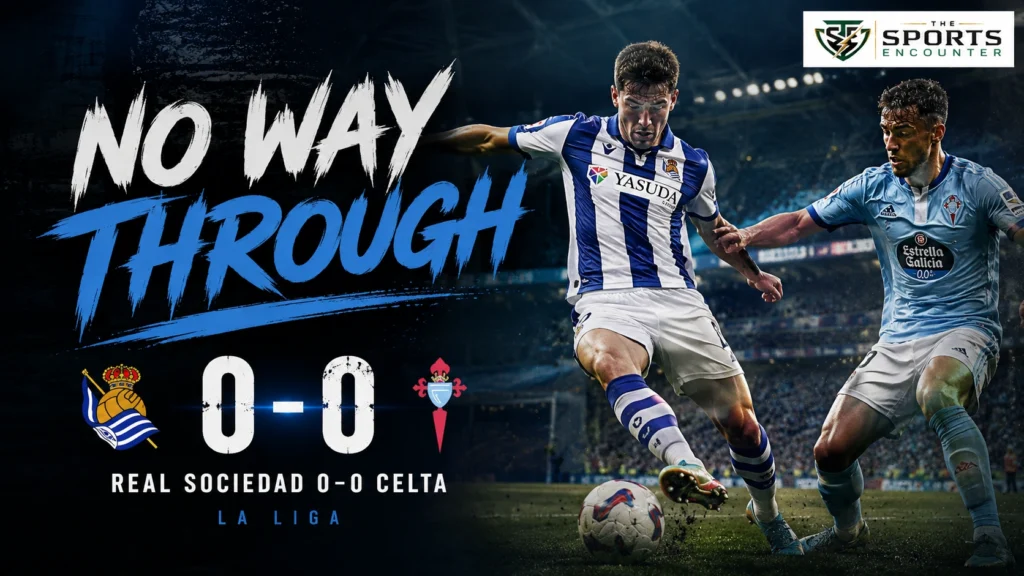
Real Sociedad and Celta Vigo played out a 0-0 draw at Anoeta in LaLiga, with the home side controlling more of the attacking territory but failing to convert an unusually large advantage in shots and corners into a goal.
Sociedad attempted 17 shots compared with Celta’s seven, put five on target to the visitors’ two and won 11 corners against three. Possession was almost even at 51-49, which made the imbalance in attacking volume even more striking.
Celta did not dominate the ball or create many chances.
They did something more useful for a team under early-season pressure.
They survived.
For Real Sociedad, the point moved them up to 11th in the live standings shown after full time. Celta remained 16th.
The official LaLiga fixture page lists the game as a Matchday 6 meeting at Anoeta, while the result extends an opening stretch in which both clubs have already experienced significant attacking frustration.
Real Sociedad’s issue is becoming increasingly familiar.
They can move the ball.
They can reach dangerous areas.
They can produce shooting volume.
What they still cannot do consistently is finish enough of those attacks.
Real Sociedad vs Celta: Match at a Glance
| Match Detail | Real Sociedad | Celta Vigo |
|---|---|---|
| Final score | 0 | 0 |
| Shots | 17 | 7 |
| Shots on target | 5 | 2 |
| Possession | 51% | 49% |
| Yellow cards | 2 | 3 |
| Red cards | 0 | 0 |
| Offsides | 2 | 1 |
| Corners | 11 | 3 |
| Post-match position | 11th | 16th |
How Did Real Sociedad Fail to Score From 17 Shots?
The numbers tell us Sociedad reached the final third frequently.
They do not tell us that those attacks were efficient.
Only five of their 17 attempts found the target.
That means 12 shots either missed the goal or were blocked before genuinely testing Celta’s goalkeeper.
The 11 corners reinforce the same point.
Sociedad repeatedly forced Celta backward and won dead-ball opportunities, but the pressure never became a goal.
This is the type of match that can become frustrating very quickly for the attacking team.
Each additional corner creates expectation.
Each blocked shot makes the next attack feel more urgent.
As the score remains 0-0, players begin looking for quicker solutions.
That can lead to rushed crosses, lower-quality shots and attacks ending before the defense has been properly moved.
Sociedad had enough volume to win.
They did not produce enough precision.
Why Is This Becoming a Real Sociedad Pattern?
Because their early-season performances have repeatedly contained encouraging passages without corresponding results.
Against Real Betis, Sociedad controlled substantial portions of the match but lost 1-0.
The Sports Encounter’s analysis of that defeat highlighted the same central issue: possession and territorial control were not being converted into enough high-quality finishing.
Luka Sučić hit the post that night.
Orri Óskarsson later had another major opportunity denied.
The performance contained enough football to suggest improvement.
The scoreboard did not.
A few days later, Real Sociedad were beaten 4-1 by Real Madrid despite competing strongly for much of the first half.
The Sports Encounter’s report from the Bernabéu showed how brutally stronger opponents can punish a team that fails to turn good periods into goals.
Against Celta, the punishment was less severe.
Sociedad did not lose.
They still left two points on the field.
Eleven Corners Should Have Produced More Danger
Set pieces were one of Sociedad’s clearest opportunities to solve the match.
Eleven corners is a major volume.
Even accounting for poor delivery, defensive clearances and second balls, a team generating that many dead-ball situations should expect to create several genuine scoring opportunities.
Celta’s success in surviving them deserves credit.
Defending repeated corners requires more than simply winning the first header.
Teams must react to loose balls.
Midfielders have to track runners arriving outside the area.
Fullbacks need to prevent recycled crosses.
Goalkeepers must command traffic in the six-yard box.
Celta continued doing enough of those things.
The final whistle therefore represented more than a goalless evening.
It represented 90 minutes of defensive resistance under sustained pressure.
Celta’s Two Shots on Target Were Enough for What They Needed
Celta attempted seven shots and placed only two on target.
That is not a particularly threatening attacking profile.
It was sufficient because the visitors did not allow Sociedad’s pressure to become decisive at the opposite end.
This was always likely to become a match in which Celta valued structure.
Their season had already included a difficult 2-1 defeat against Osasuna after Marcos Alonso was sent off.
The Sports Encounter covered that match in our LaLiga analysis of Celta’s collapse against Osasuna.
That game taught a very different lesson.
Celta had been leading through Iago Aspas before the red card altered the match.
Osasuna equalized almost immediately and later won through an Ante Budimir penalty.
Against Sociedad, Celta kept 11 players on the field and protected their shape much more effectively.
Why Celta May Value This Point More Than Sociedad
Context changes the value of a draw.
For Sociedad, this was a home match in which they produced 17 shots.
They will see opportunity lost.
For Celta, it was an away match against a team that controlled most of the attacking territory.
They will see survival.
Celta had already recorded another 0-0 earlier in the campaign against Valencia, a match included in The Sports Encounter’s opening LaLiga weekend review.
That result also showed a team capable of staying organized even when the attacking side of the game remained limited.
The challenge is obvious.
Drawing 0-0 away from home can be useful.
Building an entire season around defensive resistance is not enough.
Celta eventually need goals.
Real Sociedad’s 51% Possession Tells an Important Story
The match was not a classic example of one team monopolizing the ball.
Possession was only 51-49.
Yet Sociedad attempted ten more shots and won eight more corners.
That suggests they used possession more aggressively.
Celta had the ball for almost half the match but struggled to turn it into comparable territorial penetration.
That difference is important when interpreting the result.
Sociedad’s problem was not getting into attack.
Their problem was what happened once they arrived.
Celta’s problem was earlier in the chain.
They struggled to produce enough attacks in the first place.
Is Real Sociedad’s Attack Creating Enough High-Quality Chances?
The raw volume looks encouraging.
The conversion pattern does not.
Five shots on target from 17 attempts is roughly 29 percent.
That is not disastrous.
It does suggest many possessions are ending without forcing the goalkeeper into action.
Sociedad therefore need to examine shot selection as much as finishing.
Where are the attempts coming from?
How many follow cutbacks?
How many arrive from central areas?
How often are forwards receiving the ball facing goal rather than with defenders behind them?
How many shots are being taken because a better passing option has disappeared?
Those questions matter more than simply demanding that players “be more clinical.”
Finishing problems often begin before the shot.
Sociedad Need More From Their Final Pass
Repeated attacking volume can sometimes disguise a creative problem.
If a team reaches the penalty area 20 times but rarely creates a clean final action, the issue is not simply bad luck.
Sociedad have players capable of solving that problem.
Mikel Oyarzabal can create and finish.
Luka Sučić has already shown his shooting quality.
Óskarsson gives them movement inside the area.
The challenge is getting those players into combinations that produce better-quality opportunities.
Against Betis, Oyarzabal eventually created a major chance for Óskarsson.
Against Real Madrid, Sučić scored during Sociedad’s strongest first-half spell.
Those moments show the ingredients exist.
The frequency remains insufficient.
Celta’s Defensive Discipline Was Better Than Against Osasuna
Three yellow cards show this was not an effortless defensive display.
Celta had to foul at times.
They had to stop transitions.
They had to protect zones around the penalty area.
The important number is zero red cards.
That may sound simplistic, but Celta’s earlier loss to Osasuna changed immediately after Marcos Alonso was dismissed.
That 2-1 defeat remains relevant because it demonstrated how quickly their shape can deteriorate when numerical balance disappears.
Against Sociedad, they stayed intact.
That allowed the visitors to defend the final 20 minutes with a recognizable structure rather than improvising under pressure.
What Does the Draw Mean for Real Sociedad’s Early Season?
It keeps them moving, but not quickly enough.
Sociedad were shown in 11th after full time.
The position itself should not cause alarm this early in the season.
The performances require closer attention.
The defeat at Betis was narrow.
The loss to Real Madrid was heavier than the first half suggested.
Now comes a home draw in a match where Sociedad generated substantially more attacking activity than their opponent.
Those results tell us something.
Sociedad are often competitive.
They are not consistently decisive.
LaLiga’s Early Table Is Already Creating Pressure
The problem with dropping points in matches such as this is what happens elsewhere.
Barcelona have started aggressively.
The defending champions scored five against Elche before beating Athletic Club 2-0 and later defeating Rayo Vallecano 5-2.
The Sports Encounter’s analysis of Barcelona’s win over Rayo showed how Hansi Flick’s side can survive difficult periods and still convert enough chances to separate themselves from opponents.
That is exactly what Sociedad currently lack.
Real Madrid have also demonstrated greater efficiency.
Kylian Mbappé’s hat-trick against Sociedad was the clearest example.
He did not need 17 team shots without reward.
Madrid created openings and converted them.
The Difference Between Volume and Efficiency Is Becoming a Major Early-Season Theme
Several LaLiga matches have already reinforced this idea.
Barcelona produced 18 shots against Rayo and scored five.
Osasuna managed only 10 attempts against Getafe but won 1-0.
Sociedad produced 17 against Celta and scored none.
The Sports Encounter’s analysis of Osasuna’s narrow win over Getafe showed the opposite route to success.
Osasuna did not need overwhelming attacking volume.
They needed one penalty and enough defensive control to protect it.
Sociedad had much more attacking activity Thursday.
They did not find the decisive action.
Why Real Sociedad’s Upcoming Fixtures Now Matter More
The schedule does not become easier automatically.
According to the official LaLiga schedule, Sociedad next travel to Elche before hosting Atlético Madrid.
They then begin their Europa League campaign against Bournemouth.
That sequence increases the value of solving the finishing problem quickly.
A team entering European competition needs rotation.
Rotation makes attacking chemistry harder to maintain.
If Sociedad are already struggling to convert pressure while using their preferred combinations, the challenge becomes more complicated once continental fixtures begin.
The Sports Encounter’s European competition draw analysis has already highlighted how quickly domestic schedules become more demanding once continental matches begin.
Celta Face Their Own Important Run
Celta’s next fixtures may tell us whether this draw represents stabilization or merely another low-scoring performance.
Their official LaLiga schedule includes Getafe away before Málaga at home, followed by the start of their Europa League campaign against Omonia.
That creates a similar challenge.
Celta cannot rely indefinitely on 0-0 draws.
The defensive foundation is useful.
The attacking output needs to catch up.
Why This Match Matters Beyond Two Mid-Table Positions
Neither club is likely to judge its season primarily against the teams around 11th and 16th in September.
Both have larger ambitions.
Sociedad expect to compete for European qualification.
Celta are themselves preparing for European football.
That makes offensive efficiency increasingly important.
European schedules punish teams that need too many chances to score.
Domestic matches become more compressed.
Players rotate more often.
One missed home opportunity can quickly become three games without a win.
What Should Real Sociedad Take From the Draw?
The positive is that they controlled where most of the dangerous football occurred.
Seventeen shots and 11 corners do not happen accidentally.
The home side were able to force Celta into sustained defensive work.
The negative is equally clear.
Pressure is only valuable when it eventually produces something.
Sociedad must improve the quality of the final action rather than simply trying to create more of them.
They already created enough volume to win this match.
What Should Celta Take From the Draw?
A point and a clean sheet.
Those matter.
Especially after a difficult beginning to the season.
Celta showed greater resilience than they did against Osasuna and demonstrated that they can defend for long stretches without losing shape.
The attacking numbers remain concerning.
Seven shots and two on target will not win many matches unless the finishing is exceptionally efficient.
That becomes their next problem to solve.
Final Verdict: Real Sociedad Won the Territory, Celta Took the Point
There will be nights when Real Sociedad produce fewer than 17 shots and win.
That is precisely why this result will frustrate them.
The opportunity was there.
They controlled 51 percent of possession.
They attempted 10 more shots than Celta.
They placed three more on target.
They won eight more corners.
They still scored zero.
Celta’s performance was less ambitious but more successful in relation to what the visitors needed.
They prevented Sociedad from turning pressure into a decisive moment and left Anoeta with a clean sheet.
The 0-0 score therefore tells two different stories.
For Celta, it represents defensive recovery.
For Sociedad, it represents another warning.
Their early-season football is creating enough situations to compete.
It is not yet producing enough goals to move them where they expect to be.
Seventeen shots are evidence of attacking intent.
Eleven corners are evidence of territorial control.
Five shots on target are evidence that Celta’s goalkeeper had work to do.
Zero goals are the statistic that matters most.
Frequently Asked Questions
What was the Real Sociedad vs Celta score?
Real Sociedad and Celta Vigo drew 0-0 at Anoeta in their 2026-27 LaLiga meeting.
How many shots did Real Sociedad have against Celta?
Real Sociedad attempted 17 shots, with five on target.
How many shots did Celta have?
Celta attempted seven shots and put two on target.
Which team had more possession?
Real Sociedad had 51 percent possession compared with Celta’s 49 percent.
How many corners did Real Sociedad win?
Sociedad won 11 corners, while Celta had three.
Where are Real Sociedad in the LaLiga table?
Real Sociedad were shown in 11th place following the draw.
Where are Celta Vigo in the table?
Celta were shown in 16th following the 0-0 result.
Who do Real Sociedad play next?
Real Sociedad are scheduled to travel to Elche before hosting Atlético Madrid.
Who do Celta play next?
Celta are scheduled to visit Getafe before hosting Málaga.
Did either team receive a red card?
No. Real Sociedad collected two yellow cards and Celta three, but neither side had a player sent off.