


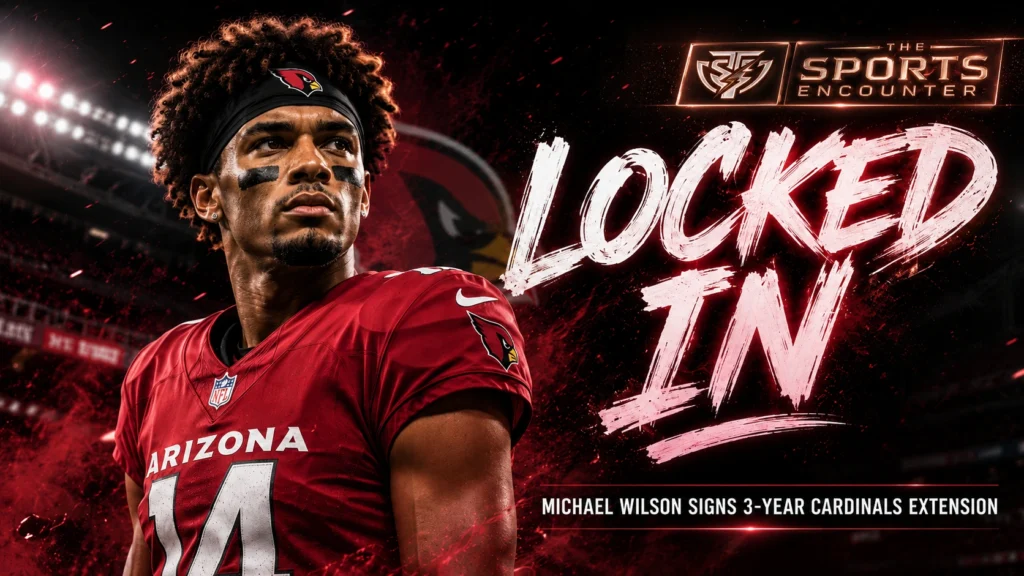
The Arizona Cardinals have removed one of their biggest looming contract questions before the 2026 regular season even begins.
Wide receiver Michael Wilson has agreed to a three-year extension that will keep him in Arizona through the 2029 season, according to NFL Network. The deal is reportedly worth $75 million, can rise to $78 million and includes $47 million guaranteed.
Wilson, 26, was entering the final year of the rookie contract he signed after Arizona selected him in the third round of the 2023 NFL Draft. Instead of allowing a potential breakout receiver to reach the open market next spring, general manager Monti Ossenfort has chosen certainty.
The timing is important.
Wilson is coming off the first 1,000-yard season of his career after catching 78 passes for 1,006 yards and seven touchdowns in 2025. His production accelerated dramatically once the season moved beyond its opening five weeks, and Arizona increasingly treated him as one of the offense’s most dependable targets alongside All-Pro tight end Trey McBride.
The extension therefore represents more than a reward for one productive season.
It is another indication of how Arizona intends to construct the next version of its offense under first-year head coach Mike LaFleur.
The Sports Encounter has followed the Cardinals’ roster construction throughout the summer, including the team’s decision to extend center Hjalte Froholdt through 2028. Wilson now becomes another established player Arizona has prevented from reaching free agency.
Michael Wilson Contract Extension: What We Know
| Detail | Information |
|---|---|
| Player | Michael Wilson |
| Team | Arizona Cardinals |
| Position | Wide receiver |
| Age | 26 |
| Extension length | 3 years |
| Reported value | $75 million |
| Reported maximum value | $78 million |
| Reported guaranteed money | $47 million |
| Contract runs through | 2029 season |
| 2025 production | 78 catches, 1,006 yards, 7 touchdowns |
| Career production | 163 catches, 2,119 yards, 14 touchdowns |
The NFL’s official report on the agreement says Wilson will remain under contract through 2029 and cites the reported $75 million value, $47 million guarantee and possible $78 million maximum.
Arizona’s own public comments had been pointing toward an extension for months. General manager Monti Ossenfort said during the NFL Scouting Combine that Wilson represented what the organization wanted its program to stand for.
The Cardinals’ official offseason coverage also made clear that extension talks had been part of the background throughout the spring.
Why Did the Cardinals Pay Michael Wilson Now?
Because waiting carried considerably more risk than acting before Week 1.
Wilson was scheduled to become an unrestricted free agent after the 2026 season.
If he followed his 1,006-yard campaign with another major season, Arizona would have entered next spring negotiating with a receiver whose market value could have risen substantially.
The Cardinals instead established the price before Wilson had another opportunity to raise it.
That approach contains risk because Arizona is committing major money based largely on one true breakout season.
But the organization has more evidence than the final 2025 stat line alone.
Wilson’s development across the season was unusually pronounced.
How Dramatically Did Michael Wilson Improve During 2025?
The answer explains much of Arizona’s confidence.
Through the first five games of last season, Wilson had only eight receptions for 52 yards and one touchdown.
He finished the year with 78 catches for 1,006 yards and seven scores.
That means his final 12 games produced:
- 70 receptions,
- 954 receiving yards,
- and six touchdowns.
His role changed with his production.
NFL Pro data cited by the league showed Wilson’s target share rising from 11 percent through the first five weeks to 23.2 percent from Week 6 onward.
Arizona was frequently playing from behind during that stretch, which naturally created more passing volume, but Wilson still had to turn opportunity into production.
He did.
Which games changed the way Arizona viewed Wilson?
The clearest evidence arrived in November and December.
Wilson caught 15 passes for 185 yards against San Francisco.
One week later, he produced 10 receptions for 118 yards against Jacksonville.
Against the Rams in Week 14, he caught 11 passes for 142 yards and two touchdowns.
He then closed the season with productive performances against Houston, Atlanta, Cincinnati and Los Angeles.
| 2025 game | Receptions | Yards | Touchdowns |
|---|---|---|---|
| vs San Francisco | 15 | 185 | 0 |
| vs Jacksonville | 10 | 118 | 0 |
| vs Los Angeles Rams | 11 | 142 | 2 |
| at Cincinnati | 5 | 89 | 1 |
| at Los Angeles Rams | 5 | 99 | 1 |
The Cardinals’ official player profile confirms that second-half surge and his final 78-1,006-7 receiving line.
Why Does Wilson’s Extension Matter for Marvin Harrison Jr.?
Because Arizona does not have to choose between building around Harrison and paying Wilson.
At least not yet.
Harrison remains one of the most talented young receivers on the roster and carries the pedigree of a former premium draft pick. Wilson’s emergence gives LaFleur a complementary receiver who has already demonstrated that he can absorb significant target volume when circumstances require it.
That matters tactically.
If defenses tilt coverage toward Harrison, Wilson has evidence that he can punish softer matchups elsewhere.
If Harrison misses time or draws an elite corner, Arizona does not automatically lose its ability to produce outside the numbers.
The Cardinals also added Kendrick Bourne during free agency, giving the room another experienced target behind Harrison and Wilson.
The team’s roster construction therefore suggests a desire for receiving depth rather than dependence on one featured star.
Why Is Trey McBride Part of the Wilson Contract Story?
Because McBride and Wilson give Arizona two proven pass-catchers operating at different positions.
McBride has already established himself as one of the league’s premier tight ends. Wilson now has a contract that reflects Arizona’s belief that he can remain a high-volume starting receiver.
Together with Harrison, that creates the foundation of an offense capable of stressing defenses horizontally and vertically.
McBride can command linebackers and safeties inside.
Harrison can demand attention outside.
Wilson can operate as a boundary receiver, intermediate target and contested-catch option.
The quarterback still has to distribute the football efficiently, but the receiving structure itself is becoming increasingly defined.
What Does the Deal Tell Us About Mike LaFleur’s Arizona Offense?
LaFleur inherited the Cardinals after three seasons as offensive coordinator of the Los Angeles Rams.
His final Rams offense led the NFL in several major categories in 2025, including points per game, total yards, passing yards, offensive touchdowns and passing touchdowns.
That background makes Arizona’s investment in receivers easier to understand.
LaFleur has spent years inside offenses that depend on route detail, receiver versatility and multiple credible targets rather than one player carrying the entire passing game.
The Cardinals are now giving him a receiving room with several different skill sets.
Arizona’s commitment to young offensive pieces was already visible during the summer when the club carefully managed No. 3 overall pick Jeremiyah Love. The Sports Encounter covered that approach in our NFL roster roundup involving Love’s preseason protection.
Why Is Arizona Building Offensive Certainty Around an Unsettled Quarterback Situation?
Because stable skill-position talent can make quarterback evaluation easier.
Jacoby Brissett enters the season as Arizona’s veteran starter, while Gardner Minshew provides experience and rookie Carson Beck represents a developmental option.
Ossenfort has publicly backed Brissett, but the franchise is not pretending its long-term quarterback answer is settled.
That makes keeping reliable receivers even more valuable.
A young quarterback entering the lineup in 2027 or 2028 would benefit from inheriting McBride, Harrison and Wilson rather than joining an offense simultaneously rebuilding its passing targets.
The Sports Encounter’s wider Week 1 analysis has already shown how differently NFL teams are managing quarterback transitions. Las Vegas, for example, is deliberately keeping No. 1 pick Fernando Mendoza behind Kirk Cousins rather than forcing its succession plan.
Arizona can pursue similar patience because it is constructing infrastructure around whichever quarterback eventually becomes the long-term solution.
Is $75 Million Too Much for a Receiver With One 1,000-Yard Season?
That is the central risk in the deal.
Wilson has not yet established multiple seasons of elite receiving production.
His career began with 565 yards as a rookie and 548 yards in 2024 before the jump to 1,006 in 2025.
| Season | Receptions | Receiving yards | Touchdowns |
|---|---|---|---|
| 2023 | 38 | 565 | 3 |
| 2024 | 47 | 548 | 4 |
| 2025 | 78 | 1,006 | 7 |
| Career | 163 | 2,119 | 14 |
The contract therefore pays partly for projection.
Arizona is betting that the 2025 version represents Wilson’s new level rather than a temporary spike.
The organization also appears to be valuing reliability, development and fit alongside raw production.
Ossenfort repeatedly praised Wilson’s work inside the program before negotiations were completed.
That context matters when evaluating why one franchise may value a player more aggressively than an outside observer looking only at receiving rankings.
Why Could the Contract Look Better if Wilson Keeps Improving?
Because wide receiver prices rarely remain static.
Every new contract for a productive young receiver resets expectations for the next negotiation cycle.
If Wilson were to produce another 1,000-yard season and enter free agency at 27, Arizona could have faced a much more competitive market.
Extending him one year early effectively transfers some risk to the Cardinals in exchange for cost certainty.
If Wilson regresses, Arizona may have paid too soon.
If he develops into a consistent 1,100-to-1,300-yard receiver, the contract could look increasingly reasonable as the market rises around it.
How Does Wilson Fit Arizona’s Broader Extension Strategy?
His deal follows another important Arizona extension from August.
Center Hjalte Froholdt signed a two-year extension that keeps him under contract through 2028.
The Sports Encounter’s analysis of the Froholdt extension argued that Arizona was buying continuity at a position where communication and availability are especially valuable.
Wilson represents the same philosophy applied to a more expensive position.
The Cardinals appear willing to pay their own players before free agency when they believe performance, availability and locker-room value align.
Left tackle Paris Johnson Jr. could eventually become the next major test of that strategy. Arizona exercised his fifth-year option through 2027 and has publicly identified him as another player it would like to retain long term.
Why Is Arizona’s 2023 Draft Class Becoming So Important?
Wilson and Johnson both arrived in 2023.
That matters because productive draft classes are the foundation of sustainable roster construction.
Teams cannot build entire cores through free agency without eventually creating salary-cap pressure.
Drafting players, developing them and deciding which ones deserve second contracts is the process that separates temporary roster improvement from something more durable.
Wilson was not a first-round pick.
Arizona selected him 94th overall out of Stanford.
Turning a third-round selection into a receiver worth a major second contract represents a meaningful development success regardless of how the next three seasons unfold.
How Does Wilson Compare With Arizona’s Receiver History?
Any discussion of a Cardinals receiver eventually runs into Larry Fitzgerald.
Wilson is nowhere near Fitzgerald’s historical production, and the comparison should not be forced.
But there is an organizational value worth noting.
Fitzgerald’s 17 seasons in Arizona demonstrated what roster continuity can mean when a franchise identifies a receiver capable of producing through different quarterbacks, coaches and competitive cycles.
The Sports Encounter examined that career in our 2026 Pro Football Hall of Fame feature, highlighting Fitzgerald’s 1,432 catches and 17,492 receiving yards.
Wilson does not need to approach those numbers for this extension to work.
Arizona simply needs him to become the kind of dependable player who remains useful even while the offense around him changes.
What Does Michael Wilson Need to Prove in 2026?
The extension answers the contract question.
It does not answer the football question.
Wilson now has to show that 2025 was the start of sustained production.
Three areas stand out.
Can he produce before Arizona falls behind?
A significant amount of Wilson’s 2025 volume came while the Cardinals were trailing or tied late in games.
The next step is demonstrating that he can produce at the same level inside neutral or winning game scripts.
Can he remain productive with Harrison healthy?
Arizona wants both receivers influencing defenses simultaneously.
Wilson’s value rises considerably if his production remains strong without requiring another major target to disappear from the offense.
Can he stay available for another full season?
Wilson played all 17 games in 2025, the first time he had completed an entire season without missing a game since high school.
That durability was a major development after injuries interrupted portions of his earlier football career.
A second consecutive healthy season would make the extension considerably easier to justify.
Why Does the Chargers Game Immediately Matter?
Arizona opens the regular season on September 13 at the Los Angeles Chargers.
The official NFL schedule then sends the Cardinals into an early stretch that includes Seattle at home and San Francisco on the road.
That third game will immediately reconnect Wilson with one of his defining performances from last season.
He caught 15 passes for 185 yards against the 49ers in November 2025.
Arizona will want evidence much earlier this year that the offense can feature him consistently.
The Sports Encounter covered the Cardinals’ preseason opener in our NFL Preseason Week 1 report, when Arizona beat Las Vegas 27-14. September now shifts the conversation from evaluation to consequences.
Why Does This Contract Matter in the NFC West?
The division gives Arizona little room for a slow rebuild.
The Rams and 49ers remain major competitors, while Seattle enters the season as the defending Super Bowl champion after an ownership transition that The Sports Encounter covered in our analysis of the Seahawks’ record $9.612 billion sale.
San Francisco has also spent the summer reinforcing depth while preparing for another demanding season, including the addition of offensive lineman Kion Smith.
Arizona therefore needs internal development to close the gap.
Wilson becoming a reliable 1,000-yard receiver is exactly the kind of development the Cardinals require because it creates premium production without requiring another blockbuster external signing.
What Does the Michael Wilson Extension Say About the Cardinals’ Rebuild?
It says Arizona believes enough of its offensive core already exists to begin protecting it.
That is a significant shift.
Rebuilding teams spend their early stages collecting draft picks, evaluating young players and preserving financial flexibility.
Eventually, the organization has to decide which players are worth keeping.
Froholdt received that vote of confidence in August.
Wilson has now received a much larger one.
The Cardinals still have major questions at quarterback, offensive tackle and across other areas of the roster.
But an offensive core built around McBride, Harrison, Wilson and Jeremiyah Love gives LaFleur something tangible to develop.
Final Verdict: Arizona Is Paying for the Player Michael Wilson Is Becoming
A three-year extension reportedly worth $75 million is a substantial commitment for a receiver with one 1,000-yard season.
That makes the deal a bet.
The evidence behind that bet is stronger than the single headline number suggests.
Wilson’s first five games of 2025 produced only 52 receiving yards.
His final 12 produced 954.
He became one of Arizona’s most heavily targeted players, delivered multiple 100-yard performances and finished the season with touchdowns in five consecutive late-season games.
He also remained healthy for all 17 games.
Arizona could have waited.
That would have given the Cardinals another season of evidence but also exposed them to a potentially much more expensive negotiation if Wilson improved again.
Ossenfort instead chose to secure a 26-year-old receiver before the market could make the decision harder.
The contract now places responsibility on both sides.
Arizona must build an offense capable of maximizing Wilson rather than paying him and allowing his role to fluctuate.
Wilson must prove that his late-2025 explosion represented genuine development rather than production inflated by negative game scripts.
If he does, the timing of this deal could become one of its greatest strengths.
The Cardinals would enter the next several seasons knowing that McBride, Harrison and Wilson can form the receiving structure around whichever quarterback eventually becomes the long-term answer.
For a franchise still trying to establish exactly what the Mike LaFleur era will become, that kind of certainty has real value.
Frequently Asked Questions
How much is Michael Wilson’s new Cardinals contract worth?
Wilson’s three-year extension is reportedly worth $75 million, can rise to $78 million and includes $47 million guaranteed.
How long will Michael Wilson stay with the Arizona Cardinals?
The extension keeps Wilson under contract with Arizona through the 2029 NFL season.
How old is Michael Wilson?
Wilson is 26 years old entering the 2026 NFL season.
What were Michael Wilson’s stats in 2025?
He caught 78 passes for 1,006 yards and seven touchdowns across 17 games.
How many career receiving yards does Michael Wilson have?
Wilson has 2,119 receiving yards through his first three NFL seasons.
Where was Michael Wilson drafted?
The Arizona Cardinals selected Wilson in the third round with the 94th overall pick of the 2023 NFL Draft out of Stanford.
Who are the Cardinals’ main receiving weapons in 2026?
Arizona’s primary passing targets include Michael Wilson, Marvin Harrison Jr. and All-Pro tight end Trey McBride, with veteran Kendrick Bourne adding further receiving depth.
Who is the Arizona Cardinals head coach in 2026?
Mike LaFleur is Arizona’s head coach. He joined the Cardinals after spending three seasons as offensive coordinator of the Los Angeles Rams.
Who do the Cardinals play in Week 1?
Arizona opens the 2026 regular season on the road against the Los Angeles Chargers on September 13.
Why did the Cardinals extend Michael Wilson before free agency?
The extension gives Arizona long-term cost certainty after Wilson’s breakout 1,000-yard season and prevents him from reaching unrestricted free agency after 2026 if his production continues rising.