


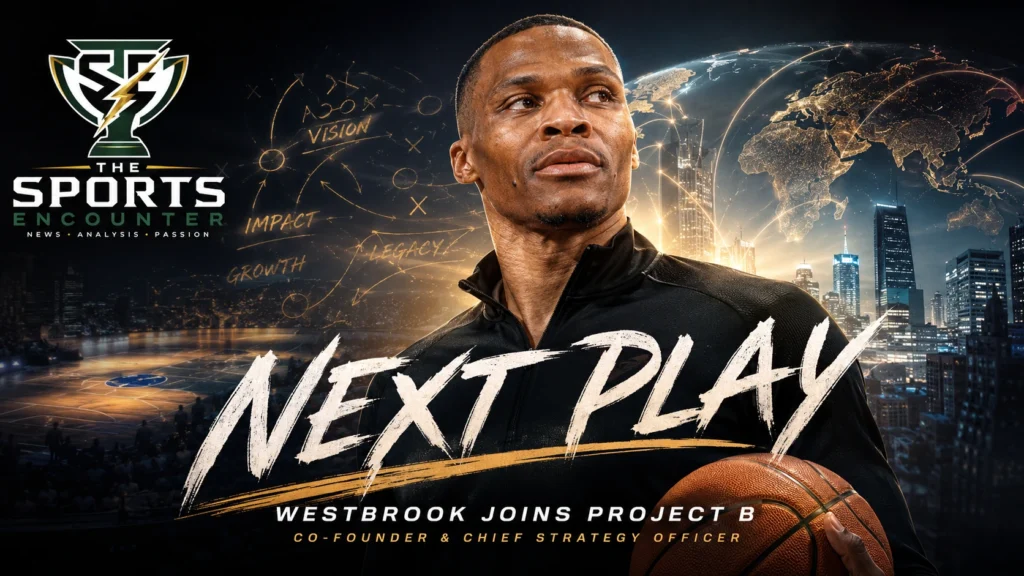
Russell Westbrook spent 18 NBA seasons attacking basketball as though every possession carried personal consequences. Less than a month after retiring, he has chosen a very different kind of challenge: helping build a new basketball property from the inside.
Project B has named Westbrook a co-founder and chief strategy officer, giving the former NBA MVP an ownership stake, a seat on the board of directors and direct influence over the league’s basketball strategy, partnerships and long-term direction.
The appointment is significant because Westbrook is not joining as a ceremonial ambassador.
He is entering the business structure.
Project B is building a global 5-on-5 basketball circuit for elite women and men, with players positioned as shareholders rather than simply employees. Its stated model combines basketball, culture, live entertainment, global host cities and digital-first distribution.
Westbrook’s arrival brings one of the most recognizable basketball names of the last two decades into that experiment.
For Project B, his value goes far beyond 209 career triple-doubles, nine All-Star selections or an MVP trophy.
He has spent nearly two decades experiencing professional basketball from the athlete side of contracts, trades, sponsorships, media expectations, team politics, global marketing and commercial value.
Now he gets to help decide how some of those systems should work.
That is where the story becomes more interesting than another retired superstar joining another investment group.
Westbrook’s first major post-playing move places him inside a wider change occurring across professional sports: athletes increasingly want ownership, equity and decision-making authority rather than compensation alone.
Project B is betting that players can become part of the product, the ownership structure and the long-term asset value at the same time.
Westbrook is now one of the people responsible for proving whether that model can work at scale.
By The Sports Encounter Editorial Desk
Published: September 3, 2026
Updated: September 3, 2026
Russell Westbrook and Project B: Key Facts
| Detail | Information |
|---|---|
| Russell Westbrook role | Co-founder and Chief Strategy Officer |
| Ownership | Equity stakeholder |
| Governance role | Board of Directors |
| Project B format | Elite 5-on-5 men’s and women’s basketball |
| League concept | Global Grand Prix-style circuit |
| Player model | Players receive ownership/equity |
| Number of planned host cities | Six |
| Confirmed 2027 hosts | Valencia and Tokyo |
| Westbrook age | 37 |
| NBA career | 18 seasons |
| NBA triple-doubles | 209, all-time record at retirement |
| NBA MVP | 2016-17 |
| NBA All-Star selections | 9 |
| Scoring titles | 2 |
Project B describes itself as a global Grand Prix-style basketball circuit built around elite men’s and women’s 5-on-5 competition.
Its official operating philosophy is unusually explicit about player ownership: every athlete is intended to participate as a shareholder in the long-term value created by the league.
Westbrook Retired From Basketball, Not From Basketball Business
Westbrook announced his retirement on August 12 after 18 NBA seasons.
His playing résumé gave him little left to prove individually.
He retired as the NBA’s all-time leader in triple-doubles with 209.
He won the 2016-17 MVP award.
He earned nine All-Star selections, two scoring titles and three assist titles.
He averaged a triple-double across four separate seasons, something no other NBA player had done.
The Sports Encounter’s full Russell Westbrook retirement retrospective examined why those numbers only partly explain his legacy.
His defining characteristic was control through force.
He wanted the rebound.
He wanted the ball.
He wanted responsibility.
That personality makes his first major post-NBA move particularly logical.
Westbrook has not moved toward a television desk or a passive advisory role.
He has moved into ownership and strategy.
That keeps him close to basketball while giving him a different form of control.
The Title Matters: Chief Strategy Officer Is Not an Ambassador Role
Sports startups often attach famous names to projects because fame creates credibility.
The celebrity appears at launch events.
The press release receives attention.
The actual business continues elsewhere.
Project B has given Westbrook a much deeper mandate.
As chief strategy officer, he is expected to help shape basketball strategy, long-term vision and strategic partnerships.
He also holds equity and sits on the board.
That means his interests are aligned with the value of the business itself.
If Project B grows, Westbrook participates in that growth as an owner.
If strategic decisions fail, he is connected to those decisions as well.
This is far more meaningful than licensing his name to someone else’s league.
Project B Is Trying to Solve a Problem Athletes Have Discussed for Decades
Professional athletes create enormous economic value.
Most traditional league structures still separate that value from ownership.
Players receive salaries.
Teams and investors own the appreciating assets.
Franchise values can rise by billions of dollars while athletes who helped create that growth eventually retire and move on.
Project B is attempting to change that relationship.
Its core principle is straightforward: players are owners.
Every athlete is intended to receive equity.
That means the player is not only compensated for appearing in the competition.
He or she participates in the long-term value of the platform.
This is increasingly attractive because modern sports valuations have become extraordinary.
The Sports Encounter recently examined that shift through the proposed $12.5 billion sale of the Los Angeles Lakers.
The lesson from transactions like that is impossible for players to ignore.
Sports assets can appreciate far more dramatically than individual salaries.
Ownership changes the equation.
Westbrook Understands the Difference Between Being Valuable and Owning Value
Few players have generated more basketball attention than Westbrook.
He became the emotional identity of Oklahoma City after Kevin Durant’s departure.
His MVP season generated nightly national attention.
His triple-double chase became a commercial and media storyline.
His moves to Houston, Washington, the Lakers, Clippers, Denver and Sacramento generated new fan interest every time he changed markets.
Westbrook understands how much attention elite players create.
Project B is asking a different question.
How much of the value created by that attention should belong to the athlete?
That is why Westbrook’s public emphasis on players having a seat at the table fits the league’s structure rather than functioning as empty branding.
He spent his career as one of basketball’s value creators.
He is now helping design a system where players can become value owners.
Women’s Basketball Is the Ideal Place to Test the Model
Project B’s early player recruitment has focused heavily on women’s basketball.
That makes commercial sense.
Women’s basketball is experiencing one of the strongest growth periods in its history.
WNBA audiences have expanded.
International stars are becoming more visible.
New markets are pursuing franchises.
Athletes have become stronger commercial brands.
The Sports Encounter’s coverage of the 2026 WNBA All-Star Game showed how stars such as Caitlin Clark, Paige Bueckers, A’ja Wilson, Breanna Stewart, Jonquel Jones, Nneka Ogwumike and Kelsey Mitchell now sit at the center of a rapidly expanding entertainment product.
Several of those established WNBA names or peers from the same generation have already committed to Project B.
The timing is deliberate.
Project B is entering women’s basketball at the moment when athlete value is rising quickly and players have greater leverage to question whether traditional structures are giving them enough of the upside.
Nneka Ogwumike and Jonquel Jones Give Project B More Than Star Power
The significance of Project B’s early roster is not simply recognition.
Nneka Ogwumike has been one of the most respected voices in women’s professional basketball.
Jonquel Jones has championship and MVP-level credibility.
Alyssa Thomas is one of the game’s most complete players.
Jewell Loyd brings scoring, championships and Olympic experience.
Kelsey Mitchell represents another generation of elite WNBA offense.
These players have spent enough time inside professional basketball to understand both its opportunities and its limitations.
Convincing them to participate gives the league a different type of validation than recruiting prospects who have never experienced established professional systems.
Project B is asking proven professionals to believe that a player-owned alternative is worth their time.
That is a much harder sell.
The WNBA Is Growing at the Same Time Alternatives Are Growing Around It
Project B does not need the WNBA to fail.
Its opportunity may actually depend on the opposite.
A stronger WNBA creates more recognizable stars.
More recognizable stars create more international basketball interest.
More interest creates space for additional properties.
The Sports Encounter’s analysis of the WNBA’s decision to bring major All-Star programming to the Obama Presidential Center showed how confidently the league is now connecting basketball with culture, community and major commercial partners.
That expanding ecosystem makes alternative competitions more viable.
Players can appear in different basketball products without requiring one league to replace another completely.
That is the model Project B appears to be pursuing.
Project B’s Biggest Difference May Be Geography
Traditional North American leagues are built around permanent home markets.
Project B is choosing a traveling circuit.
Its website describes a global structure across six iconic cities.
Valencia and Tokyo are already confirmed as host cities for 2027.
The official Project B circuit schedule currently lists Valencia from March 12-21 and Tokyo from March 26-April 4.
This model changes the relationship between team and place.
Fans do not need to live near a permanent franchise.
The league travels toward them.
That creates opportunities in markets with strong basketball interest but no NBA or WNBA team.
It also allows Project B to design each stop as a sports-and-entertainment festival rather than a conventional home game.
The Global Circuit Is an Audience Strategy
Project B is not merely choosing international cities for spectacle.
The circuit solves an audience problem.
Basketball is already global.
The NBA has fans throughout Asia, Europe, Africa and Latin America.
The WNBA has an increasingly international player pool.
Major FIBA tournaments attract strong audiences outside the United States.
Yet the highest-value professional basketball products remain overwhelmingly centered in North America.
Project B wants to move elite basketball closer to international fans.
That approach mirrors what The Sports Encounter has been following through the growing globalization of women’s basketball, including Caitlin Clark and Paige Bueckers entering the senior World Cup stage.
Berlin, Tokyo and Valencia are part of the same broader trend.
Elite basketball no longer assumes its most valuable audience sits in one country.
Westbrook Gives Project B Global Recognition Immediately
A startup sports league has to explain itself repeatedly.
Who owns it?
Who plays?
Why does it exist?
Why should fans care?
Westbrook cannot answer all of those questions.
He can make people listen long enough to hear the answers.
His name is recognizable in the United States.
His Oklahoma City years created international fandom.
His Olympic and FIBA experience strengthened his global profile.
His fashion and business interests extend beyond basketball.
For a league that wants to sit at the intersection of sport, culture and entertainment, that combination is unusually valuable.
This Is Also a Brand Decision for Westbrook
Retirement forces elite athletes to answer a difficult question.
What remains when the uniform disappears?
Westbrook has spent years building interests outside basketball through fashion, media, real estate, philanthropy and investment.
Project B gives those interests a single platform connected to the sport that made him famous.
He can influence partnerships.
He can help shape media.
He can connect basketball with consumer brands.
He can help recruit players.
He can advise on athlete experience.
He can use his existing business relationships to strengthen the project.
That makes the role far more coherent than attaching his name to an unrelated investment after retirement.
Social-Native Distribution Is Central to the Model
Project B describes itself as social-native.
That phrase can easily become marketing jargon.
The strategic idea behind it is real.
Traditional sports leagues were built around television first.
Younger audiences increasingly discover sport through clips, creators, short-form video, player accounts and social conversations before they watch a full broadcast.
Project B wants content to circulate across those environments from the beginning.
That may prove especially valuable internationally.
A fan in Indonesia, Spain or Brazil does not need a traditional local television relationship with the league before discovering a player or game.
The discovery pathway can begin through a phone.
Westbrook’s cultural profile gives Project B another advantage in that environment.
The Athlete-Ownership Model Could Change Recruitment
Traditional recruitment offers players salaries, competitive opportunity and exposure.
Project B adds another negotiating tool.
Equity.
For established stars, that can be meaningful.
A salary compensates the athlete for this season.
Ownership gives the athlete an interest in what the league may become five or ten years later.
That does not guarantee value.
Startup equity can become extremely valuable, remain modest or ultimately be worth nothing.
The risk is real.
The incentive is different.
If players believe they are building something they own, their relationship with promotion and audience growth may change.
Every new fan potentially strengthens an asset in which they participate.
Unrivaled Has Already Proved Players Will Respond to Equity
Project B is not operating in complete isolation.
Women’s basketball has already begun testing athlete-ownership models elsewhere.
Unrivaled has demonstrated that high salaries, player equity and a concentrated competition format can attract major stars and substantial investment.
The broader lesson is significant.
Players are increasingly willing to become business partners rather than simply contracted talent.
Project B extends that logic into 5-on-5 basketball and a traveling international model.
The difference in format means the two properties do not need to become direct copies.
They are evidence of the same structural movement.
The athlete wants more participation in the value chain.
Women’s Basketball Is Becoming a Marketplace for Competing Ideas
This may ultimately be healthy for the sport.
For years, women’s professional basketball had too few elite opportunities.
The conversation is beginning to reverse.
The WNBA is expanding.
International leagues remain important.
Unrivaled has created another high-level environment.
Project B is preparing a global circuit.
The Sports Encounter’s analysis of Team USA’s extraordinary depth even after losing A’ja Wilson and Kelsey Plum illustrated just how large the elite player pool has become.
More quality players create the possibility of more quality products.
The challenge becomes scheduling, workload and economic sustainability rather than simple scarcity.
Player Wellness Could Become a Competitive Advantage
Project B’s official principles include fewer back-to-back games, less travel and smarter scheduling.
That sounds unusual for a league built around international host cities.
It also reflects what modern players increasingly value.
Elite basketball calendars can become punishing.
WNBA players often move directly from domestic seasons into international competitions.
National-team commitments create another workload.
The Sports Encounter has seen the consequences of that overlap through the late roster changes affecting USA Basketball before Berlin.
If Project B can offer high-level competition without recreating the most exhausting parts of traditional schedules, that becomes another recruitment tool.
Westbrook’s Personality Fits a Challenger Brand
Project B is attempting to challenge convention.
Westbrook’s career was built around doing exactly that.
His game was never designed to satisfy consensus.
He became an MVP while playing basketball at a statistical scale many analysts initially considered unsustainable.
He averaged a triple-double when the achievement had gone untouched for more than half a century.
He then did it three more times.
His “Why Not?” identity was built around questioning assumed limits.
That makes him culturally compatible with a startup asking whether traditional professional basketball structures are the only way elite leagues should operate.
Brand fit does not guarantee business success.
It gives the partnership authenticity.
Project B Still Has to Prove the Basketball Product
The excitement around ownership and strategy can obscure a basic truth.
Fans ultimately need good games.
A league can have sophisticated ownership.
It can have international cities.
It can have major investors.
It can have recognizable executives.
If the competition does not feel important, audiences eventually leave.
Project B says every game will carry meaningful stakes.
That principle will need to survive contact with the actual schedule.
How teams are formed matters.
Competitive balance matters.
Rivalries matter.
Coaching matters.
Broadcast quality matters.
The best sports-business strategy still requires basketball worth watching.
The Six-City Format Could Help Create Scarcity
Traditional leagues produce enormous inventory.
An NBA season contains 1,230 regular-season games before the playoffs.
The WNBA schedule continues expanding as the league grows.
Project B is taking a different approach.
Its stated principle is impact over inventory.
A smaller number of concentrated events can create scarcity.
Scarcity can make each stop feel more meaningful.
The challenge is maintaining audience habits between stops.
That is where social content, player storytelling and digital distribution become essential.
Tokyo Is a Smart Test Market
Japan already has serious basketball infrastructure.
The domestic game has grown.
NBA stars have strong recognition.
Japanese players have increased international visibility.
The country also understands premium sporting events and global entertainment brands.
A Project B stop in Tokyo therefore tests something valuable.
Can a new league attract fans who already like basketball but have no historical attachment to Project B?
If the answer is yes, the global-circuit model gains credibility.
Valencia Tests a Different Basketball Culture
Spain provides another useful market because basketball is deeply established there.
Spanish fans understand the game at a high level.
Domestic clubs have long histories.
European basketball already has cultural authority.
Project B therefore cannot rely on novelty alone in Valencia.
The product has to feel elite.
That makes the March 2027 stop an important credibility test.
Tokyo measures global attraction.
Valencia can measure basketball credibility.
Could Project B Compete With Established Leagues?
The wrong question may be whether Project B will “beat” the WNBA or NBA.
The more realistic question is whether it can create a valuable place beside existing structures.
Professional sport increasingly supports multiple formats.
Basketball has traditional leagues, international competitions, 3×3, summer circuits and national-team events.
The Sports Encounter’s coverage of Australia’s Commonwealth 3×3 gold over Uganda showed how alternative basketball formats can create their own identities without replacing 5-on-5 competition.
Project B’s opportunity lies in being different enough to justify its existence while remaining familiar enough for basketball fans to care.
The Men’s Component Could Change the Scale Completely
Project B is designed for both women’s and men’s elite basketball.
The women’s side is further along publicly.
A credible men’s circuit could significantly change the size of the opportunity.
That is another reason Westbrook’s role matters.
He has immediate credibility with NBA players.
He understands the conditions veteran stars evaluate when considering new competitive opportunities.
He can speak the language of players deciding whether additional basketball is worth the physical and commercial commitment.
If Project B eventually wants established NBA or international men’s stars involved, Westbrook becomes one of its most useful recruiters.
His NBA Relationships May Be One of the League’s Most Valuable Assets
Eighteen NBA seasons create a network few startup executives possess.
Westbrook has played with and against multiple generations of stars.
He knows agents.
He knows coaches.
He knows brand executives.
He knows broadcasters.
He knows league personnel.
He has relationships throughout Los Angeles and across international basketball.
Those connections can shorten conversations that would otherwise take years for a new league to develop.
This is often what celebrity ownership is supposed to provide.
Westbrook’s advantage is that the network comes with direct basketball experience.
This Is Part of a Larger Shift in Sports Ownership
Professional sport is becoming one of the world’s most valuable asset classes.
NBA franchise prices continue rising.
NFL teams have reached valuations once associated with major corporations.
Soccer clubs are attracting institutional capital.
WNBA expansion has become increasingly competitive.
The Sports Encounter’s analysis of Bill Foley’s Las Vegas NBA expansion push showed how investors increasingly view basketball franchises as scarce long-term assets rather than simple sports teams.
Athletes see the same trend.
Many now want a place on the ownership side of that appreciation.
Project B is attempting to make that principle structural from day one.
The League’s Greatest Opportunity Is Also Its Greatest Risk
Project B is promising players something ambitious.
Ownership.
Voice.
Global exposure.
Premium competition.
Smarter scheduling.
Digital distribution.
Culture.
Long-term value.
Those promises create excitement.
They also create a high standard.
If the league ultimately operates like a conventional sports property with athlete ownership added mainly as marketing language, players will notice.
Westbrook’s presence raises expectations further.
He now shares responsibility for ensuring the philosophy survives once commercial pressures begin.
Westbrook’s Legacy Is Entering a Different Phase
His playing career will always be defined by basketball intensity.
That history is secure.
The next phase will be judged through influence.
Can he build something?
Can he help players gain leverage?
Can his basketball knowledge translate into business strategy?
Can a retired superstar become a credible sports operator?
Those questions cannot be answered by 209 triple-doubles.
Westbrook is beginning again from a different baseline.
The Sports Encounter’s NBA Hub has followed how former stars increasingly move from player identity into ownership, media and business influence.
Westbrook’s Project B role may eventually become one of the most interesting examples.
The Sports Encounter Verdict: Project B Has Added More Than a Famous Name
Russell Westbrook did not need Project B to remain relevant.
His basketball legacy was already secure when he retired.
Project B did not need another investor merely to say it had famous investors.
The importance of this partnership lies in the responsibilities attached to it.
Westbrook is now a co-founder.
He has equity.
He sits on the board.
He is chief strategy officer.
He is expected to influence basketball strategy, long-term planning and partnerships.
That turns the move into a test of something larger than his personal post-career ambitions.
Project B is betting that athletes can help own and govern the sports properties built around their talent.
Westbrook is one of the first major retired NBA stars to place himself this deeply inside that model from launch.
The timing also gives the idea credibility.
Women’s basketball is growing rapidly.
Athlete equity has become increasingly important.
International basketball audiences are expanding.
Streaming and social platforms have weakened the assumption that a new sports league requires a traditional television structure before it can find fans.
Project B is trying to combine all of those trends at once.
That combination creates enormous opportunity.
It also creates execution risk.
A player-owned structure still needs sustainable revenue.
A global circuit still needs manageable travel.
A social-native league still needs viewers willing to watch entire games.
Star names still need competitive basketball underneath them.
Those are difficult problems.
Westbrook spent his playing career building an identity around a simple question.
Why not?
Project B is effectively asking the same question about professional basketball itself.
Why should athletes only receive salary?
Why should elite leagues exist only inside traditional geography?
Why should basketball distribution begin with television rather than the platforms younger fans already use?
Why should players help create billions in sports value without participating directly in ownership?
The answers will not come from a launch announcement.
They will come when the teams take the floor, fans decide whether to care, players decide whether the model is worth supporting and the business has to prove it can sustain itself.
Westbrook is no longer trying to win those possessions with the ball in his hands.
For the first time in his professional basketball life, he is helping design the court on which the game will be played.
Frequently Asked Questions About Russell Westbrook and Project B
What is Russell Westbrook’s role with Project B?
Westbrook has joined Project B as a co-founder and chief strategy officer. He also holds an ownership stake and serves on the board of directors.
Will Russell Westbrook play in Project B?
There is currently no confirmed indication that Westbrook intends to play. His announced role is focused on ownership, strategy and business leadership.
What is Project B?
Project B is a new global basketball platform built around elite 5-on-5 men’s and women’s competition, player ownership and a traveling Grand Prix-style circuit.
When will Project B begin?
Project B is preparing to launch its first season in 2027.
Where will Project B games be played?
The league plans a six-city international circuit. Valencia, Spain, and Tokyo, Japan, are among the first confirmed 2027 host cities.
Do Project B players receive ownership?
Yes. Project B states that every athlete will be a shareholder and participate in the long-term value of the league.
Which WNBA players have joined Project B?
Announced players include major names such as Nneka Ogwumike, Jonquel Jones, Alyssa Thomas, Jewell Loyd, Kelsey Mitchell and Sophie Cunningham, among others.
How many teams will Project B have?
The initial structure has been reported as six teams with 11-player rosters.
Why did Russell Westbrook join Project B?
Westbrook has emphasized athlete ownership, inclusion and giving players a meaningful role in decision-making and value creation.
How many NBA triple-doubles did Russell Westbrook record?
Westbrook retired with 209 regular-season triple-doubles, the most in NBA history at the time of his retirement.