


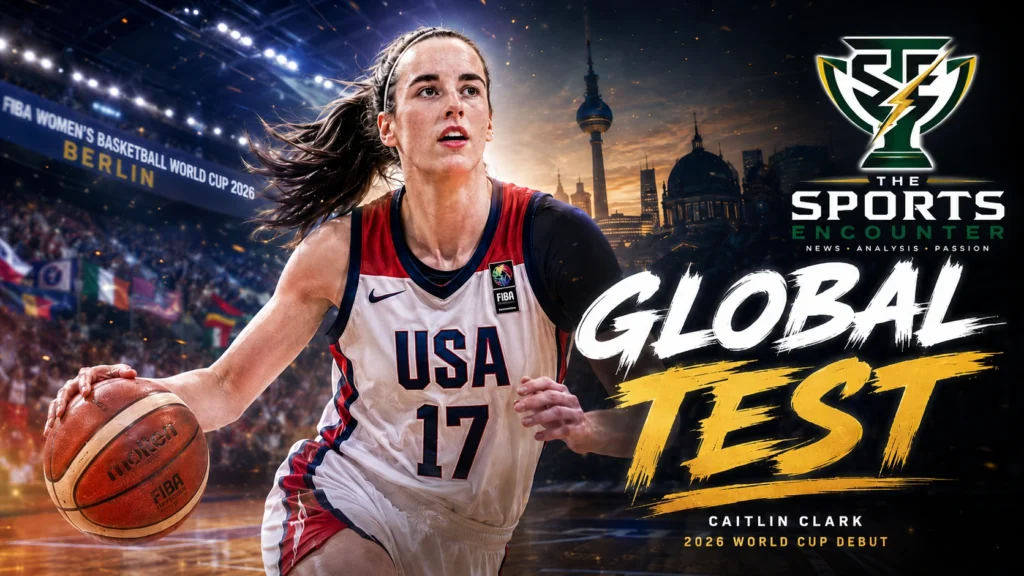
Caitlin Clark has already changed the commercial and cultural scale of women’s basketball in the United States. Berlin now asks a different question: can she carry that influence onto the international stage while helping the United States defend the most dominant dynasty in women’s basketball?
Clark will make her FIBA Women’s Basketball World Cup debut when Team USA opens its 2026 campaign against China in Berlin on September 4.
For most players, a first World Cup would already provide enough pressure.
Clark arrives with several additional layers.
She is one of the most recognizable athletes in American sports. She has helped drive extraordinary attention toward the WNBA. She has already experienced the scrutiny attached to every shot, foul, gesture and public comment. Her omission from the 2024 Olympic team became one of the most debated selection decisions in recent USA Basketball history.
Two years later, there is little ambiguity about whether she belongs.
Clark earned her place through senior international performance.
At the World Cup qualifying tournament in San Juan earlier this year, she averaged 11.6 points and a tournament-leading 6.4 assists, shot 52.9% from the field and 40% from three-point range, helped the United States finish 5-0 and was named TISSOT MVP.
That qualifying run changed the argument around her national-team role.
Berlin now changes the scale.
The World Cup is not simply another stage for Clark’s popularity. It is the first senior global championship where her basketball decisions will matter directly to the United States’ pursuit of another title.
Her responsibilities have also grown since the original roster was announced.
A’ja Wilson and Kelsey Plum are no longer part of the final team, with Sonia Citron and Kiki Iriafen added before the tournament. That removes one dominant interior scorer and one experienced secondary creator from Kara Lawson’s original structure.
The result is obvious.
More of the offense may now run through Clark, Paige Bueckers, Chelsea Gray and Jackie Young.
Clark is therefore entering Berlin with two kinds of spotlight at once.
One follows her because of who she is.
The other has been created by what Team USA now needs her to do.
By The Sports Encounter Editorial Desk
Published: September 3, 2026
Updated: September 3, 2026
Caitlin Clark at the 2026 FIBA Women’s World Cup: Key Facts
| Detail | Information |
|---|---|
| Player | Caitlin Clark |
| Age | 24 |
| Height | 6-foot |
| WNBA team | Indiana Fever |
| Position | Guard |
| World Cup status | Senior World Cup debut |
| Qualifying tournament | San Juan, Puerto Rico |
| Qualifying scoring | 11.6 points per game |
| Qualifying assists | 6.4 per game, tournament best |
| Qualifying field goal percentage | 52.9% |
| Qualifying three-point percentage | 40% |
| Qualifying record | USA finished 5-0 |
| Qualifying award | TISSOT MVP |
| World Cup dates | September 4-13, 2026 |
| Host city | Berlin, Germany |
| USA group | Group D: China, Czechia, Italy, USA |
| Opening opponent | China |
FIBA’s official Women’s Basketball World Cup page confirms that the tournament runs from September 4 through September 13 in Berlin with 16 nations competing.
The official FIBA qualifying review also confirms Clark’s MVP performance in San Juan, where she led the tournament in assists.
Clark Is Entering Berlin With Something She Did Not Have in 2024: Proof
The debate around Clark’s absence from the Paris Olympic roster was emotionally charged because the public discussion moved faster than her senior national-team résumé.
She had already become one of the most famous basketball players in America.
That did not automatically create a senior international body of work.
USA Basketball was choosing from one of the deepest player pools in world sport, and the 2024 roster was loaded with experienced Olympic and World Cup champions.
The decision still produced enormous public criticism.
Clark’s response afterward was notable because she did not spend the following two years trying to win that argument in public.
She kept playing.
Berlin is the result.
Her place in the 2026 team is supported by what happened in San Juan.
She did not simply participate in qualifying.
She controlled it.
That distinction is important.
FIBA named Clark the tournament’s most valuable player after she averaged 11.6 points, 6.4 assists and a team-best 14.6 efficiency rating while the United States swept all five games.
The Sports Encounter had already examined that transition in our analysis of Clark and Paige Bueckers joining the USA World Cup roster.
At the time, the central question was whether two of America’s most visible young guards could translate WNBA influence into senior international basketball.
Clark has already supplied part of the answer.
World Cup basketball will provide the harder part.
San Juan Showed Why Clark’s Game Can Translate Internationally
International basketball changes spacing, pace and defensive habits.
That does not reduce Clark’s strengths.
In some ways, it may sharpen them.
Her most transferable skill is not simply shooting.
It is how far away from the basket defenders have to acknowledge the possibility of a shot.
That alters geometry.
When Clark crosses half court, a defender cannot automatically wait near the three-point line.
If the defender steps higher, screening angles change.
Driving lanes become wider.
Roll players gain space behind the first line of defense.
Weak-side defenders have to make earlier decisions.
Clark can then use the space through passing rather than scoring herself.
That is exactly what appeared in San Juan.
Her 6.4 assists per game led the entire tournament.
Against Senegal, she scored 17 points and added 12 assists in only 19 minutes.
Against Spain, she scored only seven points but still recorded seven assists.
Those numbers matter because they show that Clark’s usefulness does not disappear when her shot volume falls.
International tournaments reward guards who can influence several possessions without requiring 20 attempts.
Clark’s qualifying performance suggested she can do that.
Her Biggest Berlin Test Will Be Decision-Making, Not Shooting Range
Everyone knows Clark can shoot from distance.
Opponents know it too.
The World Cup challenge will be how she responds once defenses design specific solutions.
China can put size around the lane.
European opponents can change pick-and-roll coverages repeatedly.
Australia and Belgium can punish careless turnovers with disciplined half-court offense.
France can pressure guards athletically.
Elite international teams will try to force Clark into uncomfortable decisions rather than simply hoping she misses long shots.
They may blitz ball screens.
They may switch.
They may top-lock her away from the ball.
They may force her right or left depending on personnel.
They may make her defend physically at the other end in an attempt to reduce her offensive energy.
This is why Berlin will tell us more about Clark than another 30-point WNBA night.
She will need to process different defensive pictures quickly while playing within a roster filled with players accustomed to being primary options themselves.
A’ja Wilson and Kelsey Plum’s Absences Change Clark’s Role
Clark’s original World Cup assignment already carried pressure.
The late roster changes increased it.
A’ja Wilson and Kelsey Plum were removed from the final team before Berlin, with Sonia Citron and Kiki Iriafen called into the roster.
The Sports Encounter examined the consequences in our analysis of Team USA losing Wilson and Plum before the World Cup.
Wilson’s absence changes the frontcourt.
She is one of the world’s most complete players and gives an offense a reliable solution when structure breaks down.
Plum’s absence changes the backcourt differently.
She can create on the ball, attack off movement, handle late-clock possessions and play alongside another primary guard.
Without her, Lawson has fewer experienced creators available.
That can push more responsibility toward Clark.
Paige Bueckers becomes more important too.
Chelsea Gray remains the most experienced organizing guard.
Jackie Young can handle creation responsibilities.
Clark now has a clearer pathway to significant on-ball minutes than she might have had under the original roster construction.
Clark and Paige Bueckers Represent the Next USA Backcourt
Clark and Bueckers have spent years being compared because they became stars at roughly the same moment in women’s basketball’s growth.
The comparison often becomes unnecessarily simplistic.
They do not play the same way.
That is precisely why the combination is interesting.
Clark creates pressure through range, pace and passing ambition.
Bueckers plays with more measured tempo, excellent footwork and a strong midrange game.
Clark can stretch the first layer of defense outward.
Bueckers can attack the space created inside that first rotation.
A lineup featuring both guards can also reduce the burden on either one to dominate every possession.
The Sports Encounter’s complete guide to the 2026 WNBA All-Star Game showed how Clark and Bueckers had already become the league’s two biggest fan-vote attractions, with Bueckers receiving 1,045,051 votes and Clark 1,023,321.
Berlin now removes the exhibition context.
Their decisions will affect a world championship.
The USA Roster Is Younger Than Originally Planned
The final American roster still contains championship experience.
Breanna Stewart, Chelsea Gray, Napheesa Collier, Kahleah Copper and Jackie Young understand the demands of major international tournaments.
The supporting structure around them now contains more players taking their first senior World Cup steps.
Clark, Bueckers, Angel Reese, Aliyah Boston, Rhyne Howard, Sonia Citron and Kiki Iriafen all represent different parts of a generational handover.
That makes Berlin important beyond one medal.
USA Basketball is beginning to learn which players can become structural pieces for LA28 and the championships that follow.
The World Cup gives Lawson a rare opportunity to evaluate that transition under genuine elimination pressure rather than during a training camp.
Clark is the most visible member of that group.
She is not the only one being tested.
China Is a Serious Opening Opponent, Not a Ceremonial First Game
Team USA opens against China at Max-Schmeling-Halle.
That immediately gives Clark a useful measuring stick.
China finished second at the 2022 World Cup and enters Berlin with size, international experience and one of the most imposing frontcourt structures in the tournament.
FIBA lists China as having made 12 World Cup appearances including 2026, with runner-up finishes in 1994 and 2022.
The Americans have dominated the historical matchup and hold a 15-0 FIBA head-to-head record entering the tournament.
History does not make the opener irrelevant.
China’s size can challenge American rebounding.
Its half-court execution can punish defensive lapses.
For Clark, the matchup may immediately test how well she handles taller defenders and how effectively she creates passing windows against a defense protecting the paint with length.
The official FIBA USA-China game page confirms the Group D opener in Berlin.
The World Cup Format Leaves Less Room for a Bad Group Game
The 2026 tournament has expanded to 16 teams.
That expansion comes with a new structure.
Four groups contain four teams each.
Group winners advance directly to the quarterfinals.
Second- and third-place teams must play an additional knockout qualification game to reach the quarterfinals.
Fourth-place teams are eliminated.
That makes finishing first disproportionately valuable.
An additional elimination game creates another opportunity for fatigue, injury or upset.
USA therefore has a practical reason to treat every group game seriously.
China comes first.
Italy and Czechia follow.
Clark’s ability to organize early offense could become particularly useful because dominant teams often waste group-stage possessions through impatience rather than lack of talent.
The United States has enough scorers.
It needs guards who can keep those scorers connected.
Clark’s Global Spotlight Is About More Than Social Media Numbers
Clark has become accustomed to public attention.
The scale around her is still unusual.
Every venue she enters attracts demand.
Her games create national discussion.
Her performances move beyond basketball media into mainstream culture.
That attention can become exhausting.
It can also become an extraordinary asset for women’s basketball.
Clark has framed the situation around opportunity rather than burden.
That perspective matters in Berlin because the World Cup gives FIBA access to an athlete whose domestic profile is already much larger than the typical American player entering a first senior global championship.
The question is whether some of that following stays with international basketball after Team USA leaves Germany.
If fans who primarily watch Indiana begin following China, Belgium, Australia, France or Spain because Clark pulled them into the tournament, the World Cup gains something more durable than one celebrity.
It gains new audience pathways.
The WNBA Has Already Shown What Clark’s Attention Can Do
The relationship between Clark and audience growth is visible inside the WNBA.
Her popularity has helped make Fever games national events.
Her presence changes ticket demand in opposing arenas.
She has also become one of the league’s defining television figures.
The Sports Encounter has followed that influence throughout 2026.
During the All-Star process, Clark received more than one million fan votes and became one of the central attractions of the event.
Our analysis of the WNBA’s decision to stage major All-Star events at the Obama Presidential Center examined how the league is increasingly connecting its commercial growth to culture, community and visibility beyond the court.
Clark fits naturally into that expansion.
She draws people toward basketball.
The league’s responsibility is converting that attention into interest in more players and teams.
FIBA now receives the same opportunity.
Clark Has Already Learned How Quickly Attention Can Change Direction
Global fame in sport is rarely comfortable.
The same audience that celebrates an athlete can turn one controversial moment into days of criticism.
Clark has experienced that repeatedly.
One of the clearest examples came in August when she appeared set to receive an automatic WNBA suspension after being assessed what would have been her eighth technical foul.
The league later rescinded the call.
The Sports Encounter’s report on Clark avoiding suspension after the WNBA review showed how quickly a routine in-game moment can become a national disciplinary storyline when she is involved.
That experience may actually help in Berlin.
World Cups are emotionally compressed.
A poor game can create immediate debate.
A turnover late in a knockout contest can dominate the following day.
Clark already understands what it feels like to operate inside that kind of scrutiny.
International Basketball Could Improve Clark’s Game Too
The conversation normally focuses on what Clark can bring to the World Cup.
The tournament can give something back.
International basketball will expose her to different defensive habits and teammates with different timing.
She will have to create without controlling every possession.
She will play beside multiple elite decision-makers.
She will face opponents with years of continuity in national-team systems.
She will also have to defend without the exact schemes Indiana uses to protect or position her.
Those experiences can sharpen a guard.
Learning when not to push the ball may be as valuable as learning when to accelerate.
Playing beside Stewart, Gray and Collier can help Clark see how championship veterans manage possessions where nothing obvious is available.
That education can return to Indiana after the World Cup.
The Aliyah Boston Connection Gives Team USA an Immediate Shortcut
One advantage Clark does not need to develop from scratch is chemistry with Aliyah Boston.
The Indiana teammates already understand each other’s screening angles and preferred passing windows.
That can help Lawson establish offense quickly.
Clark knows when Boston will slip a screen.
Boston knows when Clark wants to reject one.
They understand each other’s transition habits.
That familiarity becomes valuable in national-team basketball because practice time is limited compared with a club season.
The same principle applies across other WNBA relationships on the roster.
International teams often benefit from continuity.
USA traditionally has less collective training time than many opponents.
Existing club chemistry can reduce that disadvantage.
The World Cup Gives Women’s Basketball an Unusually Clean Spotlight
The WNBA has paused its season around the tournament.
That creates a valuable window.
American fans do not have to choose between a Fever game and a Team USA game.
Major WNBA storylines temporarily shift into Berlin.
Clark becomes a USA guard.
Bueckers becomes a USA guard.
Reese becomes a USA forward.
Stewart returns to the international role she has played for years.
This concentration of recognizable WNBA names gives FIBA a stronger entry point into the American audience than it normally receives during an overseas tournament.
The Sports Encounter’s basketball coverage hub has tracked how star power, league economics and changing fan behavior are increasingly connected across the sport.
Berlin is another example.
The product on the floor remains international basketball.
The audience arriving around it is increasingly global and personality-driven.
Women’s Basketball Is Growing Internationally Without Waiting for the USA
Clark’s presence should not turn the World Cup into a one-player marketing exercise.
The wider women’s game has become stronger.
FIBA expanded the tournament from 12 teams in 2022 to 16 in 2026 following the growth of the international game.
Belgium arrives with championship-level ambition.
Australia remains one of the sport’s deepest national programs.
France combines athleticism and development depth.
Spain remains tactically sophisticated.
China has size and recent World Cup pedigree.
Nigeria continues representing the growth of African women’s basketball.
The Sports Encounter has also followed that broader development outside five-on-five competition. Our report on Australia’s victory over Uganda in the Glasgow 2026 women’s 3×3 final showed how women’s basketball is producing important competitive stories across formats and regions.
Clark may draw additional viewers into Berlin.
The tournament’s job is giving them reasons to keep watching once they discover everybody else.
The United States’ Winning Streak Creates a Different Kind of Pressure
USA Basketball does not enter the World Cup trying to prove it belongs among the favorites.
It enters carrying one of the most dominant records in international sport.
The Americans are pursuing a fifth consecutive World Cup championship.
They have not lost a World Cup or Olympic game since the 2006 World Championship.
That history changes expectations.
A semifinal appearance would be an extraordinary achievement for most countries.
For the United States, it would be treated as failure.
Clark therefore enters an environment where development and results have to happen simultaneously.
USA can build for the future.
It is still expected to win now.
This Is Why Clark’s Passing May Matter More Than Her Scoring
Team USA does not lack people capable of scoring.
Stewart can create from multiple levels.
Collier can punish mismatches.
Copper can attack space.
Howard can score from the perimeter.
Bueckers can create in the midrange.
Young can attack off the dribble.
Boston and Reese give the team interior presence and rebounding.
What elite rosters sometimes lack is connective play.
Who moves the defense before the shot?
Who finds a roller instead of taking the first available jumper?
Who turns a defensive rebound into a layup before the opponent organizes?
Clark can provide that.
Her qualifying numbers suggest she already understands the role.
A tournament-best 6.4 assists per game matters more than whether she averaged 11.6 or 18 points.
USA has scorers.
Clark can make those scorers easier to use.
What Success Would Actually Look Like for Clark in Berlin
It would be easy to judge her World Cup by points per game.
That would be incomplete.
A successful tournament should include several things.
- Efficient playmaking without excessive turnover volume
- Defensive discipline against experienced international guards
- Effective chemistry with Boston and the other screeners
- Comfort playing both on and off the ball
- Useful late-clock decision-making
- Adaptation when teams take away her preferred pick-and-roll reads
- Consistent tempo control
- Contribution to a deep Team USA run
If Clark averages 13 points and eight assists while making the offense flow, that may be more valuable than averaging 22 points through high-volume shooting.
The World Cup is not asking her to recreate Indiana.
It is asking her to fit elite skills into an elite collective.
Berlin Is Also a Preview of LA28
The Los Angeles Olympics sit less than two years away.
That gives every 2026 national-team decision another layer.
Clark will be 26 during LA28.
Bueckers will be 26.
Boston will be 26.
Reese will be 26.
Howard will still be in her prime.
Several veteran stars may remain central too.
Berlin therefore offers USA Basketball a real-world laboratory for the next Olympic roster.
The players who prove they can handle major international games now make future selection decisions easier.
Clark’s 2024 Olympic absence made her national-team story unusually public.
A strong 2026 World Cup could make the LA28 conversation much simpler.
The Commercial Impact Could Extend Beyond the World Cup
If Clark performs well and Team USA reaches the final, FIBA receives several days of high-value attention from fans who may not normally follow international women’s basketball.
That audience can have downstream value.
More interest can help future sponsorship.
It can strengthen broadcast demand.
It can increase awareness of international stars.
It can make the Olympic women’s tournament even more valuable.
It can also help the WNBA because several international opponents are WNBA players themselves.
Fans following Clark may discover teammates, rivals and future league matchups through Berlin.
This is how modern sports growth often works.
One athlete creates an entry point.
The surrounding competition has to convert that attention into a wider relationship.
The Sports Encounter Verdict: Clark’s Biggest Contribution May Be Making the World Cup Feel Bigger
Caitlin Clark does not need Berlin to prove she is famous.
She does not need the World Cup to prove she can score.
She does not even need it to prove she belongs in a USA uniform anymore.
San Juan settled that part.
She averaged 11.6 points, led the qualifying tournament with 6.4 assists and left Puerto Rico with the MVP trophy.
Berlin asks a more interesting question.
Can she become one of the central decision-makers on a team expected to win every game it plays?
That challenge has become harder because Wilson and Plum are unavailable.
More creation now falls toward a younger backcourt.
Clark and Bueckers will have chances to influence games earlier than many expected.
The United States still has enough experience to protect them.
Stewart, Gray, Collier, Copper and Young provide championship knowledge.
What has changed is the balance.
The future of USA Basketball is no longer waiting politely behind the established generation.
It is beginning to share responsibility with it.
Clark sits at the center of that transition because everything around her becomes more visible.
If she struggles, the reaction will be louder than it would be for almost any other first-time World Cup player.
If she succeeds, the effect may stretch beyond Team USA.
Fans who followed her from Iowa to Indiana may follow her to Berlin.
Some of them may stay long enough to discover Emma Meesseman, Australia, France, China, Spain, Nigeria and the rest of the international women’s game.
That is where Clark’s global influence becomes genuinely interesting.
Her value to women’s basketball is not simply how many people watch Caitlin Clark.
It is how many of those people eventually start watching basketball because Caitlin Clark brought them through the door.
The World Cup now gets its opportunity to find out.
Frequently Asked Questions About Caitlin Clark and the 2026 Women’s Basketball World Cup
Is Caitlin Clark playing in the 2026 FIBA Women’s Basketball World Cup?
Yes. Clark is on the United States roster for the World Cup in Berlin and is preparing to make her senior World Cup debut.
When does Team USA play its first World Cup game?
The United States opens against China on September 4, 2026, at Max-Schmeling-Halle in Berlin.
Who is in Team USA’s World Cup group?
USA is in Group D alongside China, Czechia and Italy.
Has Caitlin Clark played for the senior USA team before?
Yes. Clark made her senior tournament debut at the 2026 World Cup qualifying tournament in San Juan, Puerto Rico.
How did Caitlin Clark perform in World Cup qualifying?
Clark averaged 11.6 points and a tournament-best 6.4 assists per game while shooting 52.9% from the field and 40% from three-point range.
Did Caitlin Clark win MVP in World Cup qualifying?
Yes. FIBA named Clark the TISSOT MVP of the San Juan qualifying tournament after she helped USA finish 5-0.
Why wasn’t Caitlin Clark on the 2024 Olympic team?
Clark was not selected for the Paris 2024 roster during her rookie WNBA season. The decision became one of the most discussed selection stories of those Games, but she has since built senior USA Basketball experience through qualifying.
Are A’ja Wilson and Kelsey Plum playing at the 2026 World Cup?
No. They are not part of the final roster. Sonia Citron and Kiki Iriafen were added to Team USA before the tournament.
How many consecutive World Cups has Team USA won?
The United States enters Berlin seeking a fifth consecutive FIBA Women’s Basketball World Cup title.
When is the 2026 FIBA Women’s Basketball World Cup final?
The tournament runs from September 4 through September 13, with the championship game scheduled for September 13 in Berlin.