


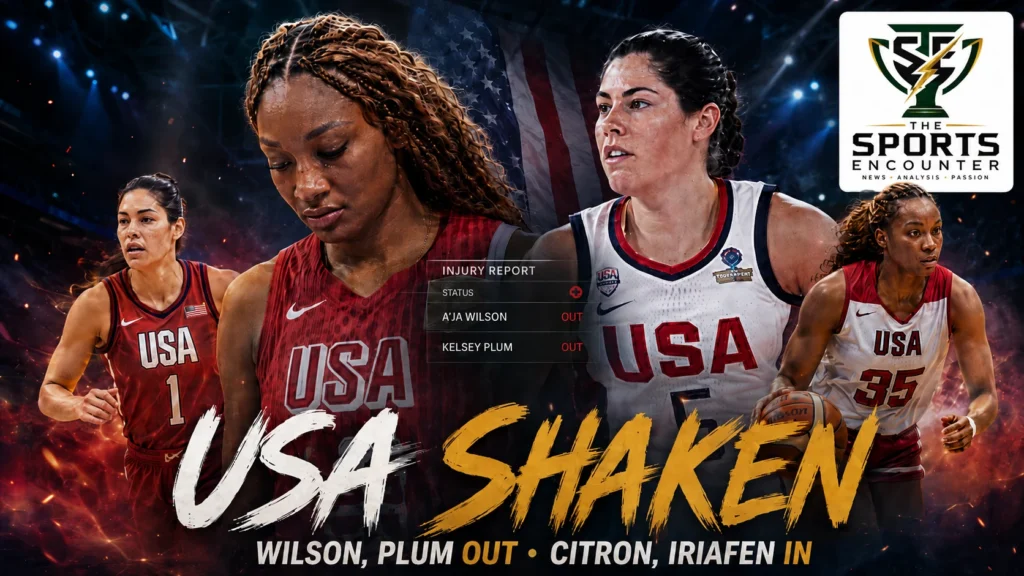
USA Basketball will begin its FIBA Women’s Basketball World Cup title defense without two of the players who were supposed to provide its championship foundation.
Kelsey Plum has been shut down for the remainder of the 2026 WNBA season because of a lower left leg injury and will not play for the United States in Berlin. A’ja Wilson has also withdrawn from the World Cup, although USA Basketball has not announced a specific injury or medical condition for the four-time WNBA MVP.
Washington Mystics teammates Sonia Citron and Kiki Iriafen have been added to the national-team roster as replacements.
The timing could hardly be more disruptive.
The World Cup begins September 4 in Berlin, giving head coach Kara Lawson only days to reshape rotations that were originally built around Wilson’s interior dominance and Plum’s perimeter creation.
The news also creates two separate consequences.
For USA Basketball, it removes two players with extensive experience in championship games, international tournaments and high-pressure WNBA playoff series.
For Phoenix Mercury, Plum’s season-ending decision means the club will not receive the late-season impact it hoped to gain when it acquired her from Los Angeles at the trade deadline.
The Americans remain extraordinarily talented.
Breanna Stewart, Caitlin Clark, Paige Bueckers, Napheesa Collier, Chelsea Gray, Jackie Young, Kahleah Copper and the rest of the roster still give Lawson more elite options than almost any opponent can match.
The shape of the team has changed immediately.
What Happened to Kelsey Plum and A’ja Wilson?
| Player | Development | Impact |
|---|---|---|
| Kelsey Plum | Shut down for remainder of 2026 WNBA season with lower left leg injury | Out for Phoenix Mercury and USA World Cup team |
| A’ja Wilson | Withdrawn from Team USA | Will miss 2026 FIBA Women’s Basketball World Cup |
| Wilson injury status | No specific injury announced by USA Basketball | Reason officially described as health-related |
| Sonia Citron | Added to USA roster | Senior World Cup debut |
| Kiki Iriafen | Added to USA roster | Returns after playing in World Cup qualifying |
| World Cup | September 4-13, 2026 | Berlin, Germany |
USA Basketball officially confirmed Citron and Iriafen as replacements, while FIBA confirmed that Plum and Wilson have been ruled out because of health issues.
Kelsey Plum Finally Ran Out of Time
Plum’s decision ends a season that never allowed her to establish sustained physical continuity.
She missed approximately six weeks earlier in the campaign while dealing with ankle and lower-leg problems.
Phoenix still made one of the most aggressive moves of the 2026 trade deadline by acquiring her from the Los Angeles Sparks on August 2.
The Mercury sent Monique Akoa Makani, a 2027 first-round pick and a 2028 second-round selection to Los Angeles.
Plum made her Phoenix debut the following day.
The expectation was clear.
Phoenix wanted another proven scorer and playmaker for the closing stretch of the season, somebody capable of creating shots under playoff pressure and relieving some of the offensive burden carried by Kahleah Copper and the rest of the rotation.
Instead, Plum’s Phoenix chapter lasted only five appearances this season.
She averaged 15.8 points and 2.8 assists in those games after averaging 21.5 points and 5.4 assists across 17 appearances overall in 2026.
Her own explanation was straightforward.
Plum said she had done everything possible to return but ultimately ran out of time. After discussions with her family, medical staff, coaches and the front office, the decision was made to end her season and prioritize a full recovery.
Phoenix Acquired Plum for the Moment That Now Will Not Come
The timing makes the injury particularly painful for Phoenix.
Trade-deadline acquisitions are rarely made for long-term theory alone.
The Mercury acquired Plum because they believed she could affect the current season.
The official Phoenix Mercury platform described her as an elite scorer, playmaker and champion when the trade was completed.
That description explains why Phoenix surrendered future draft capital.
Plum gives teams a guard who can score off the dribble, attack closeouts, create in pick-and-roll actions, shoot from deep and handle late-clock possessions.
She has also played championship basketball before.
Her Las Vegas years produced consecutive WNBA titles in 2022 and 2023.
Phoenix was acquiring more than regular-season production.
It was acquiring playoff experience.
Now that experience will remain unavailable for the rest of 2026.
The Injury Adds Another Twist to Plum’s Unusual 2026 Season
Plum began the year with Los Angeles after re-signing with the Sparks following a productive first season there.
Her 2025 campaign had established her as Los Angeles’ primary offensive engine.
She then began 2026 at an even higher scoring level before injuries interrupted the season.
The trade to Phoenix represented another major shift.
It also showed how highly contenders continued to value her despite the medical concerns.
Plum’s season now ends with three different chapters packed into one year: high-level production in Los Angeles, an injury absence, and a brief attempt to restart the season in Phoenix.
Wilson’s Absence Changes Team USA More Than Any Other Withdrawal Could
Plum’s absence removes guard depth and scoring.
Wilson’s absence changes the architecture of the team.
Our original USA World Cup roster analysis described Wilson and Breanna Stewart as the championship foundation around which the younger American stars could grow.
That pairing gave Lawson almost every frontcourt option imaginable.
Wilson could play center.
Stewart could stretch the floor.
Both could defend multiple positions.
Both could protect the rim.
Either could become the primary scorer when a knockout game slowed down.
That balance is now gone.
Team USA Cannot Replace Wilson With One Player
Wilson’s role has to be divided rather than replaced directly.
Stewart will likely carry more late-game scoring responsibility.
Napheesa Collier can take on additional defensive assignments.
Aliyah Boston can provide interior strength and screening.
Angel Reese can increase the team’s rebounding pressure and second-chance production.
Iriafen adds another athletic frontcourt option.
None of them individually offers Wilson’s complete combination of scoring, rebounding, rim protection, mobility and matchup control.
That is the strategic problem Lawson now has to solve.
Wilson Was Supposed to Be the Constant During USA Basketball’s Generational Shift
The original roster was fascinating because it combined two basketball generations.
Wilson, Stewart, Plum, Gray, Collier, Copper and Jackie Young represented the championship core.
Caitlin Clark, Paige Bueckers, Angel Reese, Aliyah Boston and Rhyne Howard represented a younger group beginning to take greater control of the national program.
Our complete 2026 WNBA All-Star guide had already shown how those generations were beginning to overlap across the league.
Wilson was one of the players connecting them.
She had enough experience to anchor the older group while remaining firmly inside her competitive prime.
Her withdrawal accelerates the transition.
Sonia Citron Gets the Opportunity Faster Than Expected
Citron now moves from promising national-team depth to World Cup participant.
The Washington guard has international youth experience and won gold at the 2021 FIBA U19 Women’s Basketball World Cup.
She played alongside Caitlin Clark at that tournament.
Citron was also part of USA Basketball’s senior national-team training camp last December.
That preparation matters because she is not entering the program completely unfamiliar with its expectations.
Berlin will still represent a dramatic increase in responsibility.
She is joining a roster only days before the tournament begins and must find a role without the long preparation period normally available to first-time World Cup players.
Kiki Iriafen Already Has Senior USA Experience
Iriafen enters with a little more recent familiarity.
She played during the FIBA Women’s Basketball World Cup qualifying tournament in San Juan earlier this year.
Across five appearances, she averaged 5.4 points and 4.2 rebounds.
That experience should make her easier to integrate than a completely new frontcourt player.
Iriafen also understands the physical requirements of international basketball, where spacing, officiating and interior contact often differ from WNBA games.
Her presence does not reproduce Wilson’s impact.
It does give Lawson another athletic forward who can rebound, run the floor and contribute without requiring a large number of offensive possessions.
The Updated USA Roster Has Nine World Cup Debutantes
FIBA’s updated roster analysis highlights just how quickly this team has changed.
The United States will now enter Berlin with nine players preparing for their first senior World Cup appearances.
That is remarkable for a program attempting to defend four consecutive world championships.
The Americans still possess major international experience through players such as Stewart, Gray and other returning champions.
The balance has shifted much further toward new faces.
Citron and Iriafen increase that movement.
Caitlin Clark and Paige Bueckers Now Carry Even More Creative Responsibility
Plum’s absence affects the backcourt differently from Wilson’s frontcourt withdrawal.
Plum was another player who could initiate offense without needing the system simplified for her.
She could play alongside Gray.
She could handle alongside Clark.
She could work off the ball beside Bueckers.
She could create her own shot late in possessions.
Without her, more responsibility falls toward Clark, Bueckers, Gray and Young.
The situation could accelerate something we had already been waiting to see in Berlin: how quickly Clark and Bueckers can become central creators at senior international level.
Clark’s Role Could Become Much Larger Than Originally Planned
Clark was already entering her first senior World Cup with enormous attention.
Now her basketball responsibility may grow along with the spotlight.
Her range can stretch international defenses beyond their preferred coverage.
Her passing can create transition opportunities before opponents organize.
Her pick-and-roll chemistry with Boston offers the Americans an established WNBA combination.
Without Plum available, Lawson may have fewer reasons to limit Clark’s initiating role.
The Fever guard has already navigated a complicated 2026 WNBA season, including the disciplinary scare we covered when the league rescinded what would have been her suspension-triggering eighth technical foul.
Berlin now gives her a completely different test.
Breanna Stewart Becomes the Senior Basketball Reference Point
With Wilson and Plum gone, Stewart’s importance rises immediately.
She has championship experience at every meaningful level.
She understands how international knockout games slow down.
She can create from the perimeter, score inside, rebound and defend several positions.
Most importantly, she gives a young roster a player who has already experienced almost every version of tournament pressure.
Lawson will need that stability.
The roster still contains exceptional talent.
It now contains less proven World Cup continuity.
USA Basketball Still Has the Deepest Talent Pool in the Tournament
The withdrawals are significant.
They do not suddenly make the United States an ordinary team.
FIBA still considers the Americans overwhelming contenders because the replacement pool itself contains players who would start for many national teams.
Citron was already an All-Star-level WNBA presence this season.
Iriafen has senior international experience.
The rest of the roster contains MVP candidates, elite scorers, elite rebounders and multiple primary ball handlers.
This is the luxury USA Basketball possesses.
Losing stars weakens the roster.
It does not empty the bench.
Team USA’s World Cup Schedule Leaves Almost No Adjustment Period
The tournament begins Friday.
| Date | Game | Stage |
|---|---|---|
| September 4 | USA vs China | Group D |
| September 6 | USA vs Italy | Group D |
| September 7 | USA vs Czechia | Group D |
The official FIBA schedule confirms that the United States opens against China on September 4.
That is hardly a gentle introduction.
China has the size and international structure to punish a team still adjusting its rotations.
Lawson cannot spend the opening game experimenting extensively.
China Becomes an Even More Important First Test
China was already the most dangerous group-stage opponent for the United States.
The matchup now becomes an immediate test of how USA replaces Wilson near the rim.
Without her, interior rebounding and defensive coverage become more collective responsibilities.
Boston, Stewart, Collier, Reese and Iriafen will all have roles in preventing China from establishing confidence through offensive rebounds and post touches.
The Americans remain more talented overall.
The first game could reveal how quickly that talent has been reorganized.
Winning Group D Has Become Even More Valuable
The World Cup’s expanded 16-team format rewards group winners with direct qualification to the quarterfinals.
Teams finishing second or third must play an additional single-elimination qualification game.
That makes first place important for every contender.
For a USA roster dealing with late withdrawals, avoiding an extra knockout game carries even greater value.
One fewer game means one fewer opportunity for another injury, foul problem or poor shooting night to disrupt the championship run.
The WNBA Pause Makes These Injuries a League-Wide Story
The WNBA has paused regular-season play for the World Cup window.
That means the league’s biggest players now shift directly into national-team competition before returning for the closing stage of the domestic season.
The workload issue was always going to be part of the tournament.
Plum’s shutdown highlights why.
WNBA stars have moved through compressed schedules, travel, international commitments and playoff races without much genuine recovery time.
Our coverage of the WNBA’s expanding All-Star footprint in Chicago examined how quickly the league’s platform has grown beyond the court.
Growth increases visibility and opportunity.
It also increases the number of demands placed on the league’s most recognizable players.
Phoenix Now Has to Recalculate Its Post-World Cup Plans
The Mercury knew Plum was returning from injury when they traded for her.
They still believed the potential payoff justified the risk.
That calculation has now failed for 2026.
Phoenix must return from the World Cup break without the guard it acquired specifically to strengthen the stretch run.
Offensive creation will have to be redistributed.
Late-clock possessions will need different answers.
The trade itself should not be judged entirely through five games because Phoenix also acquired Plum with the possibility of a longer relationship in mind.
The immediate championship logic behind the move has been damaged.
The Broader WNBA Context Makes Plum’s Loss More Significant
The WNBA has entered a phase where individual star availability can move entire markets, television schedules and postseason expectations.
Plum is one of those players.
Her 2026 All-Star selection gave her five for her career, while Wilson entered the summer as one of the league’s defining names.
Our All-Star coverage showed how much of the league’s current appeal is built around overlapping generations of established champions and younger stars.
Both sides of that balance are visible in this roster change.
Wilson and Plum disappear.
Citron and Iriafen move forward.
USA Basketball’s Future Is Arriving Faster Than Planned
The national program was already looking toward the 2028 Los Angeles Olympics.
Clark, Bueckers, Reese, Boston and Howard were selected partly because they can contribute now and remain central later.
The same long-term thinking has appeared around the men’s program, where we examined whether LeBron James could still have a place at LA 2028.
Women’s USA Basketball faces the reverse problem.
Its younger players may need to assume major-tournament responsibility sooner than expected.
Citron and Iriafen Represent the WNBA’s New Generation
Both replacements also fit the league’s broader shift toward younger talent.
Citron and Iriafen were already prominent enough to be selected for the 2026 WNBA All-Star Game.
Their move into the World Cup roster confirms that USA Basketball sees them as more than emergency depth.
They are part of the next competitive cycle.
That matters because roster transitions are rarely clean.
Veterans do not all leave at once.
Younger players do not all become leaders at once.
Injuries accelerate some changes before coaches are completely ready for them.
This is one of those moments.
The Changes Also Show Why Women’s Basketball Depth Has Become a Major American Advantage
The United States can lose A’ja Wilson and Kelsey Plum and still add two current WNBA All-Stars.
Very few countries possess that luxury.
The expanding player pool is one reason women’s professional basketball continues gaining commercial and competitive weight across the United States.
That growth extends into league expansion, a development we also examined through Detroit’s successful effort to bring a WNBA franchise back to the city.
More teams create more roster spots.
More roster spots create more development opportunities.
That wider pipeline ultimately benefits USA Basketball.
Team USA Remain Favorites, but the Margin Has Narrowed
Belgium, Australia, France, Spain and China already entered the tournament believing the United States could be challenged.
Those teams now have another reason to believe.
Wilson is the kind of player who can erase tactical problems.
A defensive breakdown can still end with her protecting the rim.
A broken offensive possession can still become two points because she creates a shot herself.
Plum gives another form of protection through perimeter creation.
Removing both places more pressure on the system itself.
USA Basketball still has enough talent to win the World Cup.
The path requires more collective execution than it did when the roster was announced.
Lawson’s Biggest Challenge Is No Longer Choosing Between Too Many Stars
When the original roster was announced, Lawson’s greatest problem looked like rotation management.
How would she distribute minutes?
Who would close games?
How would Clark, Bueckers, Gray and Plum share creation?
How would Wilson, Stewart and Collier divide frontcourt responsibility?
The questions have changed.
Now Lawson must determine which combinations compensate for missing strengths.
Who protects the rim when Stewart plays away from the basket?
Who creates when Gray rests?
Who handles the late possession that Plum might previously have taken?
How quickly can Citron and Iriafen understand the rotation?
Those questions will begin receiving answers against China.
What This Means for the 2028 Olympic Cycle
Major tournaments often accelerate roster evolution more effectively than training camps.
Citron and Iriafen will now experience the preparation, travel, scouting, pressure and knockout environment of a senior World Cup.
Clark and Bueckers will carry greater responsibility.
Boston and Reese may receive more frontcourt minutes.
Every one of those experiences can influence the 2028 Olympic roster.
Berlin was already a bridge between generations.
The withdrawals have made that bridge much busier.
Basketball’s Star-Driven Era Makes Health Management Harder to Ignore
The wider basketball calendar keeps becoming more valuable and more crowded.
League games matter.
International tournaments matter.
All-Star events matter commercially.
Playoff positioning matters.
Olympic preparation is already beginning.
For players competing across those environments, health management becomes part of roster strategy.
That issue reaches across basketball, which is why The Sports Encounter tracks major league, player and international developments through our basketball and NBA coverage hub.
Final Analysis: USA Lose Certainty, but Gain an Early Look at Their Future
Plum’s season-ending injury hurts Phoenix immediately.
Wilson’s World Cup withdrawal hurts USA Basketball immediately.
Together, the two developments alter a tournament that begins in only a few days.
The Americans had expected Wilson to control the interior and Plum to provide another experienced creator around a young backcourt.
Neither will be in Berlin.
The response tells us something about the extraordinary depth of American women’s basketball.
USA Basketball did not replace them with developmental prospects hoping to survive the stage.
It added Sonia Citron and Kiki Iriafen, two players already familiar with high-level basketball and already moving toward larger national-team roles.
The United States remains the favorite.
It is now a different favorite.
More responsibility belongs to Stewart.
More creation belongs to Clark, Bueckers, Gray and Young.
More frontcourt work belongs to Boston, Reese, Collier and Iriafen.
Citron must find a role quickly.
Lawson must build new rotations almost immediately.
The first test is China on September 4.
If USA still dominate Berlin, the story will become another demonstration of unmatched depth.
If the tournament becomes difficult, August 31 may be remembered as the day the championship picture changed before the first ball was even tipped.