


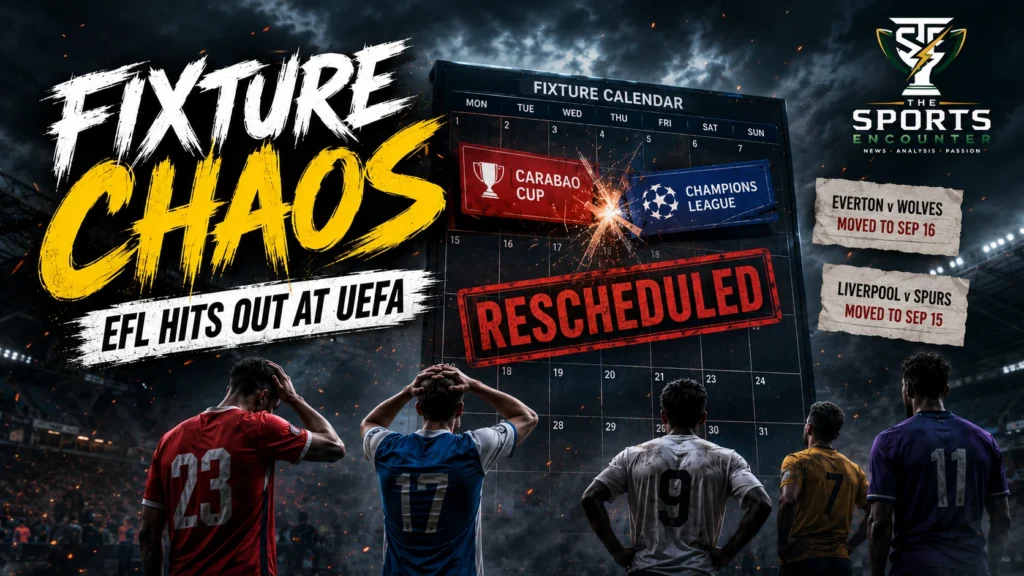
The English Football League has publicly criticized UEFA after Liverpool’s Champions League schedule forced three domestic fixtures to be rearranged, leaving Everton, Wolverhampton Wanderers, Liverpool, Tottenham Hotspur and Portsmouth dealing with the consequences of a calendar collision that began with one European match.
The dispute centers on Liverpool’s Champions League league-phase opener against Atlético Madrid at Anfield on Wednesday, September 9.
That date created an immediate logistical problem on Merseyside.
Everton had already been scheduled to host Wolves in the Carabao Cup third round on the same evening.
Local policing and operational requirements prevent Liverpool and Everton from hosting major home matches simultaneously.
The EFL said its September 9 date for Everton vs Wolves had already been confirmed with local stakeholders before UEFA released Liverpool’s Champions League schedule.
Once UEFA placed Liverpool vs Atlético on the same night, the domestic calendar began moving around it.
Everton vs Wolves has now been shifted to September 16.
Liverpool’s Carabao Cup tie against Tottenham, originally scheduled for September 16, has been brought forward to September 15.
Wolves’ Championship match against Portsmouth, which had itself been moved previously, will now take place on October 20.
The EFL says five clubs have been inconvenienced.
The deeper issue is that English football has already modified the Carabao Cup specifically to accommodate UEFA’s expanded competitions. The league now believes the cooperation has become too one-sided.
UEFA vs EFL Fixture Clash: What Changed?
| Fixture | Competition | Original Date | New Date |
|---|---|---|---|
| Everton vs Wolverhampton Wanderers | Carabao Cup Round Three | September 9, 2026 | September 16, 2026 |
| Liverpool vs Tottenham Hotspur | Carabao Cup Round Three | September 16, 2026 | September 15, 2026 |
| Wolverhampton Wanderers vs Portsmouth | Championship | September 16, 2026 | October 20, 2026 |
| Liverpool vs Atlético Madrid | UEFA Champions League | Newly confirmed European fixture | September 9, 2026 |
The EFL’s official fixture-change statement confirmed that the league had been left with no option but to rearrange domestic matches after the Champions League schedule was announced. UEFA’s official Champions League fixture list confirms Liverpool will host Atlético Madrid on September 9.
How One Liverpool Match Created Problems for Five Clubs
The sequence is worth following because it shows how interconnected the modern football calendar has become.
The EFL announced Everton vs Wolves for September 9 after confirming the date with local stakeholders.
Liverpool were scheduled to play Tottenham in the Carabao Cup one week later on September 16.
Wolves’ Championship match against Portsmouth had therefore already been moved into that September 16 space.
Then UEFA published Liverpool’s Champions League schedule.
Liverpool vs Atlético landed on September 9.
That immediately made Everton vs Wolves impossible on the same evening because Liverpool and Everton cannot both stage home fixtures at the same time.
Moving Everton vs Wolves to September 16 then created a second conflict.
Liverpool were supposed to host Tottenham that night.
That tie had to move.
Wolves also needed the date for the Everton game, pushing their Championship meeting with Portsmouth out of September entirely.
One European fixture therefore produced changes across two competitions and five clubs.
The EFL Says It Tried to Find Another Solution
The league did not simply rearrange the matches immediately.
According to its statement, EFL officials met UEFA on Monday morning to discuss alternatives.
The EFL says UEFA would not consider moving Liverpool vs Atlético because of the potential impact on international supporters travelling to the Champions League game.
That position effectively left the domestic competitions to absorb the disruption.
The EFL described the outcome as disappointing and apologized directly to supporters of the affected clubs.
The criticism is significant because governing bodies usually attempt to resolve fixture disputes without such direct public language.
This time, the EFL chose to make its frustration explicit.
The Carabao Cup Had Already Been Changed for Europe
This is where the dispute becomes more important than the three rescheduled matches.
The EFL has already altered the Carabao Cup to accommodate UEFA’s expanded calendar.
Round Three is now spread across two separate midweeks.
Special draw conditions are also used to prevent clubs involved in the Champions League and Europa League from being paired against one another at this stage.
The official Carabao Cup Round Three draw reflects that structure.
Our UEFA draw-week analysis had already identified calendar pressure as one of the defining consequences of the modern European format.
There are now 108 clubs across UEFA’s three league phases.
Champions League and Europa League teams play eight league-phase matches. Conference League teams play six.
Those additional European dates have to coexist with domestic leagues, domestic cups, international windows and broadcast commitments.
The EFL’s complaint shows what happens when that coexistence fails.
Why Carabao Cup Round Three Now Runs Across Two Weeks
The split round was designed as a practical solution.
English clubs competing in Europe could be placed into available midweeks without forcing them to play domestic cup matches immediately around UEFA fixtures.
The idea sounds straightforward.
The draw itself has become more complicated because European clubs need protection from fixture conflicts before their opponents are even determined.
Our latest Carabao Cup wrap noted that Round Three would become the point where European clubs entered and scheduling pressure increased sharply.
That pressure has arrived before the round has even begun.
Liverpool vs Tottenham Is Now Part of the Knock-On Effect
Liverpool’s Carabao Cup tie against Tottenham was one of the headline matches produced by the third-round draw.
The fixture was originally placed on September 16.
Once Everton vs Wolves moved into that slot, Liverpool’s domestic cup match had to be brought forward by 24 hours.
That change may appear modest compared with Portsmouth’s month-long postponement.
It still affects supporters, match preparation, travel arrangements and squad recovery.
Liverpool will also be managing Champions League football at the same time.
Our full Champions League draw analysis showed how demanding Liverpool’s European schedule already looks.
They host Atlético Madrid first, then face LASK away before later meetings with Villarreal, Fenerbahçe, Club Brugge, Porto, Inter and Lens.
The challenge is therefore not confined to one September week.
Everton and Wolves Bear the Immediate Consequences
Everton vs Wolves was the match directly displaced.
The clubs had already prepared around September 9.
Supporters had a confirmed date.
Operational plans had been agreed.
The fixture now moves seven days later.
For Wolves, the change creates an additional complication because they also play in the Championship.
Their domestic league calendar had already been adjusted once to accommodate the Carabao Cup.
It has now been adjusted again because the Carabao Cup itself has moved.
That is why Wolves become the clearest example of how one scheduling decision can travel through the football pyramid.
Portsmouth May Have the Strongest Reason to Be Frustrated
Portsmouth are not involved in the Champions League.
They are not involved in the Everton vs Wolves Carabao Cup tie.
They are not involved in Liverpool vs Tottenham.
Their Championship fixture has still been pushed from September to October.
That illustrates the wider cost of calendar congestion.
A club does not have to be playing in Europe to have its domestic schedule disrupted by Europe.
Supporters planning an away trip to Wolverhampton now have to reorganize around a new date more than a month later.
That is the type of indirect impact that can disappear when fixture debates are discussed only in terms of elite clubs.
The Fans Are the Least Flexible Part of the Calendar
Football authorities can move a fixture on a schedule.
Supporters cannot always move hotel bookings, train tickets, flights, work shifts or family commitments with the same ease.
The EFL acknowledged that directly in its apology.
That element deserves more attention because football scheduling increasingly prioritizes overlapping commercial and broadcast requirements.
A rearranged game may look like a simple date change on a competition website.
For travelling supporters, it can become a financial loss.
The irony in this particular dispute is that UEFA reportedly resisted moving Liverpool vs Atlético partly because international travelling supporters could be affected.
The alternative solution shifted the disruption toward domestic supporters instead.
UEFA’s Expanded Format Has Changed the Domestic Calendar
The latest conflict cannot be understood without the European format changes introduced in recent seasons.
The old Champions League group stage contained six matches per club.
The current league phase contains eight.
The Europa League has also expanded to eight league-phase matches.
Thirty-six clubs now compete in each UEFA league phase.
Our guide to UEFA’s 108-club draw week explained how the new system creates more meaningful fixtures but also occupies more calendar space.
The sporting argument is clear.
More major European matchups can improve television value and reduce the number of predictable group-stage games.
The calendar cost is equally clear.
Domestic competitions have fewer clean midweeks available.
The Champions League Now Begins Across Three Nights
The 2026-27 Champions League opening round itself demonstrates how European competition has expanded into more of the week.
Matchday 1 runs across Tuesday, Wednesday and Thursday from September 8 to September 10.
Liverpool host Atlético on the Wednesday.
Arsenal play Napoli the same night.
Manchester City visit Porto on Tuesday.
Manchester United host Sabah on Thursday.
Aston Villa travel to Club Brugge on Tuesday.
The structure spreads elite European football across three evenings, reducing the available space around those dates for domestic competitions.
Nine English Clubs in Europe Intensify the Problem
England entered 2026-27 with an unusually large European contingent.
Our Premier League season preview highlighted nine English clubs participating across UEFA competitions.
That means scheduling conflicts are not isolated to Liverpool.
Each European club carries league fixtures, domestic cup commitments and UEFA dates.
Some will also progress into knockout rounds.
The deeper the English clubs travel in Europe, the fewer recovery dates remain available later in the season.
Autumn congestion therefore creates potential problems for spring scheduling.
The Carabao Cup Is Increasingly Forced to Adapt
England’s secondary domestic cup has become one of the competitions most exposed to calendar changes.
The Premier League protects its weekend structure wherever possible.
UEFA protects designated European windows.
International windows are controlled by FIFA.
The Carabao Cup is left competing for the midweeks that remain.
Our Round Two coverage captured what makes the competition valuable: shocks, opportunities for lower-league clubs and meaningful knockout matches involving Premier League opposition.
The scheduling question is whether those sporting qualities can survive if the tournament is repeatedly forced into narrower spaces.
European Clubs Already Receive Special Round Three Treatment
The EFL’s modified draw conditions are another sign of how much the competition has changed.
Clubs playing in the Champions League and Europa League are prevented from facing one another in the Carabao Cup third round.
Without that measure, two European clubs could be drawn together with neither available midweek capable of hosting the tie.
What once would have been a completely open cup draw therefore now requires scheduling logic before sporting randomness can take over.
The modification may be necessary.
It also demonstrates how much UEFA’s calendar influences competitions it does not organize.
The EFL’s Complaint Is Really About Reciprocity
The strongest part of the league’s position is not that UEFA created one difficult fixture.
It is the argument that domestic football has already made repeated concessions.
The EFL says it changed Round Three scheduling.
It changed the draw mechanism.
It spread matches across multiple weeks.
Those moves were designed specifically to accommodate the expanded Champions League and Europa League.
The league expected similar flexibility when a direct conflict appeared.
According to the EFL, it did not receive it.
UEFA Has Its Own Supporter Argument
There is another side to the scheduling dispute.
Champions League matches attract large numbers of supporters travelling internationally.
Atlético fans heading to Liverpool may have already booked flights and accommodation around September 9.
Moving the European fixture after confirmation could create substantial disruption of its own.
UEFA therefore faced the same problem the EFL now faces.
Somebody’s supporters were going to be inconvenienced.
The unresolved question is why the conflict was allowed to reach that stage before the schedules were coordinated.
This Is Not Simply a Liverpool-Everton Problem
Merseyside’s stadium logistics triggered this specific dispute.
The structural issue extends far beyond Liverpool.
Manchester, London and other major football regions can also face policing and transport constraints when several clubs are drawn at home on the same evening.
English clubs involved across multiple UEFA competitions increase those risks.
UEFA fixture dates, broadcast selections and domestic cup schedules therefore require more coordination than ever.
Without that coordination, the same type of domino effect can appear elsewhere.
The 2026-27 Season Already Shows How Crowded Football Has Become
The current season began only weeks after the expanded FIFA World Cup.
Players returned to clubs with shortened recovery periods.
Domestic leagues started quickly.
European qualifying ran through July and August.
UEFA league phases now begin in September.
International windows remain part of the same calendar.
Our Premier League opening-weekend review showed how clubs entered the new domestic season carrying vastly different levels of continuity following a disruptive summer.
The fixture dispute adds another form of pressure before September has properly begun.
The Conference League Creates Another Calendar Layer
The Champions League and Europa League are not the only European demands.
Brighton represent England in this season’s Conference League.
Our Conference League playoff wrap detailed how Brighton joined a 36-team league phase alongside Atalanta, Getafe, Ajax, Monaco and others.
The Conference League starts later, on October 15, but adds six more European fixtures to Brighton’s domestic schedule.
That may create further pressure once autumn cup rounds and league matches begin overlapping.
UEFA’s New Calendar Produces Better Games but Harder Decisions
There is a sporting benefit to the league-phase model.
Liverpool open against Atlético Madrid.
Arsenal travel to Napoli.
Real Madrid face Inter immediately.
Manchester City visit Porto.
Our Champions League draw analysis showed how the format creates major fixtures from the opening matchday instead of waiting for the knockout phase.
Those games are commercially attractive.
They are also occupying dates that previously offered domestic football greater flexibility.
The scheduling argument therefore cannot be separated from the commercial success of the expanded competition.
Lower-League Clubs Have Less Power Over the Calendar
The Portsmouth example deserves particular attention.
Liverpool are a Champions League club.
Everton are a Premier League club.
Tottenham are a Premier League club.
Wolves are playing in the Championship this season but remain a major club with Premier League infrastructure.
Portsmouth sit furthest from the European decision that caused the change.
Their match moves anyway.
When the calendar becomes congested, clubs further down the hierarchy often possess fewer alternatives and less influence over the original scheduling decision.
What Happens to Everton vs Wolves Now?
The Carabao Cup third-round tie will be played at Everton on Wednesday, September 16.
It remains one of the more interesting Round Three fixtures.
Everton advanced after an emphatic second-round performance, while Wolves also earned their place through the knockout route.
The match now carries an additional narrative because of everything required simply to get it played.
For Everton supporters, the new date means plans made around September 9 have to be rebuilt.
For Wolves, it also alters the Championship calendar beyond the cup itself.
Liverpool’s Week Becomes More Intense
Liverpool’s Champions League opener against Atlético is now followed quickly by domestic commitments.
The club is balancing its league campaign, Europe and Carabao Cup participation under Andoni Iraola.
The altered Tottenham date places another high-level opponent into a congested September run.
Squad depth will become essential.
Managers often say every competition matters.
Calendar structures sometimes force them to reveal which competitions matter most through team selection.
Fixture Congestion Will Eventually Become a Player-Welfare Debate Too
This dispute is primarily about scheduling and supporters.
The wider calendar inevitably reaches players as well.
More European games mean fewer recovery days.
Fewer recovery days increase rotation.
Rotation can affect domestic cup selections.
Extra-time matches create another physical burden.
International football then arrives between club blocks.
The industry has spent years expanding competitions because more meaningful matches create more commercial value.
The available number of days in the year has not expanded with them.
Domestic Cups Cannot Keep Absorbing Every Conflict
The EFL’s frustration points toward a difficult long-term question.
How many concessions can a domestic competition make before its own sporting identity begins to change?
Splitting Round Three across two weeks is manageable.
Changing draw conditions is more significant.
Moving confirmed fixtures after supporters have made plans creates another level of disruption.
If UEFA competitions continue occupying more protected dates, the space available to the Carabao Cup will remain under pressure.
Better Coordination Has Become a Necessity, Not a Courtesy
The solution is not simply for UEFA to move every Champions League fixture when a domestic conflict appears.
Nor can domestic competitions operate as if the European calendar does not exist.
The modern schedule requires earlier coordination between governing bodies, leagues, broadcasters, clubs, police and local authorities.
The Everton-Liverpool clash should theoretically have been identifiable before final fixture publication.
Both stadiums are in the same city.
The operational restriction is established.
The affected competitions knew their respective windows.
Yet the problem still reached supporters after dates had been announced.
The Biggest Cost Is Loss of Fixture Certainty
The EFL has spent recent seasons trying to give supporters more notice around broadcast selections and fixture changes.
Its official 2026-27 season guidance emphasizes earlier television selections so fans can plan travel with greater certainty.
This episode works in the opposite direction.
Three matches have changed because two separate competition calendars collided after planning had already taken place.
That undermines one of the most basic things supporters want from fixture lists.
Confidence that a confirmed date will remain a confirmed date.
Final Analysis: One Champions League Date Exposed Football’s Calendar Problem
Liverpool vs Atlético Madrid is an outstanding Champions League fixture.
Everton vs Wolves is a meaningful knockout cup game.
Liverpool vs Tottenham is another major domestic cup tie.
Wolves vs Portsmouth matters to the Championship clubs and supporters involved.
None of those matches exists in isolation.
The events of August 31 have demonstrated how closely modern football competitions now compete for the same dates.
The EFL has already changed the Carabao Cup structure to accommodate European expansion.
UEFA has built a league phase designed to produce more high-profile continental fixtures.
Both systems can work.
They cannot work independently of each other.
The immediate outcome is clear.
Everton vs Wolves moves seven days.
Liverpool vs Tottenham moves one day.
Wolves vs Portsmouth moves more than a month.
Five clubs and thousands of supporters now have to adjust.
The larger warning reaches beyond September.
European competitions are getting bigger. Domestic schedules remain crowded. International windows are fixed. Broadcasters require certainty. Police and stadium operations impose real restrictions.
Somebody has to create the space.
This week, the EFL was forced to do it.
Its public criticism of UEFA suggests it does not intend to keep doing so quietly.