


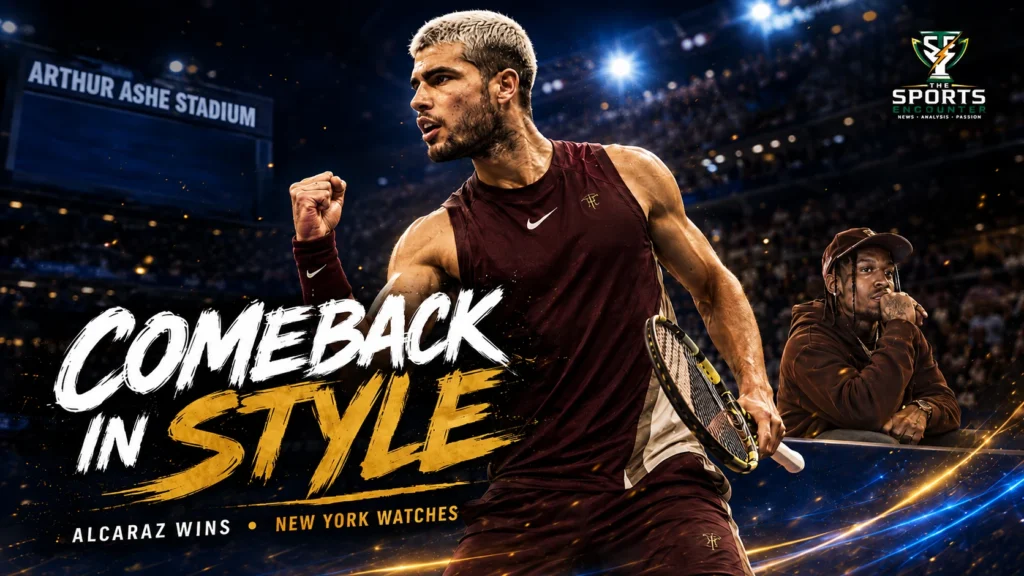
Carlos Alcaraz returned to Grand Slam singles competition on Monday and immediately reminded New York why his presence matters far beyond the scoreline.
The defending US Open champion defeated Roman Safiullin 6-4, 6-4, 6-4 on Arthur Ashe Stadium in his first singles match since April, completing a controlled first-round victory after a four-month absence caused by a right wrist injury.
But the return carried another layer.
Alcaraz walked onto court in a new Travis Scott x Cactus Jack x Nike look that transformed his comeback into part tennis match, part fashion launch and part cultural event.
Travis Scott watched from Alcaraz’s player box.
The Spaniard wore a brown ombré tank top, matching shorts and a special edition of the Nike Vapor 12 featuring Cactus Jack branding and Scott’s signature reverse Swoosh.
The shoes, reported as the Travis Scott x Cactus Jack x Nike Zoom Vapor 12 HC in a pale ivory and cacao colorway, are expected to receive a wider release later this year.
Then Alcaraz did the more important part.
He won.
The official ATP Tour match report confirmed that the 23-year-old defeated Safiullin in two hours and 22 minutes, saving five of six break points and producing a 95 mph forehand winner during a performance that became increasingly convincing as the match progressed.
The US Open’s official tournament coverage also highlighted the unusual challenge facing Alcaraz this fortnight: no man has won the US Open in the hard-court era without playing at least one North American hard-court tournament between Wimbledon and New York.
Alcaraz vs Safiullin: Match at a Glance
| Category | Carlos Alcaraz | Roman Safiullin |
|---|---|---|
| Result | Won | Lost |
| Score | 6-4, 6-4, 6-4 | 4-6, 4-6, 4-6 |
| Round | First Round | First Round |
| Match time | 2 hours, 22 minutes | |
| Break points faced | 6 | Not used as a headline metric |
| Break points saved | 5 | Not used as a headline metric |
| Next opponent | Jaime Faria | Eliminated |
The First Question Was Never the Outfit
Alcaraz’s appearance attracted immediate attention.
The hair was different.
The kit was different.
The shoes were different.
Travis Scott was sitting in the box.
None of that would have mattered much if Alcaraz had looked physically compromised.
His wrist has shaped the entire second half of his 2026 season.
The defending champion had not played a singles match since April.
He missed the clay and grass stretches that normally provide some of the most important competitive weeks of his year.
The Sports Encounter’s US Open 2026 curtain-raiser identified Alcaraz’s wrist as one of the tournament’s central uncertainties long before the first round began.
Our full US Open draw analysis added another layer: Safiullin was not a ceremonial first-round opponent. He had beaten Alcaraz in their first meeting at the Paris Masters in 2023.
That made Monday less about style and more about whether the defending champion still looked like himself.
Alcaraz Looked Cautious Before He Looked Comfortable
The opening stages were measured.
Alcaraz played with white strapping on his right arm.
His serving and forehand appeared controlled rather than fully unleashed early in the match.
That was understandable.
Four months away from singles competition is not something a player erases during the warm-up.
Timing has to return.
Trust in the body has to return.
Players recovering from wrist problems often face an additional mental test because the forehand and serve repeatedly expose the injured area to high-speed load.
Alcaraz gradually began hitting through the court with more freedom.
The clearest sign arrived when he fired a 95 mph forehand winner to break Safiullin in the seventh game.
Arthur Ashe Stadium responded immediately.
The crowd had arrived expecting the defending champion.
That shot looked much closer to him.
Safiullin Had Chances, but Alcaraz Managed the Important Points
Safiullin was never completely overwhelmed.
The Russian created six break-point opportunities.
Alcaraz saved five.
That number matters because return matches often become difficult when pressure accumulates around the recovering player’s serve.
A poor service game can quickly create hesitation.
Alcaraz repeatedly avoided that sequence.
He did not need his most spectacular tennis.
He needed enough precision at the important moments.
Three identical 6-4 sets eventually produced a scoreline that looked routine.
The path was useful precisely because it was not completely effortless.
Four Months Away, Then Straight Back Into Arthur Ashe Stadium
There was no gentle re-entry into singles competition.
Alcaraz did not return at a smaller event.
He did not use Montreal or Cincinnati to build match rhythm.
His first singles match since April came inside the largest tennis stadium in the world while defending a Grand Slam title.
The Sports Encounter’s men’s US Open title-race analysis described Alcaraz as the major uncertainty in a draw already reshaped by Jannik Sinner’s withdrawal and Novak Djokovic’s pursuit of a 25th Grand Slam title.
Monday provided the first actual evidence.
The evidence was encouraging.
The Travis Scott Collaboration Made the Return Feel Bigger Than Tennis
Alcaraz has always been unusually comfortable as both athlete and public figure.
That quality has become increasingly valuable in a sport searching for personalities capable of reaching younger audiences beyond traditional tennis followers.
The Travis Scott partnership pushed that crossover into another space.
Shortly before Alcaraz’s match, Nike released a promotional video featuring Scott and Alcaraz.
The collaboration then moved directly from advertising into live competition.
Alcaraz appeared in the Cactus Jack-designed kit on Arthur Ashe.
Scott watched courtside.
The footwear became instantly visible to television audiences and photographers covering the match.
That timing made the product launch difficult to separate from the sporting comeback.
The Shoes Were Built Around Nike’s Vapor 12 Platform
The special footwear is based on Nike’s Vapor 12 performance tennis line.
Nike describes the Vapor 12 hard-court shoe as a model designed around lighter construction, Air Zoom cushioning, lateral stability and traction for aggressive movement.
The Travis Scott version adds the visual language associated with Cactus Jack.
The reverse Swoosh is the most recognizable element.
The pale ivory and cacao styling also moved far away from the more traditional white tennis-shoe aesthetic that has dominated Grand Slam fashion for generations.
This was performance footwear presented as culture.
The US Open Has Become the Perfect Stage for This Kind of Collaboration
New York has always allowed tennis to behave differently.
Wimbledon protects tradition.
Roland Garros has its own visual identity.
The US Open has long been the major where crowd energy, celebrity attendance, music, fashion and sport overlap most naturally.
That environment made Alcaraz’s Cactus Jack debut feel less like a distraction and more like part of the tournament’s identity.
The Sports Encounter’s feature on Roger Federer’s New York return explored the same idea from another direction: Arthur Ashe Stadium has become a place where tennis history and entertainment culture regularly occupy the same night.
Alcaraz represents the younger version of that crossover.
He Had Already Tested the Fashion Direction in Mixed Doubles
The Cactus Jack look was not Alcaraz’s first unusual outfit of the tournament.
During the US Open’s redesigned mixed doubles event, he wore a purple-and-orange Nike jersey while partnering Serena Williams.
That pairing was already one of the tournament’s biggest celebrity attractions.
Our US Open mixed-doubles coverage documented how the new format brought together major singles stars and established doubles players, including Alcaraz and Williams, Novak Djokovic and Aryna Sabalenka, and several other high-profile partnerships.
The tournament has deliberately embraced crossover appeal.
Alcaraz is becoming one of its most natural vehicles.
The Clothing Changed, but the Tennis Identity Did Not
The most useful observation from Monday was how little the broader spectacle seemed to affect Alcaraz once the match settled.
There were cameras focused on the shoes.
There were cameras focused on Scott.
There was conversation about the kit.
There was still a dangerous opponent on the other side of the net.
Alcaraz gradually reduced all of it to tennis.
That is a skill in itself.
Modern elite athletes increasingly carry responsibilities far beyond competition.
They launch products.
They appear in campaigns.
They become global lifestyle brands.
The successful ones still have to separate commercial noise from competitive focus when play begins.
Alcaraz Is Trying to Break a 48-Year US Open Pattern
The physical challenge remains significant.
The US Open’s own research identified something remarkable before Monday’s match.
Every men’s champion since the tournament switched to hard courts in 1978 had played at least one North American hard-court event between Wimbledon and the US Open.
That streak covers 48 consecutive champions.
Alcaraz skipped the entire summer hard-court swing while recovering from injury.
If he successfully defends his title, he will become the first man of the hard-court era to win New York without that preparation.
That gives his comeback a historical dimension unrelated to clothing, sneakers or celebrity.
The Absence From Cincinnati Looks Even More Important Now
Most US Open contenders arrived in New York after accumulating meaningful hard-court matches.
The Sports Encounter’s Cincinnati men’s wrap showed Arthur Fils arriving at the US Open with a Masters 1000 title and substantial competitive momentum.
Others had used Montreal or Cincinnati to test form, fitness and tactics.
Alcaraz had none of that.
He entered New York with training rather than tournament evidence.
Monday was therefore not only a first round.
It was his first real hard-court examination of the summer.
The Match Also Strengthened an Already Remarkable Major Record in 2026
Alcaraz improved to 8-0 in Grand Slam matches this season.
He began the year by completing the Career Grand Slam at the Australian Open.
The wrist injury then interrupted the momentum that should have carried him through Roland Garros and Wimbledon.
His season therefore contains a strange contrast.
When available at a major, he has not lost.
The problem has been availability itself.
New York now becomes a test of whether his body can remain reliable for seven rounds.
Winning One Match Does Not Answer the Wrist Question
The straight-sets victory is encouraging.
It is not a medical clearance for the next two weeks.
Grand Slam stress accumulates.
Best-of-five tennis exposes the body differently from one controlled opening-round match.
Longer rallies, late-night scheduling, consecutive matches and increasingly dangerous opponents create new physical demands.
Alcaraz showed no obvious signs of serious physical trouble against Safiullin.
The tournament still needs more evidence.
Jaime Faria Comes Next
Alcaraz will face Jaime Faria in the second round.
Faria advanced after defeating American Jenson Brooksby.
On paper, Alcaraz will be expected to move forward.
The more important question may be whether he can continue increasing his physical intensity without producing a reaction in the wrist.
The ideal early rounds for a returning champion are not necessarily spectacular.
They are efficient.
Every unnecessary hour avoided now may matter later.
The Men’s Draw Has Already Changed Around Him
Alcaraz returned to a US Open that had already lost one of its biggest names.
Novak Djokovic was stunned by Mariano Navone in five sets in one of the tournament’s biggest opening-round shocks.
The Sports Encounter has been tracking that rapidly changing field through its August 27 US Open wrap and August 28 qualifying wrap.
Jannik Sinner’s withdrawal had already altered the hierarchy.
Djokovic’s exit changed it again.
Every round Alcaraz survives now carries greater significance.
Sabalenka Also Began Her Title Defense With a Win
Day Two was not only about Alcaraz.
Aryna Sabalenka opened her attempt to win a third consecutive US Open title by defeating Camila Osorio 6-2, 6-4.
Her result continued a tournament in which defending champions on both sides began successfully despite arriving with different pressures.
Sabalenka entered New York after an uneven North American summer.
The Sports Encounter’s Cincinnati round-of-16 analysis covered her defeat to Sara Bejlek shortly before the US Open.
Alcaraz arrived with almost no recent singles match play.
Both passed their opening tests.
Alcaraz Is Becoming One of Tennis’ Most Valuable Cultural Bridges
This is where the Travis Scott collaboration becomes more meaningful than a sneaker story.
Tennis has spent years trying to broaden its cultural reach.
It wants younger audiences.
It wants relevance beyond Grand Slam finals.
It wants athletes who can exist inside fashion, music and entertainment without weakening the sport itself.
Alcaraz has increasingly become that athlete.
His tennis remains the foundation.
Seven Grand Slam titles provide the credibility.
His personality, movement, style and willingness to experiment make the commercial layer easier to build around him.
Travis Scott Brings a Different Audience to Tennis
Scott’s involvement matters because Cactus Jack operates in a cultural space that reaches far beyond traditional tennis consumers.
The reverse-Swoosh Nike collaborations have become recognizable streetwear products.
Moving that design language into a performance tennis shoe creates an unusual bridge.
People who may never follow ATP rankings can still recognize the collaboration.
Tennis fans who would never track sneaker launches suddenly encounter Cactus Jack during a Grand Slam match.
That overlap is valuable to Nike.
It can also be valuable to tennis.
The Bigger Test Is Whether Performance Keeps Supporting the Brand
Fashion partnerships work best when the athlete remains competitive enough to make the product feel connected to elite performance.
Alcaraz understands that equation better than most.
If he loses early, the kit becomes a memorable first-round fashion moment.
If he reaches the second week, every match extends the visibility.
If he wins the tournament, the shoes become associated with a historic title defense after a four-month injury absence.
The commercial stakes therefore rise alongside the sporting ones.
Arthur Ashe Has Become Alcaraz’s Most Natural Stage
Alcaraz has a deep relationship with New York.
He won his first Grand Slam title here.
He became the youngest men’s world No. 1 after that breakthrough.
He returned as defending champion in 2026 carrying another layer of expectation.
The arena suits him.
The noise suits him.
The late-night atmosphere suits him.
Even the fashion experimentation makes more sense here than it would at most other tournaments.
TSE Analysis: The Return Was Bigger Than the Outfit, but the Outfit Was Part of the Return
It would be easy to dismiss the Travis Scott collaboration as decoration around a tennis match.
That misses what elite sport increasingly looks like.
Modern stars do not arrive at major events carrying only rackets and rankings.
They arrive carrying brands, campaigns, commercial partnerships and cultural identities.
The question is whether any of that interferes with performance.
For one round, Alcaraz handled both worlds comfortably.
He arrived wearing one of the most discussed tennis looks of the tournament.
He had one of the world’s biggest musicians sitting in his box.
He was returning from four months away.
He was defending a Grand Slam title.
He faced an opponent who had beaten him before.
He won 6-4, 6-4, 6-4.
That is why the day worked.
The collaboration created attention.
The tennis justified it.
Final Verdict
Carlos Alcaraz returned to US Open singles competition with a straight-sets victory over Roman Safiullin and moved into the second round without showing any obvious physical breakdown from the wrist injury that had kept him away since April.
The performance was controlled rather than spectacular.
That may have been exactly what he needed.
He saved five of six break points.
He gradually increased his forehand intensity.
He avoided a long opening-round battle.
He improved to 8-0 in Grand Slam matches this season.
And he did it while debuting a Cactus Jack x Nike look designed with Travis Scott, turning the defending champion’s return into one of the first major crossover moments of the 2026 US Open.
The shoes generated attention.
The straight-sets win generated something more valuable.
Evidence.
Alcaraz is back on court.
Now New York gets to discover how far back he really is.
Frequently Asked Questions
Did Carlos Alcaraz win his first match at the 2026 US Open?
Yes. Alcaraz defeated Roman Safiullin 6-4, 6-4, 6-4 in the first round.
How long was Carlos Alcaraz out before the US Open?
Alcaraz had not played a singles match since April because of a right wrist injury.
What shoes did Carlos Alcaraz wear at the 2026 US Open?
He debuted a Travis Scott x Cactus Jack x Nike Zoom Vapor 12 HC design in a pale ivory and cacao colorway featuring the reverse Swoosh associated with Scott’s Nike collaborations.
Was Travis Scott at Carlos Alcaraz’s match?
Yes. Travis Scott watched Alcaraz’s first-round victory from the Spaniard’s player box at Arthur Ashe Stadium.
Who does Carlos Alcaraz play next?
Alcaraz will face Jaime Faria in the second round.
How many Grand Slam matches has Alcaraz won in 2026?
His victory over Safiullin improved his Grand Slam record for the season to 8-0.