


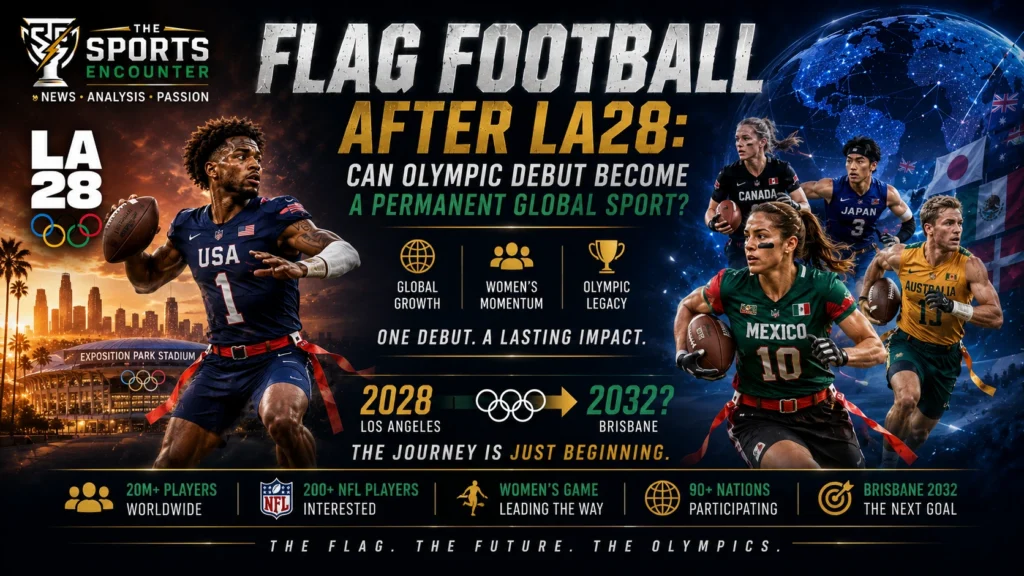
Flag football already knows when its Olympic story begins.
The more important question is what happens after Los Angeles.
When the first men’s and women’s Olympic champions leave Exposition Park Stadium in July 2028, the sport will have completed a remarkable rise from youth leagues, recreational fields and international federation tournaments to the biggest multi-sport stage in the world.
That achievement will be historic. It will not guarantee another Olympic appearance.
Flag football was approved specifically for the Los Angeles 2028 program as one of five additional sports proposed by the host organizing committee. Its place in LA28 does not automatically carry into Brisbane 2032, and the International Olympic Committee is already reshaping the process through which sports and disciplines will be evaluated for future Games.
That gives LA28 a second purpose beyond awarding medals.
Flag football must prove that it belongs beyond the United States.
The early signs are promising. The sport has a global participation base, strong growth among women and girls, expanding youth and college pathways, major NFL backing and an international competition structure that has become increasingly competitive. More than 200 NFL players from over 25 countries have also expressed interest in pursuing Olympic participation, according to NFL executive Brian Flinn in August 2026.
There is also evidence that viewers will watch elite flag football when the product is compelling. Women’s flag football ranked first across every major streaming category at The World Games 2025 in Chengdu, according to the International Federation of American Football.
Those achievements give the sport momentum.
LA28 will determine whether that momentum becomes permanence.
This is the final installment in The Sports Encounter’s Flag Football LA28 series, which began with our complete guide to flag football rules, scoring and Olympic play and has followed the sport’s evolution toward Los Angeles.
Flag Football’s Olympic Future at a Glance
| Question | Current Position |
|---|---|
| Is flag football confirmed for LA28? | Yes |
| Men’s and women’s Olympic tournaments? | Yes, six teams in each |
| Venue | Exposition Park Stadium, Los Angeles |
| Is flag football automatically confirmed for Brisbane 2032? | No |
| Is IFAF pursuing Brisbane 2032 inclusion? | Yes |
| Can NFL players pursue Olympic selection? | Yes |
| Reported NFL player interest | More than 200 players from over 25 countries |
| Global participation | More than 20 million players worldwide, according to IFAF and NFL figures |
| Biggest long-term test | Proving the sport can retain global interest beyond its American Olympic debut |
The official LA28 flag football page confirms separate six-team men’s and women’s tournaments at Exposition Park Stadium, with two 20-minute halves and a 70-yard playing field.
LA28 Is an Opportunity, Not Permanent Olympic Membership
The distinction between Olympic inclusion and permanent Olympic status matters.
Flag football was formally approved for LA28 by the IOC Session in October 2023 alongside baseball and softball, cricket, lacrosse sixes and squash.
The IOC’s official announcement described those five sports as additions proposed by the Los Angeles organizing committee for the 2028 Games.
That is why flag football cannot assume that a successful debut automatically earns a place in Brisbane.
The sport must build its case again.
Los Angeles provides unusually favorable conditions. American football is deeply embedded in U.S. sports culture. The NFL has enormous commercial reach. Southern California offers established stadium infrastructure, media attention and an audience that already understands touchdowns, quarterbacks, receivers and interceptions.
Brisbane would be different.
Australia has powerful football traditions of its own through Australian rules football, rugby league and rugby union. Flag football would have to prove that its appeal travels outside the cultural home of the NFL.
If it reaches Brisbane 2032, that would represent a much stronger statement about its international legitimacy.
The Brisbane 2032 Process Makes LA28 Even More Important
The IOC has continued refining how sports and disciplines will be considered for Brisbane 2032.
In June 2026, the IOC approved changes that allow individual disciplines to be assessed with greater flexibility rather than treating every sport as an indivisible block.
That puts pressure on emerging disciplines to demonstrate why they belong.
Factors such as participation, geographic reach, gender balance, venue requirements, operational efficiency, audience interest and commercial sustainability are likely to matter when the Olympic program is shaped.
Flag football has arguments in several of those areas.
Its small roster size lowers athlete numbers.
Its equipment requirements are lighter than tackle football.
Men and women compete in parallel formats.
The game can operate inside existing stadiums rather than demanding purpose-built infrastructure.
Its television product is compact.
That makes the format structurally attractive for the Olympic Games.
IFAF Is Already Building a Case for Brisbane
The International Federation of American Football has made clear that LA28 is not viewed as the end of the project.
In January 2026, IFAF said that continuing flag football’s Olympic presence into Brisbane 2032 was a strategic priority being pursued alongside the NFL.
The same IFAF announcement also confirmed its intention to seek both men’s and women’s flag football at The World Games 2029 in Karlsruhe.
That is an important part of the long-term strategy.
Emerging Olympic sports need meaningful competition between Games. An international event in 2029 could help prevent attention from disappearing once the Los Angeles medals are awarded.
World Championships, continental competitions and The World Games can keep national teams active while the Brisbane decision develops.
More Than 200 NFL Players Have Raised the Stakes
The NFL revealed in August 2026 that more than 200 players representing more than 25 countries had expressed interest in Olympic flag football.
That number suggests the LA28 opportunity extends well beyond a fantasy Team USA roster filled with famous quarterbacks and receivers.
Players with international eligibility may strengthen national programs outside the United States.
That could create competitive possibilities that barely existed a few years ago.
The NFL opened the pathway in May 2025 when all 32 clubs approved player participation.
The NFL’s official announcement confirmed that players would be allowed to pursue national-team selection, with participation beginning through a tryout or qualification process.
The approved framework also limits participation to a maximum of one player from each NFL club, alongside provisions for designated international players.
That prevents Olympic flag football from simply becoming an NFL All-Star tournament.
National federations still control selection.
That distinction is essential.
The NFL Can Bring Attention, but Flag Football Needs Its Own Identity
NFL involvement is an enormous promotional advantage.
Established stars arrive with ready-made audiences, social followings, sponsor interest and media recognition.
The danger appears if that becomes the entire story.
Flag football already existed as a serious international sport before NFL participation was approved.
Experienced specialists understand the field differently. They know the spacing, timing, rush rules, flag-pulling technique and tournament rhythm of five-on-five football.
That is why our analysis of flag football versus NFL football argued that elite professional athletes will still have to adapt to a different competitive environment.
LA28 should ideally produce both outcomes.
NFL players generate curiosity.
Flag specialists prove why the sport deserves respect on its own terms.
The Fanatics Classic Already Offered a Warning
The gap between professional tackle football and elite flag football is not theoretical.
In March 2026, the reigning U.S. flag football world champions defeated teams featuring current and former NFL stars at the Fanatics Flag Football Classic in Los Angeles.
IFAF reported that Team USA beat star-filled rosters featuring names such as Tom Brady, Joe Burrow, Jalen Hurts, Saquon Barkley, Davante Adams and Jalen Ramsey.
The result did not prove NFL players cannot become elite flag athletes.
It demonstrated that experience in the format matters.
That evidence should shape Olympic roster decisions.
USA Football and other national federations will gain more from building coherent teams than collecting the biggest names available.
Women’s Flag Football May Have the Strongest Olympic Legacy Case
The women’s competition could become one of the most important parts of flag football’s Brisbane argument.
At The World Games 2025 in Chengdu, women’s flag football ranked first for unique streaming users, video plays and total watch time across the event.
IFAF reported 171,000 unique users, 287,000 video plays and 84,749 hours of watch time on the TWG Live platform. The sport generated more than 23% of total watch time across the Games despite having only one medal event.
That is unusually strong evidence for an emerging Olympic discipline.
The audience was also geographically useful.
Mexico, Germany, the United States, France and the Netherlands were among the strongest territories for streaming views.
That suggests interest was not confined to a single American audience.
The Women’s Competition Has Stars Who Belong to Flag Football
This gives the women’s game another advantage.
Its leading athletes are known because of flag football itself.
Diana Flores built her reputation as Mexico’s quarterback and one of the sport’s most prominent ambassadors.
Canada has emerged as another elite program.
The United States remains a major power.
Great Britain has developed a competitive women’s national team.
Japan continues strengthening its international program.
Those players and rivalries give the women’s Olympic tournament an identity that does not depend on borrowed NFL fame.
For long-term Olympic sustainability, that may be extremely valuable.
Canada’s 2026 World Title Was Good for Flag Football
The 2026 IFAF World Championships strengthened the sport’s competitive case.
Canada defeated the United States in the women’s final, while the U.S. men recovered from a group-stage defeat to American Samoa to win the men’s championship.
The official IFAF championship report confirmed both results.
Competitive uncertainty matters.
Olympic audiences are more likely to stay engaged when several nations can realistically win medals.
American dominance may attract attention domestically, but global depth creates a healthier sport.
Canada, Mexico, Japan, Italy and other developing programs therefore matter to the Olympic future almost as much as Team USA.
International Depth Is Improving
IFAF and the NFL have reported more than 20 million flag football participants worldwide, while dozens of national federations now operate within the international structure.
The NFL said in 2025 that IFAF had 75 national member federations spanning every continent.
IFAF has also reported a 48% increase in national teams entering its world ranking system over a three-year period.
Those figures make it increasingly difficult to dismiss flag football as an American-only discipline.
The harder task is turning participation breadth into medal-level depth.
A sport can have many national programs and still remain competitively concentrated.
The next Olympic cycle should therefore be judged by how many countries can genuinely threaten the established powers.
Australia Becomes Critical to the Brisbane Case
Australia is the market flag football needs to watch most closely after the United States.
A sport hoping to remain on the Olympic program should ideally develop momentum inside the next host nation.
Flag football has room to grow there.
Australia already has elite sporting infrastructure and a strong culture of football codes, but flag football remains comparatively young.
That can be viewed as a weakness or an opportunity.
The sport does not need to replace rugby league, rugby union or Australian rules football.
It needs to create a complementary pathway that appeals to athletes who value speed, passing, agility and international competition.
The lower equipment burden can help.
Youth programs can expand without recreating the infrastructure required for tackle football.
If Australian participation rises significantly between LA28 and Brisbane, the case for Olympic continuation becomes much stronger.
Accessibility Is Flag Football’s Structural Advantage
Traditional American football faces obvious international barriers.
Large rosters increase cost.
Helmets and protective equipment add another layer.
Specialized line play requires deep athlete pools.
Repeated contact creates recovery and player-safety challenges inside condensed tournaments.
Flag football removes many of those barriers.
Five-on-five competition reduces roster needs. Limited contact lowers the equipment threshold. The game can be introduced through schools and community programs without asking every country to build an NFL-style football ecosystem.
That does not make elite development effortless.
Countries still need qualified coaches, officials, competitions and federation support.
The starting point is considerably easier.
The College Pathway Can Strengthen the Women’s Game
The United States is also developing infrastructure that could make the women’s talent pipeline much deeper by the next Olympic cycle.
IFAF reported in June 2026 that more than 200 colleges and universities were offering women’s flag football programming, while the NCAA had approved the sport for its Emerging Sports for Women program.
The NCAA pathway matters because talented athletes need reasons to remain in the sport beyond high school.
College programs provide coaching, facilities, competitive schedules and development opportunities during crucial years.
They also make flag football visible to a broader sports audience outside international tournaments.
If LA28 drives another wave of youth participation and college programs continue expanding, the women’s competition could become one of the sport’s strongest long-term assets.
LA28 Must Work as a Television Product
Olympic survival will depend partly on whether people enjoy watching the sport.
Flag football has several advantages.
The games are short.
Scoring opportunities arrive frequently.
The field is open enough for viewers to follow individual matchups.
Quarterbacks remain central to possession.
A missed flag pull can immediately create a major play.
Casual viewers do not need years of tactical knowledge to understand the basics.
Our flag football beginner’s guide explains the deeper rules, but the core action is easy to recognize.
A touchdown looks like a touchdown.
An interception instantly changes possession.
A receiver beating a defender in open space requires little explanation.
That accessibility is useful during an Olympics where dozens of sports compete for attention every day.
The LA28 Schedule Gives Flag Football a Fair Chance
Flag football is scheduled from July 15 through July 22, 2028 at Exposition Park Stadium.
The preliminary phase occupies five consecutive days before the semifinals and medal rounds.
That structure creates repeated exposure without dragging the competition across the entire Games.
Fans can discover the sport during the opening week and see champions crowned within eight days.
The venue also helps.
LA28 describes Exposition Park Stadium as an open-air venue adjacent to the Los Angeles Memorial Coliseum, placing flag football inside one of the Games’ busiest competition zones.
Location matters for a debut sport.
Flag football will not be hidden in a remote venue where only existing fans can find it.
Social Media Could Become a Major Growth Engine
The sport also produces plays suited to short-form video.
One-handed catches, interceptions, quarterback escapes, diving flag pulls and broken-field runs all work without extensive explanation.
That gives Olympic flag football an opportunity beyond traditional television ratings.
A viewer may encounter the sport through a short clip before ever watching a full game.
NFL players can accelerate that distribution because they bring established audiences.
The long-term opportunity is for flag football specialists to convert that borrowed attention into their own recognition.
LA28 Cannot Become an NFL Exhibition
The central identity challenge remains clear.
The NFL has played a major role in accelerating flag football’s development and Olympic visibility.
That support is valuable.
The Olympic tournament still has to feel international.
If every discussion revolves around which American NFL quarterback will start, viewers could leave with the impression that flag football exists mainly as a temporary Olympic showcase for professional tackle-football stars.
That would weaken the Brisbane case.
International athletes need visibility.
Women’s teams need equal editorial attention.
National-team rivalries must matter.
The sport’s tactical identity should be explained on its own terms.
This is why understanding the differences between flag football and NFL football will remain important even after NFL stars enter the picture.
What Flag Football Must Prove at LA28
| Test | What Success Would Look Like |
|---|---|
| Competitive depth | Several countries capable of beating the favorites |
| Women’s competition | Strong audiences, independent stars and credible rivalries |
| Attendance | Healthy demand across preliminary and medal sessions |
| Broadcast performance | Viewers remain engaged beyond the novelty of opening day |
| International reach | Strong interest outside the United States |
| Athlete recognition | Flag specialists become recognizable Olympic personalities |
| NFL integration | Professional stars improve the event without overwhelming its identity |
| Participation | Youth and women’s growth continues after the Games |
| Operational value | The tournament fits efficiently within the Olympic program |
| Brisbane relevance | Growing participation and competitive interest in Australia and Oceania |
The Real Legacy Begins After July 22, 2028
The buildup to LA28 may actually be the easier part of flag football’s Olympic journey.
Debut sports naturally create curiosity.
NFL participation generates headlines.
National teams are chasing historic qualification places.
Sponsors can attach themselves to a rapidly growing sport before its biggest event.
The harder questions begin after the medals are awarded.
Do young athletes keep registering?
Do schools and colleges continue adding teams?
Do national federations keep investing?
Do broadcasters remain interested in World Championships?
Do athletes discovered at LA28 stay visible?
Does Australia accelerate its development?
Those answers will tell us whether Los Angeles built a sustainable ecosystem or simply hosted a successful Olympic event.
The World Games 2029 Could Become an Important Bridge
IFAF’s intention to pursue both men’s and women’s inclusion at The World Games 2029 could become particularly useful.
The year following an Olympics is difficult for emerging sports because mainstream attention usually falls sharply.
A major multi-sport event in Karlsruhe would give national teams another meaningful target while preserving international visibility.
It would also provide useful evidence.
If fans continue watching after LA28, the argument for sustainable interest becomes much stronger.
Flag Football Should Preserve What Makes It Different
Growth often creates pressure for a sport to imitate the more established version around it.
Flag football should resist that temptation.
Its smaller rosters are part of the appeal.
Open space matters.
Speed matters.
Limited contact matters.
Accessibility matters.
Trying to reproduce the NFL too closely would weaken several of the features that make flag football internationally scalable.
The sport needs its own stars, tactical language, traditions and rivalries.
Tackle football can remain the larger sporting family.
Flag football needs to become a clearly identifiable discipline inside it.
What Would Failure Look Like?
A successful-looking LA28 tournament could still fail to create a long-term Olympic sport.
The warning signs would appear quickly.
NFL celebrity dominates every conversation.
International competitive gaps remain wide.
Audience interest disappears when famous tackle-football players are absent.
Women’s growth does not translate into sustained investment.
Youth participation spikes briefly and then stalls.
National programs struggle financially.
Australia fails to develop meaningful interest before Brisbane.
The international calendar becomes too weak between Olympic cycles.
Those outcomes are avoidable.
They are also useful benchmarks for judging whether LA28 actually changes the sport.
What Would Success Look Like by 2030?
Two years after the Los Angeles Games, flag football should be able to point toward measurable progress.
More national teams should be entering serious international competition.
World and continental events should attract larger audiences.
Women discovered during LA28 should remain visible.
Youth programs should continue growing.
College opportunities should expand.
Australia should possess stronger men’s and women’s programs.
Commercial partners should remain involved after Olympic campaigns finish.
NFL players should still be relevant, but they should no longer be the only athletes casual fans recognize.
If those conditions exist, flag football’s case for a second Olympic appearance becomes much stronger.
TSE Analysis: LA28 Should Be Judged by What Happens After the Applause
Flag football has already won an enormous battle by reaching the Olympic Games.
International federations can spend decades pursuing that opportunity without succeeding.
The next challenge is more demanding.
Los Angeles is almost perfectly designed to showcase the sport. The NFL is heavily involved, American audiences understand the basic language of football, the venue sits in a major Olympic zone and hundreds of professional players have already shown interest.
Brisbane removes much of that comfort.
That is why the 2032 question matters so much.
If flag football can move successfully from Los Angeles to Australia while continuing to strengthen in Europe, Asia, Africa, Oceania and the Americas, its Olympic identity changes completely.
It would look less like an American sport finding a favorable Olympic host and more like a genuine global discipline with American roots.
The women’s game may be central to that transformation.
So will youth participation.
The NFL can supply attention, but international federations must supply depth.
The Olympics can create curiosity, but schools, clubs, colleges and national programs must turn curiosity into sustained participation.
LA28 therefore represents a beginning rather than a finish line.
The first Olympic touchdown will be historic. The first gold medal games will matter forever. Exposition Park will become part of flag football history.
The sport’s most important victory may come years later if another generation of athletes is given the same opportunity in Brisbane.
For readers following the broader Los Angeles Games, The Sports Encounter has also examined the evolving Team USA question around LeBron James and LA28, while our NFL coverage will continue tracking professional players who enter the Olympic flag football conversation.
Frequently Asked Questions
Is flag football a permanent Olympic sport?
No. Flag football is confirmed for Los Angeles 2028, but its inclusion there does not automatically guarantee a place at Brisbane 2032 or later Olympic Games.
Will flag football be at Brisbane 2032?
Flag football is not currently guaranteed a place. IFAF and the NFL have publicly identified continued Olympic inclusion at Brisbane 2032 as a strategic priority.
Why was flag football added to LA28?
The Los Angeles organizing committee proposed flag football as one of five additional sports for the 2028 Games, and the IOC Session approved the proposal in October 2023.
How many teams will compete in Olympic flag football?
LA28 will feature six men’s teams and six women’s teams.
How many NFL players are interested in LA28?
NFL executive Brian Flinn said in August 2026 that more than 200 players representing over 25 countries had expressed interest in potentially representing their nations at the Los Angeles Games.
Can NFL players automatically make their national teams?
No. NFL players may pursue Olympic participation, but national federations remain responsible for selection and eligibility decisions.
How popular is flag football internationally?
IFAF and NFL figures estimate that more than 20 million people play flag football worldwide, with organized participation continuing to grow across multiple continents.
Why is women’s flag football important to the Olympic future?
Women and girls are among the fastest-growing participant groups, and women’s flag football ranked first across major streaming categories at The World Games 2025.
Will flag football return to The World Games?
IFAF has said it intends to seek both men’s and women’s flag football inclusion at The World Games 2029 in Karlsruhe.
Where will flag football be played at LA28?
The tournament will be staged at Exposition Park Stadium in Los Angeles.
Where can new fans learn how Olympic flag football works?
Start with The Sports Encounter’s complete flag football rules and scoring guide, then read our breakdown of what NFL stars must learn before LA28.
Los Angeles Can Launch More Than an Olympic Event
Flag football has spent years trying to reach the Olympic stage.
It now has the opportunity to prove that the stage belongs to it.
LA28 will provide the first medals, the first Olympic rivalries and the first global audience watching flag football with Olympic consequences attached.
What comes next will matter more.
If participation keeps growing, women’s pathways keep expanding, international competition becomes deeper and audiences remain engaged beyond Los Angeles, the sport will have a serious argument for Brisbane and whatever follows.
If those systems weaken once the Olympic spotlight moves on, LA28 may remain a memorable one-off.
The opportunity is unusually large because flag football already has several pieces in place.
It has global participation.
It has international championships.
It has NFL backing.
It has rapidly developing women’s competition.
It has an Olympic platform.
The next task is turning those pieces into permanence.
Follow The Sports Encounter and our dedicated Flag Football LA28 coverage as the sport moves from Olympic qualification toward Los Angeles and, potentially, a much longer future on the Games program.