


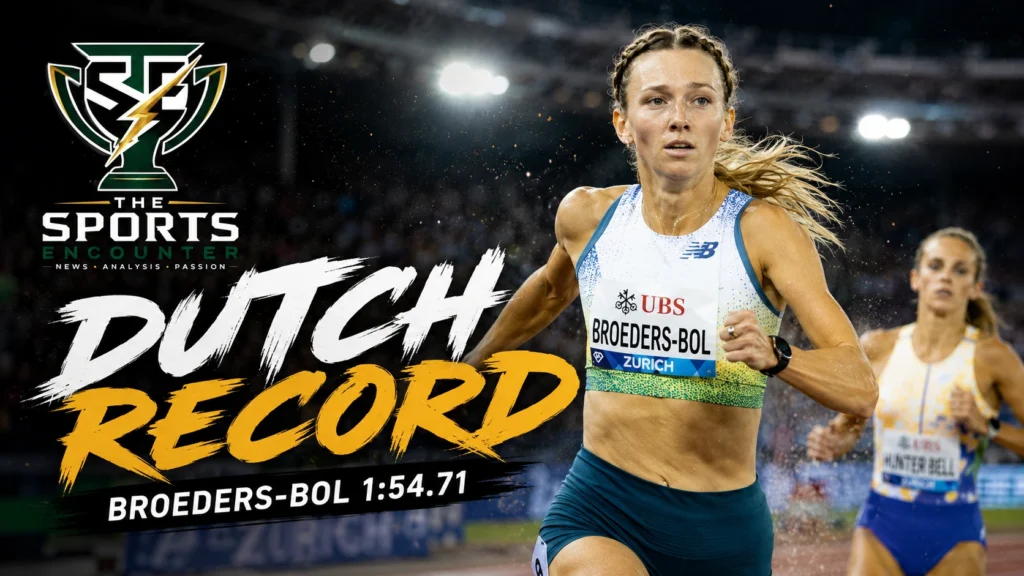
Femke Broeders-Bol entered 2026 as one of the defining 400m hurdles athletes of her generation.
She leaves Zurich looking increasingly like one of the best 800m runners in the world.
The Dutch star ran a stunning 1:54.71 at the Weltklasse Zurich Diamond League meeting on Thursday, breaking her own national record, dipping under 1:55 for the first time and moving to No. 9 on the all-time women’s 800m list.
And she still finished second.
Audrey Werro won an extraordinary race in 1:53.70, while Britain’s Georgia Hunter Bell followed Broeders-Bol home in 1:55.03. Three women therefore broke 1:56 in a race that turned what was already one of the most interesting events of the 2026 season into something even faster.
For Broeders-Bol, however, the result carries a different significance.
Her move to the 800m is no longer an experiment, a side project or a fascinating late-career challenge. She has now run a time achieved by only eight women before her in the history of the event.
The official World Athletics Zurich results confirm Broeders-Bol’s 1:54.71 behind Werro’s 1:53.70, with Hunter Bell third in 1:55.03.
Femke Broeders-Bol’s 1:54.71 at a Glance
| Detail | Result |
|---|---|
| Event | Women’s 800m |
| Meeting | Weltklasse Zurich, Wanda Diamond League |
| Date | August 27, 2026 |
| Winner | Audrey Werro, Switzerland |
| Winning time | 1:53.70 |
| Broeders-Bol position | Second |
| Broeders-Bol time | 1:54.71 |
| National record | Dutch record |
| Previous personal best | 1:55.41, Lausanne |
| Improvement | 0.70 seconds |
| All-time position | No. 9 |
| Third place | Georgia Hunter Bell, 1:55.03 |
World Athletics’ official athlete profile now lists 1:54.71 as Broeders-Bol’s 800m personal best.
Broeders-Bol Broke 1:55 Only Six Days After Setting Her Previous Record
The speed of the progression may be the most important part of this story.
Broeders-Bol ran 1:55.41 in Lausanne on August 21.
That was already a Dutch record.
She finished only eight hundredths behind Werro’s 1:55.33 and provided another sign that the gap between the Swiss star and the former hurdles specialist was becoming increasingly small.
The official Wanda Diamond League report described Lausanne as another record-breaking chapter in the developing rivalry.
Six days later, Broeders-Bol removed another 0.70 seconds from her best.
| Race | Broeders-Bol | Position | Progression |
|---|---|---|---|
| Ostrava | 1:57.13 | 2nd | First major outdoor 800m breakthrough |
| Paris Diamond League | 1:55.60 | 2nd | Moved firmly into world-class territory |
| European Championships | 1:55.54 | 3rd | European bronze |
| Lausanne Diamond League | 1:55.41 | 2nd | Dutch record |
| Zurich Diamond League | 1:54.71 | 2nd | Dutch record, first sub-1:55 |
The Sports Encounter had already identified Broeders-Bol as one of the most fascinating athletes in the Zurich field when Keely Hodgkinson withdrew and changed the shape of the race.
Zurich showed that the intrigue was justified.
This Is the Same Athlete Who Dominated the 400m Hurdles
Broeders-Bol’s 800m rise becomes even more remarkable when viewed against the career she had already built.
She is not a middle-distance runner who gradually shaved seconds from her personal best through years of two-lap specialization.
She built her reputation as one of the world’s finest 400m hurdles athletes.
Her official Diamond League profile credits her with five Diamond League titles in the event and a long winning streak that helped make her one of the most recognizable athletes in European track and field.
In 2026, she chose a different problem.
Eight hundred meters.
The transition initially raised obvious questions.
Would her 400m speed carry through the second lap?
Could a hurdles background translate into tactical positioning in a crowded middle-distance race?
Would she be able to control the severe late-race fatigue that defines elite 800m competition?
Those questions are being answered much faster than expected.
Zurich Was Not About Surviving the Second Lap
Earlier in the season, the most obvious uncertainty around Broeders-Bol was how she would manage the final 200 meters.
That is where 400m speed stops being enough.
The athlete must maintain mechanics after a full lap, react tactically and resist the lactate accumulation that turns the closing straight into one of the most painful stretches in athletics.
Zurich showed Broeders-Bol is no longer simply trying to endure that section.
She is racing it.
Werro eventually proved too strong, but Broeders-Bol stayed within an exceptionally fast contest rather than paying for the early pace with a collapse.
The 1:54.71 demonstrates something more meaningful than raw speed.
Her body is learning the event.
Being No. 9 All-Time Changes Her Status
World Athletics’ all-time list now places Broeders-Bol ninth among women over 800 meters.
That puts the Zurich performance beyond the normal language of a successful event switch.
This is historically fast running.
Her 1:54.71 places her ahead of generations of Olympic medalists, world champions and athletes who spent entire careers training specifically for the event.
That does not suddenly make her the favorite in every major 800m final.
Times and championships measure different skills.
But an athlete cannot run 1:54.71 and still be described as an outsider learning the event.
The evidence has moved past that.
Audrey Werro Still Won the Race
Broeders-Bol’s breakthrough should not erase the athlete who beat her.
Werro ran 1:53.70.
That was another extraordinary performance in a season where the Swiss runner has repeatedly moved toward the limits of the event.
The Sports Encounter followed Werro through one of the most dramatic championship journeys of the summer, beginning when she fell in the European Championship semifinal and was reinstated after appeal.
One day later, she defeated Olympic champion Hodgkinson and Broeders-Bol in the final.
Our full analysis of Werro’s European 800m gold showed how quickly she had moved from fast Diamond League runner to championship winner.
Zurich was further proof.
Werro won again.
Broeders-Bol simply made the race around her historically fast.
Second Place in 1:54.71 Tells Us How Extreme the Event Has Become
This is another detail worth keeping.
Broeders-Bol ran the ninth-fastest performance ever by a woman.
She lost.
Hunter Bell ran 1:55.03.
She finished third.
That is the current state of the women’s 800m.
Times that would have defined previous international seasons are now being produced by athletes who do not win the race.
The Sports Encounter saw the same trend in Birmingham, where Werro’s 1:54.81 beat Hodgkinson’s 1:55.01 and Broeders-Bol’s 1:55.54 in one of the defining races of the European Championships.
The entire record-heavy Birmingham session was covered in our Birmingham 2026 record-night wrap.
Zurich raised the standard again.
Broeders-Bol Has Improved by More Than Two Seconds in a Matter of Months
Her outdoor 800m debut came in Ostrava at 1:57.13.
That was already fast enough to prove the experiment had potential.
She is now at 1:54.71.
The difference is 2.42 seconds.
At recreational level, 2.42 seconds can look small.
At 1:57-level elite middle-distance racing, it is enormous.
Each additional fraction becomes progressively harder to remove because the athlete is already operating close to maximum velocity and oxygen delivery.
Broeders-Bol has made that improvement while simultaneously learning positioning, pacing, race rhythm and the specific demands of an event she did not spend her formative years specializing in.
Her Hurdling Background May Explain Part of the Transition
Broeders-Bol entered the 800m with several physical advantages that traditional middle-distance runners spend years trying to build.
She possessed elite 400m speed.
She understood rhythm.
She had developed exceptional strength through repeated hurdles training.
She also had years of experience tolerating extreme fatigue while maintaining technical form over one lap.
Those qualities do not automatically create an elite 800m runner.
They provide an unusually strong foundation.
The 800m asks an athlete to extend that speed endurance for another lap while making tactical decisions inside a pack.
Broeders-Bol appears to be learning the tactical side without losing the speed that made her dangerous over 400 meters.
The European Championships Were the First Championship Proof
Fast paced races are one thing.
Championship finals are different.
Birmingham gave Broeders-Bol the first major evidence that her new event could produce medals as well as times.
She won European bronze in 1:55.54 behind Werro and Hodgkinson.
The result came after progressing through rounds rather than preparing exclusively for one paced final.
That is an important distinction.
The Sports Encounter’s complete Birmingham 2026 review identified the women’s 800m as one of the championship’s biggest shifts in hierarchy.
Broeders-Bol contributed directly to that shift.
Lausanne Made Zurich Feel Possible
Six days before Zurich, Broeders-Bol nearly beat Werro.
The Swiss athlete won Lausanne in 1:55.33.
Broeders-Bol finished in 1:55.41.
Eight hundredths separated them.
The result changed expectations for Zurich because it showed that Broeders-Bol could remain attached to Werro throughout a fast two-lap race rather than simply chasing her from distance.
The official Wanda Diamond League review confirmed that 1:55.41 was a Dutch record.
Zurich then removed seven tenths from it.
Two national records in six days is not normal progression.
It is an athlete discovering new limits almost race by race.
The Battle With Hunter Bell Was Another Important Measure
Georgia Hunter Bell finished third in 1:55.03.
The Briton has enough middle-distance range to succeed across both 800m and 1500m, and she entered Zurich as one of the strongest tactical athletes in the field.
Broeders-Bol beating her by 0.32 seconds reinforces a point that can be lost beneath Werro’s winning time.
The Dutch runner was not merely dragged to a fast performance from the back.
She finished ahead of another established world-class middle-distance athlete.
That is competitive progress, not just statistical progress.
Hodgkinson’s Absence Still Matters
Keely Hodgkinson had been expected to race in Zurich.
The Olympic champion withdrew because her body was not ready to race again after the European Championships.
The Sports Encounter examined that decision in our Zurich 800m preview after Hodgkinson pulled out.
Her absence means Zurich did not settle the complete hierarchy.
Werro beat Broeders-Bol.
Broeders-Bol beat Hunter Bell.
Hodgkinson remains outside that particular comparison.
That leaves one of the most interesting questions in women’s athletics unresolved.
What happens when Werro, Hodgkinson and this new 1:54.71 version of Broeders-Bol line up healthy in the same race?
The Women’s 800m Has Become One of Athletics’ Deepest Events
The event currently has several different forms of elite threat.
Werro owns extraordinary pure speed and championship confidence.
Hodgkinson remains an Olympic champion with one of the strongest championship records in the field.
Broeders-Bol brings 400m speed and a rapidly improving two-lap engine.
Hunter Bell offers range and tactical intelligence.
Other established international contenders remain capable of entering the medal picture.
This is why one runner breaking 1:55 and finishing second should not be treated as an oddity.
It may be a warning about where the event is heading.
Zurich Was Already One of the Greatest Athletics Nights of 2026
Broeders-Bol’s record happened inside a meeting that produced extraordinary performances almost everywhere.
Alison dos Santos broke Karsten Warholm’s men’s 400m hurdles world record with 45.80.
Masai Russell followed with a women’s 100m hurdles world record of 12.09.
Mondo Duplantis cleared 6.25m in the pole vault as Emmanouil Karalis reached 6.20m.
Rumesh Pathirage threw 92.07m in the men’s javelin.
Werro ran 1:53.70.
Broeders-Bol ran 1:54.71.
Her national record did not receive the loudest headline because Zurich produced two world records.
That does not make it a minor performance.
Her Move to the 800m Now Looks Like a Career Reinvention
Event changes are common in athletics.
Successful event changes at world-class level are not.
Broeders-Bol has already built one elite career.
She won Diamond League titles over the hurdles and became one of Europe’s defining athletes.
Now, at 26, she is building another identity.
That makes the project particularly unusual.
This is not an athlete moving events because the previous discipline had never worked.
She is moving after already mastering one.
The 800m therefore represents choice rather than rescue.
Why No. 9 All-Time Matters More Than Another National Record
National records are important.
All-time placement provides a different scale.
A country can have a relatively weak historical record in an event, allowing a national record without corresponding global importance.
That is not what happened here.
World Athletics lists Broeders-Bol at No. 9 all-time with 1:54.71.
That means her time survives the broader historical comparison.
It is not only fast for the Netherlands.
It is fast for the entire history of women’s 800m running.
The Next Step Is Not Another Personal Best
Broeders-Bol has already proved she can run fast enough to contend with almost anybody.
The next question is whether she can consistently convert that speed into victories.
She has finished second in Ostrava.
Second in Paris.
Third at the European Championships.
Second in Lausanne.
Second in Zurich.
Those results demonstrate remarkable consistency.
They also reveal the remaining challenge.
She keeps arriving near the front.
Now she has to cross the line first against the event’s strongest athletes.
Brussels Provides the Next Test
The Diamond League Final takes place in Brussels on September 4-5.
Broeders-Bol entered Zurich still fighting to secure her place and finished the qualifying series third in the women’s 800m standings with 21 points, behind Werro and Hodgkinson.
The official Wanda Diamond League season now moves from points accumulation to the final, where one race determines the Diamond Trophy.
That format may suit Broeders-Bol differently.
There is no need to manage a series position.
There is no second chance.
One race.
One title.
Budapest Could Become Even More Important
The inaugural World Athletics Ultimate Championship follows in Budapest from September 11-13.
The Sports Encounter’s guide to the Ultimate Championship’s new format explains how compressed fields and high-pressure finals will test athletes differently from the normal Diamond League structure.
For Broeders-Bol, those environments will reveal something 1:54.71 alone cannot.
Can she use this speed when nobody is pacing the race for history?
TSE Progression Scorecard: Broeders-Bol’s 800m Reinvention
| Category | 2026 Status |
|---|---|
| Outdoor 800m debut | 1:57.13 |
| Paris Diamond League | 1:55.60, second |
| European Championships | 1:55.54, bronze |
| Lausanne | 1:55.41, Dutch record |
| Zurich | 1:54.71, Dutch record |
| Zurich improvement | 0.70 seconds from Lausanne |
| Total improvement from Ostrava | 2.42 seconds |
| World all-time ranking | No. 9 |
| Major 800m medal | European bronze |
| Current strength | Elite 400m speed combined with rapidly improving 800m endurance |
| Remaining question | Can fast second places become championship and Diamond League wins? |
| TSE verdict | The transition is complete. Broeders-Bol is now an elite 800m runner. |
The Detail That Matters
Femke Broeders-Bol did not win in Zurich.
That may make 1:54.71 easier to overlook on a night filled with world records.
It should not.
Six days earlier, 1:55.41 was the fastest 800m she had ever run.
Zurich took another seven tenths away.
She is now the ninth-fastest woman in history.
Her season started with questions about whether a world-class 400m hurdler could become a serious 800m runner.
That question has expired.
The evidence is now too strong.
Broeders-Bol has a European medal.
She has repeated Diamond League podiums.
She has broken the Dutch record twice within a week.
She has run under 1:55.
And only eight women in history have ever run faster.
The more interesting question starts now.
How much faster can she become once she stops learning the event and starts mastering it?
Frequently Asked Questions
What time did Femke Broeders-Bol run in Zurich?
Femke Broeders-Bol ran 1:54.71 in the women’s 800m at the 2026 Zurich Diamond League meeting.
Did Femke Broeders-Bol win the Zurich 800m?
No. Audrey Werro won in 1:53.70. Broeders-Bol finished second in 1:54.71, with Georgia Hunter Bell third in 1:55.03.
Is 1:54.71 a Dutch national record?
Yes. Broeders-Bol lowered her own Dutch 800m record to 1:54.71.
What was Broeders-Bol’s previous Dutch record?
She had run 1:55.41 in Lausanne on August 21, only six days before improving the record in Zurich.
Where does Femke Broeders-Bol rank all-time in the women’s 800m?
World Athletics lists her 1:54.71 performance at No. 9 on the all-time women’s 800m list.
Is Femke Broeders-Bol the former 400m hurdles star Femke Bol?
Yes. Broeders-Bol built her international reputation in the 400m hurdles before shifting her focus toward the 800m during the 2026 season.
What did Broeders-Bol run at the European Championships?
She won European bronze in Birmingham in 1:55.54 behind Audrey Werro and Keely Hodgkinson.
What was Broeders-Bol’s first major outdoor 800m time in 2026?
She ran 1:57.13 in Ostrava, finishing second behind Werro.
How much has Broeders-Bol improved since Ostrava?
Her improvement from 1:57.13 to 1:54.71 is 2.42 seconds.
Who holds the women’s 800m world record?
Jarmila Kratochvílová holds the world record at 1:53.28, set in 1983.
When is the 2026 Diamond League Final?
The Wanda Diamond League Final is scheduled for September 4-5, 2026, in Brussels.
What is Broeders-Bol’s next major challenge?
Her late-season focus moves toward the Diamond League Final and the World Athletics Ultimate Championship, where her 800m progression will be tested in championship-style racing rather than only paced meetings.