


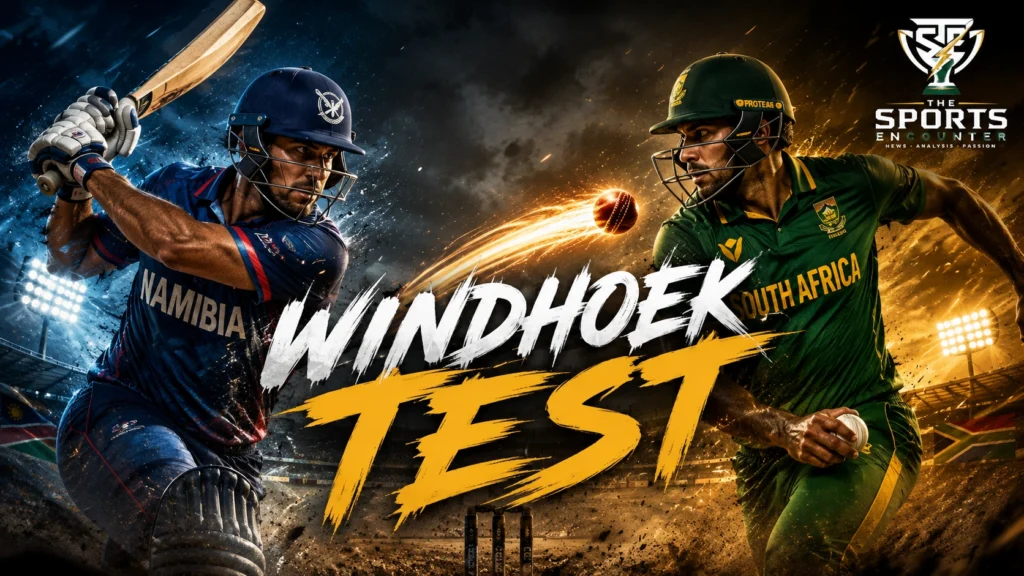
South Africa will begin the FNB T20 Tri-Series as favorites on Friday, but Namibia have already shown why Windhoek is a dangerous place for any Proteas side that mistakes unfamiliar names for a weak opponent.
The hosts beat South Africa by four wickets at the same Namibia Cricket Ground in October 2025, in the first senior international meeting between the countries. Ruben Trumpelmann took 3 for 28 that day as South Africa were restricted to 134 for 8 before Namibia completed the chase with four wickets in hand.
That result came against a depleted Proteas team. Friday brings another South African squad without most of the established white-ball core.
The difference is that Namibia now know exactly what beating this kind of South African side feels like.
South Africa have brought Dewald Brevis, Lhuan-dré Pretorius, Kwena Maphaka, Tony de Zorzi, Nqaba Peter and several players still establishing themselves internationally. Bjorn Fortuin will captain the side for the first time on a tour designed as much around expanding South Africa’s player pool as winning matches.
Namibia arrive with almost the opposite profile.
Gerhard Erasmus leads a settled group containing Trumpelmann, JJ Smit, Jan Frylinck, Bernard Scholtz and Jan-Nicol Loftie-Eaton, supported by younger players who have started forcing their way into the conversation.
The Sports Encounter’s full Namibia-South Africa-Zimbabwe tri-series preview examined the wider tournament picture. Friday’s opener deserves a closer look because the matchup contains a simple tension that could shape the entire competition: South Africa have the higher individual ceiling, but Namibia may understand the conditions and their own roles considerably better.
Namibia vs South Africa: Match Details
| Detail | Information |
|---|---|
| Match | Namibia vs South Africa |
| Tournament | FNB T20 Tri-Series 2026 |
| Date | August 28, 2026 |
| Start time | 2:00 PM CAT |
| Venue | Namibia Cricket Ground, Windhoek |
| Namibia captain | Gerhard Erasmus |
| South Africa captain | Bjorn Fortuin |
| Format | T20 International |
The ICC’s official tournament guide confirms that all seven matches will be played in Windhoek, with Namibia and South Africa opening the competition before the Proteas face Zimbabwe less than 24 hours later.
Why Namibia Should Believe They Can Win Again
There is a difference between believing an upset is possible and knowing you have already produced it.
Namibia have the second advantage.
When South Africa visited Windhoek in October 2025, the hosts restricted them to 134 for 8 before chasing 135. Trumpelmann took three wickets and Zane Green finished unbeaten on 30 as Namibia won by four wickets.
According to Cricket Namibia’s official account of that match, it was Namibia’s first international meeting with South Africa and their fourth victory over a Full Member nation.
The historical value of that win is obvious.
The tactical value matters more on Friday.
Several Namibia players now know that South African depth can be attacked if the Proteas are denied a clean powerplay and forced to construct an innings rather than simply overwhelm the bowling.
That is precisely what happened last year.
South Africa Have More Talent, But Namibia Have More Continuity
South Africa’s squad is exciting because so many players are still moving toward their long-term international roles.
Namibia’s squad is dangerous because many of their senior players already know theirs.
Erasmus has spent years carrying batting, leadership and tactical responsibility. Frylinck and Smit understand the pressure points of international T20 cricket. Scholtz offers control through spin, while Trumpelmann gives Namibia a left-arm pace option capable of changing a powerplay.
That familiarity matters in an opening match.
South Africa may need several overs to understand their combinations. Namibia should not.
The hosts have also won five of their seven T20Is since the 2026 Men’s T20 World Cup, according to the ICC’s official Namibia squad announcement.
Recent home results provide another layer of confidence. Namibia won all four matches in their June tri-series against Hong Kong and Nigeria, producing totals of 194 for 3, 230 for 6 and 220 for 5 during the tournament.
Windhoek therefore should not automatically be treated as a venue where 150 is enough.
South Africa’s Young Squad Is Experimental, Not Weak
There is a danger in overcorrecting the other way.
South Africa are missing Aiden Markram, David Miller, Kagiso Rabada, Tristan Stubbs, Marco Jansen and several other established names, but the replacements are hardly anonymous domestic fillers.
Brevis has already shown that he can take apart high-level attacks. His unbeaten 55 from 31 balls for London Spirit earlier this month was central to the chase covered in The Sports Encounter’s report on his match-winning Hundred fifty.
Pretorius is another player capable of changing the powerplay immediately. His 52 from 28 balls at Lord’s demonstrated why he remains one of South Africa’s most aggressive young top-order options, as detailed in our analysis of his attacking innings in The Hundred.
Maphaka gives South Africa genuine left-arm pace. Nqaba Peter offers legspin and wicket-taking ability through the middle. De Zorzi provides more experience than the “young Proteas” label might initially suggest.
Cricket South Africa’s official squad announcement also makes the development purpose clear. Head coach Shukri Conrad said the tour gives players an opportunity to build on their international caps while rewarding strong domestic performances.
South Africa therefore arrive with less experience than normal, but plenty of match-winning ability.
Dewald Brevis vs Namibia’s Slow-Bowling Plan Could Decide the Middle Overs
Brevis is the obvious batter Namibia need to contain.
The temptation will be to attack him almost exclusively with pace because of the risk he creates against anything short or overpitched.
Namibia may find greater value by changing his rhythm.
Erasmus, Scholtz and other slow-bowling options can force Brevis to generate his own pace while protecting the areas where he prefers to hit straight and over midwicket.
Brevis remains dangerous against spin, but the question is less about whether he can clear the ropes and more about whether Namibia can make him wait.
His recent Hundred performances have shown both sides of that equation.
He can accelerate violently once established, but his shorter innings have also shown that opposition bowlers can restrict his influence if they prevent him from settling. The Sports Encounter saw that contrast when Brevis was removed at a crucial stage during London Spirit’s defeat against Manchester Super Giants.
Namibia do not need to dismiss him immediately.
Making him consume deliveries without controlling the game could be almost as valuable.
Ruben Trumpelmann vs Lhuan-dré Pretorius Is the Powerplay Battle to Watch
This is the matchup that could define the first six overs.
Pretorius wants pace, width and anything he can hit through or over the field before the boundary riders are pushed back.
Trumpelmann’s left-arm angle complicates that approach.
For a right-handed opener, deliveries moving across the body create uncertainty around whether to attack square or protect the outside edge. When Trumpelmann brings the ball back into the pads, the same aggressive setup becomes vulnerable to bowled and lbw dismissals.
He used those variations effectively against South Africa last year.
If Namibia can remove Pretorius or Brevis early, the pressure moves onto a batting group with considerably less collective international experience than a normal Proteas lineup.
Namibia’s Most Interesting Player May Be Junior Taanyanda
Namibia’s established names will receive most of South Africa’s preparation time.
Junior Taanyanda may be the batter who benefits.
The 21-year-old made his T20I debut only in June and immediately finished Namibia’s home tri-series against Hong Kong and Nigeria as the leading run-scorer with 165 runs at an average of 82.50.
That performance established potential.
Friday establishes the level of that potential.
Facing Maphaka, Sipamla, Fortuin and South Africa’s other international-level options will tell Namibia far more than dominating lower-ranked opposition.
If Taanyanda can carry his scoring method into this match, Namibia’s batting begins to look less dependent on Erasmus, Frylinck and Smit.
That would be a much bigger development than one successful innings.
Bjorn Fortuin’s Captaincy Is Already Under Tactical Pressure
South Africa’s captaincy experiment starts with a difficult assignment.
Fortuin is experienced domestically and understands T20 cricket, but leading a national team creates different problems.
He has to decide how quickly to expose Maphaka, whether to hold overs back for Erasmus and Smit, how aggressively to use his own left-arm spin, and how much freedom to give a young batting group.
The sequence of fixtures adds another complication.
South Africa face Zimbabwe the next afternoon.
A comfortable opening victory allows Fortuin to rotate and manage workloads from a position of strength.
A defeat immediately creates tournament pressure before South Africa have had time to fully assess conditions.
The Toss Could Matter Less Than Reading the Surface Correctly
It is easy to build a preview around whether the captain should bat or bowl first.
The more important question is what the pitch is actually offering.
The Namibia Cricket Ground has produced very different batting conditions.
South Africa made only 134 for 8 there in October 2025. Namibia have since produced totals well above 190 during home T20 cricket.
The surface therefore should not be reduced to a simple “slow Windhoek pitch” narrative.
Afternoon starts may also influence how the ball behaves compared with evening franchise cricket.
Captains will need to judge the surface quickly rather than rely on reputation.
Why Namibia’s Fielding Could Matter More Than Their Batting
The 2025 victory over South Africa was built partly on catches and pressure.
That remains a useful blueprint.
Young aggressive batting groups often create opportunities because they are encouraged to keep attacking. Namibia cannot afford to give Brevis, Pretorius or De Zorzi second chances.
Zimbabwe recently showed how damaging that can become.
They dropped four catches inside the powerplay against Bangladesh and conceded a 120-run opening stand, a collapse in fielding standards examined in The Sports Encounter’s report on Bangladesh’s series-leveling victory.
Namibia have fewer resources than South Africa.
That makes basic execution even more valuable.
Catches, boundary prevention and clean ground fielding can reduce the talent gap without requiring anything extraordinary.
South Africa Need to Avoid Treating This as Development Cricket
The squad may have developmental objectives.
The match does not.
Namibia are playing a full T20 international at home and have already beaten South Africa there.
If the Proteas begin slowly because combinations are being tested or players are feeling their way into roles, Namibia have enough experience to turn that uncertainty into scoreboard pressure.
This is where South Africa’s young players need to show that franchise promise and domestic success can survive international expectation.
Brevis, Pretorius and Maphaka are already regarded as future or emerging national-team regulars.
Friday gives them a different test: being expected to dominate because the biggest South African names are absent.
Why the Opening Match Matters to the Whole Tournament
The format makes every result important.
Each team plays four league matches before the top two reach the September 6 final.
A Namibia win would immediately change the competition.
The hosts would have points against the pre-tournament favorites, while South Africa would go directly into a match against Zimbabwe the next day needing a response.
A convincing Proteas victory would create the opposite effect.
It would reinforce South Africa’s depth and force Namibia to recover against Zimbabwe.
The Sports Encounter’s coverage of Zimbabwe’s opening T20I victory over Bangladesh recently showed how quickly a first result can reshape a short series before momentum turns again. Bangladesh eventually recovered to win that series 2-1, completing the comeback in a tense decider covered in our final-match report from Bulawayo.
A tri-series creates even less room for a slow start because results against two different opponents interact with the same table.
The 2027 World Cup Context Is Already Visible
The match is a T20I, but the venue and player-development implications reach beyond this format.
South Africa, Namibia and Zimbabwe will jointly host the 2027 ICC Men’s Cricket World Cup.
The Namibia Cricket Ground is one of the tournament venues, meaning South Africa’s younger players are gaining early exposure to a ground they could encounter again during the ODI World Cup.
Brevis has already acknowledged the value of that experience, noting before the tri-series that adapting quickly to conditions in Windhoek represents an opportunity for the touring group.
Namibia’s situation is even more significant.
They are a World Cup co-host but still need to qualify through the ICC Men’s Cricket World Cup League 2 pathway.
That makes high-level competition against South Africa especially useful because the hosts need to build depth while simultaneously chasing qualification.
The wider 2027 picture is already taking shape. Afghanistan recently secured their own direct place after defeating Ireland, a qualification story explored in The Sports Encounter’s report on Rashid Khan’s decisive performance in Belfast.
Namibia vs South Africa: Key Matchups
| Matchup | Why It Matters |
|---|---|
| Ruben Trumpelmann vs Lhuan-dré Pretorius | Namibia’s experienced left-arm seamer against South Africa’s aggressive young opener could determine the powerplay. |
| Bernard Scholtz/Gerhard Erasmus vs Dewald Brevis | Namibia may use spin and pace variation to stop Brevis from controlling the middle overs. |
| Junior Taanyanda vs Kwena Maphaka | Namibia’s breakout young batter faces a major step up against one of South Africa’s most highly rated fast-bowling prospects. |
| Gerhard Erasmus vs Nqaba Peter | South Africa’s legspinner could be used aggressively against Namibia’s most important senior batter. |
| Namibia’s fielding vs South Africa’s attacking intent | The hosts cannot afford dropped chances against a batting lineup encouraged to attack from the start. |
Possible Playing XIs
Namibia: Michael van Lingen, Junior Taanyanda, Gerhard Erasmus (c), Jan-Nicol Loftie-Eaton, Jan Frylinck, JJ Smit, Zane Green (wk), Ruben Trumpelmann, Bernard Scholtz, JC Balt, Max Heingo.
South Africa: Lhuan-dré Pretorius, Tony de Zorzi, Dewald Brevis, Jordan Hermann, Connor Esterhuizen, Eathan Bosch, Bjorn Fortuin (c), Nqaba Peter, Kwena Maphaka, Lutho Sipamla, Prenelan Subrayen.
These are projected combinations rather than confirmed XIs and may change after the toss.
TSE Match Prediction
South Africa should still begin as favorites.
Their batting ceiling is higher, Maphaka gives them pace Namibia cannot easily reproduce, and the overall depth of South African cricket remains far greater.
The gap is narrower than the countries’ traditional status suggests.
Namibia have home advantage, a settled leadership core, experienced bowling, recent winning form and the memory of beating South Africa at this ground less than a year ago.
If Trumpelmann removes one of South Africa’s attacking top-order batters early and Namibia field cleanly, the match could become uncomfortable very quickly for Fortuin’s side.
TSE prediction: South Africa slight favorites, but Namibia have a genuine chance of winning rather than merely producing a respectable performance.
The Detail That Matters
The most important question on Friday is not whether Namibia can produce an upset.
They already have.
The more revealing question is whether Namibia have reached the point where beating an experimental South African side at home no longer needs to be treated as an isolated shock.
A second victory in consecutive Windhoek meetings would change that conversation considerably.
South Africa will want to show that their player-development system can absorb the absence of established stars without a meaningful drop in competitive level.
Namibia will be trying to show that experience, home conditions and an improving next generation can narrow a gap built over decades.
That makes Friday’s opener more useful than a routine early-season international.
It gives both countries something measurable.
Frequently Asked Questions
When is Namibia vs South Africa in the 2026 T20 tri-series?
Namibia face South Africa on Friday, August 28, 2026, in the opening match of the FNB T20 Tri-Series.
Where is Namibia vs South Africa being played?
The match will be played at the Namibia Cricket Ground in Windhoek.
What time does Namibia vs South Africa start?
The match is scheduled to begin at 2:00 PM Central Africa Time.
Who is captaining South Africa against Namibia?
Left-arm spinner Bjorn Fortuin will captain South Africa during the tour of Namibia.
Who is Namibia’s captain?
Gerhard Erasmus will captain Namibia.
Have Namibia ever beaten South Africa in international cricket?
Yes. Namibia beat South Africa by four wickets in a T20I at the Namibia Cricket Ground in October 2025, which was the first senior international meeting between the two countries.
Is South Africa playing a full-strength team against Namibia?
No. Several established Proteas players are absent, while South Africa have selected a squad featuring younger and fringe internationals including Dewald Brevis, Lhuan-dré Pretorius, Kwena Maphaka, Nqaba Peter and others.
Who are the key players to watch in Namibia vs South Africa?
Gerhard Erasmus, Ruben Trumpelmann and Junior Taanyanda are among Namibia’s key players, while Dewald Brevis, Lhuan-dré Pretorius, Kwena Maphaka and captain Bjorn Fortuin are important for South Africa.
Why can Namibia trouble South Africa?
Namibia have home advantage, a settled senior core, experienced bowling, strong recent T20I form and the confidence of having beaten South Africa at the same venue in 2025.
Why does the Namibia tri-series matter for the 2027 World Cup?
Namibia, South Africa and Zimbabwe will jointly host the 2027 ICC Men’s Cricket World Cup. The Windhoek venue will stage World Cup matches, while Namibia are still trying to qualify for the tournament through the ICC Cricket World Cup League 2 pathway.