


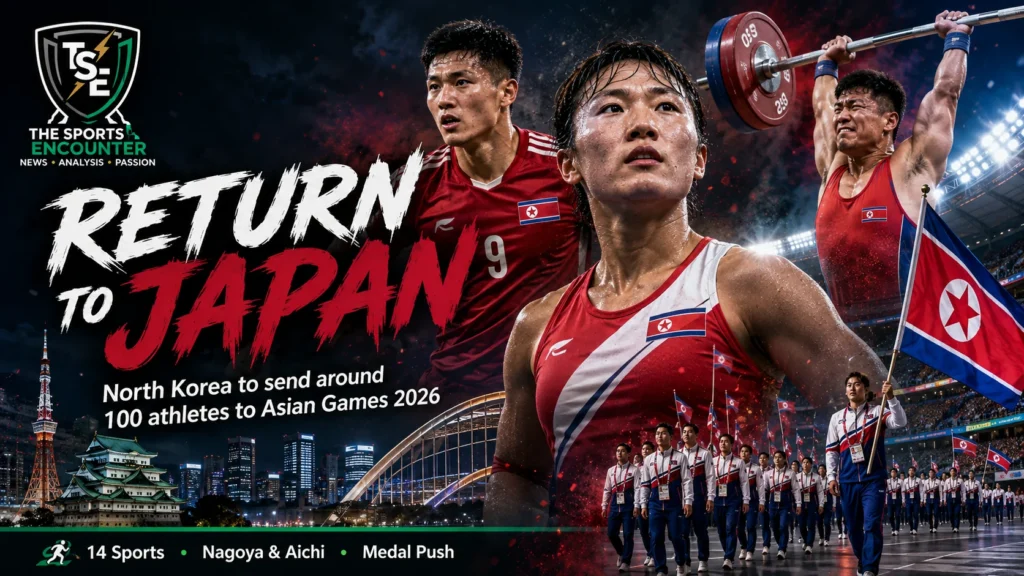
PYONGYANG: North Korea is preparing to send around 100 athletes to Japan for the 2026 Asian Games, taking a smaller team than it fielded three years ago while setting itself an even more demanding target: win more medals.
The Democratic People’s Republic of Korea plans to compete across 14 sports at the Aichi-Nagoya Asian Games, according to North Korean Olympic Committee Secretary General Ko Chol-ho.
The delegation is expected to include teams and athletes in football, weightlifting, boxing, wrestling, table tennis, karate, gymnastics, shooting, athletics, badminton and several other disciplines when Asia’s largest multi-sport competition begins in September.
North Korea won 39 medals at the previous Asian Games in Hangzhou, including 11 gold, 18 silver and 10 bronze. Its 185 athletes competed across 18 sports at an event officially titled Hangzhou 2022 but staged in September and October 2023 after a one-year postponement.
Ko says the smaller 2026 contingent is preparing to improve on that performance.
The announcement also carries wider significance. The Games will take place in Japan at a time when relations between Tokyo and Pyongyang remain deeply strained, while North Korea’s international sporting presence is still rebuilding after several years of restricted overseas competition during and after the COVID-19 pandemic.
For the athletes, however, the immediate challenge is competitive. Weightlifting produced more than half of North Korea’s gold medals in Hangzhou, its football teams have already learned their group-stage opponents, and several individual disciplines offer another opportunity for a relatively small delegation to produce a disproportionately large medal return.
North Korea at Asian Games 2026: What We Know
| Detail | Information |
|---|---|
| Competition | 20th Asian Games, Aichi-Nagoya 2026 |
| Host country | Japan |
| Main host region | Aichi Prefecture and Nagoya |
| Opening ceremony | September 19, 2026 |
| Closing ceremony | October 4, 2026 |
| North Korean athletes | Around 100 |
| Sports entered | 14 |
| Hangzhou 2023 delegation | 185 athletes across 18 sports |
| Hangzhou medals | 11 gold, 18 silver, 10 bronze |
| Total Hangzhou medals | 39 |
| 2026 medal target | More medals than Hangzhou |
| Total participating NOCs | 45 countries and regions |
| Expected athletes at Games | More than 11,000 |
| Total sports | 43 |
TL;DR
- North Korea plans to send around 100 athletes to the 2026 Asian Games in Japan.
- The delegation will compete across 14 sports.
- The sports include men’s and women’s football, weightlifting, boxing and wrestling.
- North Korea won 39 medals at the Hangzhou Asian Games staged in 2023.
- That haul included 11 gold, 18 silver and 10 bronze medals.
- North Korea is taking fewer athletes than the 185 it sent to Hangzhou.
- Secretary General Ko Chol-ho says the goal is still to win more medals than in 2023.
- Weightlifting will again be one of North Korea’s biggest medal opportunities after producing six gold medals in Hangzhou.
- Two Japan-based ethnic Korean athletes are expected to represent North Korea.
- Women’s footballer Ri Song-a and karate athlete Jong Se-ri are part of the planned delegation.
- North Korea’s women’s football campaign begins on September 14, five days before the opening ceremony.
- The men’s football team begins against China on September 16.
North Korea Has Reduced Its Delegation Dramatically From the Original Plan
The current size of the team is particularly interesting when compared with North Korea’s earlier planning.
At the first Chef de Mission meeting for Aichi-Nagoya in September 2025, DPRK National Olympic Committee attaché Song Su Il told the Olympic Council of Asia that North Korea was preparing to send nearly 300 athletes competing in more than 20 sports.
Less than a year later, the plan has changed substantially.
Ko now says around 100 athletes will travel for 14 sports.
The difference is significant.
| North Korea Asian Games Plan | Athletes | Sports |
|---|---|---|
| Initial 2025 planning figure | Nearly 300 | More than 20 |
| Current 2026 plan | Around 100 | 14 |
| Hangzhou 2023 actual delegation | 185 | 18 |
No official explanation has been provided for why the planned delegation became so much smaller.
It would therefore be premature to attribute the change to selection policy, logistics, politics, travel restrictions or any other factor without further evidence.
What can be established is that North Korea appears to have moved toward a more concentrated team while keeping an ambitious medal target.
Which 14 Sports Will North Korea Enter?
Choson Sinbo, the Tokyo-based newspaper that interviewed Ko and is closely associated with the pro-Pyongyang General Association of Korean Residents in Japan, has published a dedicated Asian Games section containing competition schedules for North Korea’s entries.
Those schedules identify the following 14 sports:
| Sport | North Korean Participation |
|---|---|
| Football | Men’s and women’s tournaments |
| Karate | Women’s kumite listed |
| Table tennis | Singles and doubles events listed |
| Soft tennis | Women’s singles listed |
| Boxing | Men’s and women’s weight divisions |
| Gymnastics | Women’s artistic events listed |
| Shooting | Pistol events listed |
| Canoe sprint | Women’s canoe events |
| Weightlifting | Men’s and women’s divisions |
| Athletics | Sprints and marathon events listed |
| Badminton | Women’s singles and doubles |
| Aquatics | Diving events listed |
| Wrestling | Greco-Roman, freestyle and women’s wrestling |
| Judo | Men’s and women’s divisions |
The published schedule is available through Choson Sinbo’s dedicated Aichi-Nagoya Asian Games section.
Weightlifting Gives North Korea Its Clearest Medal Blueprint
If North Korea expects a smaller delegation to win more medals, weightlifting provides the strongest evidence that such efficiency is possible.
Its lifters dominated Hangzhou.
North Korea won six weightlifting gold medals and 13 medals overall in the sport, finishing ahead of China in golds.
Several performances were internationally significant.
Ri Song-gum, Kang Hyon-gyong and Kim Il-gyong were among the North Korean lifters who produced world-record performances during the competition.
The International Weightlifting Federation later described the DPRK team as one of the defining forces of the Hangzhou event.
Six of North Korea’s 11 total Asian Games gold medals therefore came from one sport.
That matters when assessing the 2026 strategy.
A delegation does not have to be enormous if its athletes are concentrated in sports where multiple medal events are available and the country already possesses championship-level depth.
The same pattern can be seen at other multi-sport competitions. The Sports Encounter’s Glasgow 2026 Day 6 coverage showed how countries with established weightlifting programs could turn a limited number of elite entries into several medals within a short competition window.
North Korea Wants More Than 39 Medals
Ko’s target is ambitious because Hangzhou was already a strong return to international multi-sport competition.
North Korea finished with:
- 11 gold medals
- 18 silver medals
- 10 bronze medals
- 39 medals overall
It placed 10th in the overall medal table.
Those results were achieved after years in which many North Korean athletes had little or no regular international competition.
North Korea had withdrawn from the Tokyo Olympics, held in 2021, citing COVID-19 concerns.
The International Olympic Committee subsequently suspended the DPRK National Olympic Committee through the end of 2022 after North Korea failed to send a team to Tokyo.
That kept the country out of the Beijing 2022 Winter Olympics.
Hangzhou, delayed from 2022 until 2023, became North Korea’s major return to the continental multi-sport stage.
The country later competed at the Paris 2024 Olympics, continuing its return to international competition, although it was again absent from the Milano Cortina 2026 Winter Games.
The Aichi-Nagoya Asian Games will therefore provide another important measure of how far its elite sports system has reconnected with regular international competition.
A Smaller Team Does Not Automatically Mean a Smaller Medal Haul
Raw delegation size is an imperfect way to judge medal potential.
Large teams naturally create more opportunities, but medal efficiency often depends on where athletes are concentrated.
North Korea is entering several sports where one strong national program can generate multiple podium finishes.
Weightlifting is the clearest example.
Wrestling offers numerous weight categories.
Boxing creates multiple medal opportunities across men’s and women’s divisions.
Shooting, judo and table tennis can also allow technically strong programs to convert a limited group of athletes into several competitive entries.
Recent multi-sport competitions have repeatedly demonstrated this pattern. Our Glasgow 2026 Day 5 analysis highlighted how smaller nations and territories could reshape their entire Games through a handful of carefully developed athletes.
Nigeria’s Goodness Nwachukwu offered another version of the same phenomenon when she broke the F42 discus world record at Glasgow 2026.
North Korea’s strategy will be judged differently because it is pursuing a much larger total, but the underlying principle remains relevant.
Quality in medal-dense sports can narrow the gap created by a smaller delegation.
Women’s Football Begins Before the Opening Ceremony
North Korea will not have to wait until September 19 to begin competing.
Football starts early.
The official Aichi-Nagoya draw places North Korea’s women’s team in Group F with South Korea, Bangladesh and Myanmar.
The published schedule has the DPRK women opening against Bangladesh in Osaka on September 14 before facing Myanmar on September 17 and South Korea on September 21.
| Date | North Korea Women’s Fixture |
|---|---|
| September 14 | North Korea vs Bangladesh |
| September 17 | North Korea vs Myanmar |
| September 21 | North Korea vs South Korea |
The third fixture will naturally attract considerable attention because it brings North and South Korea together in international competition.
The sporting question is equally substantial.
North Korea has a deep tradition in women’s football and has repeatedly produced strong youth and senior national teams despite long periods of limited international access.
The official Aichi-Nagoya team draw confirms the women’s football groups.
North Korea Men’s Football Face a Difficult Group
The men’s team has been placed in Group B with China, the United Arab Emirates and Iran.
That is one of the stronger combinations in the tournament.
North Korea begin against China on September 16, meet the UAE four days later and finish the group stage against Iran on September 23.
| Date | North Korea Men’s Fixture |
|---|---|
| September 16 | China vs North Korea |
| September 20 | United Arab Emirates vs North Korea |
| September 23 | Iran vs North Korea |
China bring physical depth and major investment in their age-group programs, the UAE remain technically dangerous, and Iran traditionally possess one of Asia’s strongest football structures.
For readers following football across the continent, The Sports Encounter’s broader soccer coverage will track the major Asian Games football results once competition begins.
Two Japan-Based Koreans Are Expected in the DPRK Team
The delegation also contains an unusual local connection.
Ko said two ethnic Korean athletes based in Japan are expected to represent North Korea.
Women’s footballer Ri Song-a is one.
Karate athlete Jong Se-ri is the other.
Jong is scheduled for the women’s 61kg kumite competition, while Ri is part of the women’s football setup.
Their inclusion gives the delegation a link to the Korean community already living in Japan and adds another layer to a Games taking place amid difficult political relations between the two countries.
Japan-North Korea Relations Remain a Complicated Background
The Asian Games will take place against a political backdrop that cannot be completely separated from the logistics of North Korea competing in Japan.
Japan and North Korea do not have diplomatic relations.
Tokyo has maintained restrictions on the entry of North Korean citizens since 2016 as part of sanctions connected to North Korea’s nuclear and missile programs.
Japan has previously considered exceptions for international sporting events.
When North Korea first indicated in 2025 that it intended to participate at Aichi-Nagoya, Reuters reported that Japanese government departments were examining how the delegation would be handled under those restrictions.
The latest sources reviewed for this article confirm North Korea’s planned participation but do not provide a definitive new public Japanese government announcement explaining the precise entry exemption that will apply to the full delegation.
The political relationship remains active and difficult. Japan’s Ministry of Foreign Affairs has continued coordinating with the United States and South Korea over North Korean missile activity during August.
The current official Japanese position on relations with Pyongyang can be followed through the Japanese Ministry of Foreign Affairs.
That context should not obscure what the athletes themselves will be doing in Japan.
They are going there to compete.
North Korea’s International Sports Isolation Has Gradually Eased
The journey from Tokyo 2021 to Aichi-Nagoya 2026 has been uneven.
North Korea’s pandemic-era restrictions sharply reduced the ability of its athletes to compete overseas.
Its withdrawal from the Tokyo Olympics led to an IOC suspension.
The country then missed Beijing 2022 before returning at Hangzhou in 2023.
Paris 2024 brought North Korean athletes back to the Olympic stage.
The Aichi-Nagoya Games now place them inside another major international multi-sport environment, this time in a country with which Pyongyang has an especially difficult political relationship.
The sporting return is therefore becoming more regular even though North Korea remains selective in the events and delegations it sends overseas.
Aichi-Nagoya 2026 Will Be Enormous
North Korea’s contingent will form one small part of a much larger event.
The Olympic Council of Asia’s official Aichi-Nagoya 2026 event center lists 45 participating National Olympic Committees.
The OCA expects more than 11,000 athletes and around 6,000 officials.
The program contains 43 sports, 71 disciplines and approximately 470 medal events.
Japan will host the Asian Games for the third time after Tokyo in 1958 and Hiroshima in 1994.
The official motto is “Imagine One Asia.”
Competition will be spread across Aichi, Nagoya and other locations, with some events taking place outside the main host region.
Football begins before the opening ceremony, while other disciplines run through October 4.
Organizers Are Already Managing a Participation Challenge
The scale of the Games has created its own logistical pressure.
The OCA has reported approximately 17,000 athlete and official registrations, exceeding earlier planning estimates.
Organizers are discussing ways to manage the final number because Aichi-Nagoya will operate without a conventional centralized athletes’ village.
Accommodation plans include hotels, temporary housing and a cruise ship.
There is no evidence that those wider organizational issues caused North Korea to reduce its delegation, and the two developments should not be connected without confirmation.
They do show how large and complicated the 20th Asian Games have become.
What Would Count as Success for North Korea?
Ko has supplied the clearest benchmark himself.
More than 39 medals.
That is demanding for a team almost half the size of the one North Korea sent to Hangzhou.
The path probably requires another dominant weightlifting campaign, multiple medals from combat sports and useful contributions from shooting, gymnastics, table tennis and aquatics.
Football presents a different type of value because medal opportunities are limited to one per team, yet success carries much larger public visibility.
The women’s team in particular has the pedigree to become one of the delegation’s most closely watched entries.
North Korea therefore has two overlapping objectives.
It wants medal efficiency from its strongest individual sports.
It also wants visibility through team events capable of attracting wider attention.
Why Hangzhou Remains the Best Guide
North Korea’s 2023 performance gives us a useful baseline because the circumstances were unusual.
The country arrived after years of limited international exposure.
Its athletes nevertheless finished 10th on the medal table.
Weightlifting became a major statement.
Shooting produced medals.
Combat sports remained productive.
Several athletes competed at levels that immediately placed them among Asia’s best.
The question in Japan is whether those performances represented a temporary surge after years of closed-door preparation or evidence of a national elite-sport system capable of sustaining results through another cycle.
A smaller roster will make that answer easier to measure.
TSE Analysis: North Korea Is Betting on Concentration Rather Than Scale
The most interesting number in this announcement may eventually be 14.
North Korea could have tried to maximize visibility by entering a larger number of sports.
Instead, the current plan is considerably narrower than the one discussed publicly in 2025.
That creates a clear sporting test.
Can a team of around 100 athletes outperform a 185-athlete delegation that collected 39 medals?
Weightlifting suggests it is possible to generate extraordinary efficiency when a country has depth across several categories.
Wrestling, boxing, judo and shooting can offer similar opportunities on a smaller scale.
Football will provide the public-facing part of the campaign, particularly if the women’s team progresses deep into the tournament.
The final medal count will ultimately tell us whether North Korea’s confidence was justified.
If the team passes 39 medals with roughly 100 athletes, it would represent a significant improvement in medals per competitor and make the reduced delegation one of the more interesting performance stories of Aichi-Nagoya 2026.
If it falls well short, the difference between the original plan of nearly 300 athletes and the final contingent will become an even more important question.
Either way, North Korea’s participation gives the Asian Games another major sporting storyline before the opening ceremony has even begun.
More Multi-Sport and Asian Coverage From The Sports Encounter
- Glasgow 2026 Day 5: Records, Results and the Changing Medal Map
- Glasgow 2026 Day 6: Australia Passes 100 Medals
- Goodness Nwachukwu Breaks Discus World Record at Glasgow 2026
- Remembering Usain Bolt’s 9.69 Beijing Olympic Run
- How Teams Qualify for Flag Football at LA28
- Flag Football Stars to Know Before LA28, Including Japan’s Chihiro Iwata
- Al-Ahli vs Al-Ain Headlines Expanded AFC Champions League Elite Draw
Frequently Asked Questions
How many athletes will North Korea send to the 2026 Asian Games?
North Korea plans to send around 100 athletes to compete across 14 sports at the Aichi-Nagoya Asian Games.
When are the 2026 Asian Games?
The opening ceremony is scheduled for September 19 and the Games conclude on October 4, 2026. Some competitions, including football, begin before the opening ceremony.
Where will the 2026 Asian Games be held?
The Games are being hosted primarily by Aichi Prefecture and Nagoya in Japan, with competitions also taking place at venues in other areas.
How many medals did North Korea win at the last Asian Games?
North Korea won 39 medals at Hangzhou, including 11 gold, 18 silver and 10 bronze.
How many athletes did North Korea send to Hangzhou?
North Korea registered 185 athletes across 18 sports at the Hangzhou Asian Games staged in 2023.
Which sports will North Korea compete in at Aichi-Nagoya 2026?
Its published schedule covers football, karate, table tennis, soft tennis, boxing, gymnastics, shooting, canoe sprint, weightlifting, athletics, badminton, aquatics, wrestling and judo.
Why is weightlifting important for North Korea?
Weightlifting produced six of North Korea’s 11 gold medals at Hangzhou. The DPRK won 13 weightlifting medals overall and produced several world-record performances.
Who are North Korea’s football opponents?
The women’s team is grouped with South Korea, Bangladesh and Myanmar. The men’s team will face China, the United Arab Emirates and Iran.
When does North Korea’s Asian Games campaign begin?
The women’s football team is scheduled to play Bangladesh on September 14, five days before the opening ceremony.
Are any Japan-based athletes representing North Korea?
Yes. Women’s footballer Ri Song-a and karate athlete Jong Se-ri are expected to represent North Korea.
Did North Korea compete at the Tokyo Olympics?
No. North Korea withdrew from the Tokyo Olympics held in 2021, citing concerns related to the COVID-19 pandemic.
Did North Korea compete at Paris 2024?
Yes. North Korea returned to the Summer Olympic stage at Paris 2024 after resuming international multi-sport participation at the Hangzhou Asian Games in 2023.
How many athletes will compete at Aichi-Nagoya 2026 overall?
The Olympic Council of Asia expects more than 11,000 athletes representing 45 countries and regions.
How many sports are at the 2026 Asian Games?
The Aichi-Nagoya program contains 43 sports and 71 disciplines, with approximately 470 medal events.
What is North Korea’s medal target?
Olympic Committee Secretary General Ko Chol-ho has said the delegation hopes to improve on the 39 medals North Korea won in Hangzhou despite taking a smaller team to Japan.