


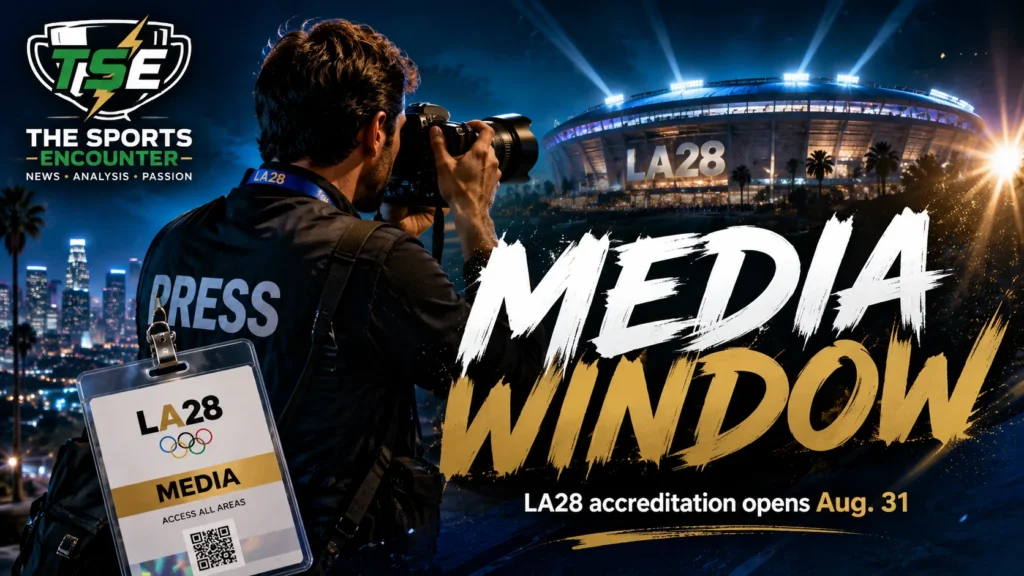
LOS ANGELES: The first serious global competition connected to the Los Angeles 2028 Olympic Games will begin long before athletes start chasing medals.
On August 31, media organisations around the world will begin competing for something equally important to their work: access.
The International Olympic Committee has confirmed that the press accreditation process for the LA28 Olympic Games will open on August 31, 2026, with written press, photographers and non-rights-holding television and radio organisations given until October 23 to submit an expression of interest.
According to the IOC’s official LA28 press accreditation announcement, only 6,000 “E” press accreditations will be available globally.
That number immediately gives the process wider significance.
The Olympics attract thousands of news organisations, agencies, photographers, broadcasters and specialist publishers from almost every corner of the world. Six thousand press places may sound substantial by ordinary sporting standards, but LA28 will bring together one of the largest international media operations in sport.
There is another important distinction. Media organisations will not simply submit an application to the IOC and wait for approval. Expressions of interest will be handled by the National Olympic Committee in the country or territory where each organisation is based. Those NOCs will assess applications and allocate available press accreditations within their respective territories.
Submitting an expression of interest does not guarantee accreditation.
For publishers hoping to report from Los Angeles in 2028, the Olympic journey therefore begins almost two years before the Opening Ceremony.
LA28 Press Accreditation: Key Dates and Details
| Item | Detail |
|---|---|
| Expression-of-interest process opens | August 31, 2026 |
| Deadline | October 23, 2026 |
| Olympic Games dates | July 14-30, 2028 |
| Available “E” press accreditations | 6,000 globally |
| Eligible media | Written press, photographers and non-rights-holding television and radio organisations |
| Initial process | Expression of interest through the Press Registration Portal |
| Who manages applications? | National Olympic Committee in the organisation’s country or territory |
| Does submission guarantee accreditation? | No |
| Who provides application updates? | The relevant National Olympic Committee |
| Olympic Main Press Center | NFL Los Angeles at Hollywood Park, Inglewood |
The First LA28 Race Is a Media Race
The Olympic Games do not begin in Los Angeles until July 14, 2028, but international sports journalism cannot operate on that calendar.
Publishers hoping to cover the Games from inside competition venues have to begin planning now.
The IOC’s accreditation process creates one of the first major institutional deadlines of the LA28 cycle. Media organisations have fewer than two months, from August 31 through October 23, to register their interest in covering an Olympic Games still almost two years away.
That long lead time reflects the scale of Olympic journalism.
Accredited media need access to competition venues, press tribunes, mixed zones, interview areas, press conferences, photography positions, transportation systems and Games-time working facilities.
Thousands of journalists will arrive in Southern California representing different countries, languages, audiences and publishing models.
The IOC therefore has to begin allocating that access long before many Olympic qualification campaigns are complete and before most national teams are known.
The IOC Has Set a Global Quota of 6,000 Press Accreditations
The number likely to attract the greatest attention from publishers is 6,000.
The IOC has established a quota of 6,000 “E” press accreditations for LA28.
Those places will be distributed to press organisations through National Olympic Committees across their respective territories.
🚨Information for the media 🚨
— IOC MEDIA (@iocmedia) August 26, 2026
With less than 2 years to go until @LA28, the press accreditation process begins next week.
Applications open 31 Aug and close 23 Oct 2026. Key information and details are available on the dedicated webpage. 👇
🔗https://t.co/AKIS7Hai14 pic.twitter.com/MaSiLiny9U
The figure is large compared with almost any ordinary sporting event, but the Olympics operate on a completely different scale.
International news agencies will apply. National newspapers and broadcasters will apply. Specialist sports publications, photographers, digital publishers and other established media organisations will also seek access.
That creates competition even before the allocation process begins.
The IOC says its objective is to create a fair and efficient accreditation system that supports comprehensive global coverage while maintaining a professional working environment for accredited press.
For publishers, however, the practical reality is simple: there are more organisations capable of covering the Olympic Games than there are available press accreditations.
National Olympic Committees Hold the Key
One of the most important operational details in the IOC announcement concerns who actually makes the territorial allocation decisions.
Expressions of interest submitted through the Press Registration Portal will be received and managed by the National Olympic Committee in the country or territory where the media organisation is based.
The NOCs remain responsible for assessing applications and allocating available press accreditations.
That means there is no single global queue where every publisher competes under exactly the same circumstances.
A Pakistani sports publisher will enter the process through the relevant Olympic structure in Pakistan. A British publisher will work through its own NOC system. The same principle applies across every participating territory.
National demand, available allocations and local procedures may therefore vary.
The IOC has specifically advised media organisations to contact their relevant NOC for information about the process, territorial timelines and updates on individual applications.
The IOC and LA28 Organising Committee will not provide individual application-status updates.
An Expression of Interest Is Not an Accreditation
This distinction deserves particular attention because it can easily disappear in headlines about the process opening.
August 31 does not begin an automatic registration system in which every eligible publisher receives access.
It begins the expression-of-interest stage.
The IOC explicitly states that submitting an expression of interest does not guarantee accreditation for the LA28 Olympic Games.
Media organisations should therefore approach the process as a competitive allocation exercise rather than an administrative formality.
The IOC has published further guidance through its dedicated LA28 press accreditation page, which will serve as the central reference point for accreditation guidelines, timelines and deadlines.
LA28 Coverage Has Already Started Long Before 2028
For sports publishers, there is another reason the accreditation process feels timely.
The LA28 story is already developing.
Olympic qualification has begun in some sports, while others are establishing competitive structures, qualification pathways and international rivalries that will eventually lead directly into Los Angeles.
Flag football provides one of the clearest examples.
The Sports Encounter has already mapped the qualification pathway for Olympic flag football, where only six men’s and six women’s teams will ultimately compete at LA28.
The 2026 IFAF Flag Football World Championships also changed the competitive landscape, with Canada, Mexico, Italy, American Samoa and other nations showing why Team USA cannot assume Olympic dominance.
Those are LA28 stories even though the Games remain almost two years away.
The same will increasingly become true across cricket, squash, lacrosse, baseball, softball and established Olympic sports as qualification systems develop.
New Olympic Sports Will Demand Specialist Knowledge
Los Angeles 2028 will be particularly demanding for newsrooms because several sports will either debut or return to the Olympic program.
Flag football and squash will make their Olympic debuts. Cricket will return to the Games after an absence of more than a century, while baseball, softball and lacrosse will also appear on the LA28 program.
That creates an obvious challenge for generalist media organisations.
Readers will need more than medal results.
They will need rules explained, qualification systems understood, athletes introduced and tactical differences clarified before competition begins.
The Sports Encounter has already started developing that knowledge base around flag football through its complete beginner’s guide to Olympic flag football rules, scoring and positions.
We have also examined why NFL experience will not automatically translate into Olympic flag football success, because the five-on-five format demands a different tactical skill set.
That is the type of reporting that establishes expertise before an Olympic event suddenly attracts a global audience.
Accreditation Gives Access, but Expertise Has to Come First
An Olympic accreditation can take a journalist closer to the story.
It cannot create knowledge overnight.
This may become particularly important for specialist and independent sports publishers seeking a place within the Olympic media ecosystem.
A newsroom that has followed an Olympic sport for two years will arrive with context that cannot be recreated by reading a briefing document on the morning of competition.
It will already understand the athletes, qualification battles, tactical evolution and major international rivalries.
For example, TSE’s tactical analysis of Olympic flag football goes beyond the basic absence of tackling and examines spacing, blitz structures, no-run zones, motion and route combinations.
Our guide to the international players already shaping Olympic flag football similarly focuses on the athletes building the sport before NFL stars fully enter the LA28 conversation.
That editorial groundwork matters whether a publisher ultimately receives accreditation or covers the Games remotely.
The Main Press Center Is Already Confirmed
LA28 has also decided where much of the Games-time media operation will be based.
NFL Los Angeles at Hollywood Park in Inglewood will serve as the Main Press Center for the 2028 Olympic Games.
The facility is the NFL’s West Coast headquarters and will become a central working hub for thousands of accredited media professionals.
According to LA28’s official Main Press Center announcement, the venue will support media workspaces while also handling operational services including accreditation, transportation and ticketing support.
The location places the Olympic press operation inside one of Southern California’s major sports and entertainment districts.
For journalists who receive accreditation, Hollywood Park will effectively become one of the largest temporary sports newsrooms in the world during the Games.
Los Angeles Will Host the Olympics for the Third Time
LA28 will also carry unusual historical weight.
Los Angeles previously hosted the Olympic Games in 1932 and 1984. When the Games return in 2028, the city will become only the third to stage the Summer Olympics three times.
The Olympic competition is officially scheduled for July 14-30, 2028.
The location adds another layer to the media interest.
Los Angeles sits at the intersection of elite sport, entertainment, technology and global celebrity culture. The region already hosts major franchises across the NFL, NBA, MLB, NHL and MLS, while Hollywood gives the city a media infrastructure unlike almost any previous Olympic host.
LA28 storylines are already reaching beyond traditional Olympic sports.
The question of whether LeBron James could appear at another Olympic Games has already generated debate, despite the basketball tournament remaining two years away.
Meanwhile, Ben Simmons has identified LA28 as part of his longer-term international basketball ambitions with Australia.
Those stories demonstrate how quickly the next Olympic cycle is taking shape.
The Accreditation Deadline Arrives Before Most Olympic Teams Exist
There is an interesting contradiction built into the process.
Press organisations must register their interest by October 23, 2026.
Many of the athletes they may ultimately travel to cover will not qualify for the Olympics until 2027 or 2028.
Some national teams will not be finalized until only weeks before the Games.
Injuries, rankings, qualification tournaments and selection decisions will dramatically change which athletes and sports generate the greatest interest.
Publishers are therefore entering the accreditation process based on their institutional case for covering LA28 rather than a fully known Games-time editorial plan.
That places greater value on a demonstrable history of sports journalism, consistent publication, professional standards and relevant Olympic coverage.
Why the August 31 Date Matters for Independent Sports Publishers
For established international agencies and national broadcasters, Olympic accreditation is a familiar institutional process.
For growing specialist publishers, the situation can be more consequential.
The 6,000-place quota means access cannot be determined by interest alone.
Smaller organisations have to show why their presence contributes something useful to Olympic coverage.
That contribution can come through specialist expertise, audiences underserved by larger publications, geographical relevance, strong digital reach or a consistent editorial record around particular sports.
Scale therefore matters, but it is not the only measure of journalistic value.
A specialist publication that understands a sport deeply can produce coverage that a much larger general newsroom may struggle to replicate.
That is particularly true at an Olympics containing more than 30 sports and hundreds of separate medal events.
Olympic Journalism Will Extend Far Beyond Accredited Venues
Publishers that do not receive one of the 6,000 accreditations will still have substantial opportunities to cover LA28.
Qualification tournaments, rankings, national-team selections, injuries, athlete interviews, tactical analysis, records and broader Olympic developments can all be reported without Games-time venue accreditation.
Accreditation provides physical access.
Editorial authority comes from the reporting itself.
The distinction matters because the modern Olympic audience does not consume coverage through one traditional channel.
Fans discover individual stories through search engines, social media, Google News, newsletters, video platforms and increasingly through AI-assisted search and discovery systems.
A publisher that establishes authority around an Olympic sport before 2028 can therefore become part of the global conversation even without matching the scale of the world’s largest media organisations.
What Media Organisations Need to Do Now
The immediate process begins on August 31.
Eligible organisations seeking LA28 press accreditation should submit an expression of interest through the IOC Press Registration Portal before October 23.
They should also consult the official IOC press release and dedicated accreditation guidance before submitting.
Media organisations should then communicate with the relevant National Olympic Committee about local procedures, timelines and the status of their application.
The IOC and LA28 will not provide individual application updates.
Most importantly, organisations should remember the wording used by the IOC itself.
An expression of interest is the beginning of the process. It is not a guarantee of Olympic accreditation.
The Final Word: LA28 Has Already Started for the World’s Newsrooms
The Olympic flame will not be lit in Los Angeles until July 2028, but for the world’s sports media, LA28 is already becoming an operational reality.
The IOC will open the expression-of-interest process on August 31 and close it on October 23. A global quota of 6,000 “E” press accreditations will be distributed through National Olympic Committees, with those committees responsible for assessing applications within their respective territories.
That process tells us something important about modern Olympic coverage.
The journalism cannot begin when the Opening Ceremony does.
Publishers have to understand qualification systems, identify emerging athletes, build expertise in new Olympic sports and establish credible coverage long before their reporters arrive in Los Angeles.
For the biggest international media organisations, this is part of a familiar Olympic cycle.
For specialist and growing sports publishers, it is an opportunity to demonstrate that meaningful Olympic journalism also comes from publications that identify stories early, understand individual sports deeply and serve audiences that deserve comprehensive coverage.
The athletes are already trying to reach LA28.
Starting August 31, the media organisations hoping to tell their stories from inside the Games begin their own journey toward Los Angeles.
Frequently Asked Questions
When does LA28 press accreditation open?
The IOC’s expression-of-interest process opens on August 31, 2026.
When is the LA28 press accreditation deadline?
Eligible media organisations must submit their expression of interest by October 23, 2026.
How many LA28 press accreditations are available?
The International Olympic Committee has established a global quota of 6,000 “E” press accreditations for the 2028 Olympic Games.
Who can apply for LA28 press accreditation?
The process announced by the IOC covers written press, photographers and non-rights-holding television and radio organisations.
How do media organisations apply?
Eligible organisations must submit an expression of interest through the IOC Press Registration Portal during the August 31 to October 23 application window.
Does submitting an expression of interest guarantee accreditation?
No. The IOC explicitly states that submitting an expression of interest does not guarantee accreditation for LA28.
Who decides which media organisations receive LA28 accreditation?
The National Olympic Committee in the country or territory where the press organisation is based will assess applications and allocate available press accreditations.
Who should media organisations contact about their application?
They should contact their relevant National Olympic Committee. The IOC and LA28 Organising Committee will not provide updates on individual applications.
When will the Los Angeles 2028 Olympic Games take place?
The LA28 Olympic Games are scheduled for July 14-30, 2028.
Where will the LA28 Olympic Main Press Center be located?
NFL Los Angeles at Hollywood Park in Inglewood will serve as the Main Press Center for the 2028 Olympic Games.
What does an “E” accreditation mean at the Olympics?
The “E” category is the Olympic press accreditation category referenced by the IOC for press organisations covering the Games. The IOC has allocated 6,000 of these accreditations for LA28.