


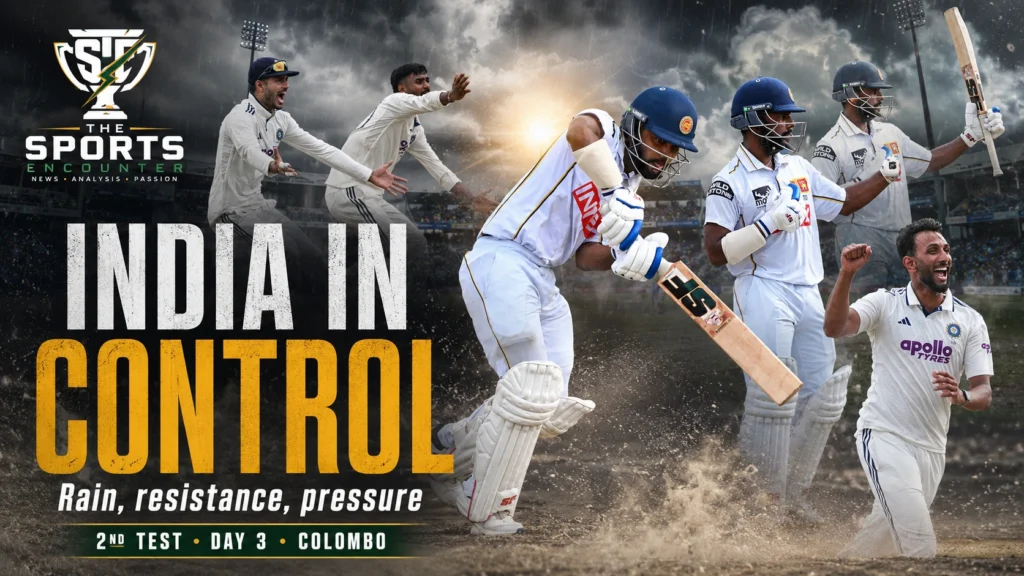
India remain firmly in control of the second Test in Colombo after Sri Lanka closed a rain-shortened third day on 265 for eight, still 238 runs behind the visitors’ imposing 503 for nine declared. Pasindu Sooriyabandara’s composed 80 and Sonal Dinusha’s unbeaten 85 gave the hosts their best resistance, but another weather-hit day still ended with Shubman Gill’s side holding the stronger hand.
The third day at the Sinhalese Sports Club produced 257 runs, six wickets and 80.4 overs before evening rain arrived again and forced an early finish. Sri Lanka began on eight for two and recovered enough to avoid complete collapse, but they remain 39 runs short of the follow-on mark of 304 with only two wickets in hand.
The scoreboard still belongs to India.
The more interesting story lies underneath it.
Sri Lanka have spent most of this series reacting to damage rather than dictating terms, yet Sooriyabandara and Dinusha gave them two performances with value beyond this match. One came from a batter playing only his second Test innings after a debut duck. The other came from a player who is starting to make the lower middle order look like the wrong place for him.
India, meanwhile, will know that the final 38 overs exposed one weakness in an otherwise dominant position. They claimed only one wicket during that period, and once the new-ball movement disappeared, the attack found it much harder to turn control into dismissals.
The ICC’s official Day 3 report described Sri Lanka’s late partnerships as a fightback but confirmed that India remain in control of the second World Test Championship contest.
Sri Lanka vs India 2nd Test: Day 3 Scorecard
| Match Detail | Situation at Stumps |
|---|---|
| Competition | ICC World Test Championship 2025-27 |
| Match | Sri Lanka vs India, 2nd Test |
| Venue | Sinhalese Sports Club, Colombo |
| India first innings | 503/9 declared |
| Sri Lanka first innings | 265/8 in 83.4 overs |
| Sri Lanka trail | 238 runs |
| Follow-on mark | 304 |
| Runs still needed to avoid follow-on | 39 |
| Top Sri Lanka scorer | Sonal Dinusha 85* |
| Pasindu Sooriyabandara | 80 from 133 balls |
| Best India bowling | Prasidh Krishna 3/47, Manav Suthar 3/83 |
| Overs bowled on Day 3 | 80.4 |
| Day 3 runs | 257 |
| Day 3 wickets | 6 |
India Started Day 3 Like a Team Ready to Finish the Job
Sri Lanka resumed on eight for two after losing Lahiru Udara and nightwatchman Prabath Jayasuriya late on the second evening. The danger was obvious. India had already put 503 on the board, and another early cluster of wickets could have turned the third day into a procession.
Prasidh Krishna made that threat immediate.
Kamil Mishara fell for 19, caught by Dhruv Jurel, leaving Sri Lanka 35 for three and exposing a middle order already under enormous scoreboard pressure.
India had seen almost exactly this type of situation in Galle. During the first Test, Sri Lanka also lost early wickets before their lower order was forced into rescue mode. The Sports Encounter’s Day 3 report from the first Test documented how Sonal Dinusha and Niroshan Dickwella had to rebuild from 90 for five simply to keep the follow-on out of play.
Colombo began threatening another version of the same story.
Sooriyabandara refused to let it repeat immediately.
Pasindu Sooriyabandara Turns a Debut Duck Into an 80 That Matters
Sooriyabandara’s 80 from 133 balls may eventually become one of the most important Sri Lankan innings of this short series, even if it does not save the Test.
His debut had produced a duck.
His second innings in Test cricket produced something completely different.
He played late against pace, resisted the temptation to reach for deliveries outside off stump and looked unusually comfortable when Siraj and Prasidh tried to push him backward with short balls.
That last detail mattered.
Young batters entering Test cricket in Sri Lanka are often judged first by how they handle spin. India deliberately tested another part of Sooriyabandara’s game. Once the early seam began fading, their quicks tried to create discomfort through bounce and body-line pressure.
Sooriyabandara kept finding ways to remain balanced.
His half-century came from 76 deliveries, and he built an 87-run fourth-wicket partnership with Kamindu Mendis that carried Sri Lanka from 35 for three to 122 for four.
For a team that entered this series with several batting absences, that matters beyond the current scorecard. The Sports Encounter’s Sri Lanka vs India series preview identified the hosts’ batting depth as one of the central concerns before the first ball was bowled.
Sooriyabandara has now supplied one possible answer.
India Break the Partnership Before Lunch, Then Suthar Hits the Middle Order
Kamindu Mendis made 32 from 58 balls and briefly gave Sooriyabandara the partner Sri Lanka needed.
The stand was not fast enough to change the match, but it was long enough to force India to work through a second phase of the ball rather than simply continuing their opening burst.
Prasidh ended it by removing Kamindu, his third wicket of the innings.
That dismissal reopened the middle order.
Manav Suthar then removed captain Dhananjaya de Silva for eight, leaving Sri Lanka 137 for five.
The left-arm spinner has now become one of India’s biggest stories of the series. He took ten wickets in Galle and entered Colombo with greater responsibility after India again backed a spin-heavy attack.
The first Test had already shown how quickly Suthar can alter a game. By Day 4 in Galle, India were six wickets away from victory after strangling Sri Lanka’s top order, with Suthar central to the control India established across the match.
His Colombo spell has been more expensive, but the wickets have again arrived at useful moments.
Sooriyabandara Falls at 80, and Sri Lanka Threaten to Unravel
Ravindra Jadeja eventually ended Sooriyabandara’s innings for 80.
The wicket came at 171, and Mohammed Siraj then removed Niroshan Dickwella for a three-ball duck two deliveries later.
Sri Lanka had gone from 137 for five to 173 for seven.
This was the moment India appeared ready to run through the remaining batting.
They did not.
That failure to finish the innings is the one part of Day 3 India may revisit critically before the fourth morning.
Sonal Dinusha Is Starting to Make No. 7 Look Too Low
Dinusha has now produced three consecutive scores of 50 or more in Test cricket.
That sequence includes his maiden century in Galle, another important second-innings contribution in the first Test, and this unbeaten 85 in Colombo.
At some point, Sri Lanka’s selectors have to ask whether a batter producing this level of control should continue walking in after so much of the innings has already disappeared.
His 85 has come from 137 deliveries with six fours and two sixes.
The innings did not begin as a counterattack. Dinusha absorbed the pressure first, particularly while wickets were still falling around him. Once India’s bowlers became less threatening, he expanded his scoring options.
He reached fifty from 82 balls.
That is a useful contrast with his century at Galle, where he and Dickwella had to rescue Sri Lanka from collapse. The Sports Encounter’s first-Test analysis showed how Dinusha’s ability to survive long pressure sequences helped Sri Lanka avoid the follow-on there.
He is now doing something similar again.
The pattern is becoming too consistent to dismiss as lower-order resistance.
TSE Analysis: Sri Lanka May Have Found a Batter Who Belongs Higher
Dinusha’s current role gives Sri Lanka insurance.
It may also be wasting part of his value.
A No. 7 batter often has to manage two conflicting jobs. If the top order succeeds, he may be required to accelerate with the tail approaching. If the top order fails, he becomes an emergency repair option.
Dinusha has spent much of this series doing the second job.
His technique suggests he may be capable of more.
He does not appear dependent on one scoring zone. He has shown patience against spin, enough judgment outside off stump to handle pace and the temperament to bat with weaker partners.
Sri Lanka’s recent batting problems make that worth exploring.
The same instability was visible during their Caribbean tour, where the final T20I series defeat again exposed how heavily the innings could depend on a small number of established players. The Sports Encounter examined that pattern after West Indies completed a series win over Sri Lanka.
Test cricket demands a different method, but the structural issue is familiar. Sri Lanka need more batters who can occupy time without becoming trapped.
Dinusha is increasingly looking like one of them.
Keshara Nuwantha Helps Dinusha Turn Survival Into Resistance
Keshara Nuwantha’s 18 from 74 balls will not dominate any scorecard.
It mattered enormously to the shape of the afternoon.
He added 57 with Dinusha for the eighth wicket and forced India to spend more than 20 overs trying to break a partnership that appeared vulnerable when it began.
Suthar eventually removed him at 230 for eight.
India expected that wicket to open the tail.
Lahiru Kumara had other ideas.
India Took Only One Wicket in the Final 38 Overs
This is the part of the day that should concern India most.
Dickwella fell at 173 for seven after 45.3 overs.
Sri Lanka reached stumps at 265 for eight after 83.4 overs.
Across those final 38 overs, India claimed only one wicket.
The problem was not effort.
The problem was declining threat.
Siraj and Prasidh had been dangerous while the ball moved through the air and off the surface. Once that movement disappeared, both quicks increasingly turned toward short-ball plans.
Those tactics produced discomfort without producing wickets.
The spinners also struggled to create sustained uncertainty.
Saransh Jain’s first spell on Test debut was genuinely encouraging. He bowled with flight and drift, repeatedly inviting batters forward rather than simply firing the ball into the surface.
His second spell offered less.
Jadeja and Suthar largely settled into flatter trajectories aimed at the stumps.
That produced control, but not enough chances.
It is the difference India will have to correct quickly on Day 4.
Saransh Jain Shows Enough on Debut to Keep India Interested
Jain finished the day wicketless after 18 overs for 51.
That figure does not tell the whole story.
His first spell contained enough drift and shape to suggest why India selected him for Colombo.
The challenge is maintaining those qualities after batters have seen him once.
Test cricket forces a spinner to solve the same batter several times.
The first spell is introduction.
The second becomes adaptation.
That is where Jain’s work begins.
India’s willingness to introduce another spinner also reflects the deeper transition taking place inside their Test squad. The Sports Encounter’s 19 straight days of Test cricket feature highlighted how this Sri Lanka series sits inside a demanding red-ball stretch where squad depth matters more than ever.
Prasidh Krishna Was India’s Most Effective Bowler
Prasidh’s 3 for 47 from 14 overs gave India the penetration they needed during the first half of the day.
He removed Mishara, broke the Sooriyabandara-Kamindu stand and repeatedly tested Sri Lanka with extra bounce.
His spell also demonstrated why India value him in conditions that do not necessarily scream fast bowling.
Height creates opportunities even when conventional seam movement fades.
The challenge is converting that bounce into dismissals once batters begin expecting it.
The repeated short-ball plan late in the day became increasingly predictable.
Prasidh had already done enough damage to finish as India’s joint-leading wicket-taker, but the final session showed where the attack still missed Jasprit Bumrah’s ability to create wickets from apparently neutral conditions.
Manav Suthar Has Three Wickets, but Colombo Has Been Harder Than Galle
Suthar’s 3 for 83 from 21 overs looks productive.
It has also cost almost four runs per over.
That difference from Galle matters.
The first-Test surface increasingly rewarded spin as the match developed. Colombo has offered less consistent assistance so far, particularly once the ball softened.
Suthar still removed Jayasuriya, Dhananjaya and Nuwantha.
He has therefore continued taking wickets even without dominating every over.
That may actually tell India something useful about his development.
Young spinners cannot expect every surface to behave like Galle.
Finding wickets on flatter days is a different test.
Rain Is Now Sri Lanka’s Most Useful Teammate
Evening rain arrived at 5:02 p.m. local time and ended play roughly an hour earlier than scheduled.
It was another interruption in a Test already shaped by weather.
The covers came on quickly as the light deteriorated and Colombo became increasingly overcast.
India would have preferred another hour with the second new ball.
They took it after 80.3 overs, immediately gaining the harder ball they had been waiting for during a long and increasingly frustrating final session.
Only a few deliveries were possible before the weather intervened.
That timing may have helped Sri Lanka more than anything else during the final hour.
Rain has already been the clearest variable capable of reducing India’s winning time. The same issue appeared during the first Test, when weather repeatedly threatened to interfere with a match India otherwise controlled. Our Galle Day 4 report showed how India had to manage both the scoreboard and the clock before completing the job.
Colombo is beginning to create a similar calculation.
The Follow-On Is Still Technically Alive
Sri Lanka need 39 more runs to reach 304 and remove the follow-on option.
Whether India would actually enforce it is another matter.
The visitors have already spent 80.4 overs in the field on Day 3.
If Sri Lanka are dismissed below 304 on the fourth morning, Gill would have to balance the attraction of making the hosts bat again immediately against the physical cost of asking his bowlers to continue without meaningful recovery.
Weather complicates the decision.
India lead the series 1-0 after winning the first Test in Galle by 165 runs. The ICC’s official first-Test report confirmed how important that result was for India’s World Test Championship position.
A draw in Colombo would still deliver the series.
A victory would provide more valuable WTC points.
That may encourage India to prioritize time over convention.
Would India Really Bat Again?
If Sri Lanka fall short of 304, Gill has three broad choices.
He can enforce the follow-on immediately.
He can bat again and try to create a massive fourth-innings target.
Or he can make the decision based almost entirely on the weather forecast and the condition of his bowlers.
The traditional logic of Test cricket would favor the follow-on when a team leads by more than 200.
Modern workload management makes the decision less automatic.
India’s quicks have already bowled long spells. The spinners have carried substantial workloads. Colombo’s heat and humidity add another physical layer.
The ICC World Test Championship schedule also reinforces why every result matters. India cannot simply think about winning the series. Championship points travel beyond Colombo.
The likely preference may therefore depend on how quickly the final two Sri Lankan wickets fall.
India’s 503 Has Made Every Sri Lankan Partnership Defensive
The central reason India remain so far ahead is still their first innings.
Devdutt Padikkal made 117.
Dhruv Jurel finished unbeaten on 115.
Rishabh Pant contributed 63, Shubman Gill made 50 and Ravindra Jadeja added 43.
That depth pushed India to 503 for nine before Gill declared.
The total means Sri Lanka have spent their entire innings measuring themselves against survival thresholds.
First came the need to avoid collapse.
Then came the follow-on.
Next comes the first-innings deficit.
India’s ability to generate runs from several parts of the order has been visible throughout their recent cricket. The Sports Encounter saw the same broader batting depth during India’s white-ball tour of England, including the ODI victory built around contributions from multiple experienced batters and Axar Patel.
The formats are different. The underlying advantage is familiar.
India are difficult to contain because the innings does not depend on one scorer.
SSC Has Already Produced Very Different Cricket This Summer
The Sinhalese Sports Club has seen plenty of high-level cricket during the Sri Lankan season, including the Lanka Premier League.
The Sports Encounter covered Galle Gallants’ five-wicket win over Colombo Kaps at the SSC, a match in which 379 runs were scored across 39.2 overs.
Test cricket has presented the same venue with a completely different problem.
The surface has been good enough for long partnerships, yet not so flat that wickets are impossible.
That balance explains why India’s first-innings total carries so much value.
They occupied enough time to remove much of Sri Lanka’s freedom.
The Bigger World Test Championship Picture Still Favors India
This series began with both teams needing points.
India arrived outside the top two in the World Test Championship standings.
Sri Lanka were also trying to keep themselves relevant after an inconsistent start to the cycle.
India’s victory at Galle strengthened their position.
A second consecutive win would change the conversation again.
The Sports Encounter’s original series analysis described these two Tests as a litmus test for two injured, evolving squads.
Three days into the second Test, India have handled that examination better.
TSE Verdict: India Own the Test, Sri Lanka Own the Best Individual Story
Day 3 belonged to India in the only measurement that ultimately decides Test matches.
They remain 238 runs ahead.
Sri Lanka have only two first-innings wickets remaining.
The follow-on remains possible.
India still possess enough time to force a result if the weather cooperates.
Yet the most encouraging individual developments belonged to Sri Lanka.
Sooriyabandara responded to a debut duck with an 80 that looked technically secure against both pace and spin.
Dinusha followed his first-Test century with another unbeaten innings that strengthens the argument for moving him higher in the batting order.
Those performances may matter considerably after this series ends.
India have fewer long-term questions arising from the day.
Their concern is narrower: once the ball became old and the pitch stopped offering movement, the attack struggled to finish the innings.
One wicket in the final 38 overs is a statistic Gill and the bowling group will notice.
The second new ball should give them another opportunity on Thursday morning.
Whether Colombo’s weather allows them to use it for long enough remains the larger uncertainty.
What India Need on Day 4
The immediate objective is straightforward.
Remove Dinusha before he converts another lower-order rescue into a century.
Dismiss Kumara and Asitha Fernando quickly.
Then decide whether the follow-on, another batting innings or an aggressive declaration offers the clearest route to victory.
The second new ball should make Siraj and Prasidh more dangerous than they looked during the final session.
India cannot afford another 30-over lower-order partnership if rain continues removing playing time.
What Sri Lanka Need on Day 4
Dinusha is the entire equation.
The hosts need 39 runs to avoid the follow-on and another 238 simply to draw level with India.
Those are very different objectives.
The first is realistic.
The second requires something extraordinary.
Dinusha must protect the tail without becoming so defensive that Sri Lanka stop moving toward 304.
Kumara has already survived 50 balls for his eight runs.
If he can continue occupying the crease, Dinusha has enough form to take Sri Lanka beyond the follow-on line.
From there, the weather and India’s tactical decisions become increasingly relevant.
Final Analysis
India have not produced a flawless third day.
They did not need one.
The 503 they built across the first two days gave them enough margin to absorb Sri Lanka’s best batting resistance and still finish Tuesday with control of the match.
Sooriyabandara’s 80 was a genuine Test innings from a player who needed one badly.
Dinusha’s unbeaten 85 was another piece of evidence that Sri Lanka may be batting one of their most composed players too low.
The hosts can take encouragement from both.
They cannot take much comfort from the scoreboard.
India remain 238 runs ahead, have the second new ball available and require only two wickets to end the innings.
The most effective resistance Sri Lanka received all day may ultimately have come from the Colombo sky.
Rain ended play early again.
If it stays away on Day 4, India still have more than enough control to turn this advantage into a series-clinching victory.
Frequently Asked Questions
What is the score in the Sri Lanka vs India second Test after Day 3?
Sri Lanka are 265 for eight in their first innings after India declared on 503 for nine. Sri Lanka trail by 238 runs.
How many runs does Sri Lanka need to avoid the follow-on?
Sri Lanka need another 39 runs to reach 304 and prevent India from having the option to enforce the follow-on.
Who top-scored for Sri Lanka on Day 3?
Pasindu Sooriyabandara made 80, while Sonal Dinusha remains unbeaten on 85 at stumps.
How many wickets did India take on Day 3?
India took six wickets during the 80.4 overs bowled on the third day.
Who is India’s leading wicket-taker in Sri Lanka’s first innings?
Prasidh Krishna and Manav Suthar have taken three wickets each. Prasidh has figures of 3 for 47, while Suthar has 3 for 83.
How did Saransh Jain bowl on Test debut?
Saransh Jain finished Day 3 wicketless with 0 for 51 from 18 overs. His first spell showed encouraging flight and drift, although he created fewer problems during his second spell.
Why did play end early in Colombo?
Rain arrived shortly after 5 p.m. local time and eventually forced stumps before the scheduled close.
Will India enforce the follow-on?
India will only have that option if Sri Lanka are dismissed below 304. Whether Shubman Gill uses it will likely depend on how quickly the innings ends, the condition of his bowlers and the weather forecast.
Who won the first Test between Sri Lanka and India?
India won the first Test in Galle by 165 runs and lead the two-match series 1-0.
When does Day 4 begin?
Day 4 is scheduled to begin at 9:45 a.m. local time in Colombo, weather permitting.