


Cincinnati began as the final major examination before the US Open.
It ended by changing the questions New York will have to answer.
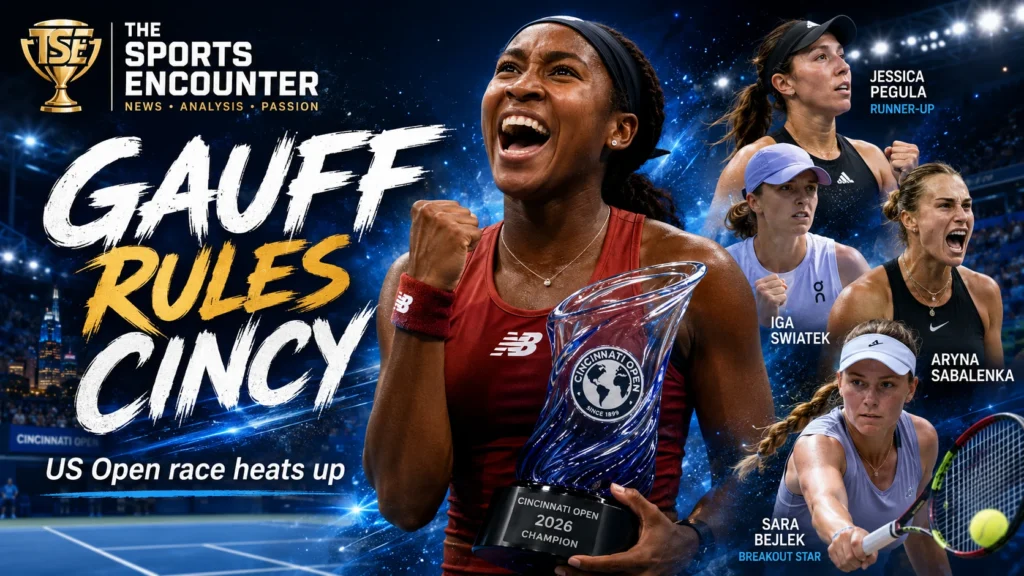
Coco Gauff defeated Jessica Pegula 6-2, 6-4 in Sunday’s women’s singles final to win her second Cincinnati Open title, completing a tournament in which the American gradually transformed from another dangerous contender into arguably the most convincing player of the final three rounds.
The trophy matters.
The timing matters more.
The 2026 US Open main draw begins on August 30, barely one week after Cincinnati’s conclusion, leaving almost no time for the leading women to rebuild confidence, recover from injuries or correct weaknesses exposed in Ohio.
Gauff leaves Cincinnati with a trophy, seven consecutive straight sets won to close the tournament and renewed evidence that the aggressive tactical changes in her game are beginning to hold up when the stakes rise.
Pegula leaves without the title but with victories over Amanda Anisimova and defending champion Iga Swiatek, two results that should matter considerably more than a disappointing final.
Swiatek leaves after a 10-match winning streak was finally stopped.
Elena Rybakina leaves with an ankle problem hanging over her US Open preparation.
Aryna Sabalenka leaves after being beaten by one of the most extraordinary breakout performers of the North American summer.
And 20-year-old Sara Bejlek leaves Cincinnati having transformed her reputation in less than a week.
This was not simply another WTA 1000.
It became the last serious stress test before New York.
Cincinnati 2026 Women’s Final Eight
| Round | Match | Result |
|---|---|---|
| Quarterfinal | Jessica Pegula vs Amanda Anisimova | Pegula 6-4, 2-6, 7-6(4) |
| Quarterfinal | Iga Swiatek vs Elena Rybakina | Swiatek led 4-1 when Rybakina retired |
| Quarterfinal | Sara Bejlek vs Madison Keys | Bejlek 3-6, 6-4, 7-6(5) |
| Quarterfinal | Coco Gauff vs Marta Kostyuk | Gauff 6-2, 6-2 |
| Semifinal | Jessica Pegula vs Iga Swiatek | Pegula 7-5, 4-6, 6-4 |
| Semifinal | Coco Gauff vs Sara Bejlek | Gauff 6-4, 6-1 |
| Final | Coco Gauff vs Jessica Pegula | Gauff 6-2, 6-4 |
The complete tournament draw and official results are available through the WTA Cincinnati Open tournament page.
The Final: Gauff Turns an All-American Occasion Into Her Match
The Cincinnati final carried more history than the scoreline eventually suggested.
Gauff and Pegula became the first two Americans to contest the women’s singles final here since Rosemary Casals defeated Nancy Richey in 1970.
No all-American Cincinnati women’s final had occurred during the WTA 1000 era, which began in 2009.
The symbolism was impossible to miss.
Two Americans.
Two Top 4 players.
Two former doubles partners.
One week before the US Open.
Yet once the match began, Gauff did not allow the occasion to become complicated.
She raced to a 5-0 lead in the first set.
Pegula briefly slowed the momentum, but the opening set had already been structurally decided. Gauff was controlling return games, attacking with more authority from the forehand side and preventing Pegula from consistently establishing the compact baseline patterns she prefers.
The second set was tighter.
Pegula began finding cleaner first-strike combinations and forced Gauff to defend more frequently.
Gauff still found the decisive break.
She closed the championship 6-2, 6-4 and collected the 12th singles title of her career.
According to the WTA, it was also Gauff’s eighth title on outdoor hard courts and seventh at WTA 1000 level.
Those numbers are beginning to define her more accurately than age does.
Gauff is still only 22.
Her résumé increasingly belongs to someone who has already been operating near the top of the sport for years.
Two Cincinnati Titles Put Gauff in a Different Category
Her first Cincinnati championship came in 2023.
That tournament became the launching pad for her first US Open title weeks later.
Three years later, the comparison is impossible to avoid.
The circumstances are different.
The player is different too.
In 2023, Cincinnati represented a breakthrough.
In 2026, it represents validation.
Gauff is no longer discovering whether she can win a major North American hard-court tournament.
She is demonstrating that she can return to the same event, navigate a completely different draw and win it again.
There is also a useful contrast with what happened only days earlier in Canada.
Gauff reached the National Bank Open semifinals before losing to Elena Rybakina 7-5, 2-6, 2-6.
The Sports Encounter’s analysis of that Toronto semifinal showed how Rybakina increasingly controlled the match once Gauff’s second serve and forehand came under pressure.
Cincinnati offered the response.
Gauff did not abandon aggression after Toronto exposed the risk.
She refined it.
The Most Important Change Was Not Her Serve
Gauff’s serve will always dominate discussion because double faults can become highly visible when her timing disappears.
The more interesting development in Cincinnati was her court position.
She came forward more frequently.
She looked for opportunities to finish points before opponents could reset.
Her quarterfinal against Marta Kostyuk provided perhaps the clearest example.
Gauff won 6-2, 6-2 in only 70 minutes.
The WTA noted that she broke serve six times and used increasingly assertive net play as part of a tactical shift that had been developing throughout the week.
That matters enormously before the US Open.
Gauff’s defensive ability is already among the best in women’s tennis.
Her movement allows her to survive points that most players lose.
The next step in her evolution has always been finding ways to shorten points when she has created an advantage.
Cincinnati suggested that process is accelerating.
During Toronto, our National Bank Open quarterfinal analysis highlighted how Gauff’s return game could carry her even when other parts of the performance fluctuated.
In Cincinnati, she added another layer.
She started turning good returns into forward movement.
That is a far more dangerous version of Coco Gauff.
Quarterfinal: Gauff Removes Kostyuk Before the Match Can Become Complicated
Marta Kostyuk entered the quarterfinal after one of the more impressive recoveries of the tournament.
She had beaten Mirra Andreeva 4-6, 6-0, 6-2 in the previous round.
That result mattered because Kostyuk had absorbed an opening-set loss against one of the game’s most talented young players and then completely reversed the match.
Gauff never allowed her that opportunity.
The American attacked the return immediately and prevented Kostyuk from gaining scoreboard security.
Once Gauff established control of the baseline exchanges, Kostyuk had to hit closer to the lines to shorten points.
Errors followed.
The match lasted 70 minutes.
Gauff lost only four games.
More importantly, she entered the semifinal without carrying unnecessary physical or emotional damage.
Sara Bejlek Was the Tournament’s Real Discovery
Gauff won Cincinnati.
Sara Bejlek changed her career there.
The 20-year-old Czech began the tournament ranked No. 35.
She left with her first Top 30 ranking.
Between those points came one of the most remarkable runs produced by any player on the WTA Tour this summer.
Bejlek defeated former French Open champion Barbora Krejcikova.
She recovered from a set down to beat Ekaterina Alexandrova.
Then came Aryna Sabalenka.
World No. 1.
One of the biggest hitters in tennis.
The player most opponents spend entire matches trying to prevent from attacking.
Bejlek beat her 7-6(7), 6-4.
It was Bejlek’s first career victory over a Top 10 player.
It was also her first victory against a world No. 1.
The significance became even greater because of how she won.
Bejlek Refused to Accept the Scoreboard Against Sabalenka
Bejlek trailed 5-1 in the first-set tiebreak.
Against Sabalenka, that normally feels terminal.
The Czech kept playing.
She turned the breaker around and won it 9-7.
Sabalenka then had opportunities to establish control in the second set.
Again, Bejlek refused to disappear.
The 7-6(7), 6-4 victory sent her into the first WTA 1000 quarterfinal of her career.
It also removed the No. 1 player in the world from the final major preparation tournament before New York.
For readers who followed The Sports Encounter’s coverage of Sabalenka and Pegula exiting early in Toronto, Cincinnati created a remarkable continuation.
Sabalenka arrived in Ohio looking for a reset.
Instead, another opponent outside the obvious championship group found a way through her.
Quarterfinal: Bejlek Somehow Escapes Again
The Sabalenka victory could easily have become the emotional summit of Bejlek’s tournament.
Madison Keys made sure she had no time to celebrate it.
Keys took the opening set 6-3.
Bejlek responded 6-4 in the second.
The deciding set became another psychological test.
Bejlek fell behind 4-2 in the third-set tiebreak.
Once again, the scoreboard told her she was close to elimination.
Once again, she ignored it.
Bejlek won five of the final six points and defeated Keys 3-6, 6-4, 7-6(5).
That sent her into her first WTA 1000 semifinal.
Two consecutive matches.
Two former major champions or world-class names across the net.
Two situations in which Bejlek appeared to be slipping toward defeat.
Two recoveries.
The quality that distinguished her run was not simply shotmaking.
It was emotional refusal.
Gauff Ends the Bejlek Run Before It Becomes Another Escape
The semifinal was the first time during the closing stages that Bejlek could not extend the match once it began moving away from her.
Gauff won 6-4, 6-1 in 76 minutes.
The first set remained competitive.
That was enough for Gauff to understand the danger.
Bejlek had already proven that leaving the door open was risky.
Gauff closed it.
The second set became progressively one-sided as Bejlek’s unforced errors increased and Gauff’s return pressure intensified.
The loss does almost nothing to reduce what Bejlek achieved.
Her ranking moved into the Top 30 for the first time.
She arrived in Cincinnati as an interesting young player.
She leaves as someone nobody in the US Open draw will want to see early.
Pegula’s Cincinnati Was Better Than the Final Makes It Look
Finals distort tournaments.
A player can spend 10 days producing elite tennis and have the entire run reduced to the final score.
Jessica Pegula should not be assessed that way.
Her route to the championship match was arguably more difficult than Gauff’s.
She beat Amanda Anisimova in one of the most competitive quarterfinals of the tournament.
Then she defeated Iga Swiatek in a nearly three-hour semifinal.
Both victories required problem-solving under pressure.
That is excellent preparation for New York.
Quarterfinal: Pegula Survives Anisimova and Herself
Pegula entered her quarterfinal against Amanda Anisimova with a perfect 5-0 career record against her fellow American.
For long stretches, that history appeared to matter very little.
Pegula took the first set 6-4.
Anisimova responded by dominating the second 6-2.
The deciding set became increasingly tense.
Pegula moved ahead 5-3 and appeared ready to close the match.
She could not.
Anisimova fought back and forced a tiebreak.
That is where Pegula recovered her composure.
She won the breaker 7-4 to complete a 6-4, 2-6, 7-6(4) victory.
The result extended her perfect record against Anisimova to six victories.
It also gave Pegula the kind of match a player often needs before a Grand Slam.
She was tested physically.
She lost control.
She rebuilt it.
Anisimova Remains One of the Most Dangerous Players in New York
The loss should not remove Amanda Anisimova from the US Open conversation.
She remains a Top 10 player and reached the 2025 US Open final.
Her Cincinnati run included a 6-1, 6-4 victory over Wimbledon champion Linda Noskova.
That was an important result.
Noskova entered the North American swing as a newly crowned Grand Slam champion after her historic Wimbledon run, which The Sports Encounter covered throughout the second week, including the all-Czech semifinal story that created the Wimbledon final.
Anisimova dismantled her.
That level remains dangerous even if Pegula ultimately survived.
Swiatek Reached Cincinnati Carrying a Nine-Match Winning Streak
Iga Swiatek arrived in Cincinnati directly after winning Toronto.
Her 6-2, 6-3 victory over Elena Rybakina in the National Bank Open final gave her a 26th career title and 12th WTA 1000 crown.
That championship also moved her ahead of Sabalenka for the second-most WTA 1000 titles since the category was introduced in 2009, behind only Serena Williams.
The Sports Encounter tracked Swiatek’s progression throughout Toronto, including her dominant quarterfinal victory over Diana Shnaider and the increasingly controlled tennis that replaced the instability of her earlier rounds.
Cincinnati initially looked like a continuation.
Swiatek defeated Diane Parry to reach the 30th WTA 1000 quarterfinal of her career.
She had reached at least the quarterfinal stage in 30 of the first 48 WTA 1000 tournaments she had played.
That level of consistency is extraordinary.
Then her quarterfinal against Rybakina ended before it truly began.
Rybakina’s Ankle Is Now One of the US Open’s Biggest Unknowns
Rybakina retired while trailing Swiatek 4-1 in the first set because of a left ankle injury.
The retirement ended her Cincinnati run and stopped a potential challenge for the world No. 1 ranking.
More importantly, it created an immediate US Open concern.
Rybakina had been one of the strongest players of the North American hard-court swing.
She reached the Toronto final.
Her route there included a comeback against Naomi Osaka and a three-set victory over Gauff.
The Sports Encounter’s Toronto semifinal preview highlighted how her serve and first-strike tennis were becoming increasingly difficult to contain.
She then beat Gauff to reach the final.
Swiatek stopped her there.
Cincinnati was supposed to provide another opportunity.
The ankle changed that calculation entirely.
The US Open begins too quickly for recovery questions to be treated casually.
Semifinal: Pegula Ends Swiatek’s 10-Match Winning Streak
Pegula’s 7-5, 4-6, 6-4 victory over Swiatek was probably the best women’s match of Cincinnati’s final weekend.
It lasted close to three hours.
It changed direction repeatedly.
Swiatek won the second set and moved ahead 3-1 in the decider.
At that stage, the Toronto champion seemed ready to extend a winning streak that had reached 10 matches.
Pegula refused.
She recovered the break.
She began winning more of the exchanges in which Swiatek normally establishes control through depth.
At 5-4, Pegula completed the comeback.
The victory gave her another Cincinnati final and one of the best wins of her season.
That should matter greatly before New York.
Beating Swiatek after falling behind in a deciding set requires more than clean ball-striking.
It requires the ability to keep adjusting when the opponent has already found a successful pattern.
Pegula showed that.
The Final Exposed the Difference Between Surviving and Dictating
Pegula survived almost everything Cincinnati threw at her.
Gauff dictated the final.
That difference produced the championship.
Pegula’s compact strokes work best when she can take the ball early and establish predictable court geometry.
Gauff prevented that.
She returned with enough depth to move Pegula backward.
She defended when necessary.
She attacked sooner than she often has in the past.
The first five games were particularly important.
Gauff’s 5-0 lead removed the possibility of a patient opening.
Pegula was forced to chase almost immediately.
Against one of the fastest defenders in the sport, chasing the score can become tactically expensive.
Cincinnati’s Final Was Also an American Tennis Statement
Gauff and Pegula contesting the first all-American Cincinnati women’s final since 1970 carries additional significance because of what comes next.
The US Open field is unusually deep with American women.
Gauff is ranked No. 4.
Pegula is No. 3.
Anisimova is inside the Top 10.
Iva Jovic has climbed into the Top 20.
Sloane Stephens, Sofia Kenin and Venus Williams are also part of the New York field through direct entry or wild cards.
The US Open’s official entry information lists the United States as the nation with the most direct entrants, including 14 women.
The question is therefore no longer whether America has enough players capable of producing a deep run.
The question is whether one of them can finish it.
Gauff already has.
She won New York in 2023.
Pegula reached the final in 2024.
Anisimova reached the final in 2025.
Cincinnati has now produced another all-American championship match.
That is a significant three-year pattern.
The US Open Race Has Changed in One Week
The Sports Encounter’s original US Open 2026 women’s preview identified Sabalenka, Swiatek, Gauff, Rybakina and the wider American group as central contenders.
Cincinnati has altered the weight of those arguments.
| Player | Cincinnati Outcome | US Open Signal |
|---|---|---|
| Coco Gauff | Champion | Momentum, improved attacking intent and second Cincinnati title |
| Jessica Pegula | Finalist | Elite hard-court form and wins over Anisimova and Swiatek |
| Iga Swiatek | Semifinalist | Toronto champion, 10-match winning streak ended narrowly |
| Sara Bejlek | Semifinalist | Breakout threat after beating Sabalenka and Keys |
| Elena Rybakina | Quarterfinal retirement | Form remains strong but ankle fitness becomes critical |
| Amanda Anisimova | Quarterfinalist | Still dangerous after beating Wimbledon champion Noskova |
| Aryna Sabalenka | Round of 16 | Another early North American exit creates questions |
| Madison Keys | Quarterfinalist | Competitive but unable to close Bejlek after winning first set |
Gauff Might Be the Most Complete US Open Candidate Right Now
That statement would have been much harder to make after Toronto.
Cincinnati changed it.
Gauff’s case rests on more than winning the trophy.
She already possesses several of the qualities most useful at the US Open.
Elite movement.
Elite returning.
Experience inside Arthur Ashe Stadium.
A major title in New York.
The ability to survive physical matches.
Now there is evidence of more purposeful front-foot tennis.
If that development survives the pressure of a Grand Slam, opponents may have fewer obvious routes into her game.
Her forehand can still be attacked.
Her second serve can still become vulnerable.
Those problems have not vanished.
The difference is that Gauff appears increasingly capable of preventing opponents from spending enough time attacking them.
Pegula May Have Lost the Final and Improved Her US Open Case
That sounds contradictory.
It is not.
Pegula already knows how to reach a US Open final.
The question has been whether she can consistently defeat multiple elite opponents during the same two-week major.
Cincinnati offered evidence.
Anisimova pushed her into three sets.
Pegula survived.
Swiatek pushed her into three sets.
Pegula came from behind in the decider and won.
Gauff was one challenge too many.
That does not erase the previous two.
After the final, Pegula’s message was essentially to clear the disappointment quickly and move toward New York.
That is probably exactly the correct approach.
Swiatek’s Loss Should Be Viewed in Context
Swiatek did not leave Cincinnati badly.
She lost an excellent semifinal to the world No. 3 after arriving directly from a title run in Toronto.
That combination matters physically.
Extended WTA 1000 tournaments followed by another WTA 1000 create an unusual workload before a Grand Slam.
Swiatek still won 10 consecutive matches across Toronto and Cincinnati before Pegula stopped her.
Her Toronto performance had already repaired some of the uncertainty created by a turbulent grass season.
The Sports Encounter followed that transformation throughout the Canadian event, including her early hard-court reset and later progression into the semifinals.
New York will now test whether the accumulated workload becomes a problem or whether the match rhythm creates an advantage.
Sabalenka Suddenly Has the Most Complicated Favorite’s Case
Aryna Sabalenka remains world No. 1.
She remains the defending US Open champion after beating Amanda Anisimova in the 2025 final.
She remains one of the two or three most intimidating hard-court players in women’s tennis when her first strike is working.
Cincinnati still matters.
Bejlek did more than catch her on a poor day.
The Czech recovered from difficult scoreboard positions and forced Sabalenka to keep playing under pressure.
This followed another premature exit in Toronto.
Two tournaments do not erase Sabalenka’s status.
They do remove the assumption that she enters New York with irresistible North American momentum.
Rybakina Could Become the Draw’s Biggest Fitness Variable
If healthy, Rybakina belongs near the top of any US Open contender list.
Her hard-court tennis before the ankle issue supported that conclusion.
She reached the Toronto final.
She beat Gauff.
She repeatedly survived difficult matches.
She entered Cincinnati as the world No. 2.
The ankle now changes everything.
The problem with injuries immediately before Grand Slams is that even recovery creates uncertainty.
Rest protects the body.
Rest also removes match repetitions.
The US Open draw will not provide extra time for a player to rediscover confidence.
Bejlek Has Become the Early-Round Opponent Nobody Wants
The official WTA rankings after Cincinnati move Sara Bejlek into the Top 30 for the first time.
That ranking jump is the statistical summary.
Her tennis provides the more interesting explanation.
She can defend.
She can redirect.
She does not appear intimidated by scoreboard deficits.
Most importantly, Cincinnati proved she can absorb the pace of elite opponents without becoming passive.
Her first Top 10 victory came against the No. 1 player in the world.
That is unusual.
Following it by beating Madison Keys makes it much harder to dismiss the Sabalenka result as an isolated upset.
Cincinnati Also Revealed the Cost of the Expanded Hard-Court Calendar
There was another storyline running beneath the results.
Fatigue.
Rybakina retired injured.
Swiatek entered after winning Toronto.
Pegula endured multiple long three-set matches.
Gauff had already played a deep Canadian run before Cincinnati.
Elina Svitolina withdrew earlier in Cincinnati because of an ankle issue after aggravating a problem carried from Toronto.
The modern North American swing is becoming as much about managing load as collecting ranking points.
Cincinnati is officially the biggest tune-up before the US Open, but the best preparation is no longer automatically the deepest possible run.
There is a point where match sharpness becomes fatigue.
Every contender now has less than a week to decide where that line sits.
What Cincinnati Means for the US Open 2026
The 2026 US Open singles main draw begins Sunday, August 30 at the USTA Billie Jean King National Tennis Center.
The women’s draw will be revealed on Thursday, August 27, according to the official US Open website.
That draw could become unusually important.
Cincinnati has created several dangerous players outside the very top seeds.
Bejlek is now one of them.
Anisimova is another.
Keys remains capable of beating almost anyone if her first-strike game catches fire.
Noskova is the reigning Wimbledon champion despite her Cincinnati defeat.
Naomi Osaka continues rebuilding.
Mirra Andreeva remains one of the most talented young players on tour.
A contender’s championship probability may depend heavily on which combination appears in her quarter.
TSE US Open Power Read After Cincinnati
| Tier | Player | Why |
|---|---|---|
| Hottest contender | Coco Gauff | Cincinnati champion, home major experience, improved attacking patterns |
| Most battle-tested | Jessica Pegula | Beat Anisimova and Swiatek in consecutive three-set matches |
| Most consistent recent elite form | Iga Swiatek | Toronto champion and Cincinnati semifinalist with 10 straight wins before losing |
| Highest ceiling with unanswered concern | Elena Rybakina | Toronto finalist whose Cincinnati run ended through ankle injury |
| Champion under pressure | Aryna Sabalenka | Defending US Open champion but early exits in Toronto and Cincinnati |
| Breakout danger | Sara Bejlek | Beat Sabalenka and Keys, reached first WTA 1000 semifinal |
| Dangerous second tier | Amanda Anisimova | 2025 US Open finalist and powerful hard-court game remains intact |
The Hidden Cincinnati Story: Women’s Tennis Has Become Harder to Predict
The easiest mistake before New York would be to reduce the women’s tournament to four names.
Cincinnati argues against that.
Sabalenka lost to Bejlek.
Keys then lost to Bejlek.
Wimbledon champion Noskova lost convincingly to Anisimova.
Rybakina was injured.
Swiatek was beaten from a break up in the deciding set.
The eventual final featured two Americans who know each other extremely well.
The hierarchy exists.
It is increasingly vulnerable.
That is what could make the 2026 US Open women’s draw exceptional.
Gauff Has Recreated a Familiar Cincinnati-to-New York Path
There is one final piece of history that tennis fans will immediately recognize.
In 2023, Gauff won Cincinnati.
She then went to New York and won the US Open.
Three years later, she has won Cincinnati again.
The temptation will be to treat the sequence as destiny.
Tennis rarely works that neatly.
The useful comparison is psychological rather than mystical.
Gauff will enter New York knowing she has already beaten several different styles on American hard courts.
She will arrive with a recent trophy.
She will arrive with evidence that tactical adjustments are working.
And unlike 2023, she arrives knowing exactly what Arthur Ashe Stadium feels like on championship night.
That makes her dangerous in a completely different way.
The Sports Encounter Verdict
Cincinnati did not give us a guaranteed US Open champion.
It gave us a much better map of the women’s field.
Gauff leaves Ohio with the strongest momentum.
Pegula leaves with perhaps the most valuable sequence of difficult victories.
Swiatek leaves with defeat but little reason for alarm after a title and a semifinal in consecutive WTA 1000 tournaments.
Sabalenka remains the defending champion and world No. 1, yet her North American preparation has produced more questions than expected.
Rybakina’s tennis belongs among the favorites.
Her ankle must now cooperate.
Bejlek has become the player every seeded contender will quietly hope appears somewhere else in the draw.
And the American women arrive in New York with something they have rarely possessed simultaneously: depth, form and multiple proven championship candidates.
The Cincinnati trophy belongs to Coco Gauff.
The tournament’s larger consequence belongs to the US Open.
New York looked competitive before Cincinnati.
Now it looks volatile.
That may be the best possible setup for the final Grand Slam of 2026.
Frequently Asked Questions
Who won the 2026 Cincinnati Open women’s singles title?
Coco Gauff defeated Jessica Pegula 6-2, 6-4 to win the 2026 Cincinnati Open women’s singles championship.
How many Cincinnati titles has Coco Gauff won?
Gauff has won Cincinnati twice, in 2023 and 2026.
How many career singles titles does Coco Gauff have?
The Cincinnati championship was Gauff’s 12th career WTA singles title.
How many WTA 1000 titles has Gauff won?
Cincinnati gave Gauff her seventh WTA 1000 singles title.
Who did Jessica Pegula beat to reach the final?
Pegula defeated Amanda Anisimova in the quarterfinals and Iga Swiatek in the semifinals.
What happened in Pegula vs Swiatek?
Pegula defeated Swiatek 7-5, 4-6, 6-4 after recovering from 3-1 down in the deciding set. The loss ended Swiatek’s 10-match winning streak.
Who was the breakout player at Cincinnati?
Sara Bejlek produced the biggest breakthrough, defeating world No. 1 Aryna Sabalenka and Madison Keys before losing to Gauff in the semifinals.
What ranking did Sara Bejlek reach after Cincinnati?
The 20-year-old Czech entered the Top 30 for the first time after reaching her maiden WTA 1000 semifinal.
Why did Elena Rybakina retire?
Rybakina retired from her quarterfinal against Iga Swiatek because of a left ankle injury while trailing 4-1 in the first set.
Is Aryna Sabalenka still the US Open favorite?
Sabalenka remains world No. 1 and defending US Open champion, but early exits in Toronto and Cincinnati have strengthened the cases of Gauff, Swiatek, Pegula and other contenders.
When does the 2026 US Open women’s singles tournament begin?
Main-draw singles play begins Sunday, August 30, 2026, at the USTA Billie Jean King National Tennis Center in New York.
When will the 2026 US Open women’s draw be released?
The official US Open website says the women’s singles draw will be revealed Thursday, August 27.