


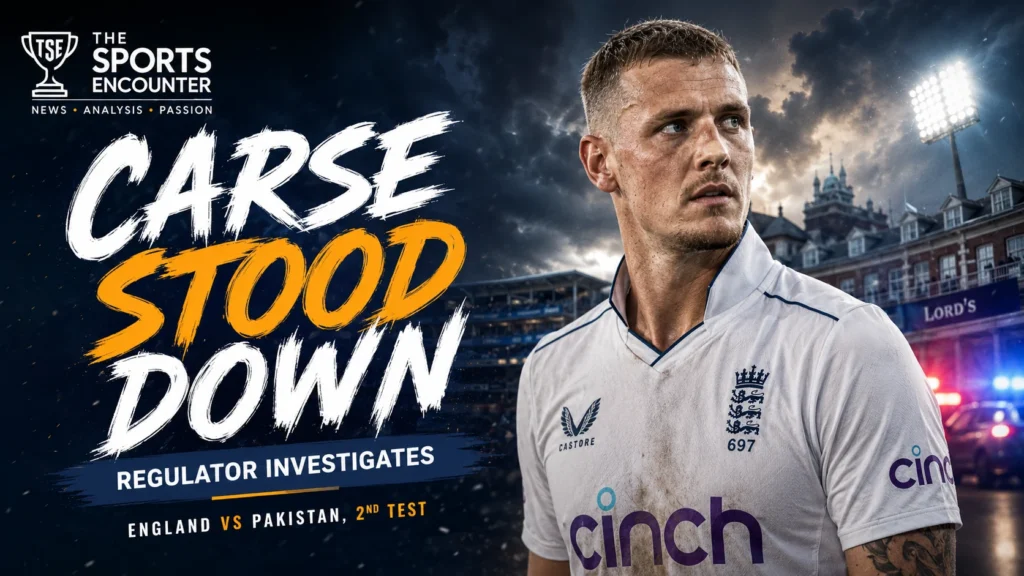
England fast bowler Brydon Carse has been removed from the squad for the second Test against Pakistan at Lord’s after the Cricket Regulator opened an investigation into an incident outside a Derby city-centre venue on Saturday night.
Carse, 31, was briefly arrested on suspicion of being drunk and disorderly after celebrating Durham’s County Championship victory over Derbyshire. Derbyshire Constabulary subsequently confirmed that he was de-arrested shortly afterward after agreeing to leave the area. No criminal charge has been announced.
That has not ended the matter from cricket’s perspective.
The England and Wales Cricket Board referred the incident to the independent Cricket Regulator, which has now begun its own investigation. England responded by making Carse unavailable for the second Test while the facts are established.
Hampshire fast bowler Sonny Baker has been called into the squad as his replacement ahead of Thursday’s Test at Lord’s.
The decision lands at an awkward moment for an England team trying to establish a new culture under Joe Root following months of leadership change, disciplinary controversy and questions about players’ relationship with alcohol.
Root abolished England’s midnight curfew less than two weeks ago and publicly backed his players to behave like responsible adults away from cricket. Carse’s removal does not prove that Root’s approach has failed, but it ensures those words will be examined again before England attempt to seal the Pakistan series at Lord’s.
Brydon Carse Investigation: What We Know
| Detail | Confirmed information |
|---|---|
| Player | Brydon Carse |
| Age | 31 |
| County | Durham |
| Incident | Derby city centre, Saturday night, August 22 |
| Police action | Briefly arrested/detained on suspicion of being drunk and disorderly, then de-arrested |
| Criminal charge | No charge announced |
| ECB action | Incident referred to the Cricket Regulator |
| England status | Stood down from second Test squad |
| Replacement | Sonny Baker |
| Next Test | England vs Pakistan, Lord’s, August 27 |
| Series position | England lead 1-0 |
What Happened in Derby?
Carse had been released from England’s Test squad after missing selection for the first Test against Pakistan at Headingley.
That allowed him to return to County Championship duty with Durham, who completed a convincing victory over Derbyshire during the weekend.
Carse scored 26 and returned match figures of 2 for 82. Ben Stokes, now retired from international cricket but still playing county cricket for Durham, took five wickets in the victory.
Durham’s players later went out in Derby to celebrate.
Video subsequently circulated on social media showing Carse surrounded by police officers with his hands behind his back. Matthew Potts could be seen speaking to him, while Stokes was also visible nearby.
There is no suggestion that either Potts or Stokes committed any offence.
The footage quickly moved beyond social media after being published by British newspapers, including The Telegraph.
The important development came when police clarified what had happened.
Police Say Carse Was De-Arrested Shortly Afterwards
Derbyshire Constabulary confirmed that a man in his 30s had been arrested on suspicion of being drunk and disorderly in Derby city centre on Saturday night.
The force said the man was subsequently de-arrested after agreeing to leave the area.
That distinction matters.
Carse has not been charged with a criminal offence based on the information available at the time of publication.
England’s decision to remove him from the Test squad therefore should not be interpreted as a finding of criminal guilt.
It is an interim sporting decision while a separate regulatory investigation proceeds.
Why Can Cricket Investigate When Police Have Not Charged Carse?
This is where the story becomes more significant than the police footage alone.
The criminal process and cricket’s disciplinary process operate under different standards and serve different purposes.
The Cricket Regulator states that it investigates allegations of misconduct both on and off the field. Where appropriate, it can bring charges under cricket regulations and refer cases to the independent Cricket Discipline Panel.
A person therefore does not need to be convicted of a criminal offence before sporting authorities can examine whether conduct breached professional obligations.
The relevant question for the Regulator will not simply be whether Carse committed a criminal offence.
It may also examine whether his actions amounted to improper conduct, damaged cricket’s interests or brought the game into disrepute.
The Regulator has not announced a charge against Carse.
At this stage, it has announced an investigation.
ECB Removes Carse While “Full Facts Are Obtained”
The ECB confirmed the referral on Monday and immediately changed England’s squad.
“Brydon Carse will no longer be available for selection for the second men’s Rothesay Test match while this investigation is ongoing and the full facts are obtained.”
The governing body confirmed that Sonny Baker would replace him.
The wording is significant because England have not described the decision as a formal suspension following a disciplinary finding.
Carse has effectively been stood down as a precautionary measure while the investigation continues.
That protects the integrity of the investigation while also preventing England from carrying an unresolved disciplinary issue directly into a Test match at Lord’s.
Why the Timing Is So Difficult for Joe Root
The incident arrives barely days after one of Joe Root’s first major decisions since returning to the Test captaincy.
Root removed the midnight curfew that had been imposed during a turbulent period for England’s men’s teams.
The new captain argued that elite international cricketers should be treated as adults capable of managing their own behaviour.
British reporting quoted Root emphasizing personal responsibility rather than strict policing of players’ evenings.
That change reflected a broader shift away from the turmoil that followed Ben Stokes’ final months as England captain.
The Sports Encounter has followed that transition closely, from the curfew controversy that destabilized England during the New Zealand series to Stokes’ eventual retirement from international cricket.
Carse’s situation now creates the first major off-field challenge of Root’s restored captaincy.
Root’s “Adults” Policy Is Now Under Immediate Scrutiny
The easy reaction would be to declare that abolishing the curfew caused the incident.
The available facts do not support that conclusion.
Carse was not away with England when the Derby incident occurred.
He had been released to play for Durham.
The events therefore happened in a county-cricket setting rather than during an England team night out.
Still, perception matters.
Root publicly moved England toward greater personal freedom, arguing that responsible professionals should not require arbitrary bedtimes.
Within two weeks, another centrally contracted England player has appeared in footage involving police after a night out.
That does not automatically make the policy wrong.
It does make the discussion unavoidable.
The Guardian reported when Root scrapped the curfew that the captain wanted players to manage themselves sensibly while understanding the responsibilities attached to representing England.
The Carse investigation will become an early test of precisely that model.
England’s Problem Is Bigger Than One Night in Derby
This incident would probably have produced scrutiny under any circumstances.
The wider history of the past 12 months makes it more combustible.
England have faced repeated questions about off-field conduct, alcohol, curfews and the boundaries between team freedom and professional responsibility.
Harry Brook was fined following an altercation involving a nightclub bouncer in Wellington.
Stokes and Gus Atkinson were later stood down while England investigated events following a night out during the New Zealand series.
They were ultimately cleared of involvement in violent conduct but received written warnings relating to contractual obligations.
Those absences materially affected England on the field.
When New Zealand won the second Test, The Sports Encounter reported how England entered the match with a disrupted side shaped partly by curfew punishment.
The controversy eventually became part of a much broader period of instability.
The Post-Stokes Reset Was Supposed to Change the Conversation
England have spent the summer trying to move on.
Stokes retired from international cricket after the New Zealand series, ending the captaincy partnership that had defined England’s red-ball identity since 2022.
Brendon McCullum also left the Test setup.
Joe Root returned as captain.
Stephen Fleming is preparing to take over as England’s permanent Test coach after the Pakistan series.
The Sports Encounter examined why Fleming’s appointment represents more than a simple coaching change. England are attempting to preserve attacking cricket while adding greater structure, tactical control and institutional stability.
Carse’s incident drags part of the conversation back toward behaviour rather than cricket.
That is precisely what England wanted to leave behind.
Carse’s Previous Betting Ban Will Inevitably Return to the Conversation
The bowler also carries disciplinary history.
Carse served a three-month suspension in 2024 after admitting historical betting breaches involving 303 wagers placed between 2017 and 2019.
There was no allegation that he had bet on matches in which he participated.
English professional cricketers are nevertheless prohibited from betting on cricket.
That case was resolved, and the ECB publicly acknowledged Carse’s cooperation, remorse and subsequent development.
The current investigation is unrelated to those betting offences.
It would therefore be misleading to merge them into one allegation.
But his previous disciplinary history may influence the public discussion surrounding another investigation involving the same player.
Carse Had Been Fighting His Way Back Into England’s Test Plans
The timing is damaging for Carse professionally as well.
His international career had regained momentum before injuries interrupted his summer.
He has played 14 Tests and taken 58 wickets.
Carse was England’s leading wicket-taker during the previous Ashes campaign, establishing himself as a physically imposing quick capable of sustaining hostile spells.
Wrist and elbow problems then delayed his return this year.
England eventually recalled him for the Pakistan series after he demonstrated his fitness through domestic cricket.
He was not selected for the Headingley Test, but the three-match series gave England enough cricket to keep him firmly in consideration.
That opportunity has now been interrupted for reasons unrelated to bowling.
Sonny Baker Gets Another England Opportunity
Hampshire fast bowler Sonny Baker is the immediate beneficiary from a selection perspective.
Baker has already been around England’s plans during a year of unusual turnover among the fast-bowling group.
His pace has repeatedly put him on the selectors’ radar, while injuries and disciplinary absences elsewhere have accelerated his opportunities.
He now joins the squad preparing at Lord’s alongside Jofra Archer, Gus Atkinson, Josh Tongue, Matthew Fisher and Ollie Robinson.
England’s updated squad for the second Test is:
- Joe Root (captain)
- Gus Atkinson
- Jofra Archer
- Shoaib Bashir
- Sonny Baker
- Harry Brook
- Jordan Cox
- Ben Duckett
- Matthew Fisher
- Emilio Gay
- Dan Lawrence
- Ollie Pope
- Ollie Robinson
- Jamie Smith
- Josh Tongue
Carse had not played in the Headingley victory, so England are not being forced to replace a member of their winning XI.
That reduces the immediate tactical disruption.
It does not remove the wider distraction.
England Enter Lord’s With the Cricket Moving in the Right Direction
The irony is that England’s actual Test cricket has finally begun to look settled.
They crushed Pakistan by an innings and 103 runs in the first Test at Headingley.
Josh Tongue and Ollie Robinson led an attack that repeatedly exposed Pakistan’s batting, while Root began his second spell as permanent Test captain with a commanding victory.
The result arrived after one of the most chaotic stretches in recent English Test history.
The Sports Encounter documented the end of that previous era when New Zealand completed their comeback at Trent Bridge and the Stokes era ended in defeat.
Root’s team appeared to have turned a page at Headingley.
The Carse story guarantees the build-up to Lord’s will no longer focus exclusively on England’s cricket.
Pakistan Have Their Own Reasons to Welcome the Distraction
Pakistan travel to Lord’s under far greater competitive pressure.
They were dismantled in Leeds and need a response to prevent England taking an unassailable 2-0 lead.
Their red-ball problems did not begin at Headingley.
Pakistan entered the England tour after a difficult Caribbean series that finished 1-1, with The Sports Encounter’s West Indies-Pakistan series review highlighting continued questions around batting structure, selection and bowling combinations.
The return of Babar Azam to a leadership role was supposed to form part of a broader reset, explored in our analysis of Pakistan’s decision to go back to Babar.
England’s off-field noise offers Pakistan no runs or wickets.
It may, however, slightly change the atmosphere around a Test that otherwise threatened to become entirely about whether the visitors could survive England’s attack.
Lord’s Test Now Carries Two Parallel Stories
England versus Pakistan remains the cricket story.
Carse versus the disciplinary process is now the institutional story running beside it.
They should not be confused.
The Cricket Regulator’s job is to establish facts and determine whether cricket regulations were breached.
Root’s job is to prepare England to win at Lord’s.
Selectors must determine whether Baker or another seamer offers the best balance.
The ECB must decide how much team freedom can coexist with contractual standards.
Those separate responsibilities will now unfold at the same time.
Could Carse Face Further Punishment?
Possibly, but no outcome should be assumed.
The Cricket Regulator explains that allegations can be investigated and, where sufficient grounds exist, charges can be brought and referred to the independent Cricket Discipline Panel.
Possible disciplinary outcomes vary according to the offence and circumstances.
That process has not reached the charging stage publicly in Carse’s case.
He may be cleared.
He may face a regulatory charge.
The ECB could also consider contractual action separately depending on what the investigation establishes.
Anything more definite at this point would be speculation.
Why “No Criminal Charge” Does Not Automatically End the Sporting Case
This distinction is likely to cause confusion as the story develops.
Police action answers questions under criminal law.
Professional sport also imposes contractual and conduct obligations on participants.
A player can therefore avoid criminal prosecution while still facing questions about whether his behaviour met the standards expected by his sport or employer.
The same principle applies across many professional sports.
That is why the ECB could stand Carse down even after police allowed him to leave without charge.
The decision does not declare him guilty.
It preserves the disciplinary process.
England’s Alcohol Question Is Really a Governance Question
The repeated focus on alcohol risks oversimplifying the larger issue.
England are trying to determine how much responsibility elite players should manage themselves and how much structure governing bodies should impose.
Curfews represent one extreme.
Complete personal freedom represents another.
Root appears to prefer autonomy with accountability.
That model can work only if accountability remains credible when something goes wrong.
Standing Carse down while an independent body investigates may actually illustrate how such a system is supposed to function.
Players do not need to be locked into hotels every evening.
They also cannot assume freedom means the absence of consequences.
That distinction may ultimately prove more important to England’s new culture than whether the team reinstates a midnight deadline.
Why This Matters in England’s Wider Red-Ball Reset
England are currently changing almost every major part of their Test structure.
The captain has changed.
The coach has changed.
Selection is becoming more competitive.
The tactical philosophy is being reassessed.
England are simultaneously trying to recover from an unstable period without stripping away the freedom that made the previous regime attractive to players.
That tension is one reason the Carse story matters beyond one player’s availability.
It tests whether the new England can be more structured without becoming suffocating.
Our wider August Test cricket overview placed the Pakistan series inside one of the busiest stretches of red-ball cricket in years. England entered that period needing sporting stability after months of upheaval.
They have started finding it on the field.
The challenge is keeping the off-field environment from becoming the story again.
What Happens Next?
The immediate sequence is relatively clear.
- The Cricket Regulator will investigate the Derby incident.
- Carse will remain unavailable for the second Test while that process continues.
- Sonny Baker joins England’s squad at Lord’s.
- England will train before Thursday’s second Test against Pakistan.
- The Regulator will determine whether there is sufficient basis for any disciplinary charge.
- The ECB may then consider whether any additional contractual action is necessary.
There is currently no publicly confirmed timetable for the completion of the investigation.
The Sports Encounter Analysis
The temptation around this story is to race straight toward a verdict.
That would be premature.
Carse has not been convicted of anything, and police did not charge him after the Derby incident.
The Cricket Regulator is now doing what an independent disciplinary body is supposed to do: establish the facts and decide whether cricket’s own rules were breached.
England have also taken the sensible interim step.
Removing Carse from one Test squad is materially different from declaring him guilty or ending his international career.
The more interesting issue sits around him.
England have spent much of the past year arguing about freedom, alcohol, curfews, responsibility and professionalism.
Stokes and Atkinson were stood down.
Harry Brook faced sanctions after his own off-field episode.
Rob Key publicly defended the culture.
Brendon McCullum relaxed restrictions.
Root then removed the curfew altogether.
Now comes the first serious test of the philosophy Root has articulated.
Trusting adults does not mean pretending adults never make bad decisions.
It means allowing freedom while maintaining a clear mechanism for accountability when questions arise.
The next few weeks will reveal whether England have finally found that balance or whether another cycle of curfews, restrictions and cultural soul-searching is about to begin.
Frequently Asked Questions
Why has Brydon Carse been removed from England’s Test squad?
Carse has been stood down while the Cricket Regulator investigates an incident involving police in Derby on Saturday night.
Was Brydon Carse arrested?
Derbyshire Constabulary said a man in his 30s was arrested on suspicion of being drunk and disorderly but was de-arrested shortly afterward after agreeing to leave the area. Carse is understood to be that man.
Has Brydon Carse been charged with a crime?
No criminal charge has been announced at the time of publication.
Why is the Cricket Regulator investigating if Carse was not charged?
Sporting conduct rules are separate from criminal law. The Cricket Regulator can investigate alleged off-field misconduct and determine whether professional cricket regulations were breached.
Who has replaced Brydon Carse?
Hampshire fast bowler Sonny Baker has been called into England’s squad.
Will Carse play against Pakistan at Lord’s?
No. The ECB has confirmed that he is unavailable for selection for the second Test while the investigation continues.
When does England vs Pakistan second Test begin?
The second Test begins at Lord’s on Thursday, August 27, 2026.
What is the England-Pakistan series score?
England lead the three-match series 1-0 after winning the first Test at Headingley by an innings and 103 runs.
Were Ben Stokes or Matthew Potts arrested?
No allegation of wrongdoing has been made against either Stokes or Potts in relation to the incident. Both were visible in footage from the evening.
Did Joe Root recently remove England’s curfew?
Yes. Root abolished the team’s midnight curfew after returning to the Test captaincy, saying players should be trusted to behave responsibly as adults.
Has Brydon Carse faced disciplinary action before?
Yes. Carse served a three-month ban in 2024 for historical betting offences. That case is separate from the current Derby investigation.
Could Brydon Carse receive a suspension?
A suspension is one possible disciplinary outcome in cricket cases generally, but Carse has not publicly been charged under cricket regulations at this stage. The Regulator must first complete its investigation.