


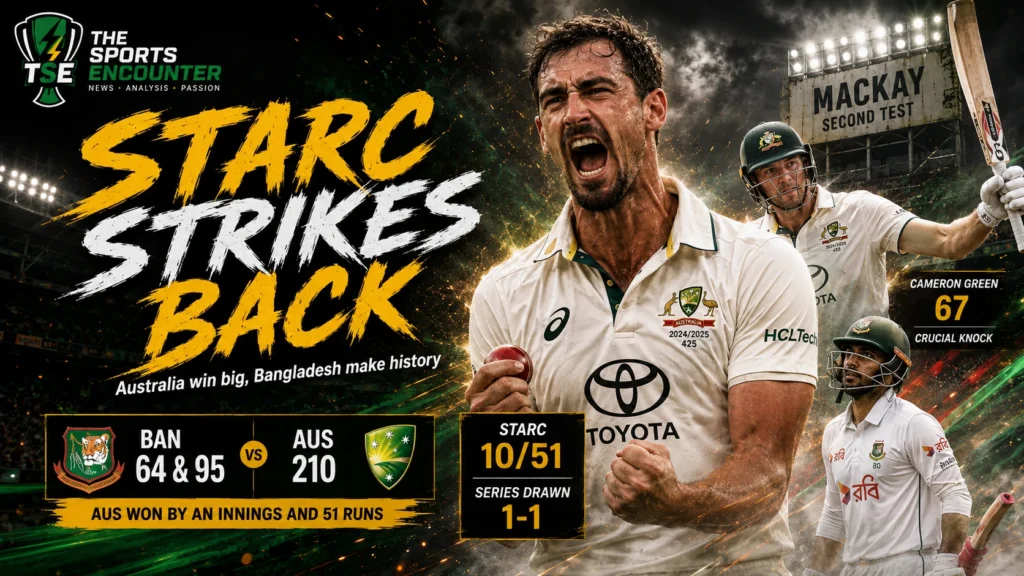
Mitchell Starc produced a devastating 10-wicket match haul as Australia demolished Bangladesh by an innings and 51 runs inside two days in Mackay, but the brutality of the series finale could not erase the history Bangladesh had already made.
Australia bowled the visitors out for 64 and 95 at the Great Barrier Reef Arena, with Starc taking 6 for 12 in the first innings and 4 for 39 in the second. Cameron Green’s 67 helped Australia reach 210 despite a magnificent seven-wicket haul from Shoriful Islam, leaving Bangladesh with a 146-run first-innings deficit they never came close to overturning.
Nathan Lyon eventually ended the match when Shoriful charged down the pitch and sliced a catch to backward point, where Starc completed the final act of a Test he had controlled from its opening delivery.
Australia won by an innings and 51 runs after only 125 overs of cricket, making the Mackay Test the second-shortest Test completed in Australia and the fourth-shortest completed Test in history by balls bowled.
The scoreline was merciless.
The series result was far more complicated.
Bangladesh’s historic victory in Darwin meant Australia’s response could only level the two-match contest. The trophy was therefore shared at 1-1, giving Bangladesh their first Test series draw on Australian soil, 23 years after their previous visit ended in two innings defeats.
That makes the final verdict on this series impossible to reduce to Mackay alone.
Australia rediscovered the ruthless bowling identity that deserted them in Darwin.
Bangladesh discovered that they could beat Australia in Australia.
Both truths will survive long after the extraordinary two-day finale.
Australia vs Bangladesh 2nd Test: Match Summary
| Series | Bangladesh tour of Australia 2026 |
| Match | Australia vs Bangladesh, 2nd Test |
| Venue | Great Barrier Reef Arena, Mackay |
| Dates | August 22-23, 2026 |
| Toss | Australia elected to field |
| Bangladesh 1st innings | 64 all out in 34 overs |
| Australia 1st innings | 210 all out in 52.3 overs |
| Bangladesh 2nd innings | 95 all out in 38.3 overs |
| Result | Australia won by an innings and 51 runs |
| Series result | Drawn 1-1 |
| Player of the Match | Mitchell Starc, 10/51 |
| Player of the Series | Mitchell Starc, 12 wickets and 20 runs |
| WTC points | Australia 12, Bangladesh 0 |
TL;DR
- Australia crushed Bangladesh by an innings and 51 runs in the second Test at Mackay.
- Bangladesh were dismissed for 64 and 95, the first time they had been bowled out below 100 in both innings of a Test.
- Mitchell Starc took 6/12 and 4/39 to finish with 10 wickets in the match.
- Starc was named both Player of the Match and Player of the Series.
- Shoriful Islam produced a career-best 7/48 as Bangladesh bowled Australia out for 210.
- Cameron Green’s 67 was the highest score of a Test dominated by bowlers.
- Pat Cummins took six wickets in the match, while Nathan Lyon claimed three in Bangladesh’s second innings.
- The Test finished during the second afternoon after only 125 overs.
- It became the second-shortest Test completed in Australia and fourth-shortest completed Test overall by balls bowled.
- The series finished 1-1 after Bangladesh’s historic first-Test victory in Darwin.
- It is Bangladesh’s first-ever drawn Test series on Australian soil.
Mackay Was Australia’s Answer to Darwin
Australia entered the second Test carrying something unusual at home: embarrassment.
Bangladesh had not merely competed in Darwin.
They had beaten Australia and entered Mackay with a 1-0 lead.
That possibility had looked remote when the teams arrived in Australia after a 23-year gap between Bangladesh’s Test tours, a challenge examined in The Sports Encounter’s Australia-Bangladesh series preview.
The preview asked whether Bangladesh’s recent progress could travel.
Darwin answered yes.
Mackay asked a different question.
How would Australia respond?
Pat Cummins’ side provided the answer from the first ball.
Starc Strikes With the First Ball and Bangladesh Never Recover
Shadman Islam faced the opening delivery.
He did not survive it.
Starc found the edge, Cameron Green completed the catch, and Bangladesh were 0 for one before the match had properly begun.
It established the tone for what followed.
Tanzid Hasan made zero.
Najmul Hossain Shanto made zero.
Litton Das made zero.
Bangladesh were 12 for five after 6.4 overs.
Starc had taken all five.
The left-armer’s opening spell was not simply fast.
It was relentlessly full enough to threaten the stumps and outside edge, while the angle created by his left arm forced Bangladesh’s right-handers to make decisions almost immediately after release.
They kept losing those decisions.
Five Wickets in 22 Balls
Starc completed his five-wicket haul in only 22 deliveries.
That alone placed the spell among the fastest five-fors in Test history.
For Bangladesh, the statistical significance hardly mattered in the moment.
They were trying to survive an attack that suddenly looked exactly as intimidating as the one expected before the series.
The contrast with Darwin was enormous.
There, Bangladesh had shown composure against Australia’s celebrated attack and created enough pressure to expose the hosts’ own batting problems.
In Mackay, Australia’s fast bowlers never allowed that confidence to become established.
The wider build-up to this series had focused heavily on the return of Starc, Cummins, Josh Hazlewood and Nathan Lyon together, one of the central themes in TSE’s pre-series analysis.
Match two finally produced the version of that attack Australia expected.
Bangladesh’s Top Order Disappears
The collapse was severe enough to make individual scores look almost incidental.
Mominul Haque reached nine.
Mushfiqur Rahim occupied 42 deliveries but made only five.
Mehidy Hasan Miraz scored 11 from 51 balls.
Hasan Mahmud made 10.
Taijul Islam finished unbeaten on 11.
Shoriful’s 14 from 19 balls was the highest score of the innings.
Bangladesh’s resistance came almost entirely from consuming deliveries rather than scoring runs.
Mushfiqur and Mehidy faced 93 balls between them.
They added 16 runs.
That tells the story of Australia’s control.
There were few release deliveries and almost no sustained period when Bangladesh could dictate the field.
Cummins Joins the Destruction
Starc did not have to take all 10 wickets.
Cummins removed Mushfiqur, Mehidy and Taskin Ahmed to finish with 3 for 25 from 10 overs.
Hazlewood took one wicket while conceding only 18 from 11.
The visitors were dismissed for 64 from 34 overs.
Australia had conceded 1-0 in the series.
Less than a session into the second Test, they had already built the platform for a response.
Then Shoriful Made Australia Look Vulnerable Again
For all the dominance of Australia’s bowling, the hosts’ batting still refused to offer complete reassurance.
Shoriful Islam returned to the side and produced one of the finest fast-bowling performances by a Bangladeshi in Australia.
Matt Renshaw made eight.
Travis Head reached 22 before Shoriful bowled him.
Marnus Labuschagne made four and also lost his stumps to the left-armer.
Australia were 41 for three.
The visitors had scored only 64, yet the game was not completely dead.
That was important because Bangladesh’s progress as an international side has increasingly been linked to a pace attack capable of causing damage outside traditional Asian conditions.
The Sports Encounter examined that broader development in Bangladesh cricket’s recent rise.
Shoriful’s spell in Mackay gave another example.
Green and Smith Prevent Another Australian Collapse
Steve Smith and Cameron Green added 77 for the fourth wicket.
It became the most important batting partnership of the match.
Smith made 42 from 74 balls.
Green produced 67 from 105.
Neither innings was extravagant.
Both were valuable because Australia were batting on a surface that required discipline while Shoriful continued asking serious questions.
Green looked particularly assured.
His 10 boundaries came without the kind of reckless strokeplay that had contributed to Australia’s problems in Darwin.
Cummins later described Green as looking in total command and said he hoped the innings would give him confidence.
That assessment matters because Green has spent much of his Test career carrying expectations that sometimes feel larger than his numbers.
Mackay offered evidence of the batter Australia continue to believe he can become.
Shoriful Takes Seven and Still Cannot Save Bangladesh
Shoriful kept coming.
He removed Smith.
Then Beau Webster.
Then Cummins.
Then Starc.
Later he returned to dismiss Green.
His final figures were 7 for 48 from 15 overs.
Seven Australian wickets for fewer than 50 runs should normally transform a Test.
It could not erase Bangladesh’s 64.
That is the brutal arithmetic of first-innings collapses.
Even after losing wickets regularly, Australia reached 210.
Nathan Lyon’s 32 from 62 balls also mattered enormously.
His late runs stretched the lead to 146.
What had looked like a damaged Australian innings became an almost impossible deficit for Bangladesh.
Australia’s Batting Still Leaves Questions
The scoreboard says 210.
The bowling dominance makes the total look much larger than it really was.
Australia’s top order remains unsettled.
Renshaw made eight.
Head made 22.
Labuschagne made four.
Carey scored five.
Webster, Cummins and Starc contributed one run between them.
Only Green, Smith and Lyon crossed 30.
This was part of the contradiction Cummins’ team will take from the series.
The attack can still destroy opposition batting lineups.
The batting order does not currently offer the same certainty.
That concern had already surfaced in Darwin, including during the Steve Smith DRS controversy on the opening day, when Smith’s 71 carried an otherwise fragile Australian innings.
Mackay improved the result.
It did not eliminate the underlying issue.
Bangladesh’s Second Innings Begins With the Same Nightmare
Any realistic route back into the match required Bangladesh to bat for a long time.
Their second innings lasted 38.3 overs.
Shadman made one.
Mominul was bowled for a first-ball duck.
Bangladesh were five for two.
Starc had both.
Tanzid tried to settle before Cummins removed him for nine.
At 24 for three, the possibility of making Australia bat again was already slipping away.
Shanto and Mushfiqur Try to Resist
Najmul Hossain Shanto responded with Bangladesh’s most positive batting of the innings.
The captain scored 31 from 46 balls, hitting six fours.
Mushfiqur played the opposite role.
He occupied the crease.
His unbeaten 29 came from 80 balls and lasted 146 minutes.
The pair gave Bangladesh their only meaningful period of control during the second innings.
They took the score to 51.
Then Lyon removed Shanto.
The innings folded again.
Lyon Enters After the Fast Bowlers Do the Damage
Nathan Lyon did not bowl in Bangladesh’s first innings.
There had been no need.
In the second, he became the finishing weapon.
Shanto was his first wicket.
Taskin Ahmed became his second after striking a six.
Shoriful was the last.
Lyon finished with 3 for 25 from 11.3 overs.
Cummins also collected three wickets for only 10 runs.
Starc added four more.
Hazlewood somehow finished wicketless despite conceding just 16 from seven overs.
Bangladesh were surrounded by pressure from every direction.
Starc Finishes With 10 Wickets
Starc’s match figures were 10 for 51.
He had taken 6 for 12 in the first innings.
He added 4 for 39 in the second.
Bangladesh’s top order had no answer to the combination of pace, swing, angle and full length.
Starc also completed two catches in the second innings, including the final one.
His influence therefore stretched beyond the bowling figures.
He was named Player of the Match.
Then Player of the Series.
Across the two Tests, he finished with 12 wickets.
His comments afterward were revealing because he did not pretend the second Test erased Darwin.
“A much better week. We knew we were not at our best in Darwin.”
That was exactly the series.
One terrible week.
One devastating response.
Bangladesh Become First Team in 21 Years Bowled Out Under 100 Twice in a Test
The Mackay collapse entered Test history for uncomfortable reasons.
Bangladesh were dismissed for 64 and 95.
It was the first time they had been bowled out for fewer than 100 in both innings of a Test.
It was also the first time any team had suffered that fate in 21 years.
Those numbers explain why the match disappeared so quickly.
Bangladesh scored 159 runs across two completed innings.
Australia scored 210 once.
Green alone scored more than 42 percent of Bangladesh’s first-innings total.
The Second-Shortest Test Ever Completed in Australia
The Test required only two days.
More precisely, the entire match lasted 125 overs, or 750 legal deliveries.
That made it the second-shortest completed Test ever played in Australia by balls bowled and the fourth-shortest completed Test in the history of the format.
The statistic inevitably raised questions about the Great Barrier Reef Arena pitch.
Australia’s players resisted blaming the surface.
Josh Hazlewood said it was not a wicket that should naturally have produced a two-day Test and noted that conditions became easier once the shine disappeared from the ball.
Nathan Lyon went further, describing the surface positively and arguing that 18 wickets on day one reflected the quality of the bowlers rather than a fundamentally flawed pitch.
Shanto also avoided making conditions an excuse.
He acknowledged extra bounce and swing but said Bangladesh had to become better at handling precisely these kinds of environments.
Shanto Wants Bangladesh Back Before Another 23 Years Pass
That may have been the most important comment of the presentation.
Bangladesh waited 23 years between Test tours of Australia.
Shanto does not want another generation to wait the same amount of time.
“Not 23 years to wait to come here.”
His argument goes beyond scheduling politics.
Teams learn overseas conditions by playing in them.
A batter cannot master Australian bounce through theory.
A seamer cannot learn the ideal length on Australian surfaces without overs in Australian conditions.
Bangladesh’s Mackay collapse was evidence of the gap that still exists.
Darwin was evidence of what becomes possible when preparation, confidence and execution align.
The two Tests together make a stronger argument for more regular competition than either result would make alone.
Australia’s 2003 Dominance Makes the 2026 Draw More Significant
Bangladesh’s previous Test tour of Australia came in 2003.
It was painful.
Australia won in Darwin by an innings and 132 runs.
They followed it with an innings-and-98-run victory in Cairns.
Bangladesh were still a young Test nation.
The competitive gap was enormous.
The Sports Encounter revisited that history before this series in our full Australia vs Bangladesh 2026 curtain raiser.
Twenty-three years later, the visitors leave with a trophy shared 1-1.
That does not mean Bangladesh are suddenly Australia’s equal in Australian conditions.
Mackay proved otherwise.
It does mean the gap is no longer large enough to make an upset unimaginable.
Bangladesh proved that in Darwin.
The Darwin Victory Changes How Mackay Should Be Read
If Mackay had been the first Test, the narrative around Bangladesh would have been brutal.
Another Asian side overwhelmed by pace.
Another two-day Test.
Another innings defeat.
Darwin prevents that interpretation from becoming the whole story.
Bangladesh had already beaten Australia.
They had already shown their bowlers could expose the hosts’ batting.
They had already survived the celebrated Australian attack long enough to create and then finish a historic victory.
The same tour therefore produced Bangladesh’s greatest Test result in Australia and one of their heaviest batting failures.
That contradiction makes the series more useful than a comfortable 2-0 result would have been.
Bangladesh’s Broader 2026 Rise Gains Another Historic Marker
The drawn Test series also fits into a larger year for Bangladesh cricket.
Earlier in 2026, they beat Australia in a bilateral ODI series, another breakthrough analyzed in TSE’s assessment of Bangladesh’s changing international profile.
Australia responded by taking control of the T20I leg, beginning with a four-wicket victory in the opening T20I before eventually completing a 3-0 whitewash.
Bangladesh’s year has contained plenty of uneven cricket.
That is why the bigger trend matters more than pretending every result represents uninterrupted progress.
They are collecting experiences and victories that previous generations rarely had.
A drawn Test series in Australia now belongs on that list.
Cummins Gets the Response He Wanted
Pat Cummins described the second Test as the opposite of Darwin.
The comparison was accurate.
Australia were sharper in the field.
The bowlers hit their lengths immediately.
The opening hours controlled the direction of the entire match.
Cummins highlighted that point specifically after the victory.
“If you get a really good first hour or two it can set up the rest of the match.”
Australia won those opening hours so comprehensively that Bangladesh spent the remainder of the Test trying to recover from them.
Cummins himself contributed six wickets across the match.
His second-innings figures of 3 for 10 were especially economical.
The captain also praised Green, whose 67 provided the batting stability Australia lacked elsewhere.
Australia’s Bowlers Look Ready for What Comes Next
One of the major questions before this tour involved the age and workload of Australia’s attack.
Starc is 36.
Hazlewood is 35.
Cummins is 33.
Lyon is 38.
The Sports Encounter highlighted the issue in its August Test-cricket schedule analysis, which placed this series at the beginning of an unusually demanding red-ball period.
Mackay provided a reassuring answer about current performance.
Starc took 10.
Cummins took six.
Lyon completed the second innings.
Hazlewood remained difficult to score against even when wickets went elsewhere.
The attack still works.
The longer-term question is how often Australia can ask the same group to work together across an increasingly crowded calendar.
Australia’s Batting Is the Bigger Concern
The bowlers answered their critics.
The batters did not completely do the same.
Green’s 67 was excellent.
Smith’s 42 was valuable.
Lyon’s 32 became unusually important.
Beyond them, the returns were thin.
| Australia batter | Runs |
|---|---|
| Cameron Green | 67 |
| Steven Smith | 42 |
| Nathan Lyon | 32* |
| Travis Head | 22 |
| Matt Renshaw | 8 |
| Alex Carey | 5 |
| Marnus Labuschagne | 4 |
| Mitchell Starc | 1 |
| Beau Webster | 0 |
| Pat Cummins | 0 |
An innings victory can hide batting problems because the bowling attack creates such a large margin.
Australia should resist that comfort.
Shoriful’s 7 for 48 exposed vulnerabilities that stronger teams will study carefully.
Shoriful Leaves Mackay With Something Valuable
Bangladesh had few individual positives from the match.
Shoriful was the obvious exception.
His seven-wicket haul demonstrated exactly why his return for the second Test mattered.
He missed Darwin through injury.
In Mackay, he gave Australia serious problems through angle, movement and discipline.
The challenge for Bangladesh is building enough batting stability around performances like his.
A bowler taking seven wickets in Australia should create a chance to win.
A first innings of 64 removed that chance before Shoriful could exploit it.
Mitchell Starc’s Match Figures
| Innings | Overs | Runs | Wickets |
|---|---|---|---|
| Bangladesh first innings | 10 | 12 | 6 |
| Bangladesh second innings | 10 | 39 | 4 |
| Match total | 20 | 51 | 10 |
Bangladesh Batting: A Test to Forget
| Innings | Total | Highest scorer | Overs |
|---|---|---|---|
| First innings | 64 | Shoriful Islam 14 | 34 |
| Second innings | 95 | Najmul Hossain Shanto 31 | 38.3 |
| Combined | 159 | – | 72.3 |
Key Turning Points
- Starc strikes first ball: Shadman Islam is dismissed immediately and Australia establish the tone.
- Bangladesh fall to 12/5: Starc completes a five-wicket burst in 22 balls.
- Bangladesh dismissed for 64: Australia gain a huge advantage before batting.
- Australia slip to 41/3: Shoriful briefly gives Bangladesh a route back.
- Smith and Green add 77: Australia’s most important partnership establishes control.
- Shoriful takes 7/48: Bangladesh’s left-armer produces a career-best performance despite the match position.
- Lyon scores 32: Australia’s lower order extends the lead to 146.
- Bangladesh fall to 5/2 second time around: Starc removes Shadman and Mominul.
- Shanto falls for 31: Lyon ends Bangladesh’s main resistance.
- Shoriful holes out: Lyon takes the final wicket as Australia win by an innings and 51 runs.
Series Result: Australia 1-1 Bangladesh
| Test | Venue | Result |
|---|---|---|
| 1st Test | Darwin | Bangladesh won |
| 2nd Test | Mackay | Australia won by an innings and 51 runs |
| Series | Australia | Drawn 1-1 |
Why the 1-1 Draw Matters for Bangladesh
Bangladesh do not need to pretend Mackay did not happen.
The defeat should hurt.
Being bowled out below 100 twice exposes exactly how much work remains before they can become consistently competitive in Australia.
History can still coexist with failure.
Before this tour, Bangladesh had never avoided defeat in a Test series played in Australia.
Their previous visit ended 2-0.
They waited 23 years for another opportunity.
They leave this one at 1-1.
No innings defeat can take that away.
Why Australia Will Leave Frustrated Too
Australia won the final Test about as emphatically as Test cricket allows.
They will still look back at Darwin.
The second Test demonstrated the level available to them.
That only makes the first-Test defeat more irritating.
Starc acknowledged Australia were below their standards in Darwin.
Cummins said essentially the same thing.
A side with Australia’s experience does not often require a defeat to become sharp.
This time it did.
That is why the trophy picture at the end tells a stranger story than the Mackay scorecard.
Australia destroyed Bangladesh.
Australia did not win the series.
The Series Bangladesh Wanted, Even If Mackay Was Not the Ending They Wanted
When Bangladesh arrived, a 1-1 draw would have represented an extraordinary result.
That remains true.
The emotional sequence complicates how it feels.
Winning the opening Test created the possibility of something even larger.
Mackay then ended that dream brutally.
Bangladesh therefore leave simultaneously disappointed and historic.
That is not a contradiction.
It is what happens when an underdog changes expectations halfway through a series.
What This Series Says About Test Cricket
The broader schedule placed Australia-Bangladesh inside a remarkable stretch of red-ball cricket covered in TSE’s 19-days-of-Test-cricket feature.
This series justified its place in that run.
One Test produced a historic upset.
The next produced one of the shortest completed Tests ever played.
A series many could have dismissed as predictable before the first ball delivered two completely different contests and a result few would have confidently predicted.
That is part of the value of giving nations such as Bangladesh more frequent opportunities in Australia.
The official Cricket Australia schedule provides Australia’s wider international program, while the ICC World Test Championship gives the series additional context through championship points. Bangladesh’s official international cricket information is available through the Bangladesh Cricket Board.
The Sports Encounter Verdict
Mackay belonged to Mitchell Starc.
The series belongs to a more complicated story.
Starc produced the kind of Test a fast bowler dreams about. Six wickets in the first innings. Four in the second. Ten for 51 across the match. Player of the Match. Player of the Series.
Australia’s attack responded to Darwin with fury and precision.
Green gave the batting innings the control it needed.
Cummins and Lyon ensured there was no second escape for Bangladesh.
Yet the trophy was shared.
That is the line Bangladesh will remember.
Twenty-three years after returning home from Australia with two innings defeats, they leave in 2026 having won a Test and drawn the series.
Mackay exposed how far they still have to go.
Darwin proved how far they have already come.
Australia remain the stronger Test side. Nothing in the two weeks seriously challenges that assessment.
Bangladesh achieved something more important for their own trajectory.
They turned an Australian Test tour from an exercise in survival into a contest whose trophy had to be shared.
Shanto’s request after the series should therefore carry weight.
Do not make them wait another 23 years.
Frequently Asked Questions
Who won the second Test between Australia and Bangladesh?
Australia won by an innings and 51 runs at the Great Barrier Reef Arena in Mackay.
What was the Australia vs Bangladesh 2026 Test series result?
The two-match Test series finished level at 1-1.
Is this Bangladesh’s first drawn Test series in Australia?
Yes. The 1-1 result is Bangladesh’s first-ever drawn Test series on Australian soil.
How did Bangladesh perform in the second Test?
Bangladesh were bowled out for 64 in their first innings and 95 in their second.
How many wickets did Mitchell Starc take?
Starc took 10 wickets in the match, including 6 for 12 in the first innings and 4 for 39 in the second.
Who was Player of the Match?
Mitchell Starc was named Player of the Match.
Who was Player of the Series?
Starc was also named Player of the Series after taking 12 wickets across the two Tests.
Who took seven wickets for Bangladesh?
Shoriful Islam took a career-best 7 for 48 in Australia’s first innings.
Who top-scored for Australia?
Cameron Green scored 67 from 105 balls.
How quickly did the second Test finish?
The match ended on the second afternoon after only 125 overs of cricket.
Was the Mackay Test one of the shortest Tests ever?
Yes. It was the second-shortest completed Test played in Australia and the fourth-shortest completed Test overall by balls bowled.
Has Bangladesh ever beaten Australia in Australia before 2026?
No. Bangladesh’s victory in the first Test at Darwin was their first Test win on Australian soil.
When had Bangladesh previously toured Australia for Tests?
Bangladesh’s previous Test tour of Australia was in 2003, meaning they waited 23 years to return for another Test series.
What did Najmul Hossain Shanto say about future tours?
Shanto said Bangladesh need more opportunities to play in conditions such as Australia and expressed hope that his team would not have to wait another 23 years for its next Test tour.