


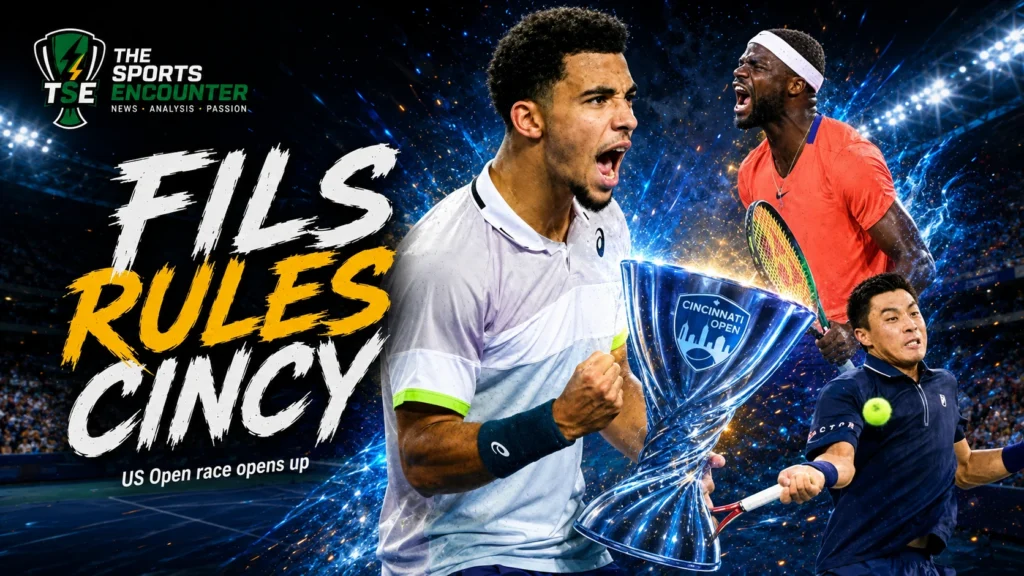
Arthur Fils arrived in Cincinnati still trying to prove that the best season of his career could survive the physical problems that had already taken months away from him.
He left Ohio as an ATP Masters 1000 champion, the highest-ranked Frenchman in the world, one of the hottest players entering the US Open and perhaps the clearest symbol of how quickly the hierarchy of men’s tennis is changing beneath Carlos Alcaraz, Jannik Sinner and the established Grand Slam contenders.
Fils defeated Frances Tiafoe 6-3, 1-6, 6-0 in Sunday’s Cincinnati Open final, producing one of the strangest championship scorelines of the season and one of its most revealing performances. He controlled the opening set, lost the second almost completely, then responded by handing Tiafoe a deciding-set bagel with the biggest title of his career at stake.
The trophy made the 22-year-old the youngest French Masters 1000 champion since the category was introduced and the first Frenchman to win at this level since Jo-Wilfried Tsonga captured Toronto in 2014. Fils also became only the second French men’s champion in Cincinnati during the Open Era after Guy Forget in 1991.
Those records are impressive. The timing makes them more important.
The US Open men’s singles draw will be released on August 27, with the main draw beginning August 30 at the USTA Billie Jean King National Tennis Center. Fils will arrive at a career-high No. 11 with no ranking points to defend in New York because a back injury kept him out of the 2025 tournament.
He is therefore entering the final Grand Slam of 2026 with freedom, form and considerably more belief than he possessed when the North American hard-court swing began.
Cincinnati also strengthened the American challenge.
Tiafoe reached his second final here in three seasons. Brandon Nakashima followed his first Masters 1000 final in Montreal by reaching another semifinal. Taylor Fritz pushed Nakashima deep into three sets. Tommy Paul removed top seed Alexander Zverev before losing a three-set quarterfinal to Flavio Cobolli.
At the same time, Novak Djokovic lost in his opening match to Thiago Agustin Tirante, Montreal champion Ben Shelton disappeared early, Daniil Medvedev fell to Nakashima after holding three match points, while Jannik Sinner did not play and has since withdrawn from the US Open because of his knee injury.
Cincinnati therefore became much more than the last Masters 1000 tournament before New York.
It changed the shape of the men’s US Open race.
Cincinnati Open 2026 Men’s Final Eight
| Round | Match | Result |
|---|---|---|
| Quarterfinal | Tommy Paul vs Flavio Cobolli | Cobolli 2-6, 6-3, 6-4 |
| Quarterfinal | Thiago Agustin Tirante vs Arthur Fils | Fils 6-3, 6-2 |
| Quarterfinal | Taylor Fritz vs Brandon Nakashima | Nakashima 7-6(9), 4-6, 6-3 |
| Quarterfinal | Lorenzo Musetti vs Frances Tiafoe | Tiafoe 7-6(2), 7-5 |
| Semifinal | Flavio Cobolli vs Arthur Fils | Fils 6-3, 6-4 |
| Semifinal | Brandon Nakashima vs Frances Tiafoe | Tiafoe 7-5, 6-3 |
| Final | Arthur Fils vs Frances Tiafoe | Fils 6-3, 1-6, 6-0 |
Official results, draws and tournament statistics are available through the ATP Tour Cincinnati results page and the Cincinnati Open draw.
The Final: Fils Wins Three Different Matches in 88 Minutes
The final score tells you almost everything about the instability of Sunday’s championship match.
6-3.
1-6.
6-0.
The advantage changed dramatically twice.
Fils began like the player who had spent the entire closing weekend imposing his forehand on opponents. He broke Tiafoe early, immediately established superior court position and repeatedly pushed the American toward his backhand side before looking for space with the next shot.
Fils did not face a break point in the opening set and won 13 of 15 points behind his first serve.
That is near-total service control in a Masters 1000 final.
Tiafoe changed the match in the second.
The American attacked earlier, took time away from Fils and started using the crowd rather than reacting to it. Suddenly the Frenchman’s first-strike patterns disappeared. Tiafoe raced through the set 6-1, and the title match appeared to have reversed completely.
Fils then disappeared briefly before the third set and later explained that he looked at himself in the mirror and challenged himself to compete even if the match was going to end in defeat.
The response was devastating.
He won six consecutive games.
Tiafoe never recovered after taking a medical timeout before the deciding set, although the American refused afterward to use his physical condition as an excuse.
Fils finished the final with 11 aces against only one double fault and converted four of eight break opportunities.
The match lasted one hour and 28 minutes.
What began as a tactical battle became a test of emotional recovery, and Fils won it decisively.
Fils Has Turned 2026 Into a Comeback Season Few Expected
The title becomes more impressive when placed beside what Fils has already endured.
A serious back injury kept him out for nearly eight months and removed him from the 2025 US Open. His return this year was also interrupted enough that he missed the Australian swing and Roland Garros.
Yet his 2026 record now stands at 32-10.
He has won Barcelona.
He reached Masters 1000 semifinals in Miami and Madrid.
Cincinnati finally converted that consistency into the biggest trophy of his career.
Only Guy Forget had previously reached three Masters 1000 semifinals in the same season for France, doing so in 1991, before Fils matched that achievement this year.
The championship also moved Fils 10 ranking places to a career-high No. 11.
He sits only 335 points outside the Top 10 and jumped to fifth in the ATP Race to Turin after the Cincinnati title.
That ranking movement is particularly striking because his season has been shortened by injury.
Two Numbers Explain Fils’ Mental Progress
Fils is now 9-0 in deciding sets this season.
He has also won eight consecutive matches against American opponents dating back to the start of 2025.
Those are useful numbers before New York.
The first tells us that extended matches have increasingly favored him rather than exposed him.
The second becomes relevant at a US Open where the United States has 14 men already guaranteed direct entry and where Shelton, Fritz, Tiafoe, Nakashima, Paul and several younger Americans will carry legitimate expectations.
Fils has repeatedly shown he is comfortable playing against American opponents and American crowds.
He proved it again in the final.
Quarterfinal: Fils Ends Tirante’s Extraordinary Cincinnati Run
Thiago Agustin Tirante arrived in the quarterfinal having already done something that reshaped the tournament.
He beat Novak Djokovic.
The Argentine recovered from losing the opening set to defeat Djokovic 2-6, 6-4, 6-4 in the second round, producing one of the biggest wins of his career and immediately removing Cincinnati’s most experienced Grand Slam champion.
Tirante continued winning after the upset rather than treating it as the destination.
He defeated Martin Landaluce and then Jakub Mensik to reach his first Masters 1000 quarterfinal.
His ranking rose toward the low 40s after beginning 2026 outside the Top 100.
Fils ended the run clinically.
The Frenchman won 6-3, 6-2 in only 64 minutes and never faced a break point.
His forehand repeatedly prevented Tirante from constructing the longer rallies that had helped him survive earlier rounds.
The match was arguably Fils’ cleanest performance of the tournament until the semifinal.
It also delivered his third Masters 1000 semifinal of the year.
Semifinal: Fils Removes Cobolli Before Another Three-Set Escape Can Begin
Flavio Cobolli reached the semifinal through one of the strangest patterns of the tournament.
Every one of his first four Cincinnati matches went three sets.
Miomir Kecmanovic pushed him three.
Alexander Blockx pushed him three.
Rafael Jodar pushed him three.
Tommy Paul pushed him three.
Cobolli kept surviving.
He called himself a warrior, a label that matched a season in which the Italian had already reached the Roland Garros final and climbed into the Top 10.
Fils refused to let another escape develop.
The Frenchman won 6-3, 6-4 in 67 minutes, striking six aces and controlling enough forehand exchanges that Cobolli rarely reached the grinding scoreboard positions he had exploited in earlier rounds.
Fils had also beaten Alex de Minaur during the tournament, meaning his Cincinnati championship included multiple victories over Top 20 opponents.
ATP ranking updates after the event confirmed that Fils defeated three Top 20 players during his title run.
Cobolli Still Leaves Cincinnati at a Career-High No. 6
The semifinal defeat should not obscure Cobolli’s progress.
He climbed four more ranking positions to a career-high No. 6.
His rise has accelerated rapidly since entering the Top 10 for the first time in June.
The most interesting part of his Cincinnati run was not the ranking.
It was his ability to remain emotionally functional when matches became uncomfortable.
That quality matters at Grand Slams, where the best-of-five format can transform temporary trouble into a completely different match.
Cobolli’s question in New York will be physical rather than psychological.
Four consecutive three-set matches in Cincinnati showed how much energy his survival style can consume.
Quarterfinal: Cobolli Turns Tommy Paul’s Dream Week Around
Paul had already produced one of Cincinnati’s biggest results before reaching the quarterfinal.
He eliminated top seed Alexander Zverev 4-6, 7-6(6), 6-4 after saving a match point.
The match endured a lengthy rain interruption and further brief stoppages, but Paul repeatedly recovered from difficult positions.
He trailed 4-2 in the deciding set.
Then he won four straight games.
Zverev finished with 14 aces but also nine double faults, and Paul repeatedly attacked second serves when the German’s confidence dipped.
The victory took Paul into his first Cincinnati quarterfinal.
Against Cobolli, he started even better.
Paul won the opening set 6-2.
Cobolli gradually extended the rallies, found more depth and reversed the physical balance of the match to win 2-6, 6-3, 6-4.
The Italian later joked that M&M’s had provided an energy boost during the turnaround.
The humor should not obscure the tennis.
Cobolli had survived another match after losing control early, something he did repeatedly throughout Cincinnati.
Nakashima’s North American Summer Has Become a Serious US Open Story
Brandon Nakashima did not reach the Cincinnati final.
He may still leave the tournament with one of the strongest US Open cases outside the obvious favorites.
Consider his North American sequence.
Semifinal in Washington.
Final in Montreal.
Semifinal in Cincinnati.
Across Montreal and Cincinnati alone, he repeatedly defeated opponents who would normally be expected to stop players before the closing weekend.
The Sports Encounter documented Nakashima’s Canadian breakthrough when he reached his first Masters 1000 final against Ben Shelton in Montreal.
Rather than suffering the emotional drop that often follows a breakthrough final, Nakashima arrived in Cincinnati and kept winning.
He defeated Daniil Medvedev after saving three match points.
He then beat Nuno Borges.
Next came Taylor Fritz.
That victory sent him into his second consecutive Masters semifinal.
Quarterfinal: Nakashima Beats Fritz in the Match American Tennis Needed
Taylor Fritz entered Cincinnati having already won Washington earlier in the summer, where he defeated Rafael Jodar in the final. The Sports Encounter covered that title in our analysis of Fritz’s Washington championship run.
His Cincinnati quarterfinal against Nakashima therefore matched two Americans carrying genuine hard-court momentum.
Nakashima won 7-6(9), 4-6, 6-3.
The opening-set tiebreak went to 11-9.
Fritz recovered to force a deciding set.
Nakashima still found the cleaner finish.
The victory was his fourth Top 10 win of the season and moved him into back-to-back Masters 1000 semifinals.
There was another layer.
Fritz had beaten Nakashima in Washington.
Cincinnati became the payback match.
This type of immediate adjustment against a familiar opponent is one of the best indicators of a player improving beyond ranking points.
Nakashima Is Now a Top-20 Player for the First Time
His Cincinnati run moved him five places to a career-high No. 17.
He entered the summer outside the established American top tier.
He now has a legitimate argument for being the most consistent American hard-court player of the last month.
Nakashima finished Cincinnati with a 12-3 record across the Washington, Montreal and Cincinnati stretch.
He also led the ATP Tour with 22 hard-court wins when he reached the Cincinnati semifinal.
The Sports Encounter had already identified the younger American shift during the National Bank Open semifinals, when Nakashima, Shelton, Learner Tien and Rafael Jodar transformed Montreal into a tournament dominated by a new generation.
Cincinnati showed that Montreal was not an isolated week.
Tiafoe Stops Nakashima and Finds His Cincinnati Comfort Zone Again
Frances Tiafoe has an increasingly unusual relationship with Cincinnati.
His season can fluctuate.
His ranking can fluctuate.
His confidence can fluctuate.
He keeps finding his way deep into this tournament.
Tiafoe beat Nakashima 7-5, 6-3 to reach his second Cincinnati final in three years.
The first set included four consecutive breaks during the opening six games and then one of the most important holds of Tiafoe’s tournament.
Serving at 4-5, he faced three set points.
He saved them.
Two disappeared through forehand winners.
Tiafoe eventually held after an 11-minute game and then shifted the pressure completely.
He won the set 7-5.
Nakashima never recovered sufficiently to force a deciding set.
Tiafoe Joins Roddick and Fish in a Cincinnati Record
By reaching another final, Tiafoe became only the third American man this century to make multiple Cincinnati championship matches.
The others were Andy Roddick and Mardy Fish.
Roddick reached the final in 2003, 2005 and 2006.
Fish did so in 2003 and 2010.
Tiafoe now has 2024 and 2026.
That is meaningful Cincinnati history.
It is also another reminder of the unresolved American Masters drought carried by the current generation.
Tiafoe was chasing his first Masters 1000 title on Sunday.
Fils denied him.
Quarterfinal: Tiafoe Holds His Nerve Against Musetti
Lorenzo Musetti gave Tiafoe one of his most tactically demanding matches.
The Italian’s variety forced Tiafoe to generate his own pace rather than simply redirecting the ball, while Musetti’s movement repeatedly extended points that appeared finished.
Tiafoe won 7-6(2), 7-5 in two hours and 17 minutes.
The first set was decided by a dominant tiebreak.
The second became messy.
Tiafoe held a match point while serving at 5-4 and failed to close.
Earlier versions of Tiafoe might have carried that frustration into the next game.
He immediately broke Musetti again and then served out the match on his fourth match point.
Despite landing only 44 percent of his first serves, Tiafoe lost just five points behind the first delivery.
That statistic says a great deal about how aggressively he played once the serve landed.
Tiafoe’s Final Defeat Should Not Erase His US Open Signal
Tiafoe’s final scoreline looks brutal because of the deciding-set bagel.
His tournament does not.
He defeated Felix Auger-Aliassime.
He defeated Musetti.
He defeated Nakashima.
Those were three Top 20 victories on the road to the final.
He finished the event with 37 tour-level wins for the season, the most among American men at that stage.
The ranking reward was significant.
Tiafoe jumped 11 places to No. 12.
He is suddenly one strong New York run away from returning to the Top 10 for the first time in three years.
That matters because the US Open has always suited his personality and tennis.
Tiafoe reached the semifinal in New York in 2022 and has repeatedly produced some of his best Grand Slam performances in front of American crowds.
Cincinnati suggests the emotional energy around home tennis is working for him again rather than becoming pressure.
The American Men Leave Cincinnati With More Depth Than Certainty
American tennis has spent more than two decades searching for another men’s Grand Slam champion.
Andy Roddick remains the last, having won the US Open in 2003.
The current group is deeper than anything the country has possessed for years.
Ben Shelton successfully defended the Canadian Masters title earlier this month, a championship The Sports Encounter examined in our Montreal final report.
Fritz won Washington.
Nakashima reached finals weekend in Montreal and Cincinnati.
Tiafoe reached the Cincinnati final.
Paul beat Zverev.
Learner Tien has already reached a Masters 1000 semifinal.
The United States also leads all nations with 14 men receiving direct entry into the US Open singles draw.
The problem is no longer a lack of candidates.
The problem is identifying which one can defeat four or five world-class opponents over two weeks.
Ben Shelton’s Cincinnati Exit Changes the US Open Conversation Slightly
Shelton arrived after producing arguably the best tournament of his career in Montreal.
He won the National Bank Open without dropping a set and defeated Nakashima in the final.
The Sports Encounter’s complete Montreal final analysis showed how effectively Shelton protected both his first and second serves throughout the championship run.
Cincinnati ended quickly.
Jaime Faria beat Shelton 6-4, 6-4 in his opening match.
That should not erase the Canadian title.
It does illustrate the physical and emotional challenge of the modern two-week Masters schedule.
Shelton had barely completed a six-match title defense before needing to reset for another major tournament.
From a US Open perspective, the early Cincinnati loss may even provide recovery time.
His form was proven in Montreal.
His body now gets additional days away from tournament play.
Djokovic’s Cincinnati Return Ends Before It Can Become a US Open Launchpad
Novak Djokovic returned to competition in Cincinnati after skipping Montreal.
The expectations were obvious.
With Sinner and Alcaraz absent, the 24-time major champion entered one of the most open Masters draws he had seen in years.
Tirante ended the opportunity immediately.
Djokovic won the first set 6-2 and looked comfortable.
The Argentine then took the next two 6-4, 6-4.
The Sports Encounter had previewed Djokovic’s Cincinnati return and the unusually open draw in our Cincinnati main-draw analysis.
The defeat does not make Djokovic irrelevant in New York.
He has won 24 Grand Slam singles titles for a reason.
It does mean he enters the US Open without the extended hard-court match sequence he probably wanted.
Zverev’s Defeat May Be More Concerning Than Djokovic’s
Alexander Zverev entered Cincinnati as the top seed and one of the strongest players of 2026.
He had won Roland Garros.
He reached the Wimbledon final.
At the start of the Cincinnati round of 16, he led the ATP Tour with 46 match victories for the year.
Paul still found a way through him.
The German served 14 aces.
He also hit nine double faults.
He held a match point in the second-set tiebreak.
He led 4-2 in the deciding set.
He lost.
That type of defeat can be more damaging than an ordinary straight-sets loss because Zverev had multiple opportunities to end the match.
The US Open will test whether Cincinnati was an isolated failure to close or evidence of pressure returning in decisive moments.
Fritz Remains an Important US Open Contender Despite the Nakashima Loss
Taylor Fritz should not disappear from the New York conversation because of one quarterfinal.
He has already won Washington this summer.
His Cincinnati loss came in three sets against arguably the hottest American player of the last several weeks.
The 2024 US Open finalist knows what it takes to reach championship weekend in New York.
His challenge remains similar to Tiafoe’s.
Can he defeat multiple elite players during the same Grand Slam rather than producing one marquee victory?
Cincinnati did not answer that question.
It did confirm that the American field beneath Alcaraz and the leading Europeans is unusually deep.
Sinner’s US Open Withdrawal Changes Everything
The largest development around the men’s tournament did not happen on a Cincinnati court.
Jannik Sinner has withdrawn from the US Open because of the right knee injury that had already forced him to miss both Montreal and Cincinnati.
The Sports Encounter first examined the issue when Sinner pulled out of Cincinnati and his New York participation came into doubt.
His subsequent US Open withdrawal removes the Wimbledon champion and former New York champion from the draw completely.
That dramatically increases opportunity elsewhere.
Carlos Alcaraz, the defending US Open champion, now enters as the leading favorite provided his wrist is fully recovered.
Zverev remains a major candidate despite Cincinnati.
Djokovic retains enormous Grand Slam credibility.
Shelton, Fritz, Tiafoe and Nakashima give the United States unprecedented depth.
Fils enters with the hottest Masters title on the tour.
Cobolli is ranked No. 6.
The Sports Encounter’s original US Open 2026 preview was written before Sinner’s withdrawal and before Cincinnati reshaped several contenders. The men’s title picture now needs to be read through a very different lens.
The US Open Race After Cincinnati
| Player | Cincinnati / Recent Result | US Open Signal |
|---|---|---|
| Carlos Alcaraz | Skipped Cincinnati with wrist issue | Defending champion and leading favorite if fully fit |
| Arthur Fils | Cincinnati champion | Career-high No. 11, 9-0 in deciding sets, major momentum |
| Alexander Zverev | Lost R16 after holding match point | Elite 2026 season but closing concerns resurfaced |
| Novak Djokovic | Lost opening match to Tirante | Limited hard-court preparation but unmatched major experience |
| Ben Shelton | Early Cincinnati exit after Montreal title | Form already proven, extra recovery could help |
| Frances Tiafoe | Cincinnati finalist | Home-court confidence and return toward Top 10 |
| Brandon Nakashima | Cincinnati semifinalist | 12-3 summer hard-court stretch and new career-high No. 17 |
| Taylor Fritz | Cincinnati quarterfinalist | Washington champion and proven US Open finalist |
| Flavio Cobolli | Cincinnati semifinalist | Career-high No. 6 and growing Grand Slam belief |
| Jannik Sinner | Did not play | Withdrawn from US Open because of knee injury |
TSE US Open Power Read After Cincinnati
1. Carlos Alcaraz Remains the Reference Point
Sinner’s absence shifts the balance immediately toward the defending champion.
Alcaraz’s wrist remains the issue worth monitoring, but nobody else combines his Grand Slam experience, athleticism, variety and ability to create offense from defensive positions as consistently.
The question is whether his lack of Cincinnati match play creates rust or useful freshness.
2. Arthur Fils Is the Hottest New Threat
Calling Fils a favorite would move too quickly.
Ignoring him would be worse.
He is 32-10 this year despite missing major portions of the season.
He has reached three Masters semifinals and won one.
He is 9-0 in deciding sets.
His Cincinnati forehand repeatedly overwhelmed players ranked above him.
He has no US Open ranking points to defend.
His biggest uncertainty is best-of-five durability after the injury history.
3. Shelton Still Has the Strongest Recent American Trophy
Montreal matters more than the Cincinnati loss.
Shelton won six matches there without dropping a set.
That level of serve control can take a player deep in New York, where the crowd will magnify every momentum shift.
4. Tiafoe Has Rediscovered His New York Ingredient
Tiafoe performs at his best when confidence and crowd energy reinforce each other.
Cincinnati looked like that version again.
His movement was sharper, his forehand held under pressure, and he repeatedly recovered after failing to close games cleanly.
The final collapse is a concern.
The six matches before it are evidence.
5. Nakashima May Be the Most Underestimated Player in the Draw
His game does not generate the same noise as Shelton or Tiafoe.
The results are becoming difficult to ignore.
Washington semifinal.
Montreal final.
Cincinnati semifinal.
Wins over Medvedev and Fritz.
A career-high ranking.
There are few players entering New York with more hard-court match confidence.
The Most Important Cincinnati Trend Was Generational
The final four included Fils, Cobolli, Nakashima and Tiafoe.
Zverev had disappeared.
Djokovic had disappeared.
Medvedev had disappeared.
Shelton had disappeared.
Fritz did not survive the quarterfinals.
The tournament was eventually won by a 22-year-old who spent much of last year unable to play.
This follows Montreal, where every men’s quarterfinalist was born in the 2000s, a generational shift The Sports Encounter examined during our National Bank Open final-eight coverage.
The significance is becoming harder to dismiss.
Men’s tennis is no longer waiting for a future generation.
It is already competing against it.
Cincinnati Also Exposed the Limits of Pre-US Open Form
There is another lesson worth carrying into New York.
The player with the best Masters result does not automatically become the best Grand Slam bet.
Cincinnati uses best-of-three sets.
The US Open asks men to win seven best-of-five matches.
Fils’ injury history therefore matters.
Nakashima’s accumulated summer workload matters.
Tiafoe’s physical discomfort in the final matters.
Alcaraz’s wrist matters.
Djokovic’s age and limited preparation matter.
Zverev’s ability to close difficult matches matters.
Shelton’s explosive style becomes more physically demanding over five sets.
The final Grand Slam will reward more than form.
It will reward recovery.
Why Fils’ Cincinnati Title May Matter Beyond New York
France has spent years waiting for another male player capable of sustaining elite results across surfaces.
Tsonga reached a Grand Slam final and won Masters titles.
Gaël Monfils spent years inside the world’s elite.
Richard Gasquet accumulated longevity.
None produced the major title French tennis has chased since Yannick Noah won Roland Garros in 1983.
Fils is nowhere near solving that history yet.
Cincinnati changes the scale of the conversation.
He now owns an ATP 500 title, a Masters 1000 championship, a Roland Garros final appearance and a career-high ranking just outside the Top 10 before turning 23.
The ceiling has moved.
The Camera Message Said Almost as Much as the Trophy
After winning the final, Fils wrote a message on the courtside camera:
“WHO’S GONNA TALK NOW?”
The line was directed toward people who had questioned him during his long injury absence.
It was emotional without being manufactured.
Fils had spent months listening to questions about whether his progress had stalled.
His response came through tennis.
That may be the most compelling narrative of the entire men’s tournament.
Cincinnati did not create Arthur Fils.
It showed what remained underneath the injuries.
What Cincinnati Means for the US Open Draw
The men’s singles draw will be released Thursday, August 27, according to the official US Open website.
Main-draw singles begin Sunday, August 30.
The draw will matter enormously because Cincinnati has created dangerous names outside the very highest seed lines.
Fils at No. 11 could land inside the section of a Top 4 seed.
Tiafoe at No. 12 is dangerous anywhere.
Nakashima enters the Top 20 for the first time.
Paul remains capable of removing elite players.
Tirante has already beaten Djokovic.
Young players such as Rafael Jodar continue to improve faster than rankings alone can describe.
A favorable quarter could dramatically alter the championship probabilities.
The American Men Have Their Best Collective Chance in Years
No American man has won a Grand Slam singles title since Roddick’s 2003 US Open championship.
Every year the statistic gets heavier.
This year the depth is unusually credible.
| American | 2026 North American Hard-Court Signal |
|---|---|
| Ben Shelton | Defended Montreal Masters title without dropping a set |
| Taylor Fritz | Won Washington |
| Frances Tiafoe | Cincinnati finalist |
| Brandon Nakashima | Montreal finalist and Cincinnati semifinalist |
| Tommy Paul | Beat top seed Zverev in Cincinnati |
| Learner Tien | Reached first Masters semifinal in Montreal |
That does not guarantee an American champion.
It means the country no longer needs everything to depend on one player.
The Sports Encounter Verdict
Cincinnati began without Sinner and Alcaraz and appeared to offer Zverev, Djokovic, Shelton, Medvedev and Fritz a valuable opportunity to seize control of the final Masters tournament before the US Open.
None reached the semifinals.
Arthur Fils took the opportunity instead.
He beat Tirante.
He beat Cobolli.
He beat Tiafoe.
When the final threatened to disappear after a 1-6 second set, he responded by winning the deciding set 6-0.
That is the most valuable detail to carry toward New York.
Fils’ Cincinnati title was built as much on response as dominance.
Tiafoe leaves without the trophy but with renewed evidence that his hard-court game remains dangerous when confidence returns.
Nakashima has turned one breakthrough Masters run into two.
Cobolli continues climbing.
Paul proved Zverev remains vulnerable under closing pressure.
Tirante removed Djokovic and announced himself as another potential early-round problem.
The established favorites still deserve respect.
The distance beneath them has narrowed.
Sinner’s withdrawal makes that narrowing even more consequential.
Carlos Alcaraz may begin the US Open as the clearest favorite, but Cincinnati has ensured that the tournament underneath him will be crowded with players carrying genuine reasons to believe.
Arthur Fils now has the biggest reason of all.
He arrives in New York as a Masters 1000 champion.
Frequently Asked Questions
Who won the 2026 Cincinnati Open men’s singles title?
Arthur Fils defeated Frances Tiafoe 6-3, 1-6, 6-0 to win his first ATP Masters 1000 title.
How old is Arthur Fils?
Fils is 22 and became the youngest Frenchman to win an ATP Masters 1000 title since the series began.
What is Arthur Fils’ ranking after Cincinnati?
Fils climbed 10 places to a career-high world No. 11 after winning the title.
How many ATP titles has Arthur Fils won?
Cincinnati was the fifth ATP Tour singles title of his career and his first at Masters 1000 level.
Who did Fils beat in the semifinals?
Fils defeated Flavio Cobolli 6-3, 6-4 in 67 minutes.
Who did Frances Tiafoe beat to reach the final?
Tiafoe defeated Lorenzo Musetti in the quarterfinals and Brandon Nakashima in the semifinals.
How many Cincinnati finals has Frances Tiafoe reached?
Tiafoe has reached two Cincinnati finals, in 2024 and 2026.
How did Brandon Nakashima perform?
Nakashima reached the semifinals after beating Taylor Fritz in three sets. The result followed his Masters 1000 final in Montreal and moved him to a career-high No. 17.
Who eliminated Alexander Zverev?
Tommy Paul defeated Zverev 4-6, 7-6(6), 6-4 after saving a match point.
Who beat Novak Djokovic?
Thiago Agustin Tirante defeated Djokovic 2-6, 6-4, 6-4 in the second round.
Did Ben Shelton go deep in Cincinnati?
No. Shelton lost his opening match to Jaime Faria shortly after successfully defending his Masters 1000 title in Montreal.
Is Jannik Sinner playing the 2026 US Open?
No. Sinner has withdrawn because of the right knee injury that also forced him to miss Cincinnati and Montreal.
When is the 2026 US Open men’s singles draw?
The official US Open website says the men’s singles draw will be released on Thursday, August 27.
When does the US Open 2026 singles main draw begin?
Men’s and women’s main-draw singles begin Sunday, August 30 at the USTA Billie Jean King National Tennis Center in New York.