


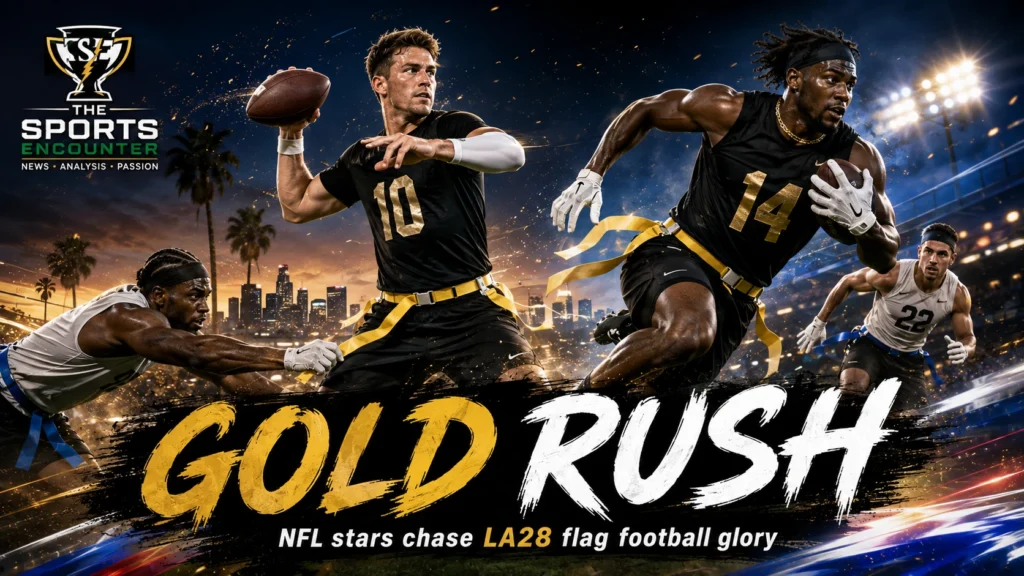
LOS ANGELES, August 22, 2026: More than 200 NFL players have already expressed interest in competing in flag football at the 2028 Los Angeles Olympics.
The number immediately grabs attention. The reason behind it is more interesting.
Olympic flag football offers NFL players something their professional careers cannot provide: the chance to represent a country, compete for an Olympic medal and become part of the first generation to play their version of football at the Games.
According to Reuters, NFL Senior Vice President of Global Flag Football Brian Flinn said more than 200 players representing over 25 countries have indicated that they would be interested in representing their nations at LA28.
The NFL began canvassing player interest after team owners approved participation in May 2025. The Olympic tournament will feature only six men’s teams and six women’s teams, so the early rush of interest is already much larger than the number of available places.
Joe Burrow has publicly talked about wanting to compete for Olympic gold. Patrick Mahomes has taken a different position, indicating that he expects to leave the opportunity to younger players.
Those contrasting reactions reveal the central tension surrounding LA28.
For some NFL stars, another summer competition creates unnecessary workload and injury risk. For others, the possibility of becoming an Olympic champion is too rare to ignore.
The Sports Encounter has already explored how LA28 is changing the ambitions of established American athletes through the debate around whether LeBron James could return for another Olympic run. Flag football now gives the NFL its own version of that conversation.
Why Are More Than 200 NFL Players Interested in LA28?
The NFL already offers money, celebrity, packed stadiums, national television exposure and the Super Bowl.
The Olympics offer a different reward.
An NFL player can become a league MVP, earn All-Pro selections and lift the Lombardi Trophy without ever experiencing what it feels like to compete for his country at an Olympic Games.
That distinction matters because LA28 will be the first Olympic appearance for flag football.
The athletes who win gold in Los Angeles will become the sport’s first Olympic champions. That achievement will remain theirs permanently, regardless of how large flag football eventually becomes.
1. Olympic Gold Creates a Different Kind of Legacy
Players spend NFL careers being measured against other professionals inside their own league.
Olympic success places them into a much broader sporting history.
Burrow’s interest makes sense from that perspective. A Super Bowl and an Olympic gold medal would represent two completely different accomplishments.
The appeal becomes stronger because LA28 may be the only realistic Olympic opportunity for many current players.
A player who is 27 or 28 in 2028 could still be near his athletic peak. Four years later, his NFL career may be ending or already over.
There is no guarantee that flag football will remain on every future Olympic program either.
For some stars, Los Angeles may genuinely be a once-in-a-career window.
2. The National Jersey Changes the Meaning of Competition
The NFL is built around franchises.
The Olympics are built around countries.
That changes the emotional stakes.
A Bengals player would no longer be representing Cincinnati. A Chiefs player would no longer be competing for Kansas City.
Players could represent the United States, Canada, Mexico, Germany, the United Kingdom or another country for which they meet international eligibility requirements.
Flinn’s disclosure that interested NFL players represent more than 25 countries is especially significant.
The NFL has become increasingly international, both through its player base and its expansion into overseas markets. Olympic flag football gives players with international backgrounds a direct national-team pathway that tackle football has rarely provided.
That could transform countries that have only a handful of elite American football athletes.
3. The Olympic Roster Is Tiny
The demand becomes even more striking when compared with the available spaces.
The LA28 tournament will feature six men’s teams and six women’s teams.
Olympic flag football will be played five-on-five, with small national-team rosters.
Hundreds of NFL players may be interested, but only a tiny percentage can actually reach Los Angeles.
For Team USA in particular, the selection battle could become one of the most competitive Olympic roster fights in American sport.
| LA28 Flag Football | Format |
|---|---|
| Men’s teams | 6 |
| Women’s teams | 6 |
| Players on field | 5 per team |
| NFL players expressing interest | 200+ |
| Countries represented among interested NFL players | 25+ |
That scarcity makes an Olympic place more valuable rather than less.
4. Flag Football Gives Skill Players a Different Stage
Flag football removes tackling and most of the collision-heavy structure that defines the NFL.
It does not remove difficulty.
Instead, it changes which skills become decisive.
Quarterbacks need rapid processing and precise short-range accuracy. Receivers must create separation almost immediately. Defenders need anticipation, acceleration and clean flag-pulling technique in open space.
The smaller field and five-on-five format also create enormous amounts of space compared with conventional NFL formations.
That should naturally appeal to quarterbacks, wide receivers, defensive backs and other explosive players who thrive when they can operate away from heavy contact.
An NFL star accustomed to playing within detailed 11-on-11 schemes gets a chance to show a more stripped-down version of his athletic ability.
5. The Olympics Offer Global Exposure Beyond the NFL Audience
The NFL is already one of the largest sports businesses in the world, but its strongest cultural influence remains concentrated in North America.
The Olympic Games reach a much broader audience.
An NFL player competing at LA28 could appear before viewers who have never watched a full NFL game.
That creates obvious commercial value for players and the league.
The NFL has spent years growing internationally through games in Europe, Latin America and other markets. The Sports Encounter has also followed the league’s wider international and preseason storylines through our NFL training camp coverage and broader NFL preseason roundup.
Olympic flag football creates a far more accessible product for new markets because it requires less equipment, fewer players and significantly less physical infrastructure than traditional tackle football.
6. Playing in Los Angeles Makes Participation Easier
Location matters.
The first Olympic flag football tournament will take place in the United States rather than requiring NFL stars to travel halfway across the world during the offseason.
Los Angeles is already deeply connected to the league through the Rams, Chargers, major NFL events and the enormous commercial infrastructure surrounding American sports.
That reduces logistical complications and increases sponsorship, media and promotional opportunities.
For an NFL player considering his only Olympic appearance, LA28 is about as convenient as the opportunity could be.
7. The March Flag Football Classic Delivered a Reality Check
NFL stars may want Olympic roster positions.
They should not assume they will receive them.
The inaugural Fanatics Flag Football Classic in Los Angeles earlier this year provided the clearest warning.
Team USA’s experienced flag football players faced rosters loaded with NFL talent, including teams associated with stars such as Joe Burrow, Jalen Hurts and other prominent players.
The national flag specialists dominated.
Reuters reported that Team USA won the tournament and defeated the NFL-heavy opposition convincingly, including a 24-14 victory in the final.
The result demonstrated something selectors cannot ignore.
Elite tackle football ability does not automatically translate into elite flag football ability.
Flag Football Is Its Own Sport
The assumption that NFL players can simply remove their helmets and immediately dominate flag football is becoming harder to defend.
The spacing is different.
The quarterback timing is different.
Defensive technique changes because a defender cannot recover by making a tackle after losing leverage.
Route concepts develop differently when there are fewer players occupying the field.
Flag-pulling itself is a specialized defensive skill.
Existing national-team players have spent years learning those details.
That means NFL stars may need to earn Olympic selection through training camps, evaluation events and national-team competition rather than reputation.
USA Football, Not the NFL, Controls Team Selection
This distinction will become increasingly important as LA28 approaches.
USA Football is responsible for the American national program.
Its preliminary Olympic selection notice indicates that athletes being considered for Los Angeles can be evaluated through international championships, future qualification events, trials and training camps.
The USA Football Olympic selection framework makes clear that the process will extend well beyond name recognition.
That is important for established flag players who may otherwise fear that NFL stars will simply take their places.
Selection should ultimately come down to who gives Team USA the best chance to win.
Joe Burrow May Be One of the Most Fascinating Candidates
Burrow is likely to remain at the center of the conversation because he has publicly embraced the idea.
His NFL skill set appears suitable for flag football.
He processes defenses quickly, throws accurately into tight windows and remains composed when plays break down.
Yet even he has already seen the difference between the two sports.
During the Flag Football Classic, Team USA’s specialists showed that experienced flag defenses can disrupt NFL quarterbacks through spacing and anticipation without relying on traditional pass rush and tackling.
Burrow may eventually become an outstanding Olympic quarterback.
He will still need to learn the game.
Patrick Mahomes Represents the Other Side of the Debate
Mahomes has indicated that he expects to leave LA28 participation to younger players.
His position is equally understandable.
Olympic flag football may eliminate tackling, but it does not eliminate physical risk.
Players still sprint, cut, accelerate, jump and change direction.
Hamstrings, ankles and knees remain vulnerable.
By 2028, veteran superstars may decide that protecting their NFL careers matters more than adding an Olympic medal opportunity.
Franchises paying enormous guaranteed salaries will also have opinions about their most valuable players adding competitive football to the offseason.
The NFL Training Camp Question Could Become Complicated
The Los Angeles Olympics will take place during the summer, close to the period when NFL teams normally begin training camp.
That overlap creates one of the biggest practical challenges.
Olympic players will need national-team preparation before competing.
After the Games, many could have to transition almost immediately into NFL training.
A quarterback missing valuable installation time could affect an entire offense.
A receiver returning fatigued could enter preseason behind teammates who spent July preparing specifically for the NFL season.
These concerns do not make participation impossible.
They do ensure that clubs, national federations, the NFL and the NFL Players Association will spend the next two years negotiating details carefully.
International NFL Players Could Change the Qualification Race
Team USA will naturally dominate headlines because of the depth of American NFL talent.
The more disruptive development may occur elsewhere.
If interested players genuinely represent more than 25 countries, some national teams could suddenly gain athletes accustomed to competing at the highest level of American football.
One elite receiver or defensive back could transform a developing flag program.
A quarterback with professional experience could have an even larger impact.
The effect could be similar to what international stars sometimes provide to smaller basketball or soccer nations: one world-class athlete changes the entire tactical ceiling of the team.
How Olympic Flag Football Qualification Works
The United States receives automatic qualification as host.
The remaining countries must earn their positions through the international flag football structure run by IFAF and national federations.
The pathway includes major international championships and final Olympic qualification events before 2028.
That means NFL players representing countries outside the United States cannot simply announce that they want to go to Los Angeles.
Their countries have to qualify first.
This could create compelling stories involving NFL players trying to lift smaller national teams through international competition long before the Olympic opening ceremony.
Why the NFL Wants Its Players on the Olympic Stage
The league’s interest is easy to understand.
Flag football gives the NFL a pathway toward something tackle football has struggled to achieve: mass global participation.
Traditional American football requires helmets, pads, specialized fields, large rosters and significant coaching infrastructure.
Flag football dramatically reduces those barriers.
Young people can play it in schools, parks and community programs without enormous budgets.
Put recognizable NFL players into the Olympic tournament and the league suddenly has some of the world’s most marketable football ambassadors appearing under national flags.
That is powerful international marketing.
It is also a long-term development strategy.
Women’s Flag Football Could Benefit Even More
The NFL-player discussion naturally focuses on the men’s competition.
The women’s Olympic tournament may produce the larger developmental impact.
Women’s flag football has been growing rapidly in schools and organized programs, but it lacks a professional platform remotely comparable with the NFL.
LA28 gives elite women an Olympic goal, international visibility and a reason for national federations to invest more heavily in development.
The Games could create household names who currently have little mainstream exposure.
For girls entering the sport, that matters enormously.
The Real Team USA Debate: NFL Stars or Flag Specialists?
This may become the most controversial question of the entire Olympic build-up.
If dozens of elite NFL players want to represent Team USA, how many places should they receive?
A roster built entirely around NFL fame would attract enormous attention.
It might not produce the strongest flag football team.
The March exhibition provided evidence that specialists understand the sport at a level NFL players cannot immediately replicate.
The best solution may eventually be a hybrid roster.
| Role | What Team USA May Value |
|---|---|
| Quarterback | Rapid processing, accuracy, mobility and flag-specific timing |
| Receivers | Separation, acceleration and spatial awareness |
| Defensive backs | Closing speed, anticipation and flag-pulling technique |
| Rusher | Explosive acceleration and disciplined pursuit |
| Flag specialists | International experience and understanding of the five-on-five system |
| NFL stars | Elite athleticism, professional experience and high-level execution |
The selectors who combine those qualities best may win the first Olympic gold medal.
LA28 Could Change How Young Football Players Develop
The Olympic effect may eventually reach far below the NFL.
Young players who do not have the size or physical profile required for elite tackle football suddenly have another pathway.
Speed, hands, throwing ability, anticipation and movement can become Olympic-level skills without requiring an athlete to survive years of collision-heavy football.
Schools and youth programs also have greater incentive to invest when athletes can see a clear international pathway.
This is where Olympic inclusion could permanently change American football development.
Could Flag Football Stay in the Olympics Beyond 2028?
Los Angeles is guaranteed.
The future beyond LA28 will depend partly on how the sport performs as an Olympic product.
A competitive tournament featuring recognizable NFL players would strengthen the case for continued inclusion.
Large crowds, global television interest and social-media engagement would demonstrate that flag football can contribute meaningful value to future Games.
That creates a shared interest among the NFL, IFAF, players, sponsors and organizers.
They want LA28 to work.
LA28 Is Part of a Wider Olympic Shift
The Olympic movement increasingly understands the value of sports that connect with younger audiences and established professional leagues.
Los Angeles will become an important test of how traditional Olympic structures interact with modern American sports culture.
The Sports Encounter has already examined the same issue through LeBron James and the possibility of another Team USA appearance, while athletes in other sports are also beginning to shape their careers around 2028.
For NFL players, Olympic planning is now becoming part of that conversation years earlier than anyone would have imagined before flag football entered the program.
TSE Analysis: NFL Stars Want Something Their Contracts Cannot Buy
The 200-player figure makes more sense when viewed through scarcity rather than money.
NFL stars already have access to extraordinary salaries.
They play in enormous stadiums.
They appear in national advertising campaigns.
They compete in one of the world’s most commercially powerful leagues.
None of those things guarantee access to an Olympic Games.
An Olympic roster spot cannot be negotiated into a contract.
A medal cannot be purchased.
The experience of representing a country cannot be replicated by another NFL Sunday.
For players who have already achieved financial security and professional recognition, that difference matters.
LA28 offers a new challenge precisely because it sits outside their normal careers.
The Biggest Mistake Would Be Assuming NFL Players Will Dominate
This is where the story becomes more interesting than a simple celebrity list.
The NFL players may possess the greater athletic résumés.
The flag specialists currently possess the greater flag football experience.
Team USA demonstrated that advantage in March.
By 2028, the gap could narrow dramatically if NFL players commit seriously to training and national-team competition.
But the Olympic tournament will punish anyone who treats the sport as a novelty.
Flag football is not watered-down tackle football.
It is a different tactical game built around space, timing, speed and precision.
What Happens Next?
Flinn said more information about NFL player involvement is expected after the 2026-27 season.
Before then, national federations will continue developing Olympic qualification and selection systems.
Players interested in Los Angeles will have to balance several competing priorities:
- Olympic selection and national-team preparation
- NFL contracts and club commitments
- Injury protection
- International eligibility
- Flag-specific training
- Competition with existing national-team specialists
- Training camp and preseason schedules
Those details will determine whether the current list of more than 200 interested players becomes a genuine Olympic talent pool or gradually shrinks as 2028 approaches.
Final Verdict
More than 200 NFL players expressing interest in Olympic flag football says something powerful about the Games.
These are athletes who already compete at the top of the richest football league in the world.
They still see something in LA28 that the NFL cannot give them.
National pride matters.
Olympic history matters.
The scarcity of the opportunity matters.
So does the possibility of becoming one of the first Olympic flag football champions.
Joe Burrow may want gold. Dozens of other NFL stars may want the same thing.
Wanting it will be the easy part.
The harder challenge will be adapting to a sport whose established specialists have already shown they can beat NFL talent, surviving one of the most competitive selection processes imaginable and earning one of the few available places in Los Angeles.
That battle may become almost as fascinating as the Olympic tournament itself.
Frequently Asked Questions
How many NFL players want to play flag football at LA28?
The NFL says more than 200 players representing more than 25 countries have expressed interest in participating at the 2028 Los Angeles Olympics.
Will NFL players be allowed to compete at the Olympics?
Yes. NFL clubs approved player participation in May 2025, although athletes will still have to meet national-team selection and Olympic eligibility requirements.
Does Joe Burrow want to play at LA28?
Yes. Burrow has publicly expressed interest in competing in Olympic flag football and trying to win a gold medal.
Will Patrick Mahomes play Olympic flag football?
Mahomes has indicated that he expects to leave the opportunity to younger players.
How many teams will compete in LA28 flag football?
The Olympic tournament will feature six men’s national teams and six women’s national teams.
How many players are on the field in Olympic flag football?
Flag football is played five-on-five.
Is the United States automatically qualified?
Yes. Team USA receives automatic entry as the host nation.
Will NFL stars automatically make Team USA?
No. USA Football controls the national-team selection process, and NFL players will have to compete with established flag specialists for roster places.
Have NFL players already faced Team USA in flag football?
Yes. At the 2026 Fanatics Flag Football Classic, Team USA’s flag specialists defeated NFL-heavy opposition and won the tournament, demonstrating how different flag football is from tackle football.
When will flag football make its Olympic debut?
Flag football will make its Olympic debut at the Los Angeles Games in 2028.