


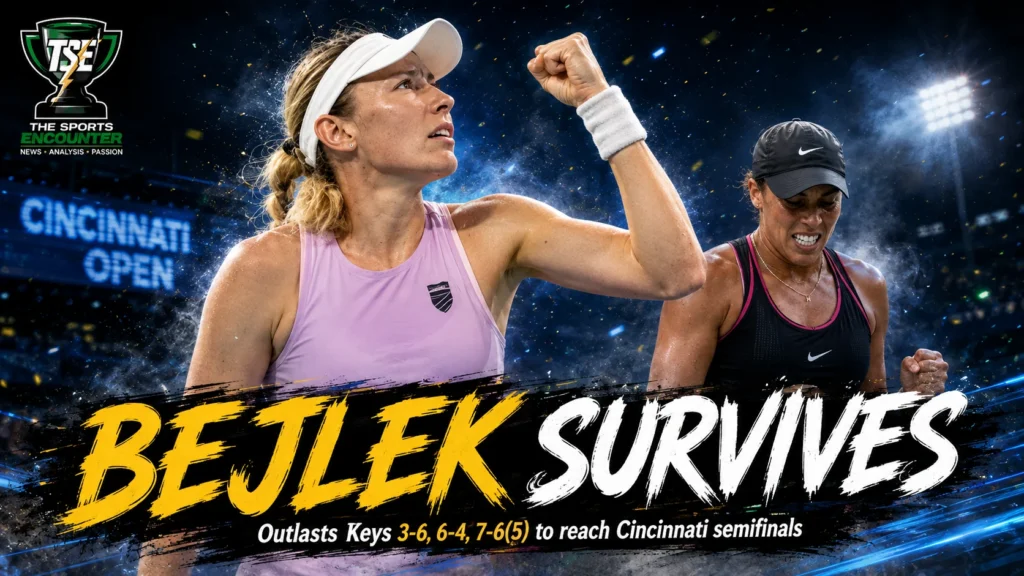
CINCINNATI, Ohio, August 21, 2026: Sara Bejlek has spent this week proving that she belongs on the same court as the biggest names in women’s tennis. Against Madison Keys, she had to prove something harder.
She had to prove she could survive herself.
The 20-year-old Czech recovered from the collapse of a 4-0 lead in the deciding set, absorbed a furious Madison Keys comeback, fell behind twice in the final tiebreak and still found enough nerve to win one of the most dramatic matches of the 2026 Cincinnati Open.
Bejlek defeated Keys 3-6, 6-4, 7-6(7-5) to reach the semifinals of a WTA 1000 event for the first time in her career.
The final score captures the length of the battle. It does not fully explain the chaos inside it.
Bejlek led 4-0 in the third set and appeared to have broken the resistance of the 2019 Cincinnati champion. Keys then won four straight games to make it 4-4. Bejlek steadied herself to move ahead 5-4 and later 6-5, but Keys refused to disappear and forced a deciding tiebreak.
There, Keys built leads of 4-2 and 5-4. Bejlek responded again. She won three of the final four points and closed the match 7-5 in the breaker, completing a victory that demanded much more than the fearless tennis that had already taken her past world No. 1 Aryna Sabalenka.
For continuing tournament coverage, match analysis and player stories, visit The Sports Encounter Tennis Hub.
Bejlek vs Keys: Cincinnati Open Quarterfinal Result
| Player | Set 1 | Set 2 | Set 3 |
|---|---|---|---|
| Sara Bejlek | 3 | 6 | 7 (7) |
| Madison Keys | 6 | 4 | 6 (5) |
Winner: Sara Bejlek
Final score: 3-6, 6-4, 7-6(7-5)
Round: Women’s singles quarterfinal
Tournament: Cincinnati Open 2026
Surface: Outdoor hard court
Venue: Lindner Family Tennis Center, Ohio
Keys Took Control Before Bejlek Changed the Match
Keys began the match looking like the player who had been here before.
The American carried the bigger reputation, home support and the experience of winning Cincinnati in 2019. Her first-strike tennis gave Bejlek less time to settle, and the opening set moved in Keys’ direction before she closed it 6-3.
That start mattered because Bejlek entered the quarterfinal carrying the emotional weight of the biggest victory of her career.
Only one round earlier, she had stunned Aryna Sabalenka 7-6(9-7), 6-4. The WTA described that victory as Bejlek’s first against a world No. 1 and her first Top 10 win. It also sent her into her first WTA 1000 quarterfinal. :contentReference[oaicite:0]{index=0}
The danger after an upset of that magnitude is obvious. Young players can spend so much emotional energy beating a superstar that the next match becomes harder than the previous one.
Bejlek avoided that trap.
She became more secure in the second set, extended rallies more effectively and prevented Keys from dictating every important exchange. The Czech took the set 6-4 and pushed the quarterfinal into a decider.
A 4-0 Lead Looked Like the Beginning of the End
The first four games of the third set suggested Bejlek was about to complete the job quickly.
She surged to a 4-0 lead.
Keys was suddenly chasing the score, the younger player had the rhythm and Bejlek appeared to have removed much of the uncertainty from a match that had been finely balanced for two sets.
Then the entire quarterfinal changed.
Keys began to shorten points more effectively, protected her serve and forced Bejlek to hit extra balls under growing scoreboard pressure.
One game became two.
Two became three.
Then Keys reached 4-4.
The four-game cushion was gone.
What had looked like Bejlek’s breakthrough moment was suddenly becoming a test of how she would respond to losing control of a match she could almost touch.
Keys’ Comeback Turned the Quarterfinal Into a Cincinnati Classic
Keys deserves enormous credit for what happened next.
Many players would have mentally accepted the result at 0-4 in the deciding set. Keys instead forced the match back into a contest point by point.
Her service games became cleaner. Her confidence returned. Bejlek began having to solve the same pressure repeatedly.
At 4-4, the momentum had moved almost entirely toward the American.
Bejlek responded with one of the most important holds of the match to lead 5-4.
Keys answered.
At 5-5, Bejlek was pushed through another difficult service game but survived again to reach 6-5.
That meant Keys had to serve to stay in the tournament.
She did.
The 20th seed held from 40-30 and forced the deciding set to 6-6.
By then, the quarterfinal had stopped feeling like a standard WTA 1000 match. The momentum had flipped too many times. Both players had been close to control without ever keeping it for long enough.
The Tiebreak Delivered One Final Swing
The deciding tiebreak matched everything that came before it.
Keys moved ahead 4-2.
At that point, Bejlek had already lost her 4-0 third-set lead and was now two points behind in the final breaker. The match appeared to be tilting toward the American again.
Bejlek pulled it back to 4-4.
Keys went ahead 5-4.
Bejlek answered once more.
At 5-5, the match had essentially become a two-point contest after nearly three sets of emotional turbulence.
Bejlek won the next point to earn match point at 6-5.
This time, she finished it.
The 7-5 tiebreak victory completed a match that demanded several recoveries within the same set.
Why This Win Says More About Bejlek Than the Sabalenka Upset
Beating Sabalenka announced Bejlek to a much wider tennis audience.
Beating Keys may tell us more about her.
The victory over Sabalenka was built on courage, clean execution and Bejlek’s ability to absorb elite pace. Reuters reported that she recovered from difficult positions in both sets before completing the biggest win of her career. :contentReference[oaicite:1]{index=1}
The Keys match asked a different question.
Could Bejlek keep thinking clearly after watching a huge lead disappear?
Could she avoid panic when the crowd sensed an American comeback?
Could she recover after falling behind in the tiebreak?
She answered yes every time.
That does not mean every decision was perfect. The third-set lead disappeared for a reason. Bejlek became vulnerable once Keys began attacking with greater freedom, and the Czech will know she cannot repeatedly surrender large advantages against elite opponents.
What matters is what happened afterward.
She did not mentally leave the match.
Bejlek’s Cincinnati Run Has Become One of the Tournament’s Biggest Stories
The quarterfinal victory extends a remarkable sequence for the Czech left-hander.
Bejlek opened her Cincinnati campaign by demolishing former world No. 1 Karolina Pliskova 6-0, 6-2. She then defeated former French Open champion Barbora Krejcikova 7-6(7-5), 6-4. :contentReference[oaicite:2]{index=2}
Ekaterina Alexandrova pushed her harder in the third round, taking the opening set before Bejlek recovered to win 4-6, 6-1, 6-2.
Then came Sabalenka.
The world No. 1 had arrived in Cincinnati as one of the central figures in the hard-court season, but Bejlek removed her in straight sets. Reuters described the result as the Czech player’s first Top 10 victory. :contentReference[oaicite:3]{index=3}
The Sports Encounter has followed the volatile North American hard-court season closely. Sabalenka had already suffered a significant setback in Toronto, where Ekaterina Alexandrova eliminated her during a weekend that also sent Jessica Pegula out of the tournament. Our National Bank Open report on Sabalenka and Pegula’s exits examined how rapidly the women’s hierarchy was shifting before Cincinnati.
Bejlek has now pushed that story much further.
From Toronto Defeat to Cincinnati Breakthrough
There is another detail that makes Bejlek’s run more impressive.
Earlier this month, Iga Swiatek beat her 6-0, 6-3 at the National Bank Open.
The Sports Encounter’s Toronto Day 4 report documented how Swiatek won the first nine games before Bejlek finally made the match competitive.
That result came only weeks ago.
Since then, Bejlek has gone from being overwhelmed by one elite opponent to beating several established players in the same WTA 1000 event.
The improvement is not linear, and one tournament should never be treated as proof that a player has permanently entered the elite. Still, Cincinnati has provided something tangible: Bejlek can now point to victories over major champions, experienced hard-court players and the world No. 1 within the same week.
Keys Leaves Cincinnati After One of Her Best Fights of the Tournament
Keys will leave disappointed, but this was not a passive defeat.
She entered the quarterfinal after beating Xiyu Wang 7-6(7-3), 6-4. That victory had taken the former Cincinnati champion into her first quarterfinal here since 2022. :contentReference[oaicite:4]{index=4}
Against Bejlek, Keys repeatedly created a route back into the match.
She won the first set.
She recovered from 0-4 in the third.
She held at 5-6 when defeat was one poor game away.
She led 4-2 in the deciding tiebreak.
Then she led 5-4.
There were enough opportunities to win this quarterfinal. Bejlek simply played the final pressure points better.
Bejlek Now Awaits Coco Gauff or Marta Kostyuk
Bejlek’s semifinal opponent will come from the remaining quarterfinal between Coco Gauff and Marta Kostyuk.
The official tournament bracket places the winner of that match against Bejlek, while the opposite semifinal has already been established between Jessica Pegula and Iga Swiatek.
Pegula reached the last four by surviving Amanda Anisimova 6-4, 2-6, 7-6(7-4). Swiatek advanced after Elena Rybakina retired while trailing 4-1 because of injury. :contentReference[oaicite:5]{index=5}
The contrast between the two semifinals is fascinating.
Swiatek and Pegula bring established WTA 1000 experience.
Bejlek arrives as the breakthrough player nobody expected to be here.
For additional context on the women’s hard-court picture, The Sports Encounter’s analysis of Swiatek’s Toronto semifinal run and our report on Gauff and Rybakina reaching the Toronto semifinals show how strongly several of the same contenders have carried their form into Cincinnati.
Bejlek’s Mental Recovery Was the Real Difference
The final set can be divided into three distinct phases.
| Phase | What Happened | Why It Mattered |
|---|---|---|
| Bejlek surge | Bejlek raced to 4-0 | She appeared to have complete control of the deciding set |
| Keys comeback | Keys won four straight games to reach 4-4 | Momentum and crowd energy shifted sharply |
| Pressure finish | Keys led 4-2 and 5-4 in the tiebreak | Bejlek had to recover again before winning 7-5 |
The biggest mistake would be to describe Bejlek’s victory as comfortable because she once led 4-0.
It was anything but comfortable.
Her advantage disappeared. Keys had the emotional lift. The tiebreak moved against her.
Bejlek kept finding enough control to win the next important point.
The US Open Has Another Name to Watch
Cincinnati is one of the final major checkpoints before the US Open, and Bejlek has transformed her profile at exactly the right time.
The Sports Encounter’s US Open 2026 preview outlined a women’s field already filled with established champions, dangerous hard-court players and rising contenders.
Bejlek now belongs in the conversation around players capable of creating problems in New York.
That does not make her a title favorite.
It does mean seeded players will have noticed what happened in Cincinnati.
She has beaten Pliskova, Krejcikova, Alexandrova, Sabalenka and Keys in succession.
That is not a soft path into a semifinal.
Cincinnati Has Rewarded Players Who Survive Chaos
The wider North American swing has been unusually unforgiving to established names.
Toronto had already produced repeated upsets and sudden momentum shifts, a pattern detailed in The Sports Encounter’s National Bank Open wrap-up on falling favorites and emerging stars.
Cincinnati has continued that theme.
Sabalenka is out.
Rybakina is out through injury.
Keys is out after coming within a handful of points of the semifinal.
Bejlek is still standing.
The official Cincinnati Open tournament page provides updated draws, scheduling and event information, with the women’s semifinals scheduled for Saturday and the final on Sunday. :contentReference[oaicite:6]{index=6}
TSE Analysis: Bejlek Did Not Win Because She Stayed Calm All Night
That would be too simple.
She lost control of the match.
She tightened.
Keys took advantage.
The 4-0 lead disappeared because the pressure changed how both players were striking the ball.
What separates this victory from a routine upset is that Bejlek recovered after the damage had already been done.
At 4-4, she could have folded.
At 4-2 down in the tiebreak, she could have rushed.
At 5-4 down, she could have started thinking about the lead she had wasted.
Instead, she kept playing the next point.
That is why this match matters.
The Sabalenka victory showed that Bejlek can beat the best player in the world.
The Keys victory showed that she can survive the emotional consequences of almost throwing a huge match away.
Those are two very different forms of confidence.
What Comes Next for Sara Bejlek?
The immediate answer is another semifinal, and potentially another huge name.
If Gauff advances, Bejlek will face one of the quickest defenders and strongest returners in women’s tennis.
If Kostyuk wins, the matchup becomes a different kind of test built around aggressive baseline exchanges and the ability to control court position.
Either opponent will force Bejlek to raise her level again.
There is also a broader challenge.
The emotional energy required to beat Sabalenka and then survive Keys is substantial. Bejlek has already played five matches in Cincinnati and has spent increasingly long stretches operating under intense pressure.
The semifinal will reveal whether the breakthrough still has another chapter.
Final Verdict
Sara Bejlek arrived in Cincinnati as a talented 20-year-old with a WTA title and growing potential.
She is leaving the quarterfinal stage as one of the central stories of the tournament.
Beating Sabalenka gave her the headline.
Surviving Keys gave the run substance.
A 4-0 lead disappeared. A former Cincinnati champion came roaring back. Keys moved ahead twice in the deciding tiebreak.
Bejlek still won.
3-6, 6-4, 7-6(7-5).
That score will send her into the record books as a Cincinnati semifinalist.
The way she reached it is what people who watched the match will remember.
Frequently Asked Questions
Who won Sara Bejlek vs Madison Keys at the Cincinnati Open?
Sara Bejlek defeated Madison Keys 3-6, 6-4, 7-6(7-5) in the women’s singles quarterfinals.
Did Bejlek lead 4-0 in the deciding set?
Yes. Bejlek raced to a 4-0 lead before Keys won four straight games to level the third set at 4-4.
What happened in the final tiebreak?
Keys led 4-2 and later 5-4, but Bejlek recovered, moved ahead 6-5 and converted the match point to win the breaker 7-5.
Who will Sara Bejlek play in the Cincinnati semifinal?
Bejlek will face the winner of the quarterfinal between Coco Gauff and Marta Kostyuk.
Who did Bejlek beat before Madison Keys?
Bejlek defeated world No. 1 Aryna Sabalenka 7-6(9-7), 6-4 in the round of 16.
Is this Bejlek’s first WTA 1000 semifinal?
Yes. Cincinnati marks Bejlek’s first appearance in a WTA 1000 semifinal.
How old is Sara Bejlek?
Bejlek is 20 years old and represents the Czech Republic.
When are the Cincinnati Open semifinals?
The tournament schedule lists the semifinals for Saturday, August 22, with the finals scheduled for Sunday, August 23.