


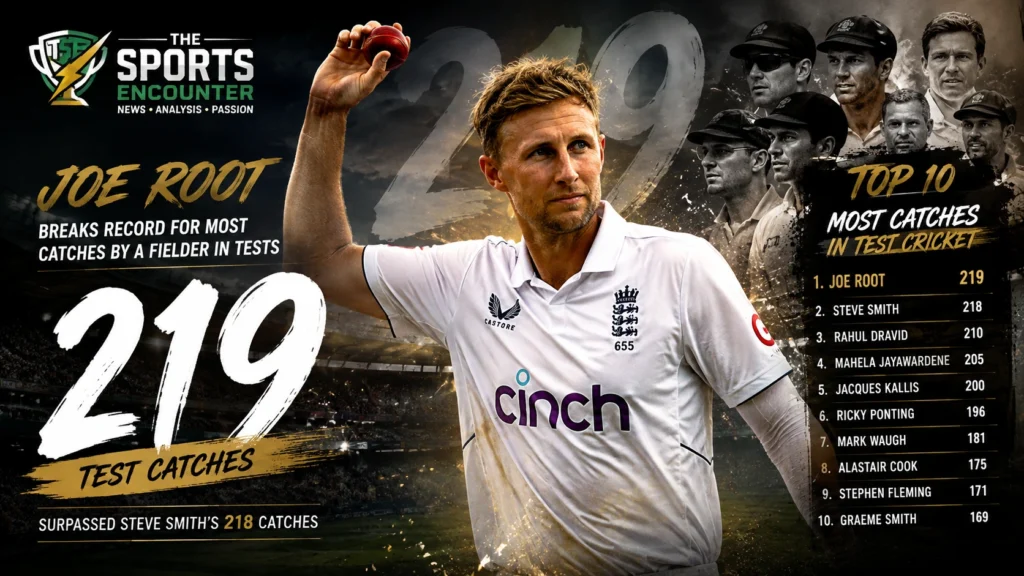
Joe Root has added another extraordinary record to a career already overflowing with them, becoming the leading non-wicketkeeper catcher in Test cricket history with 219 catches.
The England captain moved past Steve Smith’s mark of 218 during Pakistan’s second innings at Headingley on August 21, 2026, when he held Azan Awais at leg slip off Jofra Archer.
The milestone would have been impressive enough on its own. The way it happened made it even better.
Root had reportedly spoken to Archer only a couple of deliveries earlier and helped reshape the field by bringing a leg slip and short leg into the equation. Archer then attacked Awais with a delivery that moved into him, the Pakistan opener tried to work it fine, and Root completed the catch that took him to 219.
In other words, Root did more than happen to stand where the ball went. He helped create the dismissal that gave him the record.
That feels appropriate for a cricketer whose fielding has often lived in the shadow of his batting.
Root is already England’s leading Test run-scorer, has crossed 14,000 Test runs, has returned to the captaincy, and continues chasing Sachin Tendulkar’s all-time batting record. The Sports Encounter explored that pursuit when Root became only the second batter to reach 14,000 Test runs.
Now he owns one of Test cricket’s great fielding records as well.
Most Catches in Test Cricket: Top 10 Non-Wicketkeeper Fielders
| Rank | Player | Country | Test Catches | Career Status |
|---|---|---|---|---|
| 1 | Joe Root | England | 219 | Active |
| 2 | Steve Smith | Australia | 218 | Active |
| 3 | Rahul Dravid | India | 210 | Retired |
| 4 | Mahela Jayawardene | Sri Lanka | 205 | Retired |
| 5 | Jacques Kallis | South Africa | 200 | Retired |
| 6 | Ricky Ponting | Australia | 196 | Retired |
| 7 | Mark Waugh | Australia | 181 | Retired |
| 8 | Alastair Cook | England | 175 | Retired |
| 9 | Stephen Fleming | New Zealand | 171 | Retired |
| 10 | Graeme Smith | South Africa | 169 | Retired |
These figures refer to catches taken as a non-wicketkeeper in men’s Test cricket and are current through Joe Root’s 219th catch on August 21, 2026.
Joe Root’s 219th Catch Was a Captain’s Catch as Much as a Fielder’s Catch
Root’s record-breaking moment came during England’s first Test against Pakistan at Headingley.
Pakistan opener Azan Awais had made nine when Archer attacked him from around the wicket. Awais tried to work the ball into the leg side, but Root was waiting at leg slip.
The England captain completed the catch cleanly and moved one clear of Smith.
Reports from the match added an important detail. Root had discussed the field with Archer shortly before the dismissal and helped bring the catching position into play.
That turns the record into something richer than a statistical accident.
A slip catcher is often treated as the final link in a chain that begins with the bowler.
On this occasion, Root helped design the chain.
He read the batter, worked with the bowler, positioned himself for the expected mistake and then completed the chance.
That is fielding intelligence in its fullest form.
The record arrived during Root’s first permanent Test assignment since returning as England captain. The England and Wales Cricket Board officially confirmed Root’s return to the captaincy alongside Stephen Fleming’s appointment as Test coach earlier this summer.
Root and Smith Could Keep Trading the Record
There is another reason this record is fascinating.
It may not be safe.
Steve Smith sits only one catch behind Root on 218 and remains an active Test cricketer.
That means cricket could enter an unusual period in which two modern greats trade the record depending on who plays next and who receives the next chance.
Root could stretch the lead during England’s Pakistan series.
Smith could close it when Australia play.
Neither player is finished.
That makes this very different from Rahul Dravid’s long period at the top, when his 210 catches stood as a seemingly permanent benchmark.
The most-catches record has suddenly become a live contest.
Why This Record Is Harder Than It Looks
Test fielding rewards a completely different kind of concentration from white-ball cricket.
A fielder can stand in the slips for an entire session without receiving a genuine chance.
Then the ball takes an edge at high speed.
Reaction time can be measured in fractions of a second.
The fielder must remain balanced, read the line, judge whether the wicketkeeper or another slip will intervene, and complete the catch cleanly.
There is no warm-up.
No second attempt.
Test cricket can ask a fielder to remain mentally alert for six hours to complete one chance.
That is why longevity matters so much in this record.
The players at the top of the list were not merely athletic. They remained dependable for years.
The MCC’s Law 33 defines a fair catch around control of the ball and the fielder’s movement before the ball touches the ground. At the highest level, the law is simple. Executing it consistently against Test batters is much harder.
Does Most Catches Mean Best Test Fielder?
No statistical list can answer that question completely.
This is where the distinction between most catches and best fielder becomes important.
Catch totals are influenced by:
- how many Tests a player appears in;
- where he fields;
- the quality and style of his team’s bowlers;
- how often edges carry to his position;
- the conditions in which he plays;
- his role in the slip cordon;
- and career longevity.
That explains why someone such as Jonty Rhodes does not appear in this top 10.
Rhodes is widely regarded as one of cricket’s greatest fielders because of his speed, athleticism, throwing and ability to influence the game from point. He played only 52 Tests and did not spend his career permanently stationed in the slips.
A slip specialist can accumulate catches much faster than a brilliant cover fielder because far more dismissals are available in the cordon.
So the correct interpretation of this list is:
These are the most prolific catchers in Test history, not an objective ranking of the ten greatest fielders ever.
That distinction makes Root’s achievement no less remarkable.
1. Joe Root, England: 219 Catches
Root’s catching record has developed quietly because his batting takes up so much attention.
He has spent large parts of his career at slip, where England’s seam attack has repeatedly given him opportunities in conditions that reward movement.
But opportunity alone does not create 219 catches.
Root has shown soft hands, excellent balance and unusual adaptability in the cordon. He has fielded in different slip positions depending on the bowler, occasionally moved into leg slip or close-catching positions and remained an important tactical voice even when he was not captain.
His longevity has done the rest.
The Sports Encounter has followed Root’s late-career surge closely, from the strange moment when a bee interrupted him two runs short of 14,000 Test runs to the milestone itself three days later.
His record book now looks unusually complete.
2. Steve Smith, Australia: 218 Catches
Smith may have the strongest claim to being the most technically impressive catcher among the active leaders.
His reflexes at slip are exceptional.
Australia have used him close to the bat for spinners and in the cordon against pace, where his anticipation frequently looks almost pre-programmed.
Smith reached 218 before Root moved past him at Headingley.
Given that he remains active, the Australian can still reclaim first place.
This record may ultimately be decided by which of the two plays longer.
3. Rahul Dravid, India: 210 Catches
For years, Rahul Dravid owned this record.
His 210 catches became another part of a career built around reliability.
Dravid fielded mainly at slip, often to India’s spin attack, where close catching requires extremely soft hands and fast reactions.
Anil Kumble and Harbhajan Singh generated a huge number of bat-pad, edge and deflection opportunities, and Dravid became one of their safest partners.
He was rarely dramatic.
That was part of his appeal.
Dravid made difficult catches look routine.
4. Mahela Jayawardene, Sri Lanka: 205 Catches
Jayawardene’s place high on this list reflects both technique and Sri Lanka’s bowling environment.
Much of his career overlapped with Muttiah Muralitharan.
That meant countless overs spent in close-catching positions where the ball could arrive off an edge, glove, pad or bat-pad combination with almost no warning.
Jayawardene finished with 205 Test catches and also became the most prolific non-wicketkeeper catcher in ODI history.
Few players have been as consistently safe across formats.
5. Jacques Kallis, South Africa: 200 Catches
Kallis is remembered first for more than 13,000 Test runs and 292 wickets.
His 200 catches are another reminder of how complete his game was.
South Africa frequently used him in the slips, where his size, balance and dependable hands made him an ideal target for edges generated by attacks featuring Allan Donald, Shaun Pollock, Dale Steyn and Makhaya Ntini.
Reaching 200 catches while also carrying elite batting and bowling workloads gives Kallis one of the most extraordinary all-round statistical profiles in cricket history.
6. Ricky Ponting, Australia: 196 Catches
Ponting’s 196 Test catches capture only part of what made him such a formidable fielder.
He was brilliant at slip.
He was also exceptional at point and cover, where his speed, pick-up and throwing accuracy transformed ordinary singles into risks.
Ponting played in an Australian side that treated fielding standards almost as a cultural requirement.
His aggression in the field reflected the team he captained.
Among the top 10, he is one of the clearest examples of why catch totals alone cannot measure overall fielding impact.
7. Mark Waugh, Australia: 181 Catches
Mark Waugh’s 181 catches came with a reputation for making catching look effortless.
His hands were famously soft.
He rarely appeared tense at slip, even when standing close to Shane Warne and Australia’s seamers.
Waugh’s style made extraordinary reflexes appear casual.
Australia have produced generations of elite slip catchers, and Waugh remains one of the standard-setters.
8. Alastair Cook, England: 175 Catches
Cook accumulated 175 catches during one of the longest Test careers ever played by an England cricketer.
He was rarely described as a spectacular athlete.
At slip, that mattered very little.
Cook’s strength was positioning and reliability.
He spent years catching edges generated by James Anderson and Stuart Broad, two of the most successful fast bowlers in Test history.
Root eventually overtook Cook as England’s leading Test run-scorer and has now moved far beyond him in catches as well.
The scale of Root’s longevity was already becoming clear when The Sports Encounter examined his path beyond Cook and toward Tendulkar’s Test run record.
9. Stephen Fleming, New Zealand: 171 Catches
Fleming finished his Test career with 171 catches, an extraordinary number across 111 matches.
He was an excellent slip catcher and captained New Zealand through an era that demanded tactical discipline to compensate for a smaller talent pool than many rival nations.
Fleming is now connected directly to Root again.
The former New Zealand captain has been appointed England’s new Test coach, with Root returning as captain. The Sports Encounter covered Fleming’s appointment and England’s latest red-ball rebuild before this Pakistan series.
Two members of this top 10 are therefore about to work together.
10. Graeme Smith, South Africa: 169 Catches
Graeme Smith closes the top 10 with 169 catches.
Like Fleming, he combined captaincy with a permanent role in the slips.
Smith led South Africa through one of the strongest periods in their Test history and spent years catching behind attacks built around Steyn, Ntini, Pollock, Vernon Philander and Morne Morkel.
His fielding record is less famous than his leadership, but 169 catches put him comfortably among the format’s most productive fielders.
The Five Players Who Reached 200 Test Catches
| Player | Catches | Country |
|---|---|---|
| Joe Root | 219 | England |
| Steve Smith | 218 | Australia |
| Rahul Dravid | 210 | India |
| Mahela Jayawardene | 205 | Sri Lanka |
| Jacques Kallis | 200 | South Africa |
Only five non-wicketkeepers have reached 200 Test catches.
That group tells its own story.
Every player was a top-order batter.
Every player enjoyed a long Test career.
Every player spent significant time close to the bat.
And every one of them played alongside bowlers capable of generating enormous numbers of catching opportunities.
Why Top-Order Batters Dominate the List
There is a practical reason this leaderboard contains so many elite batters.
Top-order players are often selected as slip fielders because they are expected to remain in the team for long periods and usually possess strong hand-eye coordination.
Bowlers rotate.
Wicketkeepers occupy their own statistical category.
Middle-order players may be moved around the field.
But an established slip catcher can occupy the same position for ten or fifteen years.
That creates an enormous opportunity to accumulate catches.
Longevity becomes almost as important as brilliance.
Why Wicketkeeper Catches Are Excluded
This record specifically concerns fielders who are not acting as wicketkeepers.
That distinction is essential because wicketkeepers receive vastly more catching opportunities.
Every ball passes near them.
Edges, glances and deflections naturally produce much larger dismissal totals.
Comparing Root’s 219 with the career catches of specialist wicketkeepers would therefore tell us very little about relative fielding quality.
The non-wicketkeeper category exists because slip catching and general fielding represent a different statistical challenge.
Root’s Record Arrives During Another Test-Cricket Reinvention
The timing is interesting beyond the number itself.
Root has returned as England captain during another red-ball transition after Ben Stokes’ retirement.
The Sports Encounter covered Stokes’ sudden international retirement and the leadership vacuum it created before Root was restored permanently.
England’s new captain has started the Pakistan series with records arriving almost everywhere.
He scored 66 in the first innings at Headingley, reaching his 68th Test half-century and drawing level with Sachin Tendulkar for the most Test fifties.
Then came the 219th catch.
The ECB’s official England-Pakistan series guide confirms the three-Test schedule that now gives Root further opportunities to extend the catching record.
Pakistan arrived in England after a difficult red-ball reset of their own. The Sports Encounter examined that transition through Pakistan’s drawn Test series in the West Indies and Babar Azam’s return as Test captain.
Fielding Has Become More Important, Yet Harder to Measure
Modern cricket has become obsessed with measurable performance.
Batting has average, strike rate, boundary percentage, false-shot percentage and expected runs.
Bowling has economy, strike rate, movement, release points and expected wickets.
Fielding remains more difficult.
Catches are easy to count.
Runs saved are harder.
Pressure created by a fast fielder is harder still.
A player can prevent a run without touching the ball simply because the batter refuses to take the risk.
Another can turn a two into a single.
A third can force a run-out chance that someone else completes.
None of those moments appear in a simple catches column.
That is why the Root record should be treated as one specific measure of excellence rather than a complete fielding ranking.
What Makes a Great Test Slip Fielder?
The best slip fielders usually share several traits.
Soft Hands
A hard-handed catcher can cause the ball to rebound.
Elite slip fielders absorb the impact and bring the ball toward the body.
Balance
The fielder needs to remain low enough to move in either direction without committing too early.
Reading the Bowler
A catcher standing to a swing bowler positions differently from one standing to a spinner or a bowler generating seam movement.
Concentration
A chance may arrive after 150 deliveries of inactivity.
The fielder has to react as if it were the first ball of the day.
Communication
Slip cordons operate collectively.
Understanding whose catch belongs to whom prevents collisions and hesitation.
Anticipation
The very best sometimes seem to move before the edge has fully developed because they understand the shot, bowling angle and likely deviation.
Root’s 219th catch offered an unusually good example of that final quality.
England’s Catching Has Already Shaped Root’s Second Captaincy
Fielding has become a recurring theme in England’s recent Tests.
During the New Zealand series, Root publicly stressed the importance of holding chances after England let opportunities escape.
The Sports Encounter examined those weaknesses during England’s heavy second-Test defeat against New Zealand and again when New Zealand completed the series comeback at Trent Bridge.
Root understands better than most captains how much a dropped chance can cost.
He now also owns the statistical benchmark for doing the opposite.
Test Cricket’s August Schedule Gives the Record Extra Visibility
Root’s milestone has arrived during an unusually crowded period for the longest format.
Australia, Bangladesh, Sri Lanka, India, England and Pakistan are all involved in Tests across late August.
The Sports Encounter mapped the unusual calendar in our feature on 19 consecutive scheduled days of Test cricket.
That means Smith may not have to wait long for another opportunity to respond.
The catches race could remain active throughout the season.
Can Steve Smith Reclaim the Record?
Absolutely.
A one-catch gap means very little.
If Smith takes two catches in Australia’s next Test before Root adds another, first place changes hands again.
That possibility gives this statistic something rare for a historical record.
It is alive.
Root may eventually create distance.
Smith may regain the lead.
Both could finish their careers above 225.
At this stage, predicting the final order would be pointless.
The only certainty is that Dravid’s 210, once considered enormous, has now been passed by two active players.
Most Catches in Test Cricket: The Bigger Historical Picture
The list also reflects the changing geography of Test cricket.
Australia place three players inside the top seven.
South Africa have two inside the top ten.
England now have two.
India, Sri Lanka and New Zealand each contribute one.
That distribution is partly about opportunity.
Countries that played more Test cricket over long periods naturally created more chances for their leading fielders.
It also reflects tactical tradition.
Australia, England and South Africa have historically relied heavily on pace bowling and slip cordons, while India and Sri Lanka produced close-catch opportunities through elite spin.
Different bowling cultures created different paths to the same leaderboard.
TSE Verdict: Where Does Root Rank Among the Greatest Test Fielders?
If the question is purely statistical, Root is No. 1.
He has taken more catches as a non-wicketkeeper than anyone in Test history.
If the question becomes broader, the answer gets more complicated.
Ponting brought greater all-field athleticism.
Mark Waugh may have looked more natural at slip.
Dravid became synonymous with reliability.
Jayawardene was exceptional across formats.
Jonty Rhodes changed how cricket thought about fielding even though he sits nowhere near this catches list.
Root’s case is built on something else.
Longevity, adaptability, technique and extraordinary consistency.
He has spent more than a decade scoring thousands of Test runs while quietly accumulating catches at a rate that has eventually carried him beyond every specialist batter who came before him.
That combination deserves more attention.
Final Word
Joe Root’s 219th Test catch adds another line to a career that increasingly feels impossible to summarize with one skill.
He is one of the highest run-scorers in cricket history.
He is England’s captain again.
He is chasing Tendulkar.
He has now passed Steve Smith to become the most prolific non-wicketkeeper catcher Test cricket has seen.
The record may change hands again because Smith remains only one behind.
For now, however, the summit belongs to Root.
And fittingly, the catch that put him there was one he appears to have helped plan himself.
Frequently Asked Questions
Who has taken the most catches in Test cricket as a fielder?
Joe Root holds the record with 219 catches as a non-wicketkeeper in Test cricket after passing Steve Smith on August 21, 2026.
Who did Joe Root overtake?
Root overtook Australia’s Steve Smith, who had reached 218 Test catches.
Who was Joe Root’s record-breaking 219th catch?
Root caught Pakistan opener Azan Awais at leg slip off Jofra Archer during Pakistan’s second innings at Headingley.
How many Test catches did Rahul Dravid take?
Rahul Dravid finished his Test career with 210 catches and held the benchmark for years before Root and Smith passed him.
Who are the five players with 200 Test catches?
Joe Root, Steve Smith, Rahul Dravid, Mahela Jayawardene and Jacques Kallis are the five non-wicketkeepers to have reached 200 Test catches.
How many catches did Ricky Ponting take in Tests?
Ricky Ponting took 196 Test catches, placing him sixth on the all-time list.
Why are wicketkeepers excluded from the list?
Wicketkeepers receive substantially more catching opportunities because of their specialist position behind the stumps, so Test fielding records traditionally separate their catches from those taken by other fielders.
Can Steve Smith overtake Joe Root again?
Yes. Smith has 218 catches and remains active, leaving him only one behind Root at the time of publication.
Does having the most catches mean Joe Root is the greatest fielder ever?
No single statistic can establish that. Catch totals measure one part of fielding and are heavily influenced by position, career length and opportunity. Root is the most prolific Test catcher among non-wicketkeepers, while the broader debate over the greatest fielders includes players whose impact came through ground fielding, throwing and run-outs as well.