


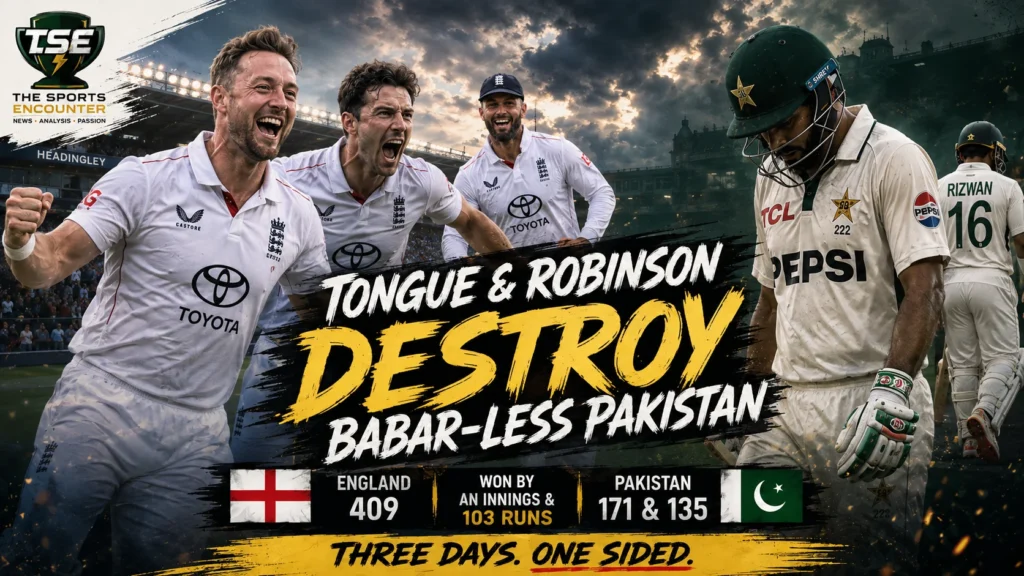
Pakistan arrived at Headingley without Babar Azam and left three days later with a defeat large enough to reopen almost every question about their Test team.
England won the first Test by an innings and 103 runs after bowling Pakistan out for 171 and 135. Joe Root’s side needed only one innings, 409 runs and a little more than two effective days of cricket to take a 1-0 lead in the three-match series.
Rain removed more than four hours from the contest. Even with that interruption, Pakistan could not take the match beyond the afternoon session on day three.
Ollie Robinson and Josh Tongue were the central figures. They took five wickets each in Pakistan’s first innings, then returned to claim three apiece in the second. Robinson finished with match figures of 8 for 80 and Player of the Match honors. Tongue ended with 8 for 89.
Jofra Archer completed the attack with three second-innings wickets, including both openers, while Gus Atkinson finally joined the wicket column by removing Mohammad Rizwan.
Pakistan had one significant bowling success of their own. Ali Usman claimed his maiden Test five-wicket haul as England reached 409. Abdullah Shafique also produced the tourists’ best innings of the match with 61 on the opening day.
Those performances were overwhelmed by everything else.
England were better with the new ball, more disciplined when conditions became easier, stronger in the field and far more composed whenever the match presented a decisive moment.
Pakistan were not simply beaten. They were repeatedly pushed into positions where the next hour demanded resistance and repeatedly failed to provide it.
The full result confirmed the warning signs that had already appeared when England took complete control of the Headingley Test on day two.
England vs Pakistan First Test 2026: Match Summary
| Match Detail | Information |
|---|---|
| Series | Pakistan tour of England 2026 |
| Match | First Test |
| Venue | Headingley, Leeds |
| Dates | August 19-21, 2026 |
| Pakistan first innings | 171 all out |
| England first innings | 409 all out |
| Pakistan second innings | 135 all out |
| Result | England won by an innings and 103 runs |
| Player of the Match | Ollie Robinson, 5/51 and 3/29 |
| Josh Tongue | 5/46 and 3/43 |
| Pakistan’s top scorer | Abdullah Shafique, 61 in the first innings |
| England’s top scorer | Harry Brook, 91 |
| Pakistan’s best bowler | Ali Usman, 5/95 |
| Series position | England lead 1-0 |
| World Test Championship points | England 12, Pakistan 0 |
The match scorecard and final bowling figures are available through the complete England-Pakistan Headingley scorecard.
TL;DR: How England Crushed Pakistan at Headingley
- Pakistan were dismissed for 171 after Ollie Robinson and Josh Tongue took five wickets each.
- Azan Awais was dismissed by Robinson from the first ball of the Test.
- Abdullah Shafique made 61 and Imam-ul-Haq 42, but Pakistan collapsed after recovering to 97 for two.
- England responded with 409 and built a first-innings lead of 238.
- Harry Brook made 91, Jordan Cox 73, Joe Root 66 and Dan Lawrence 51.
- Ali Usman claimed 5 for 95, his maiden Test five-wicket haul.
- Pakistan were dismissed for 135 in only 37.3 overs in the second innings.
- Robinson, Tongue and Jofra Archer took three wickets each in the second innings.
- Robinson and Tongue finished with eight wickets apiece in the match.
- England won by an innings and 103 runs and took a 1-0 series lead.
- The defeat is Pakistan’s second-heaviest innings loss against England at Headingley, behind the innings-and-117-run defeat of 1962.
Robinson Sets the Tone With the First Ball of the Series
Pakistan’s problems began before they had scored a run.
Ollie Robinson struck with the first delivery of the Test.
Azan Awais, playing his first Test in England, was trapped lbw for a golden duck.
Four overs later, Shan Masood was also lbw to Robinson for five.
Pakistan were 6 for two.
The conditions were helpful, but Robinson’s success came from more than simply putting the ball into the Headingley air and waiting for movement.
He repeatedly bowled the length that forced Pakistan’s batters to make decisions. Leaving became difficult. Playing forward carried risk. Waiting on the back foot allowed the ball to threaten the stumps.
The ICC’s opening-day report highlighted how Robinson and Tongue shared all 10 Pakistan wickets between them.
Robinson later explained that consistency had been his main objective because he had not felt completely satisfied with his rhythm before the Test.
That admission made the performance more impressive.
A bowler who felt he was still searching for his best rhythm finished the match with eight wickets.
Abdullah Shafique and Imam-ul-Haq Briefly Show Pakistan the Way
The first innings did contain evidence that Pakistan could have made a contest of the Test.
Imam-ul-Haq and Abdullah Shafique recovered from 6 for two with a 91-run partnership.
Imam made 42 from 74 balls.
Shafique went further, scoring 61 from 104 deliveries with eight fours.
Their approach was not spectacular, and it did not need to be.
They left deliveries that did not threaten the stumps, defended with softer hands and waited for England’s bowlers to drift away from their preferred areas.
Pakistan reached 97 for two.
At that point, the first-ball wicket and the early pressure had largely been repaired.
Then the innings collapsed.
From 97 for Two to 171 All Out: Pakistan Waste Their Recovery
Pakistan’s first innings should not be remembered as an uninterrupted display of English dominance.
That would let the visiting batters off too easily.
They had recovered.
They had two set players.
The ball was older.
The most dangerous opening spell had been negotiated.
They still lost their final eight wickets for 74 runs.
Tongue removed Imam for 42.
Robinson trapped Saud Shakeel for five and then bowled Shafique for 61.
Salman Ali Agha made 21 before Tongue bowled him. Ali Usman fell first ball. Mohammad Rizwan managed only 12.
The tail offered very little beyond Khurram Shahzad’s 14.
Pakistan were all out for 171 in 48.1 overs.
The collapse was particularly damaging because it repeated a problem seen throughout Pakistan’s recent red-ball struggles: they can repair an innings but struggle to turn recovery into control.
Shafique had recently shown what sustained occupation of the crease could achieve when his unbeaten 160 helped Pakistan end an eight-match overseas Test losing streak against West Indies.
Headingley required another innings of that scale.
Pakistan got 61.
Josh Tongue Turns Support Role Into a Five-Wicket Haul
Tongue’s figures were more expensive than Robinson’s, but his impact was equally destructive.
He took 5 for 46 from 9.1 overs in the first innings.
His wickets included Imam, Salman, Rizwan, Ali Usman and Mohammad Abbas.
Most importantly, he attacked when Pakistan’s innings was already unstable.
That matters in Test cricket.
Some bowlers create pressure.
Others recognize the moment when pressure can become collapse.
Tongue did both at Headingley.
His pace also gave England something different from Robinson’s movement and control. That variety had been identified before the series as one of England’s strongest advantages in our full England vs Pakistan Test series preview.
At Headingley, that advantage became decisive.
Babar Azam’s Absence Became More Expensive With Every Wicket
It would be too simple to say Pakistan lost only because Babar Azam was absent.
One batter does not explain a defeat by an innings and 103 runs.
But his absence mattered.
Pakistan entered the Test without their captain and most established specialist batter after Babar aggravated his right-hand injury during the warm-up match.
The Sports Encounter reported before the Test that Babar had been ruled out and Salman Ali Agha would captain Pakistan for the first time in Test cricket.
The consequence became obvious once England began breaking partnerships.
There was no experienced No. 4 capable of taking control of a difficult session.
There was no batter with Babar’s record of surviving high-quality pace for long periods.
There was also no permanent captain to absorb the emotional weight of a rapidly deteriorating match.
Pakistan knew the injury could become decisive before the Test began. Our earlier Babar Azam injury update explained why a damaged hand posed particular problems against England’s pace attack and the moving Dukes ball.
Headingley supplied the answer.
Pakistan needed their senior batters to compensate collectively.
They did not.
England Lose Two Early Wickets and Refuse to Panic
Pakistan still had a route back into the Test after making 171.
England were reduced to 48 for two.
Ben Duckett fell for 15 to Mohammad Abbas.
Emilio Gay made a quick 33 before Mohammad Ali removed him.
A disciplined bowling side could have turned 48 for two into 80 for four.
Instead, Jordan Cox and Joe Root rebuilt the innings.
Cox made 73 from 100 balls.
Root scored 66 from 112.
Their 150-run partnership took England to 198 before Pakistan finally removed Cox.
Root followed four runs later.
For one brief period, Pakistan had another opening.
England were 202 for four.
Pakistan Drop Harry Brook on 1 and Watch the Match Escape
This was one of the most costly moments of the Test.
Harry Brook had barely begun when Salman Ali Agha dropped him at second slip.
Had Pakistan taken the chance, England would have been 205 for five.
The lead would have been only 34.
Two fresh batters would have been at the crease.
Pakistan would have had a real opportunity to keep England below 300.
Brook survived and made 91.
That single missed catch did not create the entire 238-run first-innings deficit, but it showed why Pakistan spent so much of the match chasing opportunities they had already allowed to disappear.
Brook attacked without becoming reckless. He made 91 from 93 balls with 13 fours.
Dan Lawrence added 51.
England moved from a potentially vulnerable 202 for four to 322 for five.
The match was effectively changing from a contest into damage limitation.
Ali Usman’s Five-Wicket Haul Deserves More Than a Footnote
Pakistan’s clearest positive came from Ali Usman.
The left-arm spinner finished with 5 for 95 from 24 overs.
He dismissed Cox, Brook, Lawrence, Atkinson and Robinson.
For a relatively inexperienced bowler operating in English conditions against a batting order determined to score quickly, it was an impressive performance.
Salman praised him after the match and had every reason to do so.
Usman maintained a competitive line when Pakistan’s seamers were repeatedly leaking runs. He changed pace, challenged England’s batters to manufacture strokes and remained willing to attack even when the scoreboard was moving rapidly.
He had already played a major role in Pakistan’s victory in Trinidad, where he and Sajid Khan helped dismiss West Indies for 117. Our West Indies-Pakistan series review identified Ali Usman’s emergence as one of the encouraging developments from that tour.
Headingley strengthened that case.
Pakistan lost badly, but they may have found a bowler worth building around.
Pakistan’s Seamers Had Conditions and Could Not Use Them
This is where the contrast between the teams becomes uncomfortable for Pakistan.
Salman acknowledged after the defeat that there had been moisture in the pitch when Pakistan bowled.
The opportunity was there.
England’s quicks had already shown what a disciplined fuller length could achieve.
Pakistan’s seamers could not repeat it often enough.
Mohammad Abbas was the most controlled, finishing with 1 for 78 from 25 overs.
Khurram Shahzad took three wickets but conceded 133 runs from 21.5 overs at more than six runs per over.
Mohammad Ali claimed one wicket for 89.
Too many deliveries were short enough to pull, wide enough to cut or full enough to drive without demanding a difficult decision.
Pakistan’s reputation has historically been built around fast bowling, but the modern attack is searching for a consistent identity. The Sports Encounter examined that wider issue in our analysis of Pakistan’s fast-bowling past and the expectations it still creates.
Headingley made the comparison unavoidable.
England bowled with method.
Pakistan bowled too many isolated good deliveries between stretches of release balls.
England Reach 409 Without a Century
There was something revealing about England’s total.
Nobody scored a hundred.
Brook made 91.
Cox made 73.
Root made 66.
Lawrence made 51.
Jamie Smith contributed 25 and Archer added an unbeaten 23.
England still reached 409.
That is the difference between a batting lineup producing several useful innings and one depending on a single player to rescue it.
Pakistan’s highest scores across two innings were 61, 42 and 41.
England had four batters pass 50 in one innings.
Root described the performance as mature rather than reckless. England scored at 4.55 runs per over, but much of that scoring came from punishing mistakes rather than forcing extravagant shots.
That was an important development for a side entering a new phase after the end of the Ben Stokes and Brendon McCullum era.
Only weeks earlier, The Sports Encounter had examined how England’s defeat to New Zealand ended the Stokes era at Trent Bridge.
Headingley looked very different.
Joe Root’s Second Captaincy Begins With Control Rather Than Chaos
Joe Root could hardly have asked for a cleaner beginning to his second spell as England’s permanent Test captain.
He scored 66.
He watched his bowlers dismiss Pakistan twice in 85.4 overs.
He managed four fast bowlers with enough clarity that no one had to carry an unreasonable workload.
His field placements also produced immediate rewards.
One of the best examples came early in Pakistan’s second innings.
After discussing the plan with Archer, Root moved himself to leg gully for Azan Awais.
The ball went there almost immediately.
Azan flicked Archer into Root’s hands and departed for nine.
It looked almost too neat.
Good Test captaincy often does.
Root said afterward that England had approached the match with clarity despite coming directly from The Hundred.
The important word was clarity.
England knew how they wanted to bowl.
They knew when to attack with the bat.
They knew when conditions demanded patience.
Pakistan rarely looked equally certain.
Day Three Begins With a 238-Run Mountain
England resumed day three on 366 for eight.
Pakistan needed the final two wickets immediately.
Instead, England added another 43 runs.
Archer’s unbeaten 23 from 25 balls ensured the lead reached 238.
Pakistan therefore began their second innings knowing that simply batting well would not be enough.
They needed to bat for a long time before they could even make England bat again.
The psychological pressure was enormous.
The technical challenge was worse.
England had a new ball and four fast bowlers who already understood exactly where to bowl.
Archer Removes Both Openers Before Pakistan Can Settle
Pakistan were 0 for one for the second time in the match.
Imam-ul-Haq attempted to evade a short ball from Archer but left his gloves high enough for the ball to brush them on the way through to Jamie Smith.
Five balls into his innings, he was gone for a duck.
Azan then made nine before Root’s leg-gully move helped Archer remove him.
Pakistan were 13 for two.
Shan Masood and Shafique added 38, briefly giving the innings some shape.
Robinson ended the partnership when Shafique edged to Brook for 15.
Pakistan reached lunch at 59 for three.
They were still 179 runs behind.
The match remained mathematically alive.
What followed after lunch ended the argument.
Josh Tongue Tears Through Pakistan After Lunch
Tongue had not bowled before lunch.
Once Root introduced him, Pakistan’s resistance disappeared quickly.
Saud Shakeel flicked a ball to Dan Lawrence, who had been stationed behind square for exactly that type of shot.
Saud was gone for 14.
In Tongue’s next over, Shan Masood pushed at a length delivery from around the wicket and edged to Ben Duckett at first slip.
Masood made 29.
Salman Agha followed for four, lbw to another delivery that moved back enough to beat him.
Pakistan had gone from 51 for two to 76 for six.
The collapse was now terminal.
Robinson Joins the Destruction
Robinson returned and immediately removed Ali Usman.
The edge deflected from Smith behind the stumps before Jordan Cox reacted sharply at third slip.
Khurram Shahzad became Robinson’s next victim.
By then, the contest had become a race to see whether Pakistan could survive until tea.
Mohammad Rizwan resisted.
He made 41 from 39 balls, striking five fours and scoring at a rate nobody else in Pakistan’s second innings could sustain.
The innings delayed the finish.
It could not alter the result.
Rizwan’s Counterattack Ends With the Wrong Shot
Rizwan had shown that scoring remained possible.
That made the way he was dismissed more frustrating.
He attempted an aggressive stroke across the line against Atkinson and was bowled for 41.
Pakistan were 131 for nine.
Three deliveries later, Archer completed the job by dismissing Abbas.
Pakistan were all out for 135 in 37.3 overs.
The innings had lasted only 225 legal deliveries.
The Test was over before tea.
Pakistan’s Complete Batting Failure in Numbers
| Measure | Pakistan |
|---|---|
| First innings | 171 |
| Second innings | 135 |
| Total runs across both innings | 306 |
| England first innings | 409 |
| Difference | 103 runs despite England batting only once |
| Pakistan overs faced in first innings | 48.1 |
| Pakistan overs faced in second innings | 37.3 |
| Total Pakistan batting time in overs | 85.4 |
| Pakistan individual fifties | 1 |
| England individual fifties | 4 |
| Pakistan highest score | Abdullah Shafique 61 |
| England highest score | Harry Brook 91 |
This was not a match decided by one disastrous half-hour.
Pakistan were outplayed across almost every major phase.
Robinson and Tongue Finish With 16 Wickets Between Them
| Bowler | 1st Innings | 2nd Innings | Match Figures |
|---|---|---|---|
| Ollie Robinson | 5/51 | 3/29 | 8/80 |
| Josh Tongue | 5/46 | 3/43 | 8/89 |
| Jofra Archer | 0/26 | 3/50 | 3/76 |
| Gus Atkinson | 0/40 | 1/11 | 1/51 |
The numbers show how England’s attack changed shape without losing control.
Robinson and Tongue took all 10 wickets in the first innings.
Archer then became far more dangerous in the second.
Atkinson bowled eight overs for only 11 runs and eventually dismissed Rizwan.
England did not depend on one bowler.
The attack adapted as the pitch changed.
Ollie Robinson: From Fitness Questions to Player of the Match
Robinson’s performance carried an important personal story.
He revealed after the match that he had endured a difficult six weeks before the Test and had been working closely with the ECB medical team on his fitness.
The benefit was visible.
He maintained his pace through both innings and finished with 29 overs across the Test.
Robinson also adjusted his method as the surface changed.
In the first innings, the pitch was offering sharper seam movement in both directions.
By the second innings, it had slowed.
He responded by looking for more swing rather than expecting the same movement off the surface.
That adaptability is what made his eight wickets more impressive than the raw number alone.
He was not simply repeating one successful delivery.
He understood how the conditions were changing and changed with them.
Salman Ali Agha Admits England Simply Outplayed Pakistan
Pakistan’s stand-in captain did not attempt to disguise the scale of the defeat.
Salman said England had outplayed his side and acknowledged that Pakistan had made too many mistakes.
His assessment identified three important problems.
The batting lacked experience in English conditions.
The bowlers failed to make full use of the moisture available when Pakistan took the field.
The team could not maintain consistency.
He nevertheless backed the seam attack and highlighted Ali Usman’s bowling and Shafique’s first-innings 61 as genuine positives.
Salman also expressed hope that Babar will return at Lord’s.
Pakistan need him.
They also need much more than him.
Babar’s Return Cannot Become Pakistan’s Entire Lord’s Plan
It would be tempting for Pakistan to treat Babar’s possible return as the solution.
That would be dangerous.
Babar can strengthen the batting.
He cannot correct every loose delivery.
He cannot take catches for teammates.
He cannot stop established batters from giving their wickets away.
He cannot make three seamers maintain one disciplined length for an entire session.
Pakistan restored Babar as Test captain in July because the team needed stability after Shan Masood’s difficult tenure. The Sports Encounter examined the decision in detail when Babar Azam returned for his second spell as Pakistan’s Test captain.
The first victory of that new period came in Trinidad.
Headingley has now shown how far the rebuilding process still has to go.
Headingley History Makes This Defeat Even More Significant
England and Pakistan have been playing Test cricket at Headingley for more than six decades.
The venue has produced crushing England victories, famous Pakistan resistance and one remarkable Pakistan triumph.
The 2026 result now sits close to the harshest end of that history.
England vs Pakistan Tests at Headingley
| Year | Result |
|---|---|
| 1962 | England won by an innings and 117 runs |
| 1971 | England won by 25 runs |
| 1974 | Drawn |
| 1978 | Drawn |
| 1982 | England won by 3 wickets |
| 1987 | Pakistan won by an innings and 18 runs |
| 1992 | England won by 6 wickets |
| 1996 | Drawn |
| 2006 | England won by 167 runs |
| 2018 | England won by an innings and 55 runs |
| 2026 | England won by an innings and 103 runs |
After 11 Headingley Tests between the teams, England have now won seven, Pakistan one and three have been drawn.
Only England’s innings-and-117-run victory in 1962 has produced a larger innings margin than the 2026 result.
That makes this Pakistan’s second-heaviest innings defeat against England at Headingley.
1962 Was Worse on Paper, but This Defeat Carries Different Weight
The 1962 Headingley Test remains the statistical low point for Pakistan at this venue.
England made 428.
Pakistan replied with 131 and 180.
The hosts won by an innings and 117 runs.
The 2026 margin is 14 runs smaller.
Context, however, makes the modern defeat particularly damaging.
Pakistan are no longer a young Test nation learning how to tour England.
They arrived with decades of experience, professional coaching structures, franchise-hardened players and detailed performance data.
They had also just won an overseas Test in the Caribbean.
A defeat of this scale therefore cannot comfortably be explained as unfamiliarity with elite Test cricket.
The problem was execution.
1987 Shows How Different Pakistan Once Looked at Headingley
Pakistan’s only Test victory over England at Headingley came in 1987.
It remains one of the clearest examples of what Pakistan’s best touring sides could do in English conditions.
England were bowled out for 136.
Pakistan responded with 353.
England then made 199.
Pakistan won by an innings and 18 runs.
That team understood how to turn favorable bowling conditions into sustained pressure.
The 2026 side had moisture in the pitch and an attack that Salman still believes can succeed in England.
The result went in the opposite direction.
England made 409.
That contrast is difficult to ignore.
2006 Was Heavy, but Pakistan Made England Work
England also beat Pakistan comfortably at Headingley in 2006, winning by 167 runs.
That match, however, was a very different kind of contest.
It produced enormous run totals and extended deep into the Test.
Pakistan remained involved for far longer.
The 2026 defeat felt harsher because the visitors never forced England to bat twice.
They could not even take the game beyond the third afternoon despite rain removing a substantial portion of playing time.
2018 Now Looks Mild Compared With 2026
The most relevant modern comparison is 2018.
Pakistan arrived at Headingley leading that two-Test series 1-0 after an excellent victory at Lord’s.
England responded by bowling them out for 174 and 134.
The hosts made 363 and won by an innings and 55 runs.
Eight years later, Pakistan’s scores were 171 and 135.
The similarity is striking.
2018: 174 and 134.
2026: 171 and 135.
Pakistan have essentially reproduced the same batting failure at the same venue.
The difference is that England scored 46 more runs this time.
The result therefore grew from an innings-and-55-run defeat into an innings-and-103-run defeat.
For a team that has spent eight years trying to rebuild its Test batting, that comparison should concern Pakistan more than almost any individual dismissal.
The Most Damaging Comparison Is Pakistan Against Pakistan
Historical comparisons are useful, but the most important contrast comes from only two weeks ago.
Pakistan left Trinidad after beating West Indies by eight wickets.
Shafique made 160 not out.
Babar scored 88.
Sajid Khan and Ali Usman controlled the second innings.
The batting occupied the crease.
The bowlers understood the surface.
The fielding supported them.
Pakistan looked organized.
Our report on that victory asked whether ending the overseas losing streak could become the beginning of something more stable.
Headingley has made the answer less comfortable.
One good Test did not fix Pakistan.
Was This a Downfall or a Transition?
Pakistan cricket has spent years using the language of transition.
New captains arrive.
Young batters are introduced.
Fast bowlers rotate in and out.
Coaches change.
Selection philosophies change.
Each reset creates a reason to ask for patience.
At some point, transition must produce a stable destination.
Headingley showed a team still searching for one.
Pakistan fielded a mixture of youth and experience, but the problems were not limited to inexperienced players.
Experienced batters made poor decisions.
Senior fielders missed chances.
Established bowlers failed to sustain pressure.
That makes this harder to dismiss as a normal rebuilding defeat.
Why the Defeat Was So Complete
Five failures combined.
1. Pakistan Could Not Bat Through Difficult Periods
The first innings contained one significant partnership.
The second innings contained none large enough to threaten England.
Test batting in England does not require constant scoring.
It requires surviving periods when scoring becomes difficult.
Pakistan repeatedly treated pressure as something that needed an immediate answer.
2. The Seamers Failed to Maintain Pressure
Good balls arrived.
They were too often followed by deliveries England could score from.
That prevented Pakistan from creating the sustained discomfort Robinson and Tongue produced.
3. The Fielding Made a Difficult Total Harder to Defend
Dropping Brook on one changed an important passage of the match.
Against a total of 171, Pakistan needed almost every opportunity.
They did not take them.
4. England Had More Contributors
Pakistan’s meaningful batting contributions came from Shafique, Imam and Rizwan.
England received fifties from four different players.
The difference in batting depth was obvious.
5. England Adapted Faster
Robinson changed from seam movement to swing as the pitch slowed.
Root adjusted fields.
Archer improved in the second innings.
England reacted to the match in front of them.
Pakistan often appeared to be reacting to what had already happened.
England’s 1053-Ball Victory Underlines the Speed of the Collapse
The match required only 1,053 legal deliveries.
That made it one of the quickest victories of Root’s Test captaincy career.
The statistic becomes even more striking when the rain is considered.
More than four hours were lost on the second morning.
Without that interruption, England might have completed the match even earlier.
This was officially a three-day Test.
In practical playing time, it was much closer to two.
England’s Seventh Straight Headingley Test Win Adds Another Layer
The victory also extended England’s winning streak at Headingley to seven Tests.
That is their longest winning sequence at any home Test venue.
Headingley has built a modern reputation for dramatic England victories.
This one required very little drama.
England took control early and never surrendered it.
What Pakistan Must Fix Before Lord’s
The second Test begins at Lord’s on August 27.
Pakistan have less than a week to recover.
Four priorities stand above everything else.
Bat Longer
Pakistan cannot expect to win Tests in England while being bowled out inside 50 overs.
Even totals around 250 can become competitive if they occupy enough time to reduce the freshness of England’s bowlers.
171 and 135 gave England almost no physical cost for taking 20 wickets.
Make Babar’s Return a Strength, Not a Crutch
If Babar is fit, his return immediately improves the batting.
But Pakistan cannot expect him to carry the entire innings.
Shafique, Saud, Masood, Rizwan and Salman must produce partnerships around him.
Tighten the Seam Bowling
Pakistan’s quicks do not need to bowl at 150 kph.
They need to make England play six difficult balls in an over.
Headingley showed the value of control more clearly than raw pace.
Catch Everything
There is no tactical solution for dropping a batter who then makes 91.
Pakistan simply have to improve.
Lord’s Could Give Pakistan a Better Batting Surface
Lord’s will present a different challenge.
The slope can create movement, but the surface often becomes more comfortable for batting once the new ball loses its hardness.
Pakistan also carry much better recent memories there.
They won at Lord’s in 2016 and again in 2018.
Babar’s possible return therefore arrives at a venue where Pakistan have evidence that they can compete.
The problem is psychological as much as technical.
They will begin the second Test knowing another defeat ends any chance of winning the series.
The World Test Championship Damage Matters Too
The series forms part of the 2025-27 ICC World Test Championship.
England collected 12 points from Headingley.
Pakistan collected none.
Both teams entered the series in the lower half of the standings, giving them little room for repeated defeats. The ICC confirmed before the series that England and Pakistan were seventh and eighth respectively.
Pakistan’s immediate concern is Lord’s.
The broader cost is another Test disappearing from a campaign that already offered limited margin for error.
TSE Verdict: This Was More Than a Bad Three Days
Pakistan will naturally look toward Babar Azam’s possible return.
They should.
He is their best batter and permanent captain.
His presence would bring experience, technical quality and authority back into the side.
But Headingley exposed problems too deep for one player to repair.
Pakistan lost because Robinson and Tongue were outstanding.
They also lost because England were more disciplined, more patient and more certain about how they wanted to play.
The first innings was the clearest warning.
Pakistan recovered from 6 for two to 97 for two and still made only 171.
England fell to 48 for two and eventually made 409.
That contrast is the match.
One team turned recovery into a platform.
The other turned recovery into another collapse.
Robinson and Tongue finished with 16 wickets between them. Archer made sure the second innings never settled. Root began his second captaincy with the kind of controlled performance England needed after months of red-ball instability.
For Pakistan, the historical comparison is brutal.
In 2018 at the same ground, they made 174 and 134 and lost by an innings and 55 runs.
Eight years later, they made 171 and 135 and lost by an innings and 103.
The scores have barely changed.
The punishment has become worse.
Lord’s now offers Pakistan a chance to prove Headingley was a collapse rather than a direction.
Babar may return.
Pakistan need the rest of the team to arrive with him.
Follow The Sports Encounter’s cricket coverage for the second Test, Pakistan team news, England analysis and the rest of the 2026 international season.
Frequently Asked Questions
Who won the England vs Pakistan first Test at Headingley in 2026?
England defeated Pakistan by an innings and 103 runs at Headingley in Leeds to take a 1-0 lead in the three-match series.
What were the scores in the first England vs Pakistan Test?
Pakistan scored 171 and 135. England made 409 in their only innings.
Who was Player of the Match?
Ollie Robinson was named Player of the Match after taking 5 for 51 in Pakistan’s first innings and 3 for 29 in the second, finishing with match figures of 8 for 80.
How many wickets did Josh Tongue take?
Josh Tongue took eight wickets in the match. He claimed 5 for 46 in the first innings and 3 for 43 in the second.
How many wickets did Robinson and Tongue take together?
Robinson and Tongue took 16 of Pakistan’s 20 wickets. They shared all 10 wickets in the first innings and claimed three each in the second.
Why did Babar Azam not play the first Test?
Babar missed the Headingley Test because of a right-hand injury that he aggravated during Pakistan’s warm-up match in England.
Who captained Pakistan in Babar Azam’s absence?
Salman Ali Agha captained Pakistan for the first time in Test cricket.
Will Babar Azam play the second Test at Lord’s?
Pakistan hope Babar will return for the second Test, but his availability depends on his recovery from the hand injury.
Who top-scored for Pakistan?
Abdullah Shafique made Pakistan’s highest score of the match with 61 in the first innings. Mohammad Rizwan top-scored in the second innings with 41.
Who top-scored for England?
Harry Brook made 91 from 93 balls. Jordan Cox scored 73, Joe Root 66 and Dan Lawrence 51.
Who was Pakistan’s best bowler?
Ali Usman took his maiden Test five-wicket haul, finishing with 5 for 95 in England’s innings.
How many times have England and Pakistan played Tests at Headingley?
The 2026 match was their 11th Test at Headingley. England have won seven, Pakistan have won one and three have been drawn.
When did Pakistan last beat England at Headingley?
Pakistan’s only Test victory over England at Headingley came in 1987, when they won by an innings and 18 runs.
Is the 2026 defeat Pakistan’s biggest Test loss at Headingley against England?
No. England beat Pakistan by an innings and 117 runs at Headingley in 1962. The innings-and-103-run defeat in 2026 is Pakistan’s second-heaviest innings defeat against England at the venue.
What happened in the 2018 England vs Pakistan Test at Headingley?
England won by an innings and 55 runs. Pakistan made 174 and 134, remarkably similar to their 171 and 135 in the 2026 defeat.
When is the second England vs Pakistan Test?
The second Test begins at Lord’s on August 27, 2026.