


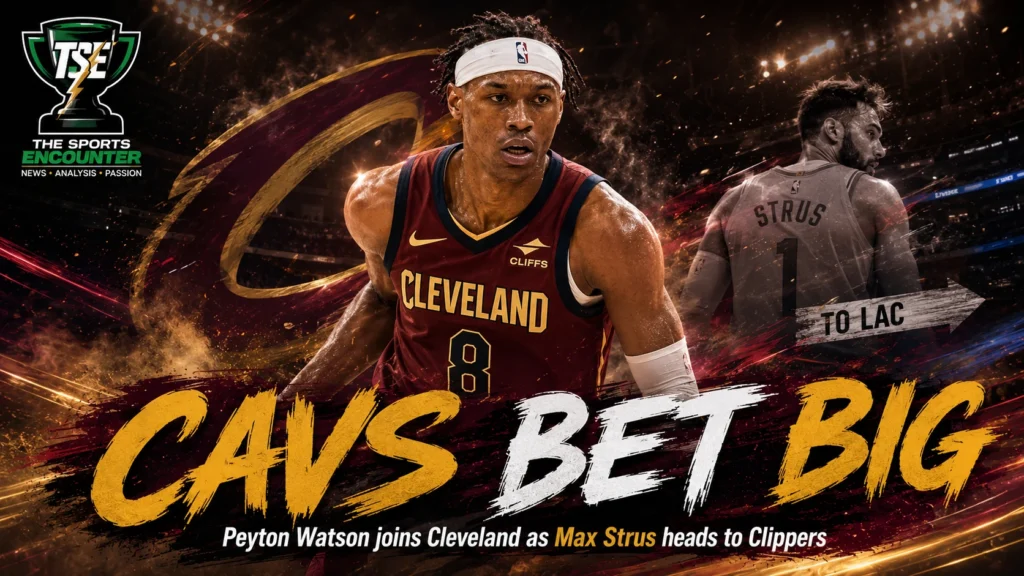
Cleveland’s offseason is beginning to look less like roster maintenance and more like a deadline.
Within hours of securing James Harden on a new three-year, $97 million agreement, the Cavaliers moved again, acquiring Peyton Watson from the Denver Nuggets in a multi-team deal that sends Max Strus to the Los Angeles Clippers and valuable future draft capital to Denver.
Watson, 23, is expected to sign a four-year, $88 million contract with Cleveland that includes a player option and trade kicker. The Cavaliers are reportedly sending Denver an unprotected 2031 first-round pick and a 2032 second-round selection originally acquired from Sacramento. Washington is also involved in the broader transaction.
The price tells us what Cleveland believes.
The Cavaliers did not watch their 2026 playoff run end in a four-game Eastern Conference finals sweep against the New York Knicks and decide they needed another scorer.
They decided they needed a different type of player around the scorers they already have.
Watson brings length, athleticism, defensive versatility, transition ability and a younger body to a projected starting group built around Harden, Donovan Mitchell, Evan Mobley and Jarrett Allen.
That is why this trade matters far beyond Watson’s 14.6 points per game last season.
Cleveland is attempting to repair the architecture around a backcourt that can create elite offense but also presents obvious defensive targets in May.
The Cavaliers have chosen their championship window. Now they are spending money, players and future draft capital to keep it open.
For more basketball coverage, follow The Sports Encounter’s NBA section.
Peyton Watson to Cavaliers Trade at a Glance
| Detail | Reported Outcome |
|---|---|
| Peyton Watson | Denver Nuggets to Cleveland Cavaliers |
| Watson contract | Four years, $88 million |
| Contract provisions | Player option and trade kicker |
| Max Strus | Cleveland Cavaliers to Los Angeles Clippers |
| Denver receives | Unprotected 2031 first-round pick from Cleveland, 2032 Sacramento second-round pick and Julian Reese |
| Watson age | 23 |
| 2025-26 scoring | 14.6 points per game |
| 2025-26 rebounding | 4.9 rebounds per game |
| 2025-26 assists | 2.1 assists per game |
| Starts | Career-high 40 |
The Associated Press reported the broader multi-team agreement, while Reuters also reported Watson’s move to Cleveland, the four-year contract structure and the future draft capital heading to Denver.
Cleveland Was Looking for a Wing, and Watson Fits the Problem Better Than Another Star
The easiest way to misunderstand this trade is to view Watson as Cleveland’s replacement for Max Strus.
He is replacing Strus on the roster.
His real purpose is larger.
Cleveland needed a player who could absorb difficult defensive assignments without requiring the ball on every possession.
Harden needs possessions.
Mitchell needs possessions.
Mobley deserves more offensive involvement.
Allen creates value through screening, rim pressure and offensive rebounding.
Adding another high-usage scorer could have made the offense more complicated without addressing what New York exposed during the playoffs.
Watson offers the opposite profile.
He can defend wings.
He can switch across positions.
He can run.
He can cut.
He can finish possessions that somebody else creates.
That skill set fits a roster with plenty of creators already.
The Cavaliers Are Building Around a Harden-Mitchell Backcourt, Not Pretending It Has No Weaknesses
Cleveland’s decision to retain Harden on a multiyear framework had been taking shape for weeks.
Harden remains one of basketball’s best half-court organizers.
Mitchell remains one of its most explosive scoring guards.
That combination can put enormous stress on opposing defenses.
It can also create problems at the other end.
Neither Harden nor Mitchell should be expected to spend 82 games taking the opponent’s most difficult perimeter assignment.
In the playoffs, teams actively search for weaker defensive links through screening actions.
They force switches.
They repeat the same action until a defense changes coverage.
Watson gives Cleveland another answer.
Instead of asking Mitchell to chase elite wings while also carrying a huge offensive load, Watson can assume more of those assignments.
A Harden-Mitchell-Watson-Mobley-Allen Five Makes Basketball Sense
Cleveland’s projected lineup now has a clearer division of responsibility.
| Player | Primary Value | Strategic Role |
|---|---|---|
| James Harden | Playmaking and half-court control | Primary organizer |
| Donovan Mitchell | Scoring and late-clock creation | Primary offensive weapon |
| Peyton Watson | Length, defense and athleticism | Top perimeter matchup defender |
| Evan Mobley | Elite defensive versatility | Defensive foundation and secondary creator |
| Jarrett Allen | Rim protection and rebounding | Interior anchor |
That lineup has an obvious logic.
Harden organizes.
Mitchell attacks.
Watson takes hard defensive assignments.
Mobley cleans up mistakes and switches across the floor.
Allen protects the paint.
The question is no longer whether the pieces have defined jobs.
It is whether those jobs fit well enough against championship-level opponents.
Watson’s Breakout Season Made Him More Than a Defensive Specialist
The Cavaliers are not paying $88 million simply for theoretical upside.
Watson just completed the best season of his NBA career.
He started 40 games and averaged career highs of 14.6 points, 4.9 rebounds and 2.1 assists.
Those numbers matter because they show progress beyond his original identity as a long, raw defensive prospect.
A team built around Harden and Mitchell does not need Watson to average 20.
It does need opponents to respect him enough that they cannot abandon him completely.
If Watson continues improving as a shooter, cutter and transition finisher, his offensive value could become just as important as his defense.
The Offensive Fit Will Determine Whether $88 Million Looks Smart
Playoff basketball attacks non-shooters ruthlessly.
If Watson occupies the corner and defenders ignore him, Cleveland’s spacing shrinks.
That creates more traffic for Mitchell.
It limits Harden’s driving lanes.
It gives opposing centers more freedom to help against Mobley and Allen.
Watson does not need to become an elite shooter.
He does need to punish teams often enough that leaving him completely unattended becomes uncomfortable.
That may be the developmental swing skill behind the entire investment.
Denver’s Willingness to Move Watson Also Deserves Attention
The Nuggets developed Watson over four seasons.
They saw the athleticism.
They saw the defensive upside.
They also saw his breakout season.
Denver’s problem was contractual.
Watson was a restricted free agent, and the Nuggets were unable or unwilling to match the financial commitment required to keep him.
Rather than lose him without recovering value, Denver turned the situation into draft capital.
An unprotected 2031 Cleveland first-round pick is potentially significant.
That is where this trade stops being an easy win for the Cavaliers.
The 2031 Pick Is the Real Gamble
Watson will be 28 in 2031.
Harden will be long past his current Cleveland timeline.
Mitchell will be in his mid-30s.
Allen will be older.
The shape of the Cavaliers could be completely different.
That is why an unprotected first-round pick six drafts into the future carries serious value.
Cleveland has no protection if circumstances collapse.
If the Cavaliers are still excellent, Denver receives a late first-rounder.
If Cleveland’s current era has ended badly, the pick could become one of the most valuable assets in the deal.
The Cavaliers have accepted that risk because they care more about 2026-27 than 2031.
This Is What Going All-In Actually Looks Like
Teams use the phrase constantly.
Most are not truly all-in.
Cleveland increasingly is.
Harden is receiving $97 million over three years.
Watson is expected to receive $88 million over four.
Mitchell has already received a major commitment.
Mobley is a foundational player.
Allen remains central to the frontcourt.
The Cavaliers are also sacrificing an unprotected future first.
They are not preserving optionality in case something better appears three years from now.
They are attacking the window in front of them.
The Knicks Sweep Changed the Standard in Cleveland
Cleveland reached the Eastern Conference finals last season.
That should ordinarily qualify as success.
The way the season ended changed the interpretation.
New York swept the Cavaliers 4-0.
By the end, the physical and tactical gap looked uncomfortable.
The Sports Encounter documented how the Knicks swept Cleveland and reached their first NBA Finals since 1999.
New York then went further, finishing the season as NBA champion and ending a 53-year championship drought.
That validated the quality of Cleveland’s opponent.
It did not make the sweep less concerning.
What New York Exposed
The Cavaliers struggled when the series became physical.
The Knicks attacked the boards.
They created difficult defensive decisions.
They forced Cleveland’s guards to work.
They turned turnovers into pressure.
They made Cleveland’s half-court possessions increasingly dependent on individual shot creation.
Watson addresses several of those problems without solving all of them.
He adds another athlete.
He adds length.
He gives Cleveland more lineup flexibility.
He can defend up a position.
He should improve the transition game.
What he cannot do by himself is prevent another collapse in ball security or guarantee the Cavaliers match New York physically across seven games.
Max Strus Leaves Behind a Different Type of Value
Strus should not be reduced to salary moving in the opposite direction.
He gave Cleveland shooting.
Spacing.
Movement without the ball.
Playoff experience.
He could stretch a defense in ways Watson may not immediately replicate.
That is the tradeoff.
Cleveland becomes longer and more athletic.
It may become less naturally spacious offensively.
The Cavaliers are betting that Harden’s playmaking, Mitchell’s shooting and the development of the rest of the roster can absorb that difference.
The Clippers Gain a Proven Shooter Without Restructuring Their Entire Team
Los Angeles becomes an interesting secondary winner.
Strus offers a plug-and-play veteran skill.
He can space the floor without requiring substantial usage.
That type of player fits almost any playoff offense.
His recent season was affected by injury, but his career shooting gravity remains valuable.
The Clippers are not receiving the highest-upside player in the transaction.
They are acquiring someone whose role is easy to understand.
Denver Converts a Restricted Free Agent Into Long-Term Value
The Nuggets’ side of the trade is less immediately exciting.
It may age very well.
That unprotected 2031 pick becomes an asset Denver can keep or use in another transaction.
The 2032 second-rounder provides another future piece.
Julian Reese adds a younger player to the organization.
If Watson becomes a star in Cleveland, Denver will inevitably be questioned.
If the Cavaliers’ 2031 pick eventually lands high in the lottery, the trade will look very different.
Washington’s Presence Helps Make the Money and Assets Work
The reported transaction involves several moving pieces, including Washington.
The broader framework illustrates how complex modern NBA trades have become under current salary and roster rules.
Teams increasingly need third and fourth partners to route contracts, picks and players in ways that keep deals legal and strategically useful.
That is why describing Watson-for-Strus as a simple swap would miss most of the story.
LeBron James Changed Cleveland’s Offseason Without Joining Cleveland
There is another important layer.
Cleveland had been considered a plausible destination for LeBron James before he ultimately chose Philadelphia.
The Sports Encounter previously ranked Cleveland as the strongest emotional and basketball fit in our analysis of LeBron’s potential 2026-27 destinations.
That return never happened.
LeBron instead joined the Philadelphia 76ers for his record 24th NBA season.
Cleveland still needed wing help.
Rather than chase another aging star, the Cavaliers moved in the opposite age direction.
Watson is 23.
Watson May Be a Better Structural Fit Than LeBron Would Have Been
This does not mean Watson is a better basketball player than LeBron.
That would be absurd.
The question is roster function.
Another high-usage offensive star would have required major redistribution of possessions among Harden, Mitchell, LeBron and Mobley.
Watson does not create that problem.
His best role is complementary.
Defend the best wing.
Run.
Cut.
Crash.
Finish.
Develop the jumper.
That could make the overall five more coherent even if it makes the roster less famous.
Philadelphia’s LeBron Move Also Raises the Stakes for Cleveland
The Cavaliers are not rebuilding in an empty Eastern Conference.
Philadelphia now features LeBron alongside Joel Embiid, Tyrese Maxey and Jaylen Brown.
The Sports Encounter’s analysis of whether the 76ers now possess the NBA’s strongest starting five showed how dramatically their ceiling has changed.
Cleveland therefore has to solve two problems at once.
Catch the champion Knicks.
Prepare for a much more dangerous Philadelphia team.
Standing still was not a serious option.
The Eastern Conference Is Becoming a Matchup War
There may not be one unbeatable favorite.
That makes roster construction even more important.
Against New York, Cleveland needs toughness, rebounding and wing defense.
Against Philadelphia, it needs length and bodies capable of surviving against larger lineups.
Against Boston, switchability matters.
Against younger transition teams, athleticism matters.
Watson can help in several of those environments.
That versatility is probably a major reason Cleveland preferred him over a more one-dimensional offensive addition.
Evan Mobley Is Still the Player Who Makes the Entire Plan Possible
Watson improves Cleveland’s defensive options.
Mobley remains the reason the system can become elite.
The former Defensive Player of the Year can defend the rim, switch onto guards and erase breakdowns behind the initial action.
A lineup containing Watson and Mobley gives Cleveland tremendous length around Harden and Mitchell.
That matters because the Cavaliers do not need every player to be an individual shutdown defender.
They need enough connectivity that mistakes do not become automatic baskets.
The Watson-Mobley Combination Could Become Cleveland’s Defensive Identity
Imagine a playoff possession against an elite wing.
Watson takes the primary assignment.
A screen arrives.
Mobley switches.
Watson rotates toward another threat.
Allen protects the rim.
The idea is to reduce the number of possessions where Harden or Mitchell are isolated against the opponent’s preferred scorer.
That is the defensive architecture Cleveland is buying.
Watson’s Age Matters Almost as Much as His Skill Set
Harden is approaching 37.
Watson is 23.
That creates an interesting dual timeline.
Cleveland is trying to win immediately without making every addition a short-term veteran.
If Watson develops, he could remain important after Harden is gone.
That gives the contract a different risk profile from a four-year deal given to a player already in his 30s.
The $88 Million Number Needs Context
NBA contracts continue to grow as league revenues and salary-cap levels increase.
$22 million annually is significant.
It is not necessarily star money in the modern NBA economy.
If Watson becomes a high-level starting two-way wing, the deal could age favorably.
If he remains a useful defender with inconsistent offense, the contract becomes more debatable.
If his development stalls entirely, Cleveland will have paid both money and a distant unprotected first-round pick for a role player.
That is the downside.
Watson Does Not Need to Become an All-Star for the Trade to Work
This is important.
Cleveland is not necessarily betting on superstardom.
It is betting on fit.
A 15-point scorer who defends elite wings, runs the floor, rebounds his position and hits enough open threes can be hugely valuable on a contender.
Players with that profile become especially important in the postseason because there is nowhere to hide a weak link.
The Cavaliers Need to Protect Watson From Becoming a Standstill Corner Player
The worst offensive use would be asking him to stand still while Harden and Mitchell run pick-and-rolls for 48 minutes.
Cleveland should exploit his athleticism.
Use him as a cutter when defenders turn their heads.
Let him screen for guards.
Create transition opportunities.
Give him chances to attack closeouts.
Allow him to run after defensive rebounds.
The more dynamic his role becomes, the less pressure falls on his jumper.
Harden Could Be Excellent for Watson’s Offensive Development
This is one of the more interesting possibilities.
Harden has spent much of his career making athletic teammates easier to play with.
His ability to manipulate help defenders creates simple reads for cutters and rim runners.
Watson does not need to create every advantage himself if Harden is creating the first one.
A well-timed backdoor cut can become a dunk.
A transition run can become an easy finish.
A screen can become a mismatch.
If the chemistry works, Watson’s efficiency may rise even without a dramatic increase in individual creation.
Donovan Mitchell Also Benefits From Having a Defensive Wing Beside Him
Mitchell’s offensive responsibility is already enormous.
The Cavaliers should not compound that by consistently assigning him the opponent’s most exhausting perimeter matchup.
Watson gives Cleveland another way to preserve Mitchell’s energy for late-game offense.
That may not appear clearly in Watson’s box score.
It can matter enormously in a seven-game series.
Max Strus’ Departure Places More Shooting Responsibility Elsewhere
This is the hidden cost Cleveland has to manage.
Strus’ movement created spacing even when he did not touch the ball.
Defenders respected his shooting enough to follow him through actions.
Watson will have to earn that respect.
If he cannot, Cleveland may need more shooting from other bench and rotation pieces to keep the floor open.
The roster work may therefore not be finished.
Cleveland’s Bench Construction Becomes More Important Now
A starting five does not win an NBA championship by itself.
The Cavaliers need reserve shooting.
Secondary ball handling.
Another switchable defender.
Frontcourt insurance.
Regular-season depth capable of reducing the workload on Harden and Mitchell.
The Watson trade improves one major area while potentially creating another need.
Harden’s Extension and Watson’s Arrival Should Be Evaluated Together
Looking at either move alone misses Cleveland’s plan.
The Harden contract says the Cavaliers believe his playmaking remains valuable enough to keep.
The Watson trade says Cleveland understands the defensive limitations that come with that choice.
One move creates the need for the other.
That is what coherent roster construction should look like.
Cleveland Has Committed $185 Million to Two Very Different Jobs
Harden: three years, $97 million.
Watson: four years, $88 million.
The combined figure is $185 million.
The players could hardly be more different.
Harden brings age, experience, creation and offensive intelligence.
Watson brings youth, length, athleticism and defensive upside.
The contracts make more sense together than separately.
The Cavaliers Are Trying to Solve the Problem Before May Exposes It Again
Regular-season basketball can hide roster flaws.
A deep rotation protects weaker defenders.
Matchups change nightly.
Opponents do not have a week to prepare.
The playoffs remove those protections.
New York found Cleveland’s vulnerabilities and attacked them repeatedly.
The Cavaliers are now responding before another postseason opponent gets the same opportunity.
New York Remains the Benchmark
The Knicks are no longer a theoretical contender.
They are the defending champions.
The Sports Encounter’s coverage of New York’s record Finals comeback against San Antonio demonstrated the physical and emotional resilience that eventually defined its title run.
Cleveland needs more of that quality.
Watson’s profile should help.
The Cavaliers still have to prove the team can execute when a playoff game becomes ugly.
LeBron’s Philadelphia Move Makes Patience Even Harder
Philadelphia did not add LeBron for a five-year plan.
The 76ers are trying to win immediately.
Cleveland is doing the same.
The Knicks are defending a championship.
That compresses the Eastern Conference window.
A contender cannot simply assume next season will provide another opportunity.
Health changes.
Contracts change.
Players age.
New teams emerge.
This is why Cleveland is willing to sacrifice future flexibility.
What Peyton Watson Gives Cleveland Immediately
- A younger starting-caliber wing
- More size around Harden and Mitchell
- A defender capable of taking difficult perimeter assignments
- Transition athleticism
- Additional rebounding from the wing
- A lower-usage offensive player who fits around established stars
- Long-term upside beyond Harden’s current timeline
What Cleveland Is Giving Up
- Max Strus and his shooting gravity
- An unprotected 2031 first-round pick
- A 2032 second-round asset
- Future roster flexibility
- The possibility that the distant first becomes highly valuable
What Watson Must Improve
The defense is the foundation.
The next step is offensive reliability.
His checklist should be straightforward:
- Improve catch-and-shoot consistency
- Make faster decisions after closeouts
- Reduce unnecessary turnovers
- Become a more reliable secondary rebounder
- Use his size as a cutter
- Finish efficiently around the rim
- Maintain defensive intensity without excessive fouling
What Cleveland Must Avoid
The Cavaliers should not mistake fit for certainty.
Watson’s presence does not automatically repair every playoff weakness.
They must avoid:
- asking Watson to create too much offense;
- allowing spacing to collapse around Mobley and Allen;
- overplaying Harden during the regular season;
- assuming defense can compensate for turnovers;
- ignoring the rebounding problems exposed by New York;
- and treating the starting five as a finished championship product before it proves itself.
The 2031 Pick Means Cleveland Needs More Than a Marginal Upgrade
This is perhaps the fairest standard.
If Watson improves Cleveland from good to slightly better, the price may eventually look excessive.
If he becomes the defensive piece that helps the Cavaliers survive Philadelphia and New York in May, nobody will care much about the 2031 pick while Cleveland is playing in the NBA Finals.
Championship trades are judged by what they unlock.
Could Watson Eventually Outlive Cleveland’s Current Window?
Yes.
That is one of the trade’s most appealing elements.
Harden’s contract is a short-term championship investment.
Watson could become part of whatever follows.
He will still be in his prime when the current version of Cleveland inevitably begins changing.
That gives the Cavaliers at least some developmental upside despite operating aggressively in win-now mode.
TSE Analysis: Cleveland Is Building a Counterweight to Its Own Stars
This is what makes the trade intelligent on paper.
Great teams do not simply accumulate their best five individual players.
They build compensating strengths.
Harden and Mitchell create offense.
Watson and Mobley protect the defense.
Allen protects the rim.
The lineup has balance because its players do different things.
That does not guarantee a championship.
It gives Cleveland a clearer path toward one.
The Biggest Risk Is That Watson’s Offense Stalls
Playoff defenses will test him immediately.
They will help off him.
They will dare him to shoot.
They will crowd Mitchell and Harden.
Watson does not need to become Klay Thompson.
He needs to make the punishment for ignoring him meaningful enough that opponents reconsider.
If he does, Cleveland’s lineup becomes difficult to attack at either end.
The Biggest Upside Is a 23-Year-Old Two-Way Wing Entering His Prime
Those players are difficult to acquire.
Teams rarely trade established elite wings in their mid-20s without receiving huge packages.
Cleveland is buying before Watson reaches that level.
The wager is that he gets there.
If his 14.6-point breakout becomes the beginning rather than the peak, $88 million could eventually look favorable.
How the Trade Changes Cleveland’s Championship Ceiling
| Area | Before Watson | After Watson |
|---|---|---|
| Perimeter defense | Major concern | Clearly improved |
| Wing size | Limited | Improved |
| Shooting | Stronger with Strus | More uncertain |
| Transition athleticism | Average | Improved |
| Age profile | Older around key creators | More balanced |
| Future flexibility | Better | Reduced by 2031 first-round pick |
| Defensive matchup options | Limited around guards | Much stronger |
The Deal Also Tells Us What Cleveland Thought of Its LeBron Alternative
The Cavaliers reportedly considered other options after LeBron chose Philadelphia, including DeMar DeRozan and Jonathan Kuminga.
Watson represents a different bet.
Younger than DeRozan.
Less offensively demanding.
More defense-oriented.
And potentially better suited to the stars already on the roster.
Cleveland appears to have decided it did not need another headline.
It needed a solution.
Prediction: Watson Will Start and Become Cleveland’s Primary Wing Defender
The roster logic points strongly in that direction.
Harden and Mitchell need defensive cover.
Mobley should not be forced to take every elite perimeter matchup because his help defense is too valuable.
Watson can assume that responsibility.
Expect Cleveland to use him against opposing stars from the opening weeks of the season.
His offensive usage should remain modest while the Cavaliers test how effectively he can function as a cutter, transition finisher and catch-and-shoot option.
Final Verdict: Cleveland Is No Longer Protecting the Future From the Present
The Peyton Watson trade makes sense only if you understand where the Cavaliers believe they are.
They do not see themselves as a young team collecting experiences.
They reached the Eastern Conference finals.
They were swept by the team that became NBA champion.
They watched Philadelphia add LeBron James.
They retained James Harden.
They have Donovan Mitchell in his prime and Evan Mobley established as one of the league’s most important defensive players.
Waiting carries risk too.
That is why Cleveland is willing to give Watson $88 million.
It is why Max Strus can be sacrificed.
It is why an unprotected 2031 first-round pick is leaving town.
The Cavaliers believe Watson fills a weakness their stars cannot solve themselves.
That is the most compelling part of the trade.
Cleveland did not respond to its playoff failure by chasing another ball-dominant name.
It went looking for length, defense, youth and athleticism.
If Watson continues developing offensively, the Cavaliers may have found the missing player who allows Harden and Mitchell to do what they do best without asking them to be something they are not.
If he does not, Denver will spend the next several years watching that unprotected 2031 pick become more interesting.
There is real risk on both sides.
For Cleveland, that is increasingly the point.
The Cavaliers have chosen their championship window.
They are done waiting for it to open wider.
FAQs
Did the Cavaliers acquire Peyton Watson?
Multiple reports say Cleveland is acquiring Peyton Watson from Denver as part of a multi-team transaction involving the Cavaliers, Nuggets, Clippers and Wizards. The reported deal had not yet appeared as an official completed transaction on the NBA’s offseason trade tracker at the time of writing.
How much will Peyton Watson earn with Cleveland?
Watson is reportedly expected to sign a four-year, $88 million contract containing a player option and trade kicker.
Who is Max Strus being traded to?
Max Strus is reportedly heading from Cleveland to the Los Angeles Clippers as part of the transaction.
What are the Cavaliers sending to Denver?
Denver is expected to receive Cleveland’s unprotected 2031 first-round pick, a 2032 Sacramento second-round selection and additional value through the multi-team structure.
How did Peyton Watson perform last season?
Watson averaged career highs of 14.6 points, 4.9 rebounds and 2.1 assists during the 2025-26 season while making a career-high 40 starts.
How old is Peyton Watson?
Watson is 23 years old and spent his first four NBA seasons with the Denver Nuggets.
Why do the Cavaliers want Peyton Watson?
His length, athleticism and defensive versatility make him a natural fit around James Harden and Donovan Mitchell, while his age gives Cleveland longer-term upside.
What could Cleveland’s starting five look like?
A likely lineup would feature James Harden, Donovan Mitchell, Peyton Watson, Evan Mobley and Jarrett Allen.
Why did Cleveland trade Max Strus?
The move effectively exchanges some shooting and spacing for a younger, more athletic and defensively versatile wing who better addresses weaknesses exposed during Cleveland’s playoff loss to New York.
Did Cleveland consider other wings?
According to the Associated Press, the Cavaliers also considered DeMar DeRozan and Jonathan Kuminga after LeBron James chose Philadelphia.
Why is the 2031 first-round pick important?
The pick is reportedly unprotected, meaning Denver would receive it regardless of where Cleveland finishes in the 2030-31 season. Because the Cavaliers’ current core could look dramatically different by then, the asset carries significant long-term upside for Denver.
Is the trade officially complete?
The transaction has been reported by the Associated Press and Reuters. At the time of this article’s preparation, the NBA’s public 2026 offseason transaction tracker had not yet been updated to list the deal as formally completed, so the article treats the transaction as reported rather than officially finalized.