


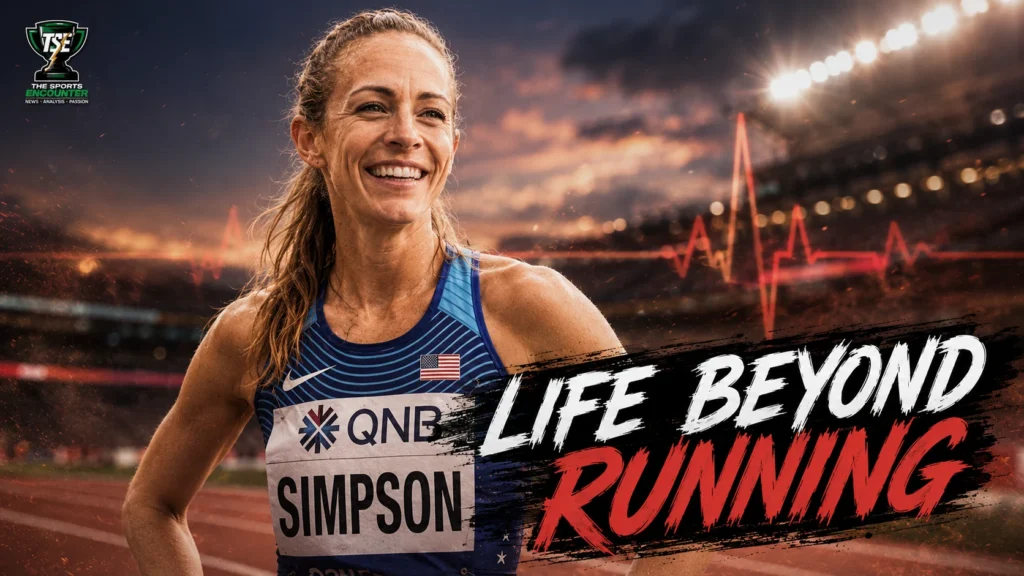
Jenny Simpson spent most of her adult life learning how to keep running when a race became uncomfortable.
World Championship finals demanded it.
Olympic pressure demanded it.
Injuries demanded it.
Now the former 1500-meter world champion is confronting something far more difficult than any final lap.
Simpson has revealed that she has been diagnosed with Arrhythmogenic Right Ventricular Cardiomyopathy, or ARVC, a rare inherited heart condition that means returning to running would be dangerous.
The diagnosis comes two months after the 39-year-old collapsed while pacing a mile group at a community track event in Raleigh, North Carolina, and required CPR and the use of an automated external defibrillator.
For one of the most accomplished middle-distance runners in American history, the news changes the meaning of retirement completely.
Simpson had already stepped away from competitive running in 2024.
She had not stepped away from running itself.
Now that distinction has been taken from her.
Jenny Simpson’s Diagnosis at a Glance
| Detail | Information |
|---|---|
| Athlete | Jenny Simpson |
| Age | 39 |
| Nationality | United States |
| Diagnosis | Arrhythmogenic Right Ventricular Cardiomyopathy (ARVC) |
| Condition type | Rare inherited cardiomyopathy |
| June incident | Collapsed while pacing a community mile event in Raleigh, North Carolina |
| Emergency response | CPR and an automated external defibrillator were used |
| Professional retirement | 2024 |
| 2011 World Championships | 1500m gold |
| 2013 World Championships | 1500m silver |
| 2016 Rio Olympics | 1500m bronze |
| 2017 World Championships | 1500m silver |
Simpson’s Message Is About Survival Before Sport
Simpson announced the diagnosis publicly on Thursday.
The language she chose was striking because it did not center medals, unfinished athletic goals or what she had lost.
It centered survival.
“My future is an incredible gift.”
She also said that her future remained hopeful and meaningful, even though the diagnosis means it would be dangerous for her to return to running.
That is the most important part of this story.
A celebrated runner has been told that the activity around which so much of her life was organized is now medically unsafe.
At the same time, she is alive to confront what comes next.
The Reuters report on Simpson’s diagnosis confirmed that she disclosed ARVC after the June collapse and said that returning to running would be dangerous.
What Is Arrhythmogenic Right Ventricular Cardiomyopathy?
ARVC is a rare form of cardiomyopathy that affects the heart muscle.
According to the American Heart Association’s explanation of arrhythmogenic right ventricular cardiomyopathy, the condition can involve replacement of healthy right-ventricular muscle with scar or fatty tissue.
That process can interfere with the heart’s electrical system and contribute to abnormal heart rhythms.
The condition can be inherited and may be associated with symptoms including palpitations, fainting and cardiac arrest, particularly around physical activity.
It is important not to generalize one athlete’s diagnosis to every person with ARVC. Medical advice depends on the individual’s specific condition, history, genetic findings, cardiac function and specialist assessment.
In Simpson’s case, the key fact comes from Simpson herself: she has been told that returning to running would be dangerous.
Why Intense Exercise Matters in ARVC
The relationship between ARVC and intense exercise is one reason Simpson’s diagnosis carries particular weight for a lifelong endurance athlete.
The American Heart Association has long advised caution around intensive exercise in people with clinically diagnosed ARVC, and a July 2026 scientific statement on high-risk exercise populations again highlighted increased concern about high-intensity activity in some forms of arrhythmogenic cardiomyopathy.
That does not mean every person with a genetic heart condition receives identical restrictions.
Sports cardiology has increasingly moved toward individualized assessment for many cardiovascular conditions.
ARVC remains a condition in which exercise-related risk can be especially important, and Simpson’s own medical team has clearly advised her against returning to running.
The June Collapse Now Has an Explanation
On June 16, Simpson was pacing runners at a Sir Walter Running Pop-Up Mile event in Raleigh.
It was not an Olympic final.
It was not a world championship.
It was exactly the kind of community event that showed what running still meant to Simpson after retirement.
She was helping other people experience the sport.
Then she collapsed.
Reports at the time said Simpson lost her pulse and received immediate CPR. An automated external defibrillator was also used before she was transported to hospital.
The speed of that response matters enormously.
In the weeks that followed, there was relief that Simpson had survived, but the underlying cause had not yet been publicly established.
Thursday’s diagnosis provides the missing context.
The People Around the Track Became Part of Simpson’s Survival Story
Major sporting careers are usually remembered through coaches, rivals, teammates and championship crowds.
The people who mattered most on June 16 were the ones close enough to act immediately.
CPR was started.
An AED was used.
Emergency medical care followed.
That sequence turned a frightening collapse into a survival story.
For a sport that often measures response in tenths or hundredths of a second, this was a different kind of timing.
Minutes mattered.
So did preparation.
So did the presence of people willing and able to respond.
Running Was Never Merely Simpson’s Job
This is what makes the diagnosis emotionally difficult to separate from Simpson’s identity.
Elite athletes retire all the time.
Retirement usually means leaving competition, not abandoning the physical activity that shaped a life.
A retired swimmer can still swim.
A former cyclist can still ride.
A retired runner can normally lace up shoes and head outside without a stopwatch, stadium or starting gun.
Simpson’s situation is different.
The activity itself has become dangerous for her.
That means the adjustment is not simply from professional athlete to former professional athlete.
It is from runner to someone who must discover what movement, purpose and community look like without running at the center.
Her Career Was Built Around One of Track’s Hardest Distances
The women’s 1500 meters demands a strange combination of patience and violence.
Races can begin tactically and finish at sprint speed.
A runner must manage position, avoid trouble, conserve energy and still possess enough acceleration to survive the final lap.
Simpson became one of the world’s best at solving that problem.
Her World Athletics profile records a 1500m personal best of 3:57.22 and a career that included a world title, two World Championship silver medals and an Olympic bronze. Her range also extended to the 3000m steeplechase, where she ran 9:12.50.
That versatility placed her among the defining American middle-distance runners of her generation.
The Sports Encounter has spent much of 2026 following similar championship-level performances across global athletics, including the opening athletics breakthroughs at the Glasgow 2026 Commonwealth Games and the record-heavy competition that followed.
Daegu 2011 Turned Jenny Simpson Into a World Champion
Simpson’s defining breakthrough came at the 2011 World Championships in Daegu.
She won the women’s 1500m title and became world champion only a year after making the event her primary focus.
World Athletics has described that championship as a moment of pure joy for Simpson, one made more powerful because she entered without carrying the heaviest expectations.
Winning a world title changed everything.
She no longer entered major championships as an outsider capable of surprising the favorites.
She became one of the athletes everybody watched.
Simpson handled that pressure well enough to keep returning to global podiums.
The Medals Kept Coming After the World Title
The 2011 gold was not an isolated championship peak.
Simpson won silver at the 2013 World Championships in Moscow, finishing behind Abeba Aregawi.
Four years later, she earned another World Championship silver in London behind Faith Kipyegon.
Those results strengthened the argument that Simpson’s greatness was built on consistency rather than one perfect tournament.
At championship level, surviving one final can be difficult.
Returning to the podium across six years requires durability, tactical judgment and the ability to adapt as new rivals emerge.
That same breadth of elite athletics has been visible in The Sports Encounter’s recent coverage, from record-breaking sprint performances on Glasgow 2026 Day 5 to the multi-event and distance-running achievements that followed.
Rio 2016 Gave Simpson Her Olympic Moment
The Olympic medal remained unfinished business until Rio.
Simpson entered the 2016 Games as an experienced contender but had endured a difficult preparation that included injury and illness.
World Athletics documented the setbacks she overcame before the 1500m final.
Faith Kipyegon won gold in 4:08.92.
Genzebe Dibaba took silver in 4:10.27.
Simpson finished third in 4:10.53.
The bronze made her the first American woman to win an Olympic medal in the 1500 meters.
That achievement now sits differently beside Thursday’s diagnosis.
The body that carried Simpson through one of the toughest tactical races in track eventually gave her a warning no competitor can outkick.
Simpson’s Legacy Was Already Secure Before the Diagnosis
The diagnosis does not create Simpson’s legacy.
It changes the final chapter of it.
Her place in American running history was already established through:
- a 2011 world 1500m title;
- World Championship silver medals in 2013 and 2017;
- Olympic bronze in Rio in 2016;
- three Olympic appearances;
- national titles;
- elite performances across the 1500m, mile and steeplechase;
- and more than a decade competing successfully against successive generations of world-class runners.
Those achievements place Simpson in a category of athletes whose careers can be evaluated through both peak performance and longevity.
That broader question of sporting greatness has also been part of The Sports Encounter’s analysis elsewhere, including our examination of how greatness can be compared across different sports.
Her Retirement in 2024 Was Supposed to Open a Different Relationship With Running
Simpson retired from elite competition in 2024.
For many athletes, that transition creates a healthier relationship with the sport that once demanded everything.
No training blocks built entirely around championships.
No qualification standards.
No need to structure an entire year around one final.
Running can become recreational again.
Simpson remained connected to the running community after retirement, which is why her presence pacing a community mile in Raleigh felt completely natural.
That connection makes her new restriction especially poignant.
She was not trying to launch a comeback.
She was sharing the thing she loved.
Athletes Often Prepare for Retirement. They Rarely Prepare for Losing the Activity Itself
Elite sport requires athletes to think constantly about endings.
Contracts end.
Olympic cycles end.
Championship windows close.
Age eventually changes what the body can produce.
Most athletes know that competition will stop one day.
What few are prepared for is being told the underlying activity is no longer safe.
That is why Simpson’s story belongs within a wider discussion about athlete identity.
Who is a runner when running is removed?
Who is a champion when there is no training session tomorrow?
The answer cannot simply be a résumé.
It has to become a new life.
The Running Community Is Still Part of That New Life
Simpson’s inability to return to running does not mean she has been removed from the sport.
Her knowledge remains.
Her experience remains.
Her credibility remains.
So do the relationships built through decades of competition.
The pathway forward may involve advocacy, mentorship, public speaking, athlete support, coaching, community work or other roles that do not require her to personally log miles.
Exactly what Simpson chooses next is hers to determine.
What is already clear from her statement is that she sees purpose beyond competition.
Her Diagnosis Also Raises Awareness of a Condition Many Fans Have Never Heard Of
ARVC is rare enough that many people will encounter the name for the first time because of Simpson.
That visibility carries responsibility.
The lesson should not be that every runner who feels tired or experiences an ordinary training symptom has ARVC.
It should also not encourage people to self-diagnose from a sports story.
The useful takeaway is narrower.
Inherited heart conditions exist.
Some can affect apparently fit people.
Symptoms such as unexplained fainting, palpitations or exertional collapse warrant medical evaluation.
And when a person collapses from cardiac arrest, immediate CPR and access to an AED can be crucial.
The June Emergency Shows Why AED Access Matters at Sports Events
Simpson’s survival brings attention to something every sports venue can understand.
Emergency preparedness is not an abstract policy document.
An AED must be accessible.
People need to know where it is.
Staff and community members need enough training to respond.
Emergency procedures need to work when the event suddenly stops being about sport.
The same principle applies at professional stadiums, school fields, community races, gyms and local athletics tracks.
There is no way to know in advance where a cardiac emergency will occur.
Preparation exists because of that uncertainty.
Running Has Always Celebrated Endurance, but Survival Redefines the Word
Track athletes spend careers learning to tolerate discomfort.
That culture can create powerful stories.
It can also make endurance sound like an obligation to keep pushing regardless of circumstance.
Simpson’s diagnosis offers a different definition.
Endurance can mean stopping.
It can mean accepting a medical limit.
It can mean rebuilding identity without proving anything to a stopwatch.
That form of adjustment may ultimately require more patience than any championship cycle she completed.
Recent Athletics Has Been Full of Athletes Redefining What Is Possible
The 2026 season has produced extraordinary performances across track and field.
At Glasgow, Emmanuel Eseme broke the Commonwealth Games 100m record, while Zoe Hobbs produced an Oceania record in the women’s sprint.
Faith Cherotich delivered a Games record in the steeplechase during Glasgow 2026 Day 6.
Goodness Nwachukwu then produced one of the Games’ most remarkable Para athletics performances by breaking her own F42 discus world record.
Two days later, Rumesh Tharanga Pathirage stunned the javelin field with a Commonwealth Games record while Georgia Hunter Bell won the women’s 800m on Glasgow Day 8.
Sport usually celebrates people for stretching physical limits.
Simpson’s story reminds us that sometimes the most important limit is the one an athlete has to respect.
There Is No Need to Turn This Into a Tragedy
The emotional weight of the story is obvious.
It still does not need to be written as though Simpson’s life has ended because her running has.
Her own words reject that framing.
She described her future as a gift.
That does not erase grief.
An athlete can feel grateful to be alive and still mourn the loss of something central to identity.
Both can be true.
The respectful response is to leave room for both realities.
Jenny Simpson’s Greatest Finish May Have Nothing to Do With a Medal
Running gave Simpson a language for much of her life.
Starting lines.
Splits.
Position.
Kick.
Finish.
Her career delivered enough great finishes to fill a highlight reel.
Daegu.
Moscow.
Rio.
London.
Thursday’s news introduces a very different challenge.
There is no race plan for rebuilding a life after being told that running itself carries too much risk.
There is no medal for accepting that decision.
There is only the future Simpson spoke about.
TSE Verdict: The Champion Remains Even When the Running Stops
Jenny Simpson’s diagnosis changes what she can safely do.
It does not change what she already did.
She was a world champion.
She stood on three World Championship podiums after that title.
She became an Olympic medalist.
She helped move American women’s middle-distance running into a different competitive era.
Most importantly today, she survived a cardiac emergency and has reached a point where doctors could identify the condition behind it.
That is why the most powerful sentence in this story is not about retirement, ARVC or the end of running.
It is Simpson’s own description of what remains.
Her future.
A gift.
Running may no longer be part of that future in the way she once knew it.
Jenny Simpson still is.
FAQs
What heart condition has Jenny Simpson been diagnosed with?
Simpson says she has been diagnosed with Arrhythmogenic Right Ventricular Cardiomyopathy, commonly abbreviated ARVC, a rare inherited heart condition that can affect the heart’s rhythm and structure.
Can Jenny Simpson run again?
Simpson has said that her diagnosis means returning to running would be dangerous. Any future physical-activity decisions are matters for Simpson and her medical team.
What happened to Jenny Simpson in June 2026?
Simpson collapsed while pacing a mile group at a community running event in Raleigh, North Carolina. CPR was performed and an automated external defibrillator was used before she was taken to hospital.
What is ARVC?
ARVC is a rare form of cardiomyopathy in which abnormal tissue can replace healthy heart muscle, particularly in the right ventricle. It can interfere with electrical signaling and contribute to potentially dangerous arrhythmias.
Is ARVC inherited?
ARVC is often associated with inherited genetic changes, although an individual’s diagnosis and family implications should be evaluated by medical specialists.
When did Jenny Simpson retire from professional running?
Simpson retired from competitive running in 2024.
Did Jenny Simpson win an Olympic medal?
Yes. Simpson won bronze in the women’s 1500 meters at the 2016 Rio Olympics in 4:10.53.
Did Jenny Simpson win a World Championship?
Yes. She won the women’s 1500m world title in Daegu in 2011 and later earned World Championship silver medals in 2013 and 2017.
How fast did Jenny Simpson run the 1500 meters?
World Athletics lists her personal best at 3:57.22, set in 2014.
Why is intensive exercise a concern with ARVC?
Authoritative cardiovascular guidance recognizes that intensive exercise can present particular risks for some people with arrhythmogenic cardiomyopathy. Individual advice should always come from a qualified cardiology team familiar with the patient’s specific case.