


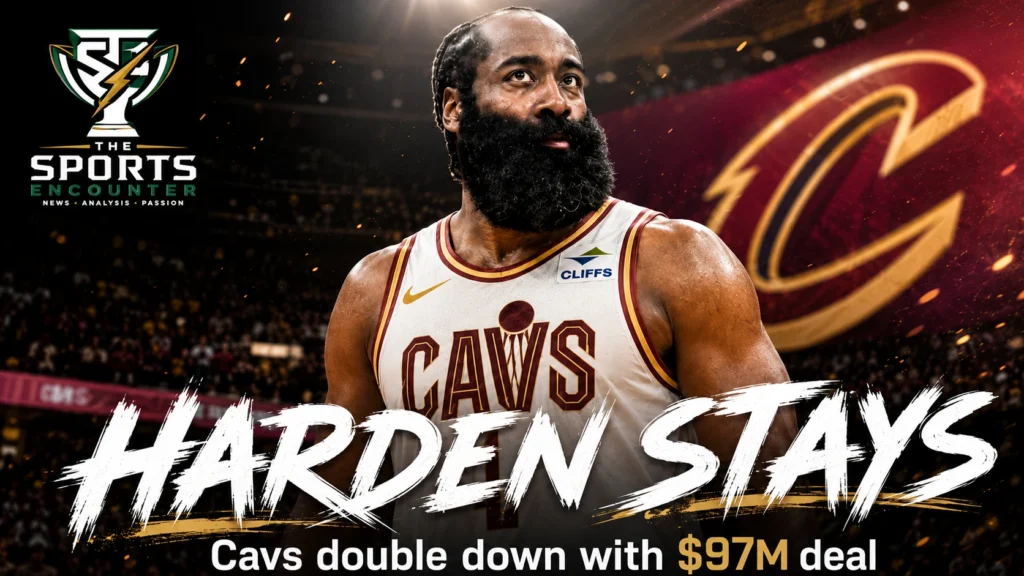
Cleveland’s decision on James Harden was never really about whether he could still play.
It was about whether the Cavaliers believed the 36-year-old guard could still help them win the four rounds that matter most.
They have now answered that question with money.
Harden has agreed to a three-year, $97 million contract to remain with Cleveland, according to multiple reports, with the deal including a player option for the 2028-29 season and a trade kicker. He had declined a $42.3 million player option earlier in the summer, opening the door to a longer arrangement that gives him greater security while keeping Cleveland’s championship core together. :contentReference[oaicite:0]{index=0}
The contract is significant because the Cavaliers are not paying Harden to lead a rebuild.
They are paying him to help finish one.
Cleveland reached the Eastern Conference finals last season before being swept by the eventual champion New York Knicks. The postseason exposed enough weaknesses to make change inevitable, especially around ball security, perimeter defense and the need for more two-way support around Donovan Mitchell and Evan Mobley.
Instead of moving away from Harden, Cleveland has doubled down.
The Cavaliers have also added Peyton Watson in a major offseason trade, giving them a younger, longer wing who should help cover some of the defensive pressure created by a Harden-Mitchell backcourt. Watson is expected to sign a four-year, $88 million deal after arriving from Denver. :contentReference[oaicite:1]{index=1}
The result is a roster that looks more balanced than the one Cleveland took into the 2026 playoffs.
Whether it is balanced enough to beat New York, Philadelphia and the other Eastern contenders is now the $97 million question.
For more basketball coverage, visit The Sports Encounter’s NBA section.
James Harden’s New Cavaliers Contract at a Glance
| Detail | Information |
|---|---|
| Player | James Harden |
| Team | Cleveland Cavaliers |
| Contract | 3 years, $97 million |
| Player option | 2028-29 season |
| Additional clause | Trade kicker |
| Previous option declined | $42.3 million for 2026-27 |
| Age | 36 |
| NBA season ahead | 18th |
| Joined Cleveland | February 2026 |
| Trade | Acquired from LA Clippers for Darius Garland and a second-round pick |
Cleveland Is Betting on the Version of Harden That Still Organizes Winning Offense
Harden is no longer the player who routinely challenged for scoring titles in Houston.
Cleveland does not need him to be.
What the Cavaliers still need is his control.
Harden remains one of the league’s most experienced pick-and-roll operators. He can slow a possession down, manipulate a switch, get a big man involved, create a corner three and manufacture free throws when the offense becomes static.
Those skills matter more in May than they do in January.
Cleveland’s previous playoff failures often became too dependent on Mitchell creating difficult offense late in the shot clock. Harden gives the Cavaliers another player who can initiate actions without requiring the system to collapse into isolation basketball.
That was the logic behind the February trade that sent Darius Garland to the Clippers and brought Harden to Cleveland. NBA.com confirmed the deal at the time, with the Cavaliers making a clear win-now move despite Harden being a decade older than Garland. :contentReference[oaicite:2]{index=2}
The decision to extend Harden now confirms that Cleveland still believes the short-term benefit outweighs the age curve.
There Is One Statistical Discrepancy Worth Clearing Up
The Associated Press report supplied for this story lists Harden at 10.7 points per game across 26 regular-season appearances with Cleveland.
Other current reporting, including Reuters, lists him at 20.5 points and 7.7 assists per game over those 26 contests. Reuters also reports that Harden averaged 25.4 points and 8.1 assists before the February trade while still with the Clippers. :contentReference[oaicite:3]{index=3}
The 20.5-point figure is consistent with the broader statistical record around his Cleveland stint, so that is the figure used for analysis here.
The Playoffs Complicated the Evaluation
Harden’s postseason was not easy to interpret.
His scoring increased.
His mistakes did too.
The source material supplied for this article lists Harden at 19.7 points per game during Cleveland’s playoff run, but also notes that his turnovers rose to 4.7 per game and that he committed at least five turnovers in 10 of the Cavaliers’ 18 postseason games.
That is the tension Cleveland is accepting.
Harden still creates enough offense to improve a contender.
He can also become a target when possessions tighten.
The Knicks made that distinction painfully clear during the Eastern Conference finals.
The Knicks Sweep Is the Context Behind Every Cleveland Move
Cleveland did not lose a competitive seven-game series to New York.
The Cavaliers were swept.
Game 4 became a 130-93 rout as the Knicks reached the NBA Finals for the first time since 1999. New York dominated the glass 60-33, produced a 20-0 run in the first half and never allowed Cleveland to turn the elimination game into a contest. :contentReference[oaicite:4]{index=4}
The Sports Encounter covered the broader significance of that sweep in our analysis of the Knicks reaching the NBA Finals.
That series exposed a harsh truth.
Cleveland had enough talent to reach the conference finals.
It did not have enough answers once the matchup turned against it.
Harden’s Turnovers Were Only Part of the Problem
It would be too easy to make Harden the entire explanation.
Cleveland lost the series collectively.
The Cavaliers struggled to protect the ball.
They struggled defensively against New York’s physicality.
They were beaten on the glass.
The offense became increasingly predictable.
The transition defense suffered when possessions ended badly.
Harden’s turnovers made those weaknesses more visible, but they did not create all of them.
That matters because Cleveland’s front office appears to believe the right answer is to improve the structure around Harden rather than replace him.
Peyton Watson Is the Most Important Clue
The addition of Watson helps explain the Harden extension.
Cleveland needed a wing who could defend bigger players, cover ground and bring more physical length into lineups built around Mitchell and Harden.
Watson fits that description.
Reuters reports that Cleveland acquired the 24-year-old after a breakout 2025-26 season in which he averaged 14.6 points and produced career highs in rebounds, assists and steals. The deal sends an unprotected 2031 first-round pick to Denver, showing how aggressively Cleveland is treating the current window. :contentReference[oaicite:5]{index=5}
This is not a cautious roster.
The Cavaliers are spending future flexibility to solve present problems.
A Projected Starting Five Now Looks More Balanced
| Position | Player | Primary Role |
|---|---|---|
| Guard | James Harden | Primary organizer, pick-and-roll creator |
| Guard | Donovan Mitchell | Lead scorer, late-clock shot creator |
| Forward | Peyton Watson | Perimeter defense, athleticism, transition play |
| Forward | Evan Mobley | Defensive anchor, secondary scorer |
| Center | Jarrett Allen | Rim protection, screening, rebounding |
That five makes more basketball sense than asking Harden and Mitchell to survive defensively without enough size around them.
Watson can take difficult wing assignments.
Mobley can erase mistakes behind the play.
Allen protects the rim and rebounds.
Harden and Mitchell can carry the creation load.
On paper, the responsibilities are cleaner.
The Harden-Mitchell Fit Is Still the Central Question
Two high-usage guards can work together.
The challenge is defining what happens when neither has the ball.
Mitchell is most dangerous when he attacks quickly and forces the defense to react before it gets organized.
Harden often prefers to manipulate a possession more slowly.
Neither style is wrong.
The Cavaliers have to make them complementary.
That means Harden cannot dominate every half-court possession.
Mitchell cannot spend entire stretches standing away from the action.
The offense needs movement before the pick-and-roll, not only after it.
Harden’s Value Increases If Cleveland Uses Him as an Organizer Rather Than a Volume Scorer
The best version of this team probably does not require Harden to average 25.
It requires him to make the game easier for everyone else.
Get Mobley touches in favorable areas.
Create lob opportunities for Allen.
Find Watson in transition.
Reduce the number of possessions where Mitchell has to beat two defenders by himself.
That version of Harden can still be immensely valuable.
The Cavaliers are effectively paying for intelligence, control and shot creation rather than expecting the Houston scoring machine to return.
Donovan Mitchell Remains the Franchise’s Main Offensive Player
The contract does not change the hierarchy.
Mitchell is still Cleveland’s primary scorer.
The Cavaliers need Harden to strengthen Mitchell’s environment rather than compete with him for control.
That distinction is vital in the postseason.
Mitchell is younger, more explosive and better equipped to carry the scoring load through four rounds.
Harden should become the player who makes sure Mitchell does not have to manufacture every difficult possession.
Evan Mobley May Be the Player Who Makes the Entire Experiment Possible
Cleveland can live with an older Harden defensively because Mobley changes the geometry behind him.
The 2025 NBA Defensive Player of the Year can switch, recover, protect the rim and cover errors in ways most big men cannot.
That does not mean Harden can stop competing defensively.
It means Cleveland has a safety net few teams can replicate.
Mobley’s development may ultimately matter more than Harden’s contract when assessing the Cavaliers’ championship ceiling.
Jarrett Allen Still Gives Cleveland Necessary Size
Allen’s role becomes especially important against teams like New York.
The Cavaliers cannot repeat a conference final in which they are physically overwhelmed on the glass.
Allen gives them an interior presence.
Mobley gives them mobility.
Watson gives them another long defender.
That combination should allow Cleveland to build more defensive lineups around its two guards.
The Contract Is More Reasonable Than the Headline Number Looks
Three years and $97 million sounds substantial for a player entering his late 30s.
The structure matters.
Harden declined $42.3 million for 2026-27 and accepted a multiyear arrangement with a lower annual average.
That gives Cleveland greater year-to-year flexibility than simply paying the option figure and then negotiating again.
The Sports Encounter identified this logic earlier in the offseason in our analysis of Harden’s Cleveland negotiations, where a lower annual salary in exchange for longer security already looked like the sensible outcome.
Harden Also Gets What He Wanted
Security.
He could have taken the $42.3 million option and entered another contract year.
Instead, he gets a three-year framework and an option on the final season.
The trade kicker provides another layer of protection.
For a 36-year-old star, that matters.
For Cleveland, the lower annual salary provides more room to maneuver around one of the NBA’s strictest tax and apron environments.
The Cavaliers’ February Gamble Is Now a Multi-Year Commitment
Trading Garland was already a major philosophical change.
Garland was 26.
Harden was 36.
One represented long-term continuity.
The other represented urgency.
Cleveland chose urgency.
The new contract confirms that choice was not intended to last five months.
The Cavaliers believe the Mitchell-Mobley era has reached a point where waiting carries its own risk.
Why Cleveland Could Not Simply Start Over
Championship windows are rarely as wide as teams imagine.
Mitchell is in his prime.
Mobley is established enough to be a Defensive Player of the Year.
Allen remains a high-level starting center.
Cleveland just reached the conference finals.
The front office could have interpreted the Knicks sweep as proof that the roster had reached its ceiling.
Instead, it interpreted the run as evidence that the Cavaliers were close enough to keep pushing.
The Eastern Conference Has Become More Difficult, Not Less
Cleveland’s biggest problem is that everyone else is moving too.
The Knicks are defending champions.
Philadelphia added LeBron James to a group already featuring Joel Embiid, Tyrese Maxey and Jaylen Brown.
Boston remains dangerous.
Milwaukee still has elite talent.
Other younger teams are improving.
The Sports Encounter recently asked whether Philadelphia now has the NBA’s best starting five, a question that matters directly to Cleveland because any route to the Finals could require surviving that level of star power.
The Knicks Remain Cleveland’s Immediate Measuring Stick
New York ended the Cavaliers’ season.
Then the Knicks finished the job by winning their first NBA championship in 53 years.
The Sports Encounter covered the culmination in our report on New York’s five-game Finals victory over San Antonio.
Cleveland’s offseason has to be judged against that standard.
Can Watson help with the physical matchups?
Can Harden protect the ball better?
Can Mitchell create more efficiently?
Can Mobley punish smaller lineups?
Can Allen keep Cleveland from being overwhelmed on the boards?
Those are the questions the Knicks forced the Cavaliers to answer.
The Champion Knicks Are Not Even Clear Favorites
That gives Cleveland another reason to push now.
The NBA does not have an unbeatable team.
The Sports Encounter’s analysis of early 2026-27 championship odds showed that the defending champion Knicks opened behind San Antonio, Oklahoma City and Boston.
That tells every contender the same thing.
The league is open enough to justify risk.
Cleveland is behaving accordingly.
Could Harden Eventually Become a Smaller Part of the Offense?
He should.
That is not criticism.
It is the natural evolution of a great player moving through his late 30s.
Harden’s value can remain high even as his usage falls.
He can organize second units.
Close some games and sit late in others.
Run possessions through Mobley.
Allow Mitchell to dominate stretches.
The contract should not force the Cavaliers to play Harden like a superstar from 2019.
The Player Option Protects Harden’s Final Years
The option for 2028-29 is important.
Harden controls the final season.
If he remains productive, he can stay under the agreement.
If the market unexpectedly offers something better, he retains leverage.
For Cleveland, the tradeoff is accepting some late-career risk in exchange for keeping the annual salary below the declined option figure.
The Trade Kicker Sends Another Signal
Harden wanted stability.
A trade kicker makes it more expensive or complicated for Cleveland to move him later.
That does not make a future trade impossible.
It makes the contract feel more like a commitment than a temporary bridge.
Harden appears to want Cleveland to be more than the sixth stop in a late-career sequence.
His Career Has Become a Search for the Championship That Still Eludes Him
Harden has accumulated almost every individual credential possible.
NBA MVP.
Eleven All-Star selections.
Scoring titles.
Assists title.
All-NBA honors.
Historic offensive seasons.
The championship remains missing.
That is why Cleveland makes sense.
The Cavaliers are close enough to contend without requiring Harden to carry an entire franchise.
The 2026-27 Season Could Become One of Harden’s Last Serious Chances
Time changes the stakes.
At 26, a playoff loss can be treated as experience.
At 36, each season has more finality.
Cleveland gives Harden Mitchell, Mobley, Allen and Watson around him.
That is enough talent to justify belief.
The question is whether the group can survive four playoff matchups without its weaknesses being exposed again.
The Defensive Problem Has Not Magically Disappeared
Watson helps.
Mobley helps enormously.
Allen protects the paint.
Harden still has to defend.
Playoff teams will test him in screening actions.
They will try to involve him repeatedly.
They will force switches and make him move laterally.
The Cavaliers cannot hide him on every possession.
That means effort and conditioning remain central to whether the deal works.
Turnovers May Be the Bigger Concern
Defense gets more attention because Harden is older.
Ball security may decide Cleveland’s ceiling.
Four or five turnovers against a transition-heavy playoff opponent can become 10 easy points.
Those possessions also prevent Cleveland from establishing its half-court defense, where Mobley and Allen are most valuable.
The 4.7 turnover figure from last postseason is therefore not cosmetic.
It is probably the most important number Harden needs to improve.
Watson Can Help Without Touching the Ball Much
This is why the new wing fit is promising.
Watson does not need Harden-level usage.
He can defend.
Run the floor.
Cut.
Finish plays.
Attack closeouts.
That is exactly the type of player a roster with multiple creators needs.
Cleveland does not need another player asking for 18 shots.
Cleveland Is Spending Draft Capital Like a Team That Knows the Clock Is Running
The unprotected 2031 first-round pick sent out in the Watson move is significant.
Future first-round picks are among the NBA’s most valuable assets because nobody knows where a team will be five years later.
Cleveland gave one up anyway.
That tells us the front office does not want to waste the current Mitchell-Mobley window protecting a future that may look completely different.
The Harden Deal Also Changes Any LeBron-Cleveland Conversation
The Sports Encounter previously ranked Cleveland as a possible late-career destination for LeBron James because of the emotional pull of another homecoming and the quality around Mitchell and Mobley. Our analysis also identified Harden’s fit as one of the major questions.
LeBron has since chosen Philadelphia, but the underlying point remains useful.
Cleveland is operating like a franchise that believes it can win now.
Harden’s extension reinforces that identity.
The Cavaliers Cannot Evaluate This Deal on Regular-Season Wins
That is the key standard.
Cleveland is already good enough to win a lot of regular-season games.
The contract succeeds only if Harden helps solve playoff problems.
Can he control a Game 6 on the road?
Can he protect the ball against elite pressure?
Can he create when Mitchell is trapped?
Can he survive defensively when opponents hunt him?
Those questions determine whether $97 million is good value.
What Harden Must Give Cleveland in 2026-27
- Reliable half-court organization
- Fewer live-ball turnovers
- Enough catch-and-shoot willingness to complement Mitchell
- Consistent effort defensively
- Playmaking for Mobley and Allen
- Controlled minutes that preserve his legs for the playoffs
- Leadership when postseason possessions become uncomfortable
What Cleveland Must Give Harden
- A clearly defined offensive role
- Enough wing defense around the backcourt
- Regular-season workload management
- Lineups with sufficient shooting
- More involvement for Mobley as a creator
- Alternative ball-handling when Harden sits
- A system that does not ask a 36-year-old guard to solve every difficult possession
TSE Analysis: The Contract Makes Sense Because Cleveland’s Alternative Was Less Convincing
The Cavaliers could have let Harden leave.
Then what?
They would still need another high-level playmaker.
They would still have a win-now core.
They would still face the pressure created by last season’s conference-finals sweep.
Finding a better creator on a cheaper contract would have been difficult.
Harden is imperfect.
He is also already integrated into the roster, wants to stay and remains capable of running elite offense.
At an annual value below the option he declined, the logic is understandable.
The Real Gamble Is Not the First Two Years
The first two seasons should be the easier part to defend.
The concern is 2028-29.
Harden will be approaching 39.
If his decline accelerates, the player option could become expensive.
That is the price Cleveland is paying for securing a lower annual number now.
Championship teams accept some future pain when the present opportunity is real enough.
Prediction: Cleveland Will Be Better, but Harden Alone Does Not Solve the Knicks Problem
The Cavaliers should enter 2026-27 with a stronger and more balanced roster.
Watson helps defensively.
Harden provides continuity as the primary organizer.
Mitchell remains an elite scorer.
Mobley gives Cleveland one of the league’s best defensive foundations.
That makes another deep playoff run realistic.
It does not make Cleveland the obvious Eastern Conference favorite.
Philadelphia’s star power is enormous.
New York has championship proof.
Boston remains a major threat.
The Cavaliers have moved closer.
They still have something to prove when the postseason becomes physical and every possession matters.
Final Verdict: Cleveland Has Chosen Its Window
The Cavaliers could have treated the Knicks sweep as the end of an experiment.
They treated it as unfinished business.
That is the clearest message behind James Harden’s three-year, $97 million agreement.
Cleveland traded for him because it wanted more immediate control and playoff creation than Garland could provide at that moment.
Five months later, the front office still believes in the idea.
Watson has been added to cover defensive weaknesses.
Mitchell remains the scorer.
Mobley remains the foundation.
Allen remains the interior presence.
Harden remains the organizer.
The Cavaliers are not building for 2031.
They are spending 2031 assets to win now.
That is why the contract should be judged differently from a normal veteran extension.
If Cleveland reaches the Finals, $97 million will look like the cost of keeping a championship window open.
If the Cavaliers suffer another playoff collapse defined by Harden turnovers and defensive targeting, the same contract will become evidence that they doubled down on the wrong solution.
There is no ambiguity anymore.
Cleveland has chosen its core.
Now that core has to prove it can finish the job.
FAQs
How much is James Harden’s new Cavaliers contract worth?
Harden has agreed to a three-year, $97 million deal to remain with Cleveland.
Does James Harden’s new contract include a player option?
Yes. The deal includes a player option for the 2028-29 season.
Did James Harden decline his previous player option?
Yes. Harden declined a $42.3 million option for the 2026-27 season before agreeing to the new multiyear contract.
When did James Harden join the Cavaliers?
Cleveland acquired Harden from the Los Angeles Clippers in February 2026 in a trade that sent Darius Garland and a second-round pick to Los Angeles.
How did James Harden perform for Cleveland?
Reuters reports that Harden averaged 20.5 points and 7.7 assists across 26 regular-season games after joining the Cavaliers.
How did the Cavaliers finish the 2026 playoffs?
Cleveland reached the Eastern Conference finals before being swept 4-0 by the New York Knicks, who went on to win the NBA championship.
Who did Cleveland add this offseason?
The Cavaliers acquired Peyton Watson from Denver in a major trade. Watson is expected to join Cleveland on a four-year, $88 million contract.
What could Cleveland’s starting lineup look like?
A projected starting group features James Harden, Donovan Mitchell, Peyton Watson, Evan Mobley and Jarrett Allen.
Why did Cleveland re-sign Harden?
The Cavaliers still value his playmaking, half-court control and ability to create offense alongside Mitchell. The lower annual value of his new deal compared with the declined option also offers Cleveland greater roster flexibility.
Can the Cavaliers win the 2027 NBA championship?
Cleveland remains a legitimate contender, but the Knicks, 76ers, Celtics and other Eastern Conference teams present major challenges. The Harden extension improves continuity without eliminating the questions exposed during last season’s playoffs.