


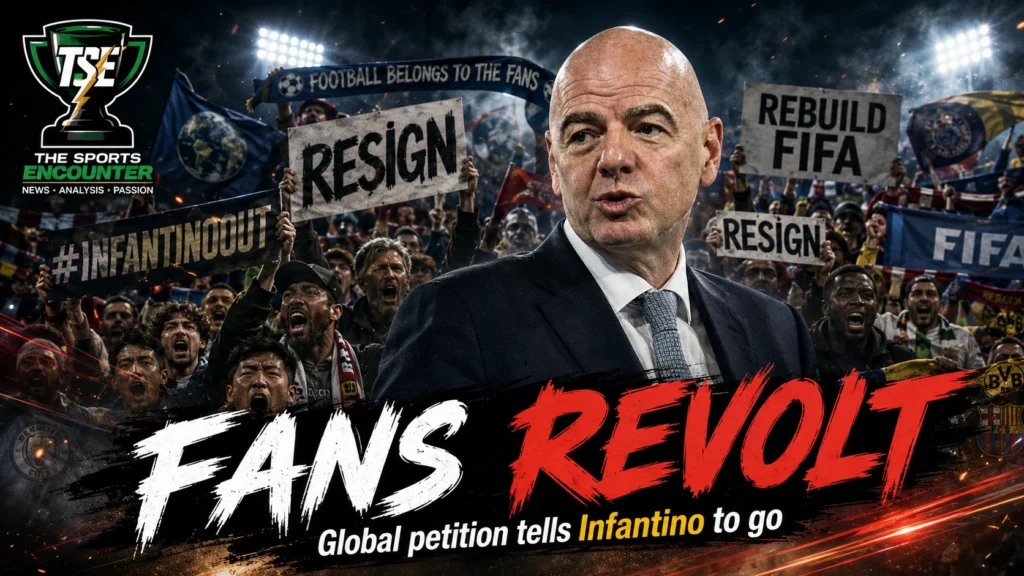
Gianni Infantino’s crisis is no longer confined to FIFA offices, confederation boardrooms and national association politics.
It has reached the supporters.
Fan organizations from Europe, Africa and North America have joined roughly 40 national supporter groups in backing a global petition calling for the FIFA president to resign and demanding structural reform of world soccer’s governing body.
The campaign, promoted under the hashtag #InfantinoOut, follows the collapse of Infantino’s controversial attempt to bring private investors into a new commercial structure tied to future World Cup and FIFA revenues.
The proposal was eventually abandoned after fierce resistance from major regional confederations, national federations, senior FIFA figures and other stakeholders.
Now the backlash has taken on another dimension.
Supporters are arguing that the failed investment proposal was not an isolated mistake. Their petition connects it to wider concerns about governance, transparency, executive power, consultation, World Cup ticket pricing and the relationship between FIFA leadership and the people who actually fill stadiums.
That matters because Infantino is already facing the most serious institutional challenge of his presidency.
UEFA, the Asian Football Confederation and CONCACAF have openly challenged FIFA’s leadership. Officials are discussing the possibility of an unprecedented no-confidence move. Several national federations have withdrawn support for Infantino’s 2027 reelection campaign. A senior FIFA executive who criticized the investment project has left the organization.
Infantino still has powerful allies.
That is what makes this crisis more complicated than a simple resignation campaign.
World soccer is dividing into competing political camps, and the supporter petition has now added a public legitimacy battle to a struggle that was already about money, governance and control.
For more global soccer coverage, follow The Sports Encounter’s soccer section.
Infantino Crisis at a Glance
| Issue | Current Position |
|---|---|
| FIFA president | Gianni Infantino |
| Main trigger | Abandoned proposal involving private investment in FIFA commercial rights |
| Fan response | Global petition calling for Infantino’s resignation and FIFA reform |
| Major fan organizations involved | Football Supporters Europe, Football Supporters Africa, Independent Supporters Council and national groups |
| Confederations opposing leadership | UEFA, AFC and CONCACAF leadership |
| Potential governance action | Discussion of a no-confidence vote or Extraordinary Congress |
| Infantino’s position | Intends to seek reelection in March 2027 |
| Nomination deadline | November 18, 2026 |
| Support remains | Parts of CAF, CONMEBOL and several Arab national associations |
The Fan Petition Changes the Nature of the Crisis
Institutional opposition can be dismissed politically.
Confederations compete for influence.
National associations have electoral interests.
Executives disagree over money and authority.
Supporter anger is harder to frame in the same way.
The petition is being backed by Football Supporters Europe, Football Supporters Africa and North America’s Independent Supporters Council, alongside dozens of national fan groups. Both the Associated Press and Reuters reported the coordinated campaign on August 20. The Associated Press report details the supporter coalition and its calls for resignation and reform. :contentReference[oaicite:0]{index=0}
The central accusation is severe.
Supporters believe the attempt to sell part of FIFA’s future commercial value represented a breach of trust involving the World Cup itself.
The petition does not stop at asking Infantino to leave.
It calls for FIFA to be rebuilt in a way that prevents a similar governance crisis from happening again.
That is the more important demand.
This Is No Longer Only About One Failed Deal
The investment proposal triggered the crisis.
The backlash has expanded beyond it.
Supporter organizations are now linking the controversy to long-running concerns around:
- concentration of presidential power;
- limited consultation with football stakeholders;
- opaque decision-making;
- World Cup ticket pricing;
- previous proposals for biennial World Cups;
- FIFA’s relationship with supporters;
- and the lack of strong internal checks on executive authority.
That transformation matters.
A dispute over one commercial proposal can theoretically be solved by withdrawing the proposal.
A crisis of trust cannot.
What Infantino Actually Tried to Do
The abandoned plan would have created a new FIFA commercial structure and invited private investment into future revenues generated by the World Cup and other FIFA competitions.
Reuters reported that the proposed arrangement involved selling around 20% of the new commercial entity for approximately $4.2 billion, implying a valuation of roughly $20 billion. Reuters’ timeline traces the proposal from development through its eventual collapse. :contentReference[oaicite:1]{index=1}
The objection was not simply that private investors might make money from football.
Commercial partners already do.
Broadcasters do.
Sponsors do.
Hospitality companies do.
The deeper concern was about governance.
Who approved the idea?
Who was consulted?
How much control would investors receive?
What revenues would be transferred?
How would decisions affecting future World Cups be protected?
Those questions became politically explosive because many senior football officials believed they were being asked to react to a project after too much of the architecture had already been developed.
The Proposal Collapsed, but the Political Damage Did Not
Infantino ultimately abandoned the plan.
That would normally end a policy dispute.
This one kept growing.
UEFA declared that trust had been damaged.
AFC and CONCACAF leadership joined the criticism.
Some national associations withdrew support for Infantino’s reelection.
Senior figures inside FIFA publicly distanced themselves from the project.
The resignation or departure of FIFA officials deepened the perception that the problem was broader than one commercial miscalculation.
The Associated Press reported that former FIFA chief operating officer Kevin Lamour had criticized the proposal and accused the leadership of misleading staff before leaving the organization. :contentReference[oaicite:2]{index=2}
Kevin Lamour’s Exit Intensified the Governance Question
Internal criticism matters differently from external criticism.
A confederation president can be accused of protecting regional interests.
A supporter group can be accused of activism.
When senior executives inside the organization begin challenging how decisions were made, the argument becomes harder to contain.
Lamour’s departure was described by FIFA Vice President Sandor Csanyi as the “final straw” in his own withdrawal of support for Infantino.
That development added another senior figure to the growing list of officials questioning the president’s leadership. :contentReference[oaicite:3]{index=3}
UEFA, AFC and CONCACAF Are Considering an Extraordinary Step
The institutional challenge is potentially historic.
Senior figures familiar with discussions told Reuters that UEFA, the AFC and CONCACAF have considered pursuing a no-confidence vote against Infantino.
Reuters could find no previous case in FIFA’s 122-year history of Congress formally holding such a vote against a sitting president. :contentReference[oaicite:4]{index=4}
That does not mean removing Infantino would be straightforward.
FIFA’s statutes do not contain a specific no-confidence mechanism for the presidency.
The political route would likely begin with an Extraordinary Congress.
How Could FIFA’s Members Force the Issue?
FIFA has 211 member associations.
Under its statutes, an Extraordinary Congress must be called if at least one-fifth of them submit a written request specifying the agenda.
That means 43 associations.
UEFA has 55 members.
The AFC has 47.
Either confederation contains enough national associations in theory to reach the threshold without help from another region.
In practice, confederation leadership cannot simply cast all of those votes as one bloc.
Individual associations would have to support the request.
Reuters’ analysis of the process notes that a simple majority of valid votes is generally sufficient for Congress decisions, although FIFA’s statutes do not explicitly define a presidential no-confidence procedure. The procedural uncertainty is one reason opponents have to consider their strategy carefully. :contentReference[oaicite:5]{index=5}
A Failed Challenge Could Actually Help Infantino
This is the central strategic danger facing his opponents.
A no-confidence effort sounds powerful.
Losing one could strengthen the president.
If opponents force an Extraordinary Congress and Infantino survives comfortably, he would emerge with fresh evidence that the public criticism of his leadership does not reflect FIFA’s voting arithmetic.
That could make challenging him in March 2027 even more difficult.
Reuters reported that senior figures supporting a no-confidence move are aware of precisely this risk. :contentReference[oaicite:6]{index=6}
That is why the crisis cannot be understood through headlines alone.
Infantino is under enormous pressure.
He is not powerless.
FIFA Elections Are Won by Associations, Not Headlines
This distinction is crucial.
Each of FIFA’s 211 members gets one vote.
England gets one.
Brazil gets one.
Malawi gets one.
Tahiti gets one.
The system gives small and large football nations equal electoral weight at Congress.
Infantino has built much of his political strength around that structure.
FIFA Forward development funding and direct relationships with smaller associations have created constituencies that may view his presidency very differently from UEFA leadership or European supporter groups.
That is why counting public critics is not the same thing as counting votes.
Infantino Still Has Significant Support
Six Arab football associations publicly backed him earlier this month.
They included Qatar, Morocco, Egypt, Lebanon, Sudan and Mauritania.
Four of the signatories also sit on the FIFA Council.
CAF President Patrice Motsepe has said Africa continues to support Infantino and that leadership should ultimately be determined democratically by FIFA’s members. :contentReference[oaicite:7]{index=7}
CONMEBOL leadership has also remained supportive.
Mexico and Argentina have publicly offered backing despite the position adopted by CONCACAF leadership, illustrating how little guarantee there is that confederation presidents can deliver unified regional voting blocs. :contentReference[oaicite:8]{index=8}
The AFC Split Shows How Complicated the Politics Are
Asia may provide the clearest example.
AFC President Sheikh Salman bin Ebrahim Al-Khalifa joined UEFA and CONCACAF leaders in criticizing Infantino.
Qatar strongly objected to the AFC position and argued that Sheikh Salman had not adequately consulted member associations before acting.
The dispute became unusually public, with the AFC president defending his responsibility to protect the sport’s interests while Qatar continued supporting Infantino. :contentReference[oaicite:9]{index=9}
That tells us something important.
There is no simple “Asia versus Infantino” story.
There is an internal Asian political argument happening inside the larger FIFA crisis.
European Opposition Is Growing, but It Is Not the Whole Electorate
Several European associations have withdrawn previously declared support for Infantino’s 2027 reelection.
Serbia, Sweden and Wales were among the countries reported to have done so, with further opposition developing elsewhere. :contentReference[oaicite:10]{index=10}
Norway has gone further.
Norwegian federation president Lise Klaveness has publicly called for Infantino to resign and sharply criticized FIFA’s management culture. :contentReference[oaicite:11]{index=11}
Europe can produce enormous political pressure.
It cannot elect or remove a FIFA president by itself unless it builds alliances across other confederations.
New Zealand Shows the Crisis Has Reached Oceania Too
New Zealand Football withdrew support for Infantino’s reelection and called for an independent review following the investment controversy.
The wider Oceania response remains less unified, with some associations continuing to support him.
That pattern is repeating across world football.
Leadership opposition does not automatically equal bloc opposition.
Regional politics remain fragmented. :contentReference[oaicite:12]{index=12}
The Fan Petition Attacks the Source of Infantino’s Legitimacy Differently
National associations determine FIFA elections.
Supporters determine whether FIFA’s competitions retain cultural legitimacy.
That is the leverage fan groups are trying to use.
They cannot vote Infantino out.
They can make staying politically expensive.
They can organize.
They can influence national associations.
They can pressure sponsors.
They can turn governance disputes into public stories.
They can connect elite institutional arguments with ordinary supporters who may care far more about ticket prices than corporate structure.
World Cup Ticket Prices Have Become Part of the Anger
The petition does not treat the investment proposal as an isolated controversy.
It also cites the ticketing policy used for the 2026 World Cup in the United States, Canada and Mexico.
Supporter groups criticized FIFA for introducing record prices without meaningful consultation with organized fan representatives.
Some ticket categories later became available at dramatically reduced prices for loyal supporters after the initial backlash, according to the AP report supplied for this article. :contentReference[oaicite:13]{index=13}
That episode matters because ticketing creates a direct relationship between governance and ordinary fans.
Private equity can feel abstract.
A ticket costing hundreds or thousands of dollars does not.
Fans Are Asking a Fundamental Question About the World Cup
Who is the tournament for?
That question sits underneath both controversies.
FIFA sees the World Cup as a commercial asset capable of generating enormous revenue that can then be redistributed throughout global football.
Supporters see it as a cultural institution that should remain accessible and protected from excessive commercialization.
Both views can coexist up to a point.
The conflict begins when fans believe the commercial logic has started dictating the sporting logic.
FIFA’s Financial Argument Is Not Trivial
There is another side that needs to be acknowledged.
FIFA distributes billions of dollars to national associations around the world.
Many smaller federations depend heavily on FIFA funding for infrastructure, youth programs, coaching, women’s football and national-team development.
Under the abandoned investment proposal, associations could potentially have accessed one-off funding of up to $20 million for development purposes, according to Reuters. :contentReference[oaicite:14]{index=14}
That helps explain why some associations remain supportive.
For a wealthy federation, concerns about long-term commercial governance may dominate.
For a smaller federation, $20 million can transform football infrastructure.
Those competing incentives are real.
The Problem Was How the Proposal Was Governed
This is why the debate cannot simply be reduced to “private money bad” or “development money good.”
The larger issue is process.
Were FIFA’s members fully informed?
Were confederations consulted early enough?
Were commercial assumptions independently tested?
Was the World Cup’s long-term value being protected?
Were conflicts and relationships disclosed appropriately?
Could the same amount of capital have been raised differently?
Those are governance questions rather than ideological ones.
The Supporter Campaign Wants Structural Reform, Not Just a New President
This is probably the most important part of the petition.
Replacing Infantino without changing FIFA’s power structure could leave the same incentives intact.
The campaign calls for stronger transparency, checks and balances, accountability and protection against excessive concentration of authority.
Reuters reported that supporter groups explicitly want reforms capable of preventing future leadership from repeating the current crisis. :contentReference[oaicite:15]{index=15}
What Would Meaningful FIFA Reform Actually Look Like?
A serious reform agenda would have to go beyond slogans.
Potential areas include:
- clearer FIFA Council approval requirements for major commercial restructurings;
- independent valuation of material commercial transactions;
- mandatory disclosure of potential conflicts;
- earlier consultation with confederations and member associations;
- formal supporter consultation on ticketing and major fan-facing policies;
- stronger independent audit and ethics powers;
- clear presidential authority limits;
- transparent publication of major FIFA Council decisions;
- and better protection for senior staff who raise governance concerns.
Some of these measures would restrict executive freedom.
That is the point of institutional checks.
Infantino’s Leadership Style Is Now Part of the Debate
The controversy has moved beyond the merits of one proposal into the way FIFA is managed.
Norway’s Klaveness accused the organization of operating through fear after Lamour’s departure.
Supporter groups describe power as excessively concentrated around the presidency.
Confederation leaders complain about inadequate consultation.
Those accusations do not automatically prove misconduct.
They show that opponents increasingly believe the governance problem is cultural rather than procedural. :contentReference[oaicite:16]{index=16}
FIFA Has Already Apologized for How the Proposal Was Handled
That is important context.
FIFA has acknowledged mistakes around the investment project and withdrew it.
The organization’s leadership has also continued to express support for Infantino.
His allies can therefore argue that the system corrected itself.
A proposal was developed.
Stakeholders objected.
The proposal was abandoned.
The counterargument is that it should never have reached that stage without broader approval.
The entire political crisis turns partly on which interpretation FIFA members accept.
Infantino’s Opponents Still Need a Candidate
Criticizing an incumbent is easier than replacing one.
No major challenger had publicly emerged at the time of the latest reporting.
The nomination deadline is November 18.
The presidential election is scheduled for March 2027.
That gives the opposition limited time to identify someone capable of uniting Europe, parts of Asia, North America and enough associations elsewhere to win.
Premier League chief executive Richard Masters has already publicly called for a candidate who could bring the confederations together. :contentReference[oaicite:17]{index=17}
A Purely European Candidate May Struggle
This is one reason the opposition has a difficult problem.
If the campaign is framed as Europe attempting to retake control of FIFA, many African, Asian, Caribbean and smaller associations may rally around Infantino regardless of their concerns about the investment proposal.
A successful challenger would probably need to campaign on:
- institutional reform;
- continued development funding;
- respect for smaller associations;
- regional balance;
- commercial growth without privatizing governance;
- and protection of the World Cup as a global public sporting asset.
That is a much more difficult coalition to build than a simple anti-Infantino movement.
The Premier League Has Entered the Governance Debate Too
Richard Masters’ intervention illustrates how far the dispute has spread beyond FIFA’s formal voting membership.
The Premier League has no vote in FIFA Congress.
Its economic and political influence is enormous.
Masters said world football needs leadership capable of bringing confederations back together and emphasized the importance of examining FIFA’s governance structure rather than treating the conflict as merely personal. :contentReference[oaicite:18]{index=18}
European Clubs Have Their Own Leverage
European Football Clubs, representing hundreds of clubs, has aligned with demands for governance change.
Reuters reported that clubs have warned they could refuse participation in future Club World Cups if concerns around governance and their relationship with FIFA are not addressed. :contentReference[oaicite:19]{index=19}
Clubs cannot remove the president.
They can damage FIFA competitions commercially.
A Club World Cup without Europe’s biggest clubs would lose enormous broadcast and sponsorship value.
Sponsors Are the Missing Public Voice
One group has remained conspicuously quiet.
FIFA’s commercial partners.
No major sponsor had publicly broken with Infantino over the crisis at the time of Reuters’ reporting. :contentReference[oaicite:20]{index=20}
That silence matters.
Sponsors generally avoid entering governance disputes unless brand risk becomes impossible to ignore.
A growing global supporter campaign could change that calculation.
If public anger begins attaching directly to sponsor brands, pressure can accelerate quickly.
This Is Where the Petition Could Become Politically Important
The number of signatures matters less than what happens after them.
Does the petition become a one-week online story?
Or do supporter groups turn it into sustained pressure?
Potential escalation could include:
- organized stadium banners;
- national federation lobbying;
- letters to FIFA sponsors;
- coordinated supporter statements;
- ticketing protests;
- fan congresses;
- and pressure on presidential candidates to adopt formal reform commitments.
That would make the campaign much harder to ignore.
World Cup Ticketing Gives Fans a Powerful Organizing Issue
Governance language can feel distant from ordinary supporters.
Ticket prices do not.
The 2026 World Cup became the largest edition ever, with 48 teams and 104 matches across the United States, Canada and Mexico.
Its commercial success has also intensified arguments over affordability and access.
The supporter petition connects those concerns directly to Infantino’s broader leadership record.
That is strategically effective because it gives fans a personal reason to care about a governance dispute.
The World Cup’s Record Revenue Creates a Difficult Optics Problem
FIFA expects enormous revenue from the current commercial cycle.
That makes the argument for external investment harder for critics to understand.
If the World Cup is already generating unprecedented income, why sell part of its future economics?
Supporters naturally ask whether maximizing capital has become an end in itself.
FIFA’s answer would likely focus on accelerating development investment globally.
The credibility of that explanation depends on trust.
Trust is precisely what the crisis has damaged.
The 2026 World Cup Should Have Been Infantino’s Political High Point
This may be the strangest part of the story.
The expanded World Cup was commercially enormous.
Infantino had overseen a tournament of unprecedented scale.
Normally, that should strengthen an incumbent FIFA president heading toward reelection.
Instead, the weeks following the tournament have become the most dangerous period of his leadership.
The investment proposal transformed a moment of commercial triumph into a governance crisis.
The Timing Could Not Be Worse for FIFA
The organization should be using the period after the World Cup to celebrate growth, review sporting outcomes and prepare the next cycle.
Instead, attention is focused on:
- leadership legitimacy;
- potential no-confidence action;
- executive departures;
- withdrawn electoral support;
- fan petitions;
- club threats;
- and open divisions among confederations.
That is an extraordinary reversal.
Infantino’s Supporters Have a Strong Counterargument
They can point to FIFA’s expansion of development funding.
They can point to revenue growth.
They can point to expanded tournaments.
They can argue that Europe is uncomfortable with an organization increasingly focused on the wider global membership.
They can say that one abandoned proposal should not erase a decade of institutional growth.
Those arguments will resonate with some member associations.
Dismissing them would underestimate the politics of the election.
The Opposition’s Strongest Argument Is About Process
Not geography.
Not personalities.
Process.
If major commercial decisions affecting the future of the World Cup can be developed without sufficiently broad consultation, opponents argue that the governance model itself is too dependent on presidential authority.
That case can potentially unite associations across regions because it is not inherently European.
Every member association has an interest in knowing how FIFA’s largest assets are governed.
The Supporter Petition Reinforces That Argument
Fans are essentially making the same point from another direction.
They want institutions larger than one president.
They want rules capable of surviving leadership changes.
They want consultation before decisions that affect the supporter experience.
They want the World Cup protected from decisions they consider excessively commercial.
Whether one agrees with every accusation in the petition, those demands are structurally significant.
Could Infantino Simply Survive Until the Election?
Yes.
That may remain the most likely political route.
Unless opponents force an Extraordinary Congress or Infantino voluntarily steps aside, the scheduled March 2027 election provides the conventional mechanism for deciding his future.
CAF President Motsepe has explicitly argued that the election is where members should make that choice. :contentReference[oaicite:21]{index=21}
The question is whether the crisis remains stable enough to wait that long.
What Happens if Infantino Is Removed Early?
Reuters reports that FIFA statutes would place the longest-serving vice president into the presidency temporarily until the next election.
That person is currently AFC President Sheikh Salman bin Ebrahim Al-Khalifa. :contentReference[oaicite:22]{index=22}
That possibility adds another layer to the politics because Sheikh Salman is himself one of the confederation leaders challenging Infantino.
Any early removal would therefore create immediate questions about interim authority, reform priorities and electoral neutrality.
There Is Almost No Historical Roadmap
FIFA has experienced leadership crises before.
Sepp Blatter faced enormous internal and external pressure.
Governance scandals have repeatedly damaged the organization.
What FIFA has not developed is a clear constitutional tradition for removing a sitting president through a no-confidence mechanism.
Reuters found that similar political efforts were discussed around Blatter in 2001 and 2002, but no formal no-confidence vote took place. :contentReference[oaicite:23]{index=23}
That makes the current situation institutionally unusual.
The Petition’s Success Should Not Be Measured Only in Signatures
Online petitions are easy to dismiss because many accumulate attention without institutional consequences.
This one is different because established supporter organizations are using it as part of a broader campaign.
Football Supporters Europe already has formal relationships with UEFA and experience influencing issues such as ticket pricing.
The involvement of groups from Africa and North America gives the campaign more legitimacy than a purely European initiative.
The important metric will therefore be access.
Can these organizations get meetings with national federations?
Can they influence election platforms?
Can they force ticketing reform?
Can they persuade sponsors to speak?
The Absence of Supporter Voting Power Is the Structural Problem
Fans ultimately have no formal vote in FIFA governance.
National associations do.
That creates a recurring tension.
The people who consume the sport most passionately have influence but little constitutional authority.
FIFA’s critics argue that stronger supporter consultation mechanisms could reduce that disconnect.
Should Fans Have a Formal FIFA Role?
Direct voting rights would be difficult to design.
Who represents “the fans”?
How are groups selected?
Would wealthy supporter organizations dominate?
Would organized ultras have the same role as family supporters?
Those questions are real.
A formal advisory council is much easier to imagine.
UEFA already works with organized supporter networks on ticketing and fan issues.
FIFA could adopt something similar globally.
The Broader Lesson Is About Stakeholder Governance
Modern sports bodies are no longer accountable only to national federations.
They interact with players.
Clubs.
Leagues.
Broadcasters.
Sponsors.
Governments.
Supporters.
Commercial investors.
Each group has different incentives.
Strong governance requires processes capable of balancing them without allowing one constituency to capture the organization.
FIFA’s Challenge Is Larger Because the World Cup Is Larger
The tournament is no longer merely a sporting competition.
It is one of the world’s largest recurring media and commercial events.
Its scale creates opportunities.
It also makes governance failures more expensive.
A controversial decision affecting a small federation may remain local.
A controversial decision involving the future economics of the World Cup becomes global instantly.
TSE Analysis: The Most Dangerous Change for Infantino Is the Coalition Forming Against Him
No single opponent is decisive yet.
That is exactly why the situation is dangerous.
Confederations are objecting.
National federations are withdrawing support.
Senior FIFA figures have criticized the investment project.
European clubs are threatening leverage.
Premier League leadership is calling for change.
Supporter organizations are demanding resignation.
Those groups do not share identical interests.
They do share a growing concern about how FIFA is governed.
If those separate grievances become one political coalition, Infantino’s position changes dramatically.
The Coalition Is Still Fragile
This point matters just as much.
UEFA and AFC do not always want the same things.
European supporter priorities may differ from African association priorities.
Clubs may want more commercial control themselves.
Smaller federations may fear losing development money under a new leadership structure.
CONMEBOL and CAF remain important sources of support for Infantino.
Turning shared dissatisfaction into 106 or more votes is a completely different task.
Why the Fans’ Entry Could Help Hold the Coalition Together
Supporters provide a simple public message.
Trust.
That is easier to communicate than the details of private equity structures or Congress procedures.
A campaign framed around protecting the World Cup and restoring governance standards can create political cover for national associations considering whether to abandon Infantino.
It can also make neutrality harder.
The Next Three Months Could Decide Everything
The November 18 nomination deadline is approaching.
Before then, several things could happen:
- a challenger could emerge;
- more associations could withdraw support;
- Infantino could rebuild alliances;
- supporter pressure could grow;
- sponsors could finally intervene;
- an Extraordinary Congress request could develop;
- or the crisis could gradually lose momentum.
Each scenario changes the election.
What Infantino Needs to Do if He Intends to Survive
Simply insisting on his record may not be enough.
A credible recovery would probably require:
- full transparency around the abandoned commercial proposal;
- an independent review with published conclusions;
- clear commitments limiting future unilateral commercial initiatives;
- direct engagement with confederations;
- supporter consultation on ticketing;
- internal protections for dissenting senior staff;
- and a reform agenda strong enough to convince skeptical associations that the lesson has been learned.
Without that, the opposition can continue portraying the issue as unresolved.
What Infantino’s Opponents Need to Do
They need more than anger.
They need arithmetic.
A credible candidate.
A policy platform.
Commitments to development funding.
Support outside Europe.
Clear governance reforms.
And reassurance that removing Infantino would not simply transfer power from Zurich to another entrenched regional bloc.
That is a much harder campaign than signing a joint statement.
What Supporters Need to Do
If fan groups want the petition to matter institutionally, the next step is organization.
National campaigns need to engage their own football associations.
Questions need to be asked before Congress votes.
Election candidates should be asked publicly what reforms they support.
Ticketing and fan consultation should become measurable commitments rather than general promises.
That is how public anger becomes governance pressure.
The 2027 Election Is Becoming a Referendum on FIFA’s Structure
It may begin as a vote on Gianni Infantino.
It is increasingly becoming something larger.
How powerful should the FIFA president be?
How much consultation should major commercial decisions require?
Who protects the World Cup’s long-term economics?
How should development funding be balanced against commercial risk?
What role should clubs and fans have?
Those questions will remain even if Infantino wins.
Final Verdict: The Crisis Has Escaped FIFA’s Walls
The failed investment proposal could once have been managed as an internal governance dispute.
That moment has passed.
UEFA, AFC and CONCACAF leadership have challenged Infantino.
National federations have withdrawn support.
Senior figures have questioned FIFA’s management culture.
Clubs have threatened commercial leverage.
Now supporters are organizing internationally and demanding resignation.
That does not mean Gianni Infantino is about to lose the FIFA presidency.
His support remains substantial, particularly across parts of Africa, South America, the Arab world and other associations that value the development model built during his presidency.
It does mean the argument has fundamentally changed.
Infantino is no longer defending one failed business proposal.
He is defending the legitimacy of the way FIFA has been governed under his leadership.
His opponents face their own test.
They must turn public anger into a workable reform coalition, find a credible candidate and prove they can protect the interests of all 211 associations rather than simply replace one center of power with another.
The supporter petition makes that political contest harder to contain.
The crisis has moved from the executive suite to the stands.
For FIFA, that may be the point where a governance problem becomes something much more dangerous.
A legitimacy problem.
FAQs
Why are soccer fans calling for Gianni Infantino to resign?
Supporter organizations are protesting Infantino’s failed attempt to bring private investment into a commercial structure linked to future World Cup and FIFA revenues, while also raising broader concerns about governance, consultation and World Cup ticket pricing.
Who is supporting the petition?
Groups include Football Supporters Europe, Football Supporters Africa, the Independent Supporters Council in North America and dozens of national supporter organizations.
What was Infantino’s private investment proposal?
The plan involved creating a new FIFA commercial entity and selling a minority stake to private investors. Reuters reported that approximately 20% could have been sold for around $4.2 billion.
Did FIFA abandon the proposal?
Yes. Infantino withdrew the plan following widespread opposition.
Are UEFA, AFC and CONCACAF trying to remove Infantino?
Senior figures from the three confederations have discussed the possibility of pursuing a no-confidence vote, according to Reuters.
Can FIFA hold a no-confidence vote against its president?
FIFA’s statutes do not specifically define a presidential no-confidence mechanism. However, 43 of FIFA’s 211 associations can require an Extraordinary Congress to be convened.
How many votes would be needed to remove Infantino?
The exact procedure is legally unclear because no specific no-confidence rule exists, although FIFA Congress decisions generally require a simple majority of valid votes.
Does Infantino still have support?
Yes. He retains support from several national associations, including six Arab federations that publicly backed him, as well as important constituencies within Africa and South America.
Is Gianni Infantino running for reelection?
Yes. Infantino intends to seek reelection at the March 2027 FIFA Congress.
When is the deadline for FIFA presidential candidates?
The nomination deadline is November 18, 2026.
Why are World Cup ticket prices part of the controversy?
Supporter groups have criticized FIFA for record 2026 World Cup ticket prices and what they say was insufficient consultation with organized fan representatives.
Could fan pressure actually remove Infantino?
Fans have no direct vote in FIFA elections, but organized supporter pressure can influence national federations, sponsors, clubs and the wider political environment surrounding the 2027 election.