


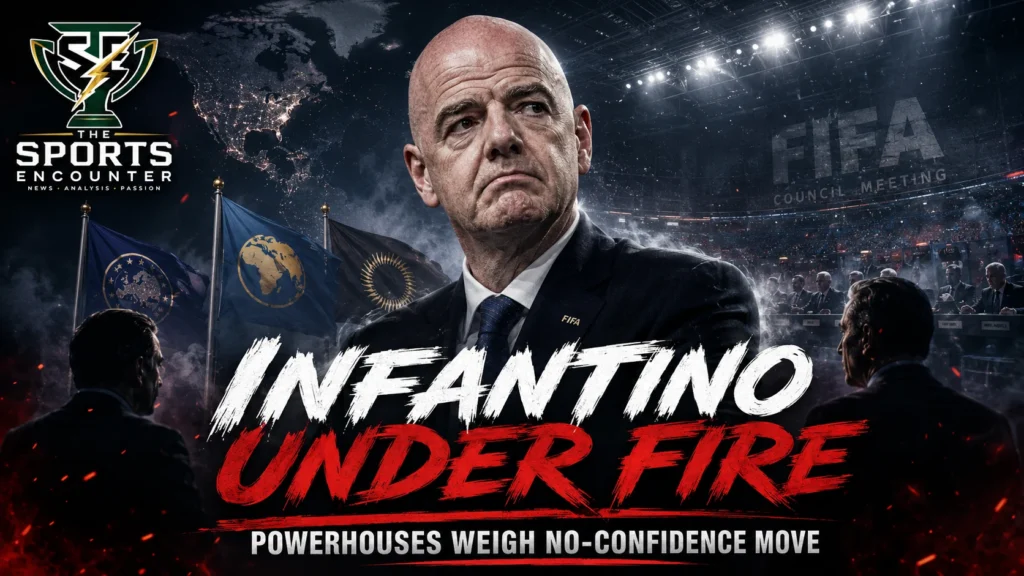
Gianni Infantino survived the collapse of his most controversial commercial proposal.
He may now have to survive something much more dangerous.
Senior figures familiar with discussions inside world soccer say UEFA, the Asian Football Confederation and CONCACAF are considering whether to pursue a vote of no confidence against the FIFA president, potentially opening the first such challenge to a sitting leader in the governing body’s 122-year history.
The development moves FIFA’s governance crisis into a new phase.
This is no longer only about angry statements, resignations, commercial disagreements or promises to revisit internal processes. The discussion has reached the question of whether Infantino should remain in office at all.
According to Reuters, the three confederations are weighing a possible no-confidence move after the collapse of Infantino’s proposal to sell private investors a minority stake in a new commercial entity that would have controlled major FIFA commercial rights, including those linked to the World Cup.
Infantino has said he intends to seek re-election at the scheduled FIFA Congress in March 2027.
His opponents are now discussing whether to wait that long.
For continued coverage of the politics, business and competitive consequences surrounding world soccer, follow The Sports Encounter’s soccer coverage and our FIFA World Cup 2026 hub.
The FIFA Crisis at a Glance
| Issue | Current Position |
|---|---|
| FIFA President | Gianni Infantino |
| Next scheduled election | March 2027 FIFA Congress |
| Presidential nomination deadline | November 18, 2026 |
| Confederations discussing no-confidence option | UEFA, AFC and CONCACAF |
| FIFA member associations | 211 |
| Associations needed to require an Extraordinary Congress | At least one-fifth of membership, equivalent to 43 associations |
| Current formal no-confidence rule | FIFA statutes contain no specific provision governing such a vote |
| Infantino support | Still significant, particularly in Africa and among several Arab associations |
| Club pressure | European Football Clubs has warned of possible future Club World Cup non-participation |
Why the No-Confidence Discussion Changes Everything
The pressure on Infantino has been building for weeks.
Opposition hardened after FIFA explored creating a commercial entity involving private investors and placing major revenue-generating assets under that structure.
UEFA, the AFC and CONCACAF opposed the proposal and later accused FIFA’s leadership of failures involving transparency, consultation and governance.
That was already an extraordinary level of institutional resistance.
A no-confidence discussion is different.
It moves the dispute from disagreement over policy into a direct confrontation over leadership.
Reuters reported that it could find no previous instance of a FIFA Congress holding a no-confidence vote against a sitting president.
If such a process were attempted, FIFA would be entering largely untested territory.
The Question Is No Longer Whether Infantino Has Critics
He clearly does.
The more important question is whether those critics can organize enough member associations to turn political anger into constitutional action.
That distinction matters because FIFA is not governed according to the commercial power of leagues or the global popularity of individual national teams.
Its Congress operates through national associations.
Each attending member association has one vote.
Brazil gets one.
Germany gets one.
Malawi gets one.
Qatar gets one.
Canada gets one.
That structure has always been central to FIFA politics, and it remains Infantino’s strongest protection.
How Could an Extraordinary FIFA Congress Be Triggered?
Under FIFA’s statutes, the FIFA Council can convene an Extraordinary Congress at any time.
It is also required to call one when at least one-fifth of FIFA’s 211 member associations submit a written request specifying the agenda items they want considered.
That works out to 43 associations.
Once the threshold is reached, the Extraordinary Congress must be convened within three months.
The procedural route therefore exists.
The harder question comes afterward.
FIFA’s statutes do not contain a dedicated provision setting out exactly how a no-confidence vote against the president should operate.
That means any attempt to remove Infantino would likely involve close scrutiny of FIFA’s statutes, Congress powers and applicable Swiss association law.
The Reuters report on the discussions makes clear that the constitutional uncertainty is part of the political calculation facing Infantino’s opponents.
Forty-Three Associations Can Call the Meeting. That Does Not Mean They Can Win It.
This is where the numbers become politically important.
UEFA alone has enough member associations in theory to clear the 43-association threshold required to demand an Extraordinary Congress.
But a request for a meeting and a successful removal vote are entirely different things.
Confederations are not monolithic voting blocs.
A national association can disagree with its confederation president.
It can publicly support governance reform while declining to remove Infantino.
It can criticize the commercial proposal but still prefer to settle the issue through the March 2027 election.
That is why the combined political weight of UEFA, the AFC and CONCACAF cannot simply be added together and treated as a guaranteed anti-Infantino vote.
Their influence is enormous.
Their control over every individual member vote is not.
The Biggest Risk for Infantino’s Opponents: Call the Vote and Lose
This may be the most important strategic issue in the entire crisis.
One senior figure told Reuters that an unsuccessful no-confidence attempt could strengthen Infantino rather than weaken him.
The logic is straightforward.
If his opponents call an unprecedented Congress, campaign openly for his removal and then fail to secure enough votes, Infantino could claim something far more powerful than internal management support.
He could claim democratic validation from FIFA’s membership.
That result would arrive only months before the scheduled March 2027 presidential election.
It could discourage potential challengers.
It could expose divisions within UEFA, Asia and CONCACAF.
It could allow Infantino to portray the revolt as a failed attempt by powerful regional interests to override smaller national associations.
That is why anger alone will not be enough.
His opponents need arithmetic.
Why the World Cup Investment Proposal Caused Such a Rupture
The crisis grew out of Infantino’s attempt to reshape the commercial architecture surrounding FIFA’s biggest assets.
The abandoned proposal centered on a new FIFA commercial entity in which private investors would have been able to acquire a minority stake.
The entity would have controlled commercial rights connected to FIFA’s flagship properties, including the World Cup.
For FIFA’s leadership, the argument was that outside capital could accelerate investment and provide member associations with major new development funding.
Under the proposal described by Reuters, associations could have accessed up to $20 million in one-off capital for projects covering infrastructure, coaching, national teams, competitions, grassroots soccer and the women’s game.
For critics, the financial upside did not answer the governance question.
Who would control the commercial future of the World Cup?
How much influence would private investors gain?
How had such a fundamental proposal reached an advanced stage without broader consultation?
Those concerns turned a financing proposal into a fight over ownership, transparency and authority.
A $15 Billion Cycle Makes the Stakes Enormous
This is not a dispute over a minor commercial department.
FIFA expects revenue for its 2023-2026 cycle to exceed $15 billion, with the 2026 World Cup generating the largest share of that income.
The tournament has become a financial engine supporting FIFA’s development programs across 211 associations.
Infantino has repeatedly argued that FIFA’s revenue allows the organization to fund soccer around the world, particularly in countries whose domestic associations could not sustain the same level of activity without FIFA support.
That argument matters politically.
For wealthy European associations, questions about commercial control may dominate the debate.
For smaller federations, the first question may be much simpler.
What happens to our funding?
That is where the political fight becomes complicated.
Infantino Still Has Support, Especially in Africa
Anyone writing Infantino’s political obituary now would be moving much too quickly.
CAF President Patrice Motsepe has said Africa continues to support him and that FIFA’s membership should decide his future through the electoral process.
That backing matters because CAF represents one of FIFA’s largest regional voting blocs.
Several Arab associations have also publicly supported Infantino.
Reuters reported that six Arab football associations, including Qatar and 2030 World Cup co-host Morocco, backed him last week.
FIFA’s management leadership also reaffirmed support for Infantino after a crisis meeting in Morocco earlier this month.
Those endorsements do not guarantee survival.
They do show why the opposition remains wary of testing his support prematurely.
Smaller Associations May Decide the Future of the Most Powerful Man in Soccer
This is where FIFA’s one-country, one-vote system becomes decisive.
The governing body’s political structure gives smaller national associations influence that bears little relationship to commercial market size.
That is intentional.
It prevents the largest soccer economies from formally controlling FIFA by themselves.
For Infantino, it has also created a political base built around development investment and direct relationships with associations far beyond Europe’s biggest federations.
Football Association of Malawi President Fleetwood Haiya captured that reality when he challenged Infantino’s opponents to explain what they would offer instead.
His position was pragmatic.
If someone wants Malawi’s vote, that person needs to explain what a different FIFA would mean for Malawi.
That is the campaign any challenger will eventually have to fight.
The November 18 Deadline Is Becoming More Important by the Day
Infantino intends to seek another term at the March 2027 FIFA Congress.
Yet no challenger has publicly entered the race.
The deadline for presidential nominations is November 18.
That leaves his opponents with a strategic problem.
Removing a sitting president is one challenge.
Replacing him with someone capable of holding together 211 associations is another.
If UEFA, the AFC and CONCACAF want leadership change, the absence of an agreed alternative could become a major weakness.
A campaign built entirely around removing Infantino eventually has to answer a question that every federation will ask:
Who comes next?
Kevin Lamour’s Departure Deepens the Internal Governance Problem
The crisis escalated further this week with the departure of FIFA Chief Operating Officer Kevin Lamour.
Lamour had criticized the private-investment proposal and said employees had been deceived over what he characterized as the project of one person.
FIFA did not publicly give a reason for his departure in the account reported by Reuters.
From a governance perspective, the optics are difficult.
A controversial commercial proposal collapses.
Senior confederations challenge the president.
An executive who openly criticized the project then leaves the organization.
Even where individual events have separate explanations, the cumulative effect is a perception of institutional fracture.
Sandor Csanyi’s Withdrawal of Support Is Symbolically Important
FIFA Vice President Sandor Csanyi also withdrew his support for Infantino this week.
He described Lamour’s departure as the final straw.
One official changing position does not determine a FIFA presidency.
But defections matter because they can change perceptions.
Political leadership often survives controversy while allies believe the leader will ultimately remain in power.
Once senior insiders start moving away, other officials begin reassessing the cost of staying.
That does not mean a cascade is inevitable.
It means Infantino can no longer treat every senior endorsement as permanent.
UEFA, AFC and CONCACAF Are an Extraordinary Coalition
The institutional alignment itself deserves attention.
UEFA represents Europe’s national associations and the richest domestic soccer ecosystem in the world.
The AFC covers Asia, including some of the fastest-growing commercial markets and some of the biggest state-backed investment in global soccer.
CONCACAF governs North America, Central America and the Caribbean, including the region that just hosted the 2026 World Cup.
These three organizations do not naturally agree on every question.
For their leadership to arrive at a common accusation of a fundamental breach of trust reflects how serious the commercial dispute became.
But again, confederation leadership and individual national votes are not interchangeable.
Then There Is the Club World Cup Threat
Infantino’s problem is no longer confined to federations.
European Football Clubs, chaired by Paris Saint-Germain president Nasser Al-Khelaifi and representing more than 800 clubs, is aligned with those pushing for change, according to Reuters.
The organization has warned FIFA that its members could refuse to participate in future men’s and women’s Club World Cups unless governance concerns and the relationship between FIFA and clubs are addressed.
Clubs do not vote in FIFA presidential elections.
They possess another kind of power.
Players.
Brands.
Television audiences.
Sponsors.
Supporters.
Commercial value.
A Club World Cup without leading European clubs would remain a tournament in name.
Its global market value would be a different question entirely.
Could Clubs Really Boycott a FIFA Competition?
Threatening non-participation and actually carrying it out are different steps.
Clubs have contractual, domestic and international obligations.
Players themselves may want to compete.
Broadcast agreements and sponsorship relationships complicate collective action.
There would also be enormous pressure on individual clubs tempted to break ranks.
Still, FIFA cannot dismiss the warning.
The modern Club World Cup depends heavily on elite clubs because FIFA is trying to turn the tournament into a global commercial property capable of competing for the same attention as the Champions League and major domestic competitions.
If those clubs question FIFA’s governance, the argument becomes commercial as well as political.
The Real Battle May Be Over Who Controls World Soccer
The Infantino crisis has exposed a deeper tension that existed long before the current commercial proposal.
Who ultimately controls the game?
FIFA has 211 national associations and claims global authority.
The confederations control major regional competitions.
Domestic leagues create much of the week-to-week audience.
Elite clubs employ the world’s best players and generate enormous commercial value.
Players are increasingly challenging overloaded calendars.
Supporters fund the entire ecosystem through tickets, television subscriptions, merchandise and attention.
Those interests overlap.
They also collide.
The World Cup investment dispute has become a focal point because it touches the most valuable symbolic asset in international soccer.
Who gets to commercialize the World Cup, and under what authority?
That is not merely a finance question.
It is a power question.
Infantino’s Strongest Argument Is FIFA’s Development Model
Infantino’s political strength has always been easier to understand when viewed outside Europe’s major soccer economies.
FIFA Forward funding has helped finance pitches, training centers, competitions, women’s soccer, youth development and national association operations across many countries.
For federations with limited domestic commercial revenue, those grants are not abstract.
They can determine whether infrastructure gets built.
The proposed investment plan offered the possibility of dramatically larger one-time funding.
That helps explain why opposition was not universal.
A federation president in a developing market may look at the same proposal as a European governing body and reach a completely different conclusion.
One sees commercial risk.
The other sees a new national training center.
Why Governance Still Matters Even if the Money Is Attractive
Financial benefit does not remove the need for process.
That is the heart of the criticism being directed toward FIFA.
A proposal affecting the commercial rights of the World Cup cannot be judged only by how much money it might raise.
The process matters.
The ownership structure matters.
The investors matter.
Decision rights matter.
Transparency matters.
Long-term obligations matter.
The question raised by UEFA, the AFC and CONCACAF is whether FIFA’s leadership adequately consulted the wider soccer structure before advancing a proposal with consequences that could have lasted well beyond one presidency.
Could FIFA Operate Normally if Infantino Survives but Loses the Major Confederations?
This may be the uncomfortable question even if Infantino wins every formal vote.
Former International Olympic Committee marketing executive Michael Payne put the dilemma sharply in comments to Reuters.
Winning a narrow majority through smaller associations would establish electoral legitimacy.
It would not automatically repair relations with the biggest soccer markets.
A FIFA president theoretically could survive with UEFA leadership, AFC leadership, CONCACAF leadership and powerful clubs publicly hostile to him.
Governing effectively in that environment would be another matter.
Major tournaments require cooperation.
Commercial negotiations require trust.
Calendar agreements require compromise.
Political victory and institutional functionality are not always the same thing.
Could the March 2027 Election Become the Safer Battlefield?
Infantino’s opponents may eventually decide that an unprecedented removal attempt carries too much risk.
The scheduled election offers a clearer constitutional mechanism.
Find a credible challenger.
Build a coalition.
Campaign among the 211 associations.
Win the vote.
The problem is time.
The nomination deadline is November 18.
A challenger needs more than name recognition.
He or she would need relationships across Africa, Asia, Oceania, the Caribbean, Europe and South America.
A candidate presented as Europe’s answer to Infantino may struggle elsewhere.
A genuine challenge requires a global coalition.
Why Infantino Could Still Win Again
The current headlines can create the impression that his position is collapsing everywhere.
The evidence is more complicated.
He still has declared support.
He still controls the presidency.
FIFA’s management leadership has backed him.
CAF remains supportive.
Several Arab associations remain supportive.
No confirmed challenger has entered the election.
No 43-association request for an Extraordinary Congress has been reported as formally submitted.
No no-confidence vote has been scheduled.
Those facts are important.
At present, this is an escalating political threat rather than a completed removal process.
What Would Have to Happen Next?
Several developments would transform the situation from political pressure into formal action.
- At least 43 FIFA associations formally request an Extraordinary Congress.
- The proposed agenda explicitly addresses Infantino’s leadership.
- UEFA, AFC and CONCACAF demonstrate that their national associations will actually vote together.
- More associations currently backing Infantino defect.
- A credible presidential alternative emerges before November 18.
- Major clubs coordinate a genuine Club World Cup boycott threat rather than individual warnings.
Until some of those things happen, Infantino remains in office and remains a candidate for another term.
No Sponsor Has Publicly Broken With FIFA
One group has remained conspicuously quiet.
FIFA’s major commercial partners.
Reuters reported that no sponsor had publicly criticized Infantino over the crisis.
That does not necessarily mean sponsors are unconcerned.
Large corporations often avoid entering governance disputes until financial or reputational risk becomes unavoidable.
Payne suggested that sponsors were watching the situation with disbelief after FIFA had come through a commercially successful World Cup only to enter a governance crisis immediately afterward.
If major sponsors begin publicly demanding answers, the political equation would change again.
The Timing Could Hardly Be Worse for FIFA
The 2026 World Cup should have been a victory lap.
The first 48-team tournament had concluded across the United States, Canada and Mexico.
FIFA could point to enormous revenues, expanded participation and unprecedented commercial scale.
Instead, attention has shifted rapidly from the tournament itself to the governance of the institution behind it.
That is why the current crisis feels particularly damaging.
FIFA has moved from its biggest showcase directly into a battle over whether its president can retain the confidence of some of the most powerful institutions in the game.
A No-Confidence Vote Would Be Historic, but History Does Not Guarantee Success
The absence of precedent gives the idea enormous headline value.
It also creates uncertainty.
FIFA has survived extraordinary scandals before.
Presidents have resigned.
Officials have been suspended.
Investigations have transformed leadership structures.
But a Congress directly confronting a sitting FIFA president through a no-confidence motion would take world soccer into unfamiliar territory.
That uncertainty may explain why the three confederations appear to be weighing their options rather than immediately triggering the process.
TSE Analysis: The Votes Matter More Than the Headlines
Infantino is facing the most dangerous political moment of his presidency.
That much is difficult to dispute.
UEFA, the AFC and CONCACAF discussing a no-confidence mechanism represents a level of coordinated institutional opposition that would have seemed almost unthinkable immediately after the World Cup.
The departure of Kevin Lamour adds internal pressure.
Sandor Csanyi’s withdrawal of support adds another visible defection.
The Club World Cup warning gives clubs their own leverage.
Yet none of those developments, individually or collectively, removes a FIFA president.
Votes do.
Forty-three associations could force the extraordinary meeting.
A much broader coalition would be needed to make the political outcome safe enough for Infantino’s opponents to risk the confrontation.
That is why the next stage will probably take place less in public statements and more in private conversations with national associations.
Who is willing to sign?
Who is willing to vote?
Who changes sides if a credible successor appears?
And who decides that keeping Infantino remains financially or politically preferable to entering an uncertain post-Infantino FIFA?
The Bigger Question Is What FIFA Looks Like After This
Even if Infantino survives until March.
Even if he wins another election.
Even if the no-confidence idea never reaches a Congress.
The relationship between FIFA and several of world soccer’s most powerful institutions has changed.
The investment proposal exposed a disagreement over commercial control.
The aftermath exposed a disagreement over trust.
Those are harder to repair.
The World Cup will continue.
Regional competitions will continue.
Clubs will continue playing.
But the machinery connecting those parts of the sport depends on cooperation among people who currently appear to have very different ideas about how FIFA should be governed.
That is why the most consequential line in this story is not whether Infantino resigns tomorrow.
It is that three regional power centers are now discussing whether they should try to remove him at all.
Once a conversation reaches that point, returning to business as usual becomes much harder.
FAQs
Are UEFA, AFC and CONCACAF trying to remove Gianni Infantino?
Reuters reported on August 20 that senior figures familiar with the discussions said UEFA, the AFC and CONCACAF were considering whether to pursue a no-confidence vote against the FIFA president. No such vote had been formally scheduled at the time of the report.
Can FIFA hold a vote of no confidence in its president?
FIFA’s statutes contain no specific provision governing a presidential no-confidence vote. However, FIFA Congress is the organization’s supreme legislative body, and an Extraordinary Congress can be called under the statutes. Any removal attempt would therefore involve interpretation of Congress powers and the relevant legal framework.
How many countries are needed to call an Extraordinary FIFA Congress?
At least one-fifth of FIFA’s 211 member associations must make a written request. That means 43 associations.
Does UEFA have enough members to trigger an Extraordinary Congress by itself?
In numerical terms, yes. UEFA has more than 43 member associations. Whether enough individual federations would formally sign such a request is a separate political question.
When is the next FIFA presidential election?
Infantino intends to seek re-election at the scheduled FIFA Congress in March 2027.
When is the deadline for candidates to challenge Infantino?
The nomination deadline reported for the presidential election is November 18, 2026.
Why are UEFA, AFC and CONCACAF angry with Infantino?
The dispute centers on FIFA’s abandoned proposal to sell private investors a minority stake in a new commercial entity controlling major FIFA commercial rights. Critics have raised concerns about transparency, consultation and governance.
Does Infantino still have support?
Yes. He retains meaningful support among FIFA member associations, particularly in Africa, while several Arab associations have also publicly backed him.
What role can European clubs play if they have no FIFA vote?
European Football Clubs has warned that clubs could refuse to participate in future men’s and women’s Club World Cups if governance concerns are not addressed. Clubs cannot vote in FIFA Congress but hold substantial sporting and commercial leverage.
Has any FIFA president faced a no-confidence vote before?
Reuters said it could find no previous instance in FIFA’s 122-year history of Congress holding a no-confidence vote against a sitting president.