


The NFL’s late-summer roster market is starting to look less like cleanup and more like emergency problem-solving.
Seattle is taking a calculated shot on one of the league’s most recognizable ball-hawking cornerbacks. Jacksonville, meanwhile, has moved quickly to reinforce an offensive line hit by injury.
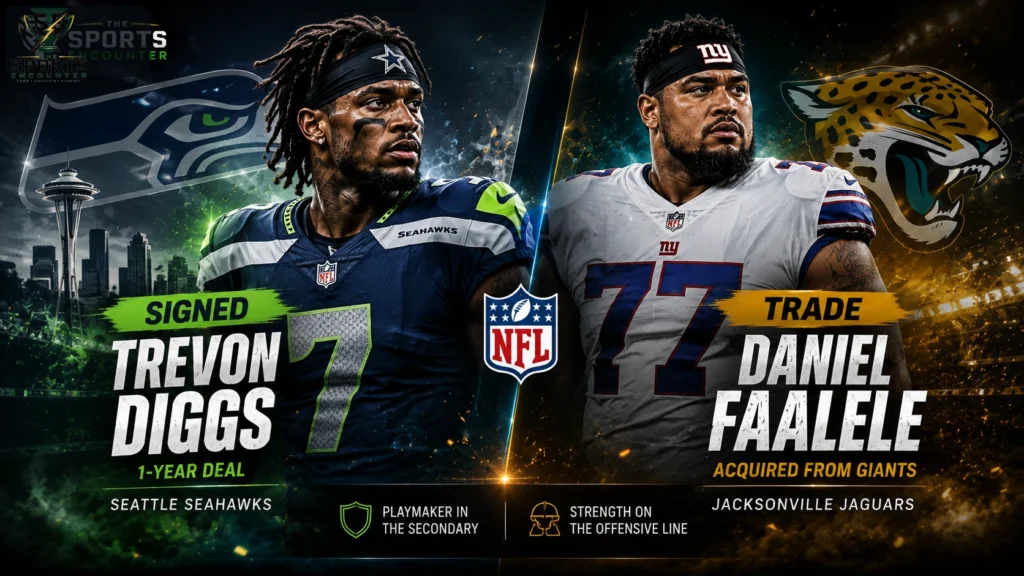
The Seahawks are signing two-time Pro Bowl cornerback Trevon Diggs to a one-year deal after bringing him in for a workout, while the Jaguars are acquiring massive guard Daniel Faalele from the New York Giants for a late-round 2027 draft pick.
The moves solve very different problems.
Seattle is chasing upside in the secondary.
Jacksonville needs playable protection now.
Both transactions also reveal how quickly NFL roster priorities change once training camp starts exposing injuries, depth issues and uncertainty that looked manageable in May.
Fans can follow the broader wave of roster movement through The Sports Encounter’s NFL coverage, where signings, injuries, trades and training-camp developments are tracked throughout the preseason.
NFL Signings and Trades Update: Diggs and Faalele at a Glance
| Player | Position | Move | New Team | Key Context |
|---|---|---|---|---|
| Trevon Diggs | Cornerback | One-year signing | Seattle Seahawks | Former All-Pro and two-time Pro Bowler trying to revive career after injuries |
| Daniel Faalele | Guard | Trade from Giants | Jacksonville Jaguars | Added after Patrick Mekari underwent back surgery |
The NFL’s official 2026 roster tracker provides league-wide context for offseason signings and trades. :contentReference[oaicite:0]{index=0}
Trevon Diggs Is Heading to Seattle on a One-Year Deal
Trevon Diggs is getting another chance to show that the playmaker who once terrorized quarterbacks has not disappeared.
The Seahawks are signing the veteran cornerback to a one-year contract after he worked out for the team on Tuesday, according to reports confirmed Wednesday.
Financial terms were not immediately disclosed.
Seattle’s decision makes sense once Diggs’ career is viewed in full rather than through the injuries that have defined his last three seasons.
At his peak, he was one of the NFL’s most dangerous takeaway specialists.
In 2021, Diggs intercepted 11 passes, led the league in that category, returned two for touchdowns and earned both Pro Bowl and All-Pro recognition.
That season turned him into one of the biggest defensive names in football and eventually helped him secure a five-year, $97 million extension with Dallas in 2023.
The Seahawks are now betting that some portion of that player still exists.
Seattle Is Buying Upside, Not Certainty
This is not the same Trevon Diggs who signed that Cowboys extension.
Injuries changed the trajectory.
He tore his ACL two games into the 2023 season and later missed the final six games of 2024 with another left knee problem.
Right-knee issues disrupted the following campaign as well.
Across the last three seasons, Diggs appeared in only 22 games.
That availability record is why the one-year structure matters.
Seattle does not have to treat him as a long-term cornerstone.
The Seahawks can evaluate the knees, the movement, the tackling and the coverage consistency in real time.
If the old instincts return, they may have found a veteran playmaker at exactly the right moment.
If they do not, the commitment is limited.
Diggs Still Has 20 Career Interceptions
The ball production remains impossible to ignore.
Diggs has recorded 20 interceptions in 67 career regular-season games, including 64 starts.
He also owns 63 passes defended and 242 tackles.
Those numbers explain why Seattle was willing to bring him into the building despite the physical concerns.
Interception production can be volatile, but anticipation, route recognition and confidence around the football are difficult traits to manufacture.
Diggs has already proved he owns them.
Seattle’s Secondary Makes This a Fascinating Fit
The Seahawks are not signing Diggs because they lack defensive ambition.
They are signing him because the defending champions understand how much secondary depth matters over a 17-game season.
Seattle has already spent the offseason reshaping parts of its defensive backfield.
The Sports Encounter previously highlighted the Seahawks’ roster philosophy while examining the NFL’s most underrated 2026 offseason signings, including former Seattle defensive back Coby Bryant’s move to Chicago.
Diggs gives the Seahawks another experienced option inside a cornerback room that cannot assume everyone will remain healthy.
Reports also say Seattle plans to sign former Detroit Lions cornerback Terrion Arnold, although that situation carries separate roster and league-status complications.
The Most Interesting Part of the Diggs Deal Is Familiarity
Seattle is not introducing Diggs to a completely unfamiliar coaching environment.
Secondary coach Karl Scott previously worked with him at Alabama, while Seahawks defensive coordinator Aden Durde spent time with Diggs in Dallas.
That familiarity may shorten the adjustment period.
Coaches already understand the strengths.
They also understand the weaknesses.
That matters with a veteran player trying to rediscover his best football.
A new team does not have to spend weeks learning why certain techniques work for him or where he needs help.
Seattle can begin with a much clearer picture.
TSE Analysis: Diggs Does Not Need to Become 2021 Diggs Again
This signing will be judged incorrectly if the standard becomes 11 interceptions.
Seattle does not need that.
What the Seahawks need is a healthy defensive back who can survive NFL coverage snaps, create occasional takeaways and provide veteran depth when injuries inevitably hit.
Even six or seven competent games at a high level could become valuable over a championship defense’s season.
The larger question is whether Diggs can still move confidently enough after multiple knee problems.
Cornerbacks live on acceleration, recovery speed and trust in their lower body.
Hesitation is expensive.
That makes his physical condition more important than his résumé.
Diggs’ Exit From Dallas Ended an Unusual Chapter
His Cowboys tenure ended with more than injury questions.
Dallas waived Diggs late last season after a period that included concerns over his availability and a widely discussed travel issue following a win over Washington.
Head coach Brian Schottenheimer said at the time that the decision involved multiple factors.
Green Bay then added Diggs late in the season.
He appeared in the regular-season finale and played one snap in the Packers’ wild-card loss to Chicago.
That short Packers stint never became a meaningful reset.
Seattle now provides the real opportunity.
The Sports Encounter recently covered another veteran comeback discussion through Aaron Donald’s workout with the Rams. Diggs’ circumstances are obviously different, but the underlying preseason question is similar: how much of a former star’s peak physical level still remains?
Jacksonville Solves a Different Problem With Daniel Faalele
While Seattle is chasing defensive upside, Jacksonville is reacting directly to injury.
The Jaguars are acquiring Daniel Faalele from the New York Giants in exchange for a late-round pick in the 2027 NFL Draft.
Multiple reports identify the compensation as a sixth-round selection. :contentReference[oaicite:1]{index=1}
The timing is straightforward.
Jacksonville guard Patrick Mekari recently underwent back surgery, creating immediate uncertainty on the offensive line.
Faalele gives the Jaguars something they badly needed.
Experience.
And a lot of size.
Daniel Faalele Is One of the Biggest Players in the NFL
Faalele stands 6-foot-8 and weighs around 370 pounds.
That size made him one of the most physically unusual offensive-line prospects in recent draft history.
The Australian entered the NFL as a fourth-round pick by Baltimore in 2022 after playing college football at Minnesota.
He initially worked as a reserve tackle before moving inside.
The transition eventually turned him into a full-time guard.
Faalele started all 17 regular-season games for Baltimore in 2024 and did it again in 2025.
Across four NFL seasons, he has made 66 regular-season appearances and 35 starts. :contentReference[oaicite:2]{index=2}
Jacksonville Needed a Guard Who Has Actually Played NFL Snaps
That distinction matters.
Training-camp depth can look acceptable until a starter goes down.
Then coaches discover how quickly the talent gap widens between developmental reserves and players who have started meaningful NFL games.
Faalele has lived through full seasons as a starting guard.
He understands blitz pickups, defensive-line games, protection changes and the physical grind of playing every week.
Jacksonville does not need to teach him how an NFL Sunday feels.
The Jaguars need to integrate him into their terminology and determine whether he can stabilize an injury-hit interior.
Patrick Mekari’s Surgery Changed the Equation
The Faalele trade is best understood as an injury response.
Mekari’s back surgery created uncertainty at a position Jacksonville could not afford to leave exposed.
Other offensive linemen have also dealt with availability issues during camp, increasing the pressure on the Jaguars to find help before the regular season begins.
The Sports Encounter recently explored how fast offensive-line depth can become a roster priority when covering San Francisco’s signing of Kion Smith.
The principle applies here on a larger scale.
An offensive line can lose one player and survive.
Multiple injuries can change the entire offense.
Why Jacksonville Could Justify Giving Up a Draft Pick
A sixth-round pick in 2027 sounds like future value.
Jacksonville is buying present certainty.
Late-round picks matter, but they also carry significant developmental uncertainty.
Faalele has already played four NFL seasons.
He has already started 35 games.
The Jaguars know the approximate floor they are acquiring.
For a team trying to protect its quarterback and keep the offense functional, that immediate value can outweigh the possibility of finding a contributor with a future Day 3 selection.
The Giants Had a Different Calculation
New York could afford to move Faalele because its guard depth had evolved.
Veteran Jon Runyan and 2026 first-round pick Francis Mauigoa are positioned as starters.
That pushed Faalele toward a reserve role.
He had only signed with the Giants as a free agent in April after leaving Baltimore.
Instead of carrying a veteran backup who might have struggled to justify his place on the final roster, New York converted him into future draft capital.
That is efficient roster management.
Jacksonville receives a player it needs more.
New York receives an asset for a player it needs less.
Faalele Also Reunites the Debate Around Interior Protection
Guards are becoming more valuable across the NFL.
The rise of dominant interior pass rushers has changed how teams think about protection.
Quarterbacks cannot step up when pressure arrives directly through the A and B gaps.
The Sports Encounter examined that changing market through Peter Skoronski’s record-setting $100 million Titans extension.
Faalele obviously does not operate at Skoronski’s contractual level.
The positional logic still matters.
Teams cannot treat guards as replaceable bodies when interior pressure can ruin an entire passing structure.
What Faalele Must Prove in Jacksonville
Size alone will not secure him a long-term role.
At 370 pounds, Faalele can absorb power and create movement when his technique is clean.
The challenge comes against quicker interior defenders.
Modern defensive tackles attack edges, change direction and force large guards to redirect.
Jacksonville must determine whether Faalele can remain balanced enough in pass protection while still using his mass as an advantage in the run game.
Conditioning Will Matter
August trades create a particular challenge for offensive linemen.
They must learn a new playbook while already deep into training camp.
Terminology changes.
Protection calls change.
Footwork rules can change.
Faalele’s previous starting experience helps, but Jacksonville still faces a race against time if Mekari remains unavailable into the regular season.
Seattle and Jacksonville Are Solving Two Different Types of Risk
| Team | Risk | Response | Potential Reward |
|---|---|---|---|
| Seattle Seahawks | Secondary depth and uncertainty | Sign Trevon Diggs for one year | Possible high-upside veteran ball production |
| Jacksonville Jaguars | Offensive-line injuries | Trade a 2027 sixth-round pick for Daniel Faalele | Experienced guard depth with starting background |
This is the part of NFL roster building that often receives less attention than free agency in March.
Teams enter camp with plans.
Practice begins exposing weaknesses.
Injuries arrive.
Depth charts change.
Suddenly a veteran cornerback or backup guard becomes considerably more valuable than he looked two weeks earlier.
The Sports Encounter’s recent NFL training-camp roundup has already shown how quickly preseason developments can alter roster priorities around the league.
Seattle’s Move Has the Bigger Name, Jacksonville’s May Be More Necessary
Diggs will generate more attention.
That is natural.
He has an All-Pro season, 20 career interceptions and a recognizable name from years in Dallas.
Faalele’s acquisition carries less glamour.
Jacksonville may ultimately need him more.
If Mekari misses meaningful time, the Jaguars require somebody who can handle starting snaps.
Protection failures can derail an offense far faster than most roster weaknesses.
A cornerback signing might create turnovers.
A guard acquisition may prevent the quarterback from being hit before the play develops.
The Deals Fit a Busy NFL August
The Diggs and Faalele moves continue a period of aggressive roster churn across the league.
The Sports Encounter recently covered Stefon Diggs joining Washington amid a wider wave of NFL roster changes, while Deebo Samuel’s return to San Francisco showed how veteran names can suddenly re-enter the market late in the offseason.
Injuries have added another layer of urgency.
The latest NFL injury roundup highlighted how rapidly availability questions are reshaping depth charts before Week 1.
That is why August transactions deserve more attention than the calendar sometimes gives them.
What Happens Next for Trevon Diggs?
The first challenge is physical.
Seattle must determine how Diggs’ knees respond to consecutive practices, live coverage work and preseason preparation.
The second challenge is competitive.
A former Pro Bowler does not automatically receive a starting job because of his résumé.
Diggs has to earn snaps.
If his movement returns, Seattle suddenly owns another cornerback capable of changing games with one read.
If his recovery remains incomplete, he may simply become experienced depth.
What Happens Next for Daniel Faalele?
Jacksonville has less time for experimentation.
The Jaguars need to integrate Faalele quickly and establish whether he can help cover Mekari’s absence.
He brings the physical profile.
He brings starting experience.
The remaining work involves fit.
Can he learn the protections quickly?
Can he handle Jacksonville’s preferred run concepts?
Can he remain effective against faster interior rushers?
Those answers will determine whether this becomes a temporary depth move or something more significant.
TSE Verdict: August Roster Moves Are About Problems, Not Headlines
Seattle and Jacksonville entered Wednesday with different concerns.
The Seahawks saw an opportunity to add a former All-Pro cornerback without making a long-term commitment.
The Jaguars saw an offensive-line problem becoming too dangerous to ignore.
Both reacted.
That is what competent NFL roster management looks like in August.
Teams stop worrying about whether a transaction wins social media and start worrying about whether the roster can survive September.
Diggs could become one of the more interesting comeback stories of the 2026 season.
Faalele could become a far quieter addition whose value shows up every time Jacksonville’s quarterback gets another second in the pocket.
The names are different.
The logic is the same.
Training camp exposed a need, and two teams refused to wait for the regular season to punish them for it.
Frequently Asked Questions
Did the Seahawks sign Trevon Diggs?
Seattle is signing Trevon Diggs to a one-year deal after the veteran cornerback worked out for the Seahawks. Financial terms were not immediately disclosed. :contentReference[oaicite:3]{index=3}
How many interceptions does Trevon Diggs have?
Diggs has recorded 20 interceptions in 67 career regular-season games.
What was Trevon Diggs’ best NFL season?
His best season came in 2021, when he led the NFL with 11 interceptions, returned two for touchdowns and earned Pro Bowl and All-Pro honors.
Why are the Jaguars trading for Daniel Faalele?
Jacksonville needed additional offensive-line depth after guard Patrick Mekari underwent back surgery. Faalele brings 35 career starts and two full seasons of starting experience at guard.
What are the Jaguars giving the Giants for Daniel Faalele?
Reports say Jacksonville is sending New York a 2027 sixth-round draft pick. :contentReference[oaicite:4]{index=4}
How big is Daniel Faalele?
Faalele is listed at 6-foot-8 and approximately 370 pounds. :contentReference[oaicite:5]{index=5}
Where did Daniel Faalele play before the Giants?
Faalele spent his first four NFL seasons with the Baltimore Ravens. He started every regular-season game at guard in both 2024 and 2025 before signing with New York in 2026.
Where can fans follow the latest NFL roster moves?
Fans can follow The Sports Encounter’s NFL section for roster news, signings, trades, injuries and training-camp updates, alongside the official NFL roster tracker.