


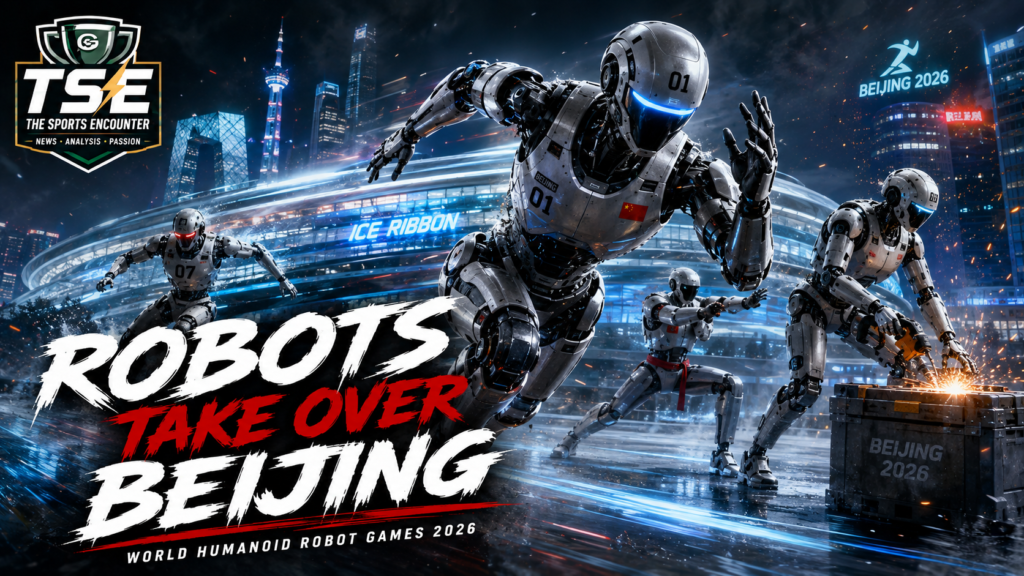
Beijing is preparing for a sporting event that would have sounded like science fiction only a few years ago.
From August 22 to 26, the Chinese capital will host the second World Humanoid Robot Games at the National Speed Skating Oval, better known as the Ice Ribbon, with 666 teams and 2,056 robots from 16 countries across six continents expected to compete.
The scale alone is striking.
Participation has risen 138 percent from the inaugural edition in 2025, when 280 teams and just over 500 humanoid robots took part. This year, the number of machines has roughly quadrupled, and the competition has expanded far beyond races, football and choreographed demonstrations.
The 2026 Games will still have the spectacle.
Robots will sprint, jump, fight, play soccer, lift weights, pull against each other in tug-of-war and compete in table tennis.
But the more important contests may happen away from the biggest crowds.
This year’s program also includes industrial assembly, logistics, hotel services, household tasks, firefighting, retail assistance and other scenarios designed to test whether humanoid robots can operate reliably in environments that resemble actual workplaces.
The future is no longer being demonstrated only on a laboratory floor.
It is being timed, scored and judged in public.
World Humanoid Robot Games 2026: Key details
| Detail | Information |
|---|---|
| Event | Second World Humanoid Robot Games |
| Dates | August 22-26, 2026 |
| Host city | Beijing, China |
| Main venue | National Speed Skating Oval, “Ice Ribbon” |
| Teams | 666 |
| Robots | 2,056 |
| Countries | 16 |
| Continents represented | 6 |
| Main competition areas | Sports, combat, industrial, domestic and service scenarios |
More than 2,000 robots are coming to Beijing
The participation figures show how quickly the World Humanoid Robot Games have grown.
According to organizers, 2,056 robots representing 666 teams will take part in the second edition, with competitors arriving from 16 countries spread across six continents.
China Daily reported that 641 of the teams are Chinese, involving 157 companies and 200 universities and research institutions.
The remaining international field includes teams from countries such as the United States, Germany, Japan and Brazil.
Brazil is expected to field a national team, another indication that the competition is beginning to move beyond a purely domestic Chinese technology showcase.
The scale has changed dramatically from 2025.
The inaugural World Humanoid Robot Games featured 280 teams from 16 countries and more than 500 robots.
A year later, the event is no longer testing whether there is enough interest to sustain a second edition.
It is dealing with the opposite problem: how to manage thousands of machines, batteries, teams, communication systems and competition schedules inside one major event.
Robots taking over Beijing on August 22 for the Second World Humanoid Robot Games
— RT (@RT_com) August 18, 2026
666 teams and 2,056 robots from 16 countries across six continents will compete
The future is already here pic.twitter.com/fYglSJNCGB
The Ice Ribbon is becoming an arena for a completely different kind of athlete
The National Speed Skating Oval was built for the Beijing 2022 Winter Olympics.
Its original purpose was elite human performance.
Four years later, the same venue is being repurposed for machines designed to imitate, and increasingly challenge, human movement.
The Beijing municipal government has confirmed that the Games will run from August 22 through August 26 at the Ice Ribbon.
The venue will host a combination of competitive and scenario-based events, turning an Olympic arena into one of the world’s largest public laboratories for humanoid robotics.
That transformation feels symbolic.
The venue once measured milliseconds between human speed skaters.
Now it will measure whether artificial athletes can sprint faster, balance better, manipulate objects more precisely and recover from mistakes without engineers stepping in.
Robot soccer remains one of the biggest attractions
Among the sporting competitions, soccer remains one of the most compelling tests.
A humanoid robot playing football needs much more than the ability to kick a ball.
It needs visual perception.
It must identify teammates and opponents.
It has to judge distance.
It must maintain balance during contact and direction changes.
It needs to decide when to pass, shoot or reposition.
And increasingly, it is expected to do those things with greater autonomy rather than constant remote control.
That makes robot soccer an unusually useful engineering test.
A successful robot must combine perception, decision-making, movement and recovery inside an unpredictable environment.
Those same capabilities are essential if humanoid machines are eventually expected to work in warehouses, factories, homes or emergency situations.
Long jump, weightlifting and tug-of-war raise the physical stakes
This year’s Games are also introducing more physically demanding events.
Organizers have added long jump, weightlifting, tug-of-war and table tennis.
Each creates a different technical problem.
Long jump tests explosive power, landing stability and joint control.
Weightlifting places enormous stress on actuators, structural components and balance algorithms.
Tug-of-war tests traction, force distribution and stability under continuous resistance.
Table tennis may be one of the most difficult challenges of all because it requires extremely fast visual processing, precise timing and fine motor control.
For engineers, a few extra centimeters in a jump or an additional kilogram lifted can represent months of work refining motors, joints, software and structural design.
What looks like entertainment from the stands can therefore be a highly visible engineering benchmark.
The real test begins when robots stop performing and start working
The sporting competitions will create the viral clips.
The scenario-based events may tell us much more about where humanoid robotics actually stands.
Reuters reported that this year’s Games will test robots in factory, hotel and household environments, with some machines required to complete longer sequences of tasks without human intervention.
Competitions include industrial assembly, warehouse packing, material handling, retail services, office work, electric-vehicle charging and fine-manipulation tasks such as connecting cables and using tools.
These are very different challenges from running in a straight line.
A robot can be optimized for speed and still be useless in a workplace.
Real environments are messy.
Objects move.
Lighting changes.
Humans interrupt.
Instructions vary.
A machine may need to recognize an unfamiliar object, pick it up, place it correctly and recover when something goes wrong.
That is where robotics becomes economically interesting.
Household robots are being asked to fold clothes and organize rooms
Domestic-service events offer one of the clearest examples of the shift toward practical capability.
Teams have been training robots to complete household tasks such as organizing objects, handling documents, doing laundry and folding clothes.
Competition rules require some home-service robots to perform multiple tasks within a 30-minute period.
That sounds simple until the difficulty is considered from a machine’s perspective.
Clothing changes shape constantly.
Fabric bends.
Objects do not always sit in exactly the same position.
A robot must combine vision, hand-eye coordination, force control and sequential decision-making to finish the task without damaging anything.
This is the kind of challenge that exposes the difference between a robot performing a rehearsed routine and one that can genuinely operate in a human environment.
Firefighting turns robot games into a safety experiment
Emergency-response events introduce a much more serious dimension.
Humanoid robots are being tested in firefighting scenarios where they must detect hazards, navigate difficult environments and operate equipment.
The long-term appeal is obvious.
If robots can eventually enter burning buildings, chemical facilities or unstable disaster zones, they could take on jobs that place human responders at extreme risk.
That potential has always been one of the strongest arguments for advanced robotics.
The Games provide a public environment where those claims can be tested rather than simply demonstrated through promotional videos.
Why the second edition matters more than the first
The inaugural 2025 Games proved that humanoid robots could compete in recognizable sporting formats.
They ran.
They fought.
They danced.
They played football.
They also fell over, lost balance and occasionally required human intervention.
That was part of the attraction.
The machines looked impressive and unfinished at the same time.
One year later, the expectations have changed.
Simply completing a race or producing a backflip is no longer enough to demonstrate meaningful progress.
The question is whether the machines are becoming more autonomous, more reliable and more useful.
China is pushing humanoid robotics at extraordinary speed
The Games sit inside a much larger Chinese robotics strategy.
China has become the dominant market for humanoid robot shipments, supported by state policy, private investment and a rapidly growing ecosystem of manufacturers.
Reuters reported that China accounted for more than 80 percent of global humanoid shipments in recent industry estimates.
Companies such as Unitree, AgiBot and UBTech have become increasingly visible as Chinese manufacturers compete to reduce costs, improve autonomy and find commercial applications.
The 2026 World Robot Conference in Beijing is also showcasing more than 2,000 robotic exhibits from more than 300 companies immediately before the Games.
That overlap is important.
The conference shows what companies say their machines can do.
The Games provide an environment where some of those capabilities can be tested under pressure.
Unitree’s rise shows how quickly the industry is changing
One of the most closely watched companies in the sector is Unitree Robotics.
The Chinese humanoid manufacturer has grown rapidly and recently unveiled a new high-speed machine nicknamed “Superman,” capable of extremely powerful jumps and high running speeds.
Unitree has also moved into public markets, reflecting how much investor enthusiasm has built around humanoid robotics.
That enthusiasm creates opportunity.
It also creates pressure.
Companies can impress investors with dancing robots, martial-arts demonstrations and viral videos.
Eventually, customers need machines that can perform useful work reliably enough to justify their cost.
That commercial gap may become one of the defining themes of the 2026 Games.
The economics still do not fully work
Humanoid robotics has advanced rapidly, but the economics remain difficult.
Reuters cited industry estimates suggesting industrial humanoid robots can still cost roughly 300,000 to 500,000 yuan.
For a machine to economically replace a worker earning around 80,000 yuan per year within two years, the total robot cost would need to fall much closer to 160,000 yuan, including maintenance.
That gap is substantial.
It explains why many robots produced today are still used for research, demonstrations, training-data collection or highly controlled industrial tasks rather than broad everyday employment.
The Games therefore arrive at an important stage in the industry’s development.
The hardware is becoming impressive enough to attract mass attention.
The software, reliability and economics still need to catch up.
From robot marathons to robot workplaces
Beijing has already used sporting competition as a testing ground for robotics.
Earlier in 2026, humanoid robots competed in another half-marathon in the city, with substantial improvements in autonomy, speed and endurance compared with the previous year.
Those events matter because running exposes weaknesses quickly.
Battery management becomes visible.
Motors overheat.
Balance systems are tested continuously.
Small mechanical problems compound over long distances.
But running remains a relatively structured activity.
The next frontier requires robots to handle uncertainty.
That is why the scenario-based events at the World Humanoid Robot Games may matter more than any sprint record.
A robot can win a race and still fail in a kitchen
This is one of the most important distinctions surrounding humanoid robotics.
Humans often assume a machine capable of an impressive physical feat must also be broadly intelligent.
That is not necessarily true.
A robot designed to sprint can be optimized around one narrow task.
Its body, software and control systems can all be tuned specifically for forward movement.
Ask the same machine to enter an unfamiliar kitchen, identify a shirt, fold it, open a drawer and place the shirt inside, and the difficulty changes completely.
Those tasks require perception, reasoning, dexterity and adaptation.
This year’s Games are increasingly designed to expose that gap.
Why sports remain the perfect robot laboratory
There is still a strong reason to keep the sporting competitions.
Sport compresses complex engineering challenges into something the public understands immediately.
Everyone knows what it means to run faster.
Everyone recognizes a successful goal.
Everyone understands the difficulty of lifting more weight or landing a jump.
That makes sports an unusually effective bridge between technical research and public understanding.
It also gives engineers clear performance benchmarks.
A robot either completes the race or does not.
It scores or misses.
It stays upright or falls.
The results are difficult to hide behind marketing language.
2,056 robots create an operational challenge of their own
Managing more than 2,000 robots creates another technological test behind the scenes.
Organizers have developed dedicated infrastructure for storing, charging, tracking and maintaining the machines.
A dedicated “Robot Home” is expected to house more than 1,500 robots and support large-scale battery charging.
Competition organizers also need reliable wireless communication systems capable of operating in an environment filled with machines transmitting data simultaneously.
That makes the Games partly an experiment in robot-event infrastructure.
If humanoid machines eventually become common in factories, hospitals, airports or commercial buildings, the systems required to monitor and maintain large fleets may become nearly as important as the robots themselves.
Six continents make this more than a Chinese technology show
China will dominate participation numerically, but the international element remains important.
Teams from 16 countries across six continents give researchers and companies an opportunity to compare very different engineering philosophies.
Some teams emphasize speed.
Others prioritize stability.
Some build highly specialized machines.
Others focus on general-purpose humanoid platforms capable of performing several tasks.
That variety is useful because there is still no universally accepted blueprint for what the successful humanoid robot should look like.
The industry is effectively testing competing ideas in public.
The “robot Olympics” comparison only goes so far
The World Humanoid Robot Games will inevitably be described as a robot Olympics.
The comparison is useful, but incomplete.
Human Olympic athletes train their bodies to reach the limits of biological performance.
Robot competitors are simultaneously athletes, prototypes and engineering experiments.
When a humanoid robot loses balance, the failure may reveal something about an actuator, sensor, control algorithm or software model.
When another machine completes a complex task smoothly, the performance can influence future product development.
Every event is therefore both competition and research.
The future of work sits behind the spectacle
The broader implications extend well beyond sports.
Companies are developing humanoid robots partly because the human body has already shaped the world around us.
Factories, homes, staircases, doors, tools and vehicles are designed for human proportions.
A machine that resembles the human form could theoretically operate within those environments without requiring every workplace to be rebuilt around automation.
That is the promise.
The Games will show how far reality still sits behind it.
The robots are improving faster than the public conversation
Humanoid robotics is moving quickly enough that demonstrations which seemed extraordinary two years ago can already feel routine.
Dancing robots once dominated headlines.
Then came backflips.
Then boxing.
Then marathons.
Now organizers are asking robots to fold laundry, connect cables, charge electric vehicles and operate inside simulated workplaces.
The progression is significant.
Public attention naturally follows the most spectacular videos.
The industry’s future may depend on the least glamorous ones.
TSE analysis: The real contest is usefulness versus spectacle
The easiest way to understand the World Humanoid Robot Games is as entertainment.
More than 2,000 robots competing in sports sounds irresistible.
There will almost certainly be spectacular moments.
There will also be falls, failures and machines that do something unintentionally funny.
Those clips will travel fastest online.
But the most important competition is happening underneath them.
The robotics industry is moving from asking whether humanoid machines can impress people to asking whether they can justify their existence economically.
A robot capable of performing a backflip is impressive.
A robot capable of reliably completing an eight-hour factory shift without supervision is transformational.
The gap between those two abilities remains enormous.
Beijing’s Games are increasingly designed to measure it.
The future is already here, but it is still learning how to walk
The phrase “the future is already here” feels appropriate when 2,056 humanoid robots are preparing to compete inside an Olympic venue.
But the second half of that sentence matters too.
The future remains unfinished.
These robots are faster than last year’s machines.
They are more autonomous.
They can handle more complicated tasks.
They are attracting more investment, more teams and more international attention.
They still fall.
They still struggle with unfamiliar environments.
They remain expensive.
Many still require significant human support.
That is precisely why the World Humanoid Robot Games are worth watching.
They show progress without hiding the limitations.
When the second edition begins in Beijing on August 22, the sporting results will produce winners and losers.
The bigger question will be harder to answer.
How close are these machines to becoming genuinely useful parts of everyday human life?
Five days inside the Ice Ribbon may give us one of the clearest answers yet.
Frequently Asked Questions
When are the World Humanoid Robot Games 2026?
The second World Humanoid Robot Games will take place in Beijing from August 22 to August 26, 2026.
Where are the World Humanoid Robot Games being held?
The main venue is Beijing’s National Speed Skating Oval, commonly known as the Ice Ribbon, which was built for the 2022 Winter Olympics.
How many robots will compete?
Organizers say 2,056 robots representing 666 teams will participate.
How many countries are taking part?
Teams from 16 countries across six continents are expected to compete.
What sports will humanoid robots compete in?
The program includes events such as track and field, soccer, street dance, long jump, weightlifting, tug-of-war, table tennis and combat competitions.
Will the robots perform real-world tasks too?
Yes. Scenario-based competitions include industrial assembly, logistics, hotel services, household tasks, retail assistance, firefighting and other practical challenges.
Why are the robot games important?
The Games provide a public testing environment for humanoid mobility, autonomy, dexterity, perception and reliability. They also allow researchers and companies to compare how close humanoid robots are to performing commercially useful work.
Official event information is available through the Beijing Municipal Government’s World Humanoid Robot Games event page.
For broader coverage of major sporting events, emerging competitions and the changing boundaries of sport, follow The Sports Encounter.