


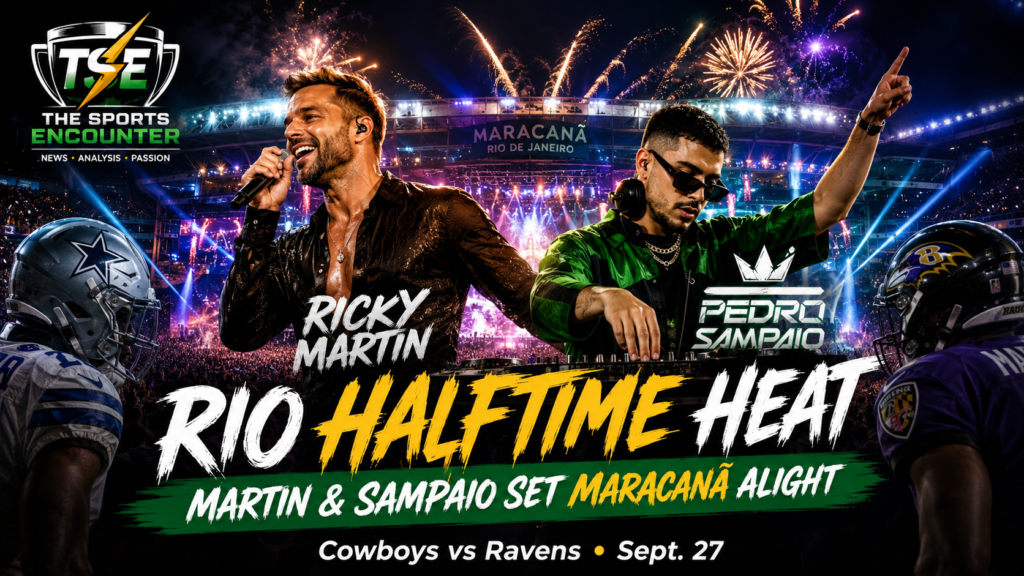
The NFL is not treating its first regular-season game in Rio de Janeiro like an ordinary overseas fixture.
It is building a show around it.
Ricky Martin and Brazilian DJ Pedro Sampaio will perform at halftime when the Dallas Cowboys face the Baltimore Ravens at Maracanã Stadium on September 27, giving the league a music lineup designed as deliberately as the football matchup itself.
Martin brings global recognition.
Sampaio brings Rio.
The combination tells us exactly what the NFL wants this game to become.
Not an American event transplanted into Brazil.
A Brazilian night built around American football.
The league has confirmed that the Week 3 matchup will kick off at 5:25 p.m. local time in Rio, with Dallas serving as the designated home team. It will be the first NFL regular-season game staged in the city and the first at the Maracanã, one of world sport’s most recognizable venues.
For a league that has spent years expanding aggressively outside the United States, the entertainment choice matters because Rio offers something different from London, Munich, Madrid or Melbourne.
It offers a city where music, football, carnival culture and stadium spectacle are already inseparable.
NFL Rio Game 2026: Key Details
| Detail | Information |
|---|---|
| Game | Baltimore Ravens vs Dallas Cowboys |
| Date | September 27, 2026 |
| Venue | Maracanã Stadium, Rio de Janeiro |
| Kickoff | 5:25 p.m. local time |
| Halftime performers | Ricky Martin and Pedro Sampaio |
| Broadcast | CBS and Paramount+ |
| Designated home team | Dallas Cowboys |
| Historical significance | First NFL regular-season game in Rio de Janeiro |
The NFL’s official announcement confirms Martin and Sampaio as the halftime performers, while the league’s international schedule places Ravens-Cowboys at Maracanã in Week 3.
Ricky Martin Gives the NFL Instant Global Recognition
Martin is one of the most recognizable Latin pop performers of the past three decades.
His breakthrough as a solo global star arrived in the late 1990s, when “Livin’ la Vida Loca” became one of the defining crossover hits of the era.
His catalog gives the NFL exactly what international halftime entertainment requires.
Recognition across generations.
Music that translates immediately inside a large stadium.
A performer comfortable in front of enormous live audiences.
Martin also arrives with recent NFL history behind him after appearing during the Super Bowl LX halftime show in Santa Clara earlier this year.
That gives the league continuity.
He already understands the scale and production language of an NFL halftime event.
Pedro Sampaio Makes the Booking Feel Like Rio
If Martin gives the show international reach, Sampaio gives it local authenticity.
The Brazilian DJ grew up in Rio de Janeiro and has developed into one of the country’s most commercially successful modern music acts.
His presence prevents the halftime show from feeling like a generic celebrity booking.
He belongs to the city.
That relationship was obvious in his reaction to the announcement.
“I grew up in Rio de Janeiro, seeing Maracanã Stadium as a place where history was made.”
Sampaio described performing there for the first time alongside Martin as something he never imagined while growing up in the city.
That emotional connection is exactly what the NFL needs.
International expansion becomes more convincing when local audiences feel included rather than targeted.
Maracanã Changes the Scale of the Event
The venue carries its own mythology.
Maracanã is associated with World Cups, Brazilian football, major finals, packed crowds and some of the loudest sporting nights South America has produced.
American football arrives there as a guest.
That makes the choice significant.
The NFL could have selected a newer venue built around commercial efficiency.
Instead, it chose a stadium with cultural weight.
That decision places the league inside a story much older than its presence in Brazil.
For one Sunday, the field normally associated with Brazil’s football identity becomes home to Lamar Jackson, Dak Prescott and an NFL spectacle.
The Cowboys Are the Perfect Team for This Kind of International Event
Dallas remains one of the NFL’s most recognizable brands.
The Cowboys carry international familiarity even among sports fans who do not follow the league closely.
That makes them a logical centerpiece for Rio.
The game will also mark Dallas’ first regular-season international appearance since 2014, when the Cowboys beat Jacksonville in London.
The organization enters Rio with a 1-0 international regular-season record.
From a marketing perspective, “America’s Team” playing at Maracanã is almost too obvious a pairing.
The contrast itself creates attention.
One of American sport’s most famous franchises enters one of Brazilian sport’s most famous stadiums.
Baltimore Brings the Football Star Power
The Ravens give the game another layer.
Lamar Jackson is one of the league’s most recognizable quarterbacks and one of its most visually exciting players.
His mobility makes him unusually accessible to new NFL viewers because the athleticism is immediately obvious even without deep tactical knowledge.
That matters in an international game.
A newcomer may not understand protection schemes or route combinations.
Everyone understands a quarterback escaping pressure and accelerating into open space.
Dallas and Baltimore therefore offer a strong balance between brand recognition and elite athletic entertainment.
The Halftime Show Is Part of a Much Bigger NFL Strategy
The Rio booking should be viewed alongside the rest of the league’s 2026 international calendar.
The NFL will stage nine regular-season games outside the United States this season, with events scheduled across Rio de Janeiro, Melbourne, London, Munich, Madrid, Mexico City and Paris.
The league has moved far beyond experimenting with one or two overseas games.
International football is becoming a recurring part of the regular season.
The NFL’s official international-games schedule confirms the scale of that expansion.
Rio is one of the most important additions because Brazil represents a huge sports market with an established appetite for American football.
Brazil Is No Longer an Experimental NFL Market
The league’s decision to commit to multiple games in Rio over several years shows that this is not a one-night test.
The NFL announced a multiyear commitment to play at least three regular-season games in Rio across a five-year period.
That transforms the city from a novelty destination into a recurring international market.
The halftime show should therefore be read as part of a longer courtship.
The league wants Brazilian fans to build emotional attachment to the event.
Music helps.
Local stars help.
Maracanã helps.
Eventually, the goal is for the game itself to feel normal.
Why Music Matters More in an International NFL Game
American audiences already understand the rituals surrounding an NFL Sunday.
International audiences may engage with the event differently.
Some arrive for the football.
Others arrive because the occasion feels culturally significant.
Halftime entertainment broadens the entry point.
A Ricky Martin fan may buy a ticket without being able to explain cover-two defense.
A Pedro Sampaio follower may attend because a major Rio artist is performing at Maracanã.
Once those fans enter the stadium, the NFL has an opportunity to convert spectacle into sporting interest.
That is why the entertainment is not decorative.
It is part of audience acquisition.
Rio Offers the NFL Something London Cannot
London has become familiar territory for the league.
Germany has developed rapidly.
Madrid and Paris offer enormous European commercial potential.
Rio brings a different emotional character.
Brazilian sports culture is loud, expressive and deeply connected to music.
The Maracanã setting amplifies that.
The NFL does not need Rio to imitate an American stadium.
The smarter strategy is to let Rio change the NFL experience.
Martin and Sampaio fit that philosophy perfectly.
Sampaio Understands What Maracanã Means
The most important quote in the announcement may belong to Sampaio.
“Maracanã is part of the history of both sports and music.”
That observation captures why the booking works.
Maracanã has never functioned solely as a football stadium.
It is a cultural venue.
Major performers have shared the same space as some of the greatest players in Brazilian football history.
The NFL is inserting itself into that tradition rather than asking the city to forget it for a day.
Ricky Martin Knows What Brazilian Crowds Can Produce
Martin’s own statement emphasized the energy of Brazilian audiences.
“There’s nothing quite like the energy of the Brazilian people.”
That may sound like standard promotional language.
In Rio, it has practical importance.
The success of the first Maracanã game will be judged partly by atmosphere.
If the crowd responds with the intensity associated with major Brazilian events, the broadcast will immediately look different from a typical overseas NFL game.
That visual and acoustic identity matters to the league’s global ambitions.
The NFL Is Learning From the Super Bowl Model
The Super Bowl long ago became bigger than the game itself.
Halftime entertainment, commercials, celebrity attendance and cultural conversation expanded the audience beyond traditional football fans.
The international schedule appears to be borrowing some of that logic.
Not every overseas game needs a Super Bowl-scale production.
But marquee entertainment can turn an ordinary regular-season fixture into a destination event.
Rio is ideally suited to that approach.
The Jonas Brothers Booking in Melbourne Shows a Pattern
The league has already announced the Jonas Brothers for its Melbourne international game between the Los Angeles Rams and San Francisco 49ers.
Martin and Sampaio continue the same strategy.
The NFL is attaching recognizable musical acts to major new international markets.
That suggests entertainment may increasingly become a standard feature when the league enters a city for the first time.
The logic is straightforward.
Football gets people interested.
Entertainment makes the occasion harder to ignore.
The Sports Story Still Has to Deliver
There is one risk in building so much spectacle around the event.
The football cannot become secondary.
Dallas and Baltimore have to provide a game worthy of the setting.
International fans are increasingly sophisticated NFL viewers.
They do not need novelty alone.
They want competitive games, recognizable stars and meaningful regular-season stakes.
Week 3 provides enough early-season importance to make the result matter.
The Sports Encounter will follow that matchup through our NFL coverage as the 2026 season develops.
TSE Analysis: The Real Win Would Be Making the NFL Feel Brazilian for One Night
The easiest way to stage an international sporting event is to reproduce the home product somewhere else.
The smarter way is to let the host city reshape it.
Rio should not feel like Dallas with palm trees.
It should feel like Rio.
That means music.
That means a crowd with its own rhythm.
That means using Maracanã’s history rather than covering it with NFL branding.
Martin and Sampaio give the halftime show exactly that possibility.
One represents Latin pop on a global scale.
The other represents the city itself.
If the NFL gets the balance right, viewers may remember the entire night rather than only the score.
The League Is Competing for Attention, Not Only Fans
Global sports expansion is increasingly a battle for entertainment time.
The NFL is not merely competing against other American sports.
It competes against football, Formula 1, concerts, streaming platforms, esports and every other major event demanding a weekend audience.
That makes cultural relevance valuable.
A standalone Cowboys-Ravens game will attract NFL fans.
A Cowboys-Ravens game at Maracanã with Ricky Martin and Pedro Sampaio can attract people who might otherwise never schedule their Sunday around American football.
That is a much larger opportunity.
Frequently Asked Questions
Who is performing at the NFL Rio halftime show?
Ricky Martin and Brazilian DJ Pedro Sampaio will perform at halftime of the 2026 NFL Rio Game.
Which teams are playing in Rio?
The Baltimore Ravens will face the Dallas Cowboys.
When is the NFL game in Rio?
The game is scheduled for Sunday, September 27, 2026.
Where will the game be played?
The matchup will take place at Maracanã Stadium in Rio de Janeiro.
What time does Ravens vs Cowboys start?
The game is scheduled for 5:25 p.m. local time in Rio, which corresponds to 4:25 p.m. ET.
Is this the first NFL game in Rio de Janeiro?
Yes. It will be the first NFL regular-season game played in Rio de Janeiro.
Has Ricky Martin performed at an NFL event before?
Yes. Martin appeared during the Super Bowl LX halftime show in February 2026.
Who is Pedro Sampaio?
Pedro Sampaio is a Brazilian DJ, producer and singer from Rio de Janeiro who has become one of Brazil’s most successful contemporary music artists.
Will the NFL return to Rio after 2026?
The league has announced a multiyear commitment that includes at least three regular-season games in Rio over five years.
Maracanã Is About to Get a Different Kind of Sunday
For generations, Maracanã has belonged to football in the Brazilian sense of the word.
On September 27, the other football arrives.
The Cowboys bring one of America’s most famous sporting brands.
The Ravens bring Lamar Jackson and a team capable of providing genuine competitive quality.
Ricky Martin brings international star power.
Pedro Sampaio brings Rio.
The NFL could have staged a game and left it at that.
Instead, it is building an event around the city.
That may prove to be the more important decision.
If the football is good, the music hits and Maracanã responds the way Maracanã usually does, the NFL’s first night in Rio could become much more than another international fixture.
It could become the night American football finally feels at home in the city.