


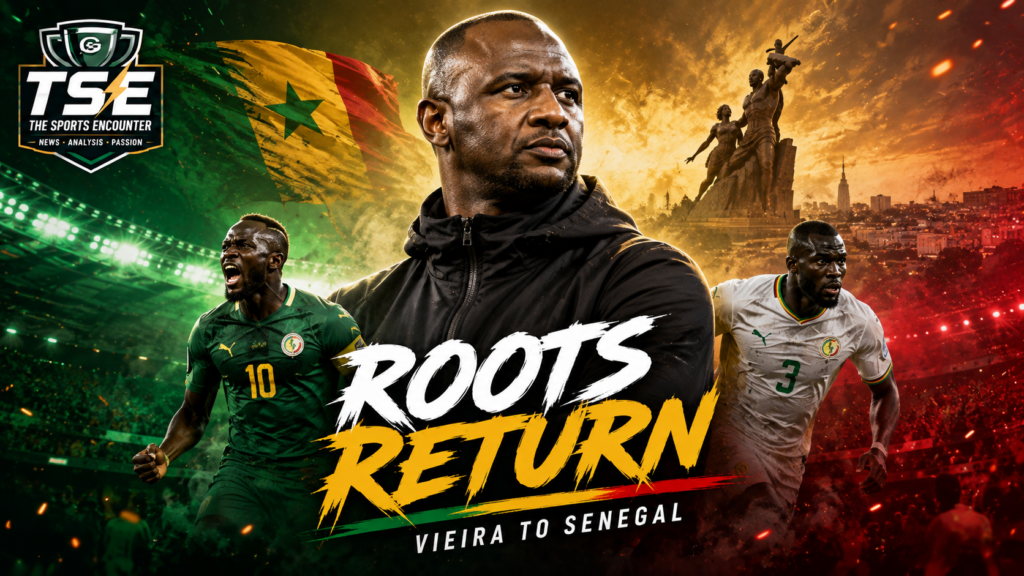
Patrick Vieira is returning to the country of his birth to begin the first international management job of his career.
Senegal have appointed the former France and Arsenal midfielder as head coach of the senior national team, placing one of African soccer’s most recognizable figures in charge of a squad trying to recover from a disappointing 2026 FIFA World Cup and prepare for another major continental campaign.
The Senegalese Football Federation confirmed Vieira’s appointment on Tuesday following the departure of Pape Thiaw, whose tenure ended after Senegal were eliminated in the Round of 32 at the World Cup.
For Vieira, the appointment carries an emotional dimension few coaching jobs could match.
He was born in Dakar in 1976 before moving to France as a child. He later became one of the defining midfielders of his generation, winning the 1998 FIFA World Cup and Euro 2000 with France and building a club career most closely associated with Arsenal.
Now, at 50, Vieira returns to Senegal with a very different responsibility.
He is no longer arriving as the Dakar-born child who built his football identity elsewhere. He is returning as a coach expected to help shape the next phase of the Lions of Teranga.
FIFA has confirmed Vieira’s appointment following Senegal’s early exit at the 2026 World Cup.
Patrick Vieira to Senegal: Key facts
| Detail | Information |
|---|---|
| Coach | Patrick Vieira |
| Age | 50 |
| Born | Dakar, Senegal |
| Previous national-team coaching jobs | None |
| Previous clubs coached | New York City FC, Nice, Crystal Palace, Strasbourg, Genoa |
| Major playing honors | 1998 FIFA World Cup, Euro 2000, three Premier League titles |
| Senegal predecessor | Pape Thiaw |
| Immediate objective | Prepare Senegal for AFCON 2027 |
Senegal are turning the page after World Cup disappointment
The timing of Vieira’s appointment matters.
Senegal entered the 2026 World Cup carrying significant expectations but failed to make a deep run, exiting in the Round of 32.
That result brought Pape Thiaw’s tenure to an end and left the federation with an important decision.
The Lions of Teranga remain one of Africa’s strongest national teams, but the standards surrounding them have changed dramatically over the past decade.
Senegal are no longer judged primarily on qualification or occasional tournament progress.
Winning the 2021 Africa Cup of Nations changed the benchmark.
The country now expects to compete for continental titles and establish itself consistently among the strongest African teams on the international stage.
Vieira inherits that expectation immediately.
A Dakar-born coach with a complicated football identity
Vieira’s personal story gives the appointment unusual resonance.
He was born in Dakar but moved to France when he was young and ultimately represented the French national team throughout his international career.
That career became extraordinary.
Vieira won more than 100 caps for France and played an important role in the country’s golden generation.
He was part of the squad that won the 1998 World Cup on home soil and followed that success by winning Euro 2000 two years later.
At club level, he became one of Arsenal’s most important modern captains.
Vieira made more than 400 appearances for the Gunners and won three Premier League titles, including captaining the famous Invincibles team through an unbeaten league campaign in 2003-04.
That playing career means he arrives in Senegal with immediate authority.
The challenge is converting that playing stature into international coaching success.
This is Vieira’s first national-team coaching job
Vieira has built a varied managerial career since retiring as a player.
He has coached in Major League Soccer, Ligue 1, the Premier League and Serie A.
His résumé includes New York City FC, Nice, Crystal Palace, Strasbourg and Genoa.
Those jobs have given him experience managing different leagues, cultures, dressing rooms and tactical environments.
International football will ask different questions.
A national-team coach has limited training time.
Players arrive from dozens of clubs operating under different tactical systems.
There is less opportunity to correct problems through daily repetition.
Tournament football also rewards adaptability because managers often have to solve very different opponents within days of each other.
Vieira’s ability to simplify his ideas without making Senegal predictable will be one of the most important elements of his new job.
Why Vieira could be suited to international management
Some aspects of Vieira’s coaching career suggest international football may suit him.
His teams have often been structured, physically competitive and comfortable playing without excessive tactical complexity.
That can translate well to national-team football, where coaches rarely have enough preparation time to construct elaborate club-level systems.
Vieira also understands high-pressure tournament environments from his playing career.
He experienced World Cups, European Championships, title races and Champions League football at the highest level.
That does not guarantee managerial success.
It does give him a strong understanding of how elite players respond when tournament pressure increases.
Senegal already have the player base to compete
Vieira is not inheriting a weak national team.
Senegal continue to possess a deep pool of players competing across major European and international leagues.
The bigger challenge is creating a team capable of maximizing that talent consistently.
Recent Senegal sides have combined physical strength, defensive quality and attacking speed, but tournament success increasingly requires more than athletic superiority.
Teams need midfield control.
They need tactical flexibility.
They need ways to break down compact opponents.
They also need the ability to manage matches when protecting narrow leads.
Those are areas where Vieira’s own understanding of midfield structure could become particularly valuable.
Vieira’s midfield background could shape Senegal’s identity
Vieira was one of the most complete midfielders of his era.
He could defend space, carry the ball through pressure, win physical duels and contribute to attacks without losing positional discipline.
Senegal will not suddenly become a reflection of Vieira the player, but his understanding of midfield balance should influence how he builds the side.
The most successful international teams usually control the central areas even when their attacking styles differ.
Vieira will likely want Senegal to become more secure in possession without sacrificing the athletic qualities that have long made the team dangerous.
Finding that balance could determine whether his tenure works.
AFCON 2027 becomes the first major benchmark
Vieira’s first major tournament target will be the 2027 Africa Cup of Nations.
Qualifying begins soon, meaning he will not have the luxury of an extended transition period.
His first international windows will therefore serve two purposes.
Vieira needs results immediately enough to keep Senegal on course for qualification.
He also needs to begin identifying the tactical core of the team he wants to take into the tournament.
That requires decisions around leadership, midfield roles, attacking structure and the balance between experienced players and emerging talent.
For Senegal, AFCON 2027 represents an opportunity to prove that the 2021 title was the beginning of a sustained era rather than an isolated peak.
The pressure around Senegal is very different from Vieira’s club jobs
Vieira has managed clubs where expectations ranged from survival to European qualification.
Senegal brings a different kind of pressure.
National-team football connects directly with identity and national pride.
Every selection is discussed.
Every omission becomes a debate.
Every tournament failure can dominate the national conversation.
Vieira’s Senegalese roots may create an initial emotional connection with supporters, but that connection will only carry him so far.
Results will determine how quickly symbolism gives way to judgment.
His club record remains an open question
Vieira’s managerial career has included encouraging periods without yet producing a defining breakthrough.
At Crystal Palace, he initially earned praise for trying to modernize the team’s playing style and introduce younger players.
His tenure ultimately ended after results deteriorated.
He later worked at Strasbourg and briefly in Serie A with Genoa.
Those experiences make his appointment interesting because Senegal are not hiring a coach who arrives with an overwhelming record of managerial trophies.
They are betting on football intelligence, leadership, international experience and the possibility that a different coaching environment can unlock more from him.
International football has revived coaching careers before
Club management and national-team management do not always reward the same skills.
A coach can struggle with the constant recruitment, squad politics and weekly tactical demands of club football but thrive when working with a smaller group of elite players during concentrated international windows.
Others experience the opposite.
Vieira now gets the opportunity to discover which category he belongs in.
His personality may also suit the role.
He has generally projected calm authority rather than constant confrontation.
That can be valuable in international environments where players arrive carrying different club experiences and need rapid alignment around one national objective.
Senegal need evolution without losing what already works
Vieira’s biggest mistake would be trying to rebuild everything immediately.
Senegal’s recent success was built on qualities worth protecting.
The team has historically been difficult to overpower physically.
It has produced strong defenders.
Its transition game has troubled opponents who leave space.
Its players often bring considerable experience from European club football.
The next step should involve adding solutions rather than erasing strengths.
Senegal need more ways to dominate possession against defensive opponents and greater consistency in controlling matches after taking the lead.
Vieira’s challenge is to improve those areas without making the side slower or overly cautious.
The symbolism of his return will matter across African soccer
Vieira’s appointment also carries a wider African football story.
Many elite players born in Africa eventually represented European national teams after moving abroad at young ages.
The relationship between birthplace, nationality, migration and football identity has therefore always been complicated.
Vieira’s career belongs inside that history.
He represented France with distinction and became one of the country’s greatest midfielders.
Now he is returning professionally to Senegal in a role that directly connects him with the football culture of his birthplace.
There is no need to frame those identities as competing.
Both are part of his story.
That complexity may actually help him understand a modern Senegal squad filled with players whose careers cross borders, leagues and cultures.
Senegal are betting on leadership as much as tactics
The federation’s decision also reflects the need for authority after a disappointing World Cup.
Vieira has spent much of his football life inside elite dressing rooms.
He captained Arsenal.
He played alongside World Cup winners.
He competed under some of Europe’s most respected coaches.
Those experiences should help him manage senior internationals who already hold major roles at their clubs.
National teams can become difficult when reputation begins to outweigh collective responsibility.
Vieira’s playing status means few Senegal players will question whether their new coach understands elite standards.
TSE analysis: Senegal are taking a calculated gamble on fit rather than résumé
Vieira is not the obvious appointment if the only criterion is managerial trophies.
His coaching career does not provide enough evidence to guarantee success.
Senegal appear to be betting on something broader.
They are choosing a coach who understands elite football, knows African and European football cultures, carries immediate authority and has a personal connection to the country.
That combination gives the appointment logic.
The risk comes from assuming those qualities will automatically solve the tactical and competitive demands of international management.
They will not.
Vieira still has to prove he can make difficult selection decisions, prepare efficiently between international windows and build a tournament team capable of winning under pressure.
The first few matches will reveal how Vieira sees Senegal
Supporters should learn quickly what kind of Senegal team Vieira wants.
His first squad selection will show how heavily he values continuity from the World Cup group.
His midfield choices will indicate whether he prioritizes control, physicality or creativity.
The shape of the team will reveal whether he intends to build around Senegal’s traditional transition threat or give the side a more possession-oriented identity.
Those early decisions will matter more than introductory speeches.
Vieira already has the name recognition.
Now he needs a football identity.
A return to Dakar with unfinished work ahead
Vieira left Senegal as a child and built one of the most decorated careers of any midfielder of his generation.
He returns almost five decades later with a completely different challenge.
There will be emotion around the appointment because the story naturally connects his birthplace with the extraordinary journey that followed.
Yet Senegal did not appoint him to complete a personal circle.
They appointed him to win football matches.
AFCON 2027 provides the first major destination.
The 2026 World Cup disappointment provides the urgency.
And Vieira’s own coaching career provides the uncertainty that makes the appointment worth watching.
For Patrick Vieira, returning to Senegal may feel like coming back to his roots.
For the Lions of Teranga, it is supposed to be the beginning of something new.
Follow The Sports Encounter’s soccer coverage for African football, international soccer, AFCON 2027 developments and major stories from around the game.