


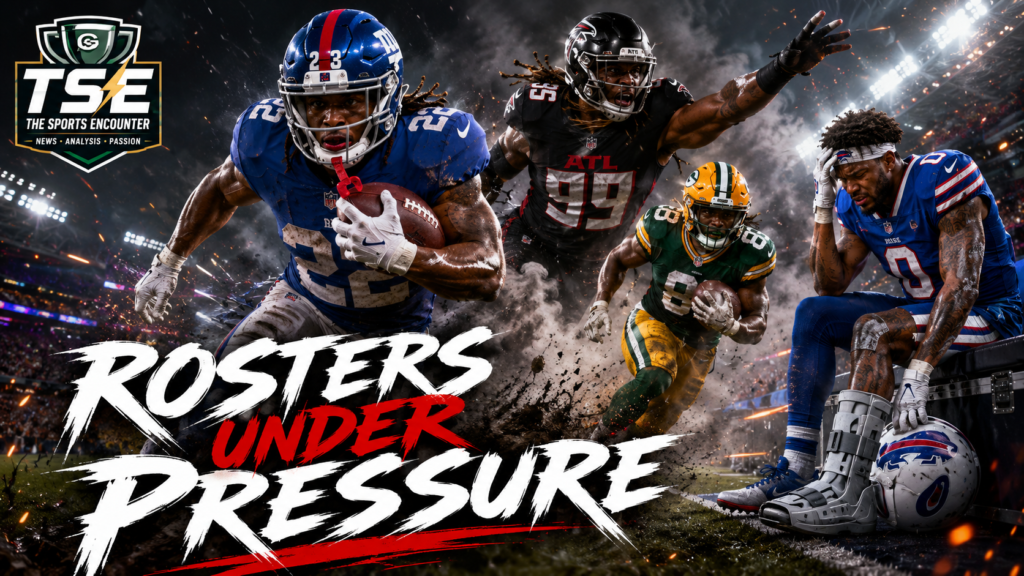
The final weeks before the 2026 NFL regular season are becoming less about evaluating depth charts and more about protecting them.
Across the league, injuries are already forcing teams into consequential roster decisions. The New England Patriots have responded to an offensive-line setback by signing veteran guard Greg Van Roten. The New York Giants are taking a calculated chance on former Pro Bowl running back Najee Harris. Atlanta has brought Za’Darius Smith out of retirement to reinforce an edge group already hit by suspension and a season-ending injury.
Elsewhere, the Chicago Bears are waiting on Kyle Monangai’s injured knee, Buffalo Bills receiver Keon Coleman is in a walking boot with a foot and toe sprain, while the Green Bay Packers finally received encouraging news with Josh Jacobs returning to practice.
None of these moves or injuries exists in isolation. With the regular season approaching, every lost starter, compromised backup and late veteran signing changes how coaches can build their Week 1 rosters.
NFL signings and injury update at a glance
| Team | Player | Development | Immediate impact |
|---|---|---|---|
| New England Patriots | Greg Van Roten | Signed one-year contract | Provides veteran guard and center depth after Ben Brown’s leg injury |
| New York Giants | Najee Harris | Signing one-year deal | Adds an experienced running back still working back from Achilles injury |
| Atlanta Falcons | Za’Darius Smith | Signed one-year deal | Reinforces depleted pass rush after Jalon Walker injury and James Pearce Jr. suspension |
| Chicago Bears | Kyle Monangai | Week-to-week with hyperextended knee | Availability for Week 1 now uncertain |
| Buffalo Bills | Keon Coleman | Foot/toe sprain, wearing walking boot | Creates another question around Buffalo’s receiving group |
| Green Bay Packers | Josh Jacobs | Returned to practice | Positive development after nearly two weeks out with groin injury |
Patriots turn to Greg Van Roten after Ben Brown injury
New England’s move for Greg Van Roten is a classic August signing driven by circumstance.
The Patriots agreed to a one-year, $3 million contract with the 36-year-old veteran guard, according to NFL Network. The deal can reportedly rise to $4.5 million through roster bonuses and playing-time incentives.
New England’s need increased when Ben Brown injured his leg during the Patriots’ 13-13 preseason tie against the Indianapolis Colts. Brown had been positioned as the primary reserve at both center and guard, making his absence more significant than that of an ordinary backup.
Head coach Mike Vrabel indicated Brown could miss several weeks and potentially up to two months. That timetable threatens his availability beyond the remainder of preseason and into the opening stretch of the regular season.
Van Roten gives New England something difficult to manufacture at this stage of the summer: experience and reliability.
He has appeared in 144 NFL games with 105 starts across stops with the Green Bay Packers, Carolina Panthers, New York Jets, Buffalo Bills, Las Vegas Raiders and New York Giants. He also spent two seasons in the CFL.
More importantly for a team trying to stabilize its interior line, Van Roten has proved remarkably durable late in his career. He played every offensive snap for the Giants across each of the past two seasons and has missed only one game over the past five years.
He also has experience playing both left and right guard.
That versatility is the real value of the signing. New England is not simply adding another body for preseason. The Patriots are buying insurance against one injury turning into an offensive-line rotation problem when the games begin to count.
The move follows a broader trend seen throughout The Sports Encounter’s NFL preseason coverage, with teams increasingly turning to experienced free agents when injuries expose areas where developmental depth may not be ready.
Najee Harris gives Giants experience, but there is a major condition
Najee Harris joining the New York Giants carries far more intrigue.
The 28-year-old running back is signing a one-year contract after working out for the Giants on Monday. Financial terms had not been disclosed at the time of publication.
On career production alone, Harris is an obvious addition.
The former Pittsburgh Steelers first-round pick rushed for more than 1,000 yards in each of his first four NFL seasons from 2021 through 2024 and made the Pro Bowl as a rookie.
Across 71 career games, he has rushed for 4,373 yards and 28 touchdowns while adding 183 receptions for 1,174 yards and another six scores.
The problem is that the Giants are not signing the healthy Pittsburgh version of Harris.
They are signing a player approximately 11 months removed from an Achilles injury and one who appeared in only three games for the Los Angeles Chargers last season.
Giants head coach John Harbaugh acknowledged that reality following Harris’ workout, indicating that the veteran is not yet fully back or in football condition.
That makes this less of a straightforward acquisition and more of a calculated rehabilitation bet.
New York does not necessarily need Harris to become an immediate workhorse. If he can recover enough explosiveness and conditioning to contribute as the season develops, his physical running style, pass-catching experience and ability to handle volume could give the Giants another useful option.
The timing is also interesting for Harris personally.
He played under Jim Harbaugh with the Chargers last season and now moves to a Giants team coached by Jim’s brother John.
Family connection aside, this move will ultimately be decided by Harris’ body rather than his résumé.
If the Achilles recovery progresses, the Giants may have found meaningful veteran depth on a low-risk contract. If it does not, the name recognition will matter very little.
Za’Darius Smith solves an immediate Falcons problem
Atlanta’s decision to sign Za’Darius Smith may be the most urgent of Tuesday’s roster moves.
The Falcons officially added the three-time Pro Bowl pass rusher on a one-year contract after he worked out for the team on Monday. The club did not disclose financial terms, although the deal has been reported at $6 million with incentives that could take it to $8 million.
Smith turns 34 in September and had announced his retirement in October 2025.
Normally, signing a veteran who recently retired would look like a depth move.
Atlanta’s circumstances make it considerably more important.
The Falcons have already lost Jalon Walker to a season-ending knee injury, a development The Sports Encounter covered when Walker’s torn ACL reshaped Atlanta’s defensive plans. James Pearce Jr. is also suspended for the first eight games of the season.
Suddenly, pass-rush depth has become one of Atlanta’s clearest roster vulnerabilities.
Smith brings 70.5 career sacks, 343 tackles and 10 forced fumbles across 145 games. At his peak with Green Bay, he recorded 13.5 sacks in 2019 and another 12.5 in 2020.
He is not being asked to recreate those numbers at 34.
Atlanta needs professional snaps, pocket pressure and someone capable of keeping opposing offensive lines honest while the defense navigates Walker’s absence and Pearce’s suspension.
There is also built-in familiarity.
Smith previously played for Falcons head coach Kevin Stefanski in Cleveland during the 2023 and 2024 seasons, reducing some of the uncertainty that normally accompanies adding a veteran this late in camp.
The Falcons officially confirmed Smith’s signing on Tuesday.
Atlanta’s defensive situation has already become one of the more important preseason roster stories in the NFC. Smith does not erase the loss of Walker, but he gives Stefanski an experienced solution instead of forcing younger players into roles they may not yet be ready to handle.
Kyle Monangai injury threatens one of Chicago’s strengths
Chicago’s concern centers on a player who quietly became an important part of the Bears’ offense during his rookie season.
Running back Kyle Monangai is considered week-to-week after hyperextending his right knee during Sunday’s practice.
Monangai was injured when he became tangled with defensive tackle Grady Jarrett during an 11-on-11 period. An MRI followed, and head coach Ben Johnson subsequently confirmed the week-to-week timetable.
That language is better than a season-threatening diagnosis, but the timing creates uncertainty around Chicago’s September 13 opener at Carolina.
Monangai rushed for 783 yards and five touchdowns in 17 games as a rookie last season, despite making only one start. He also caught 18 passes for another 164 yards.
Those numbers reveal why his status matters.
D’Andre Swift remains Chicago’s lead back, but Monangai gives the Bears a second runner capable of handling meaningful volume rather than functioning as an occasional replacement.
The pair showed how dangerous that combination could become last season. In Chicago’s November win over Philadelphia, Swift rushed for 125 yards while Monangai produced 130, making them the first Bears tandem since Walter Payton and Matt Suhey in 1985 to each exceed 100 rushing yards in the same game.
The Bears therefore are not merely monitoring the health of a reserve.
They are monitoring one half of a backfield combination that had begun to give their offense a genuine two-runner identity.
The latest setback also arrives after Chicago already dealt with another offensive injury concern earlier in camp, when Luther Burden III left practice with a leg injury during an earlier round of NFL training-camp developments.
Chicago has built enough offensive depth to absorb short absences. Losing Monangai for the opening weeks would still remove one of the better change-of-pace and workload-sharing options available to Johnson.
Keon Coleman walking boot creates a different kind of pressure in Buffalo
The sight of Keon Coleman wearing a walking boot at Bills practice immediately raised concern on Tuesday.
There is now more clarity about the injury.
NFL Network reported that Coleman sustained a sprained foot and toe during Buffalo’s 29-14 preseason victory over the Carolina Panthers.
He had three receptions for 17 yards and a touchdown in that game before the injury became apparent.
The Bills now have to determine how much preparation time he will lose and whether the problem threatens his availability when the regular season begins.
That would be significant for any starting receiver. It carries extra weight with Coleman because 2026 already shapes up as an important season in his development.
Buffalo selected him 33rd overall in the 2024 NFL Draft, but the physical tools have yet to translate into consistent production.
Last season, Coleman recorded 38 catches for 404 yards and four touchdowns in 13 games. Former head coach Sean McDermott held him out of four games, while disciplinary issues, including tardiness, also complicated his year.
Through two NFL seasons, Coleman has 67 receptions for 960 yards and eight touchdowns across 26 games.
The numbers are respectable but fall short of what Buffalo hoped it was getting near the top of the second round.
That makes every lost training-camp rep more meaningful.
Preseason is when receivers refine timing, route adjustments and trust with quarterbacks. A walking boot does not automatically signal a long absence, but even a relatively short interruption can matter when a player is still trying to establish himself as a consistent offensive piece.
Buffalo’s next updates will therefore matter less for the medical label itself and more for Coleman’s timetable.
Josh Jacobs finally gives Green Bay some good injury news
Not every development Tuesday moved in the wrong direction.
Green Bay Packers running back Josh Jacobs returned to practice after missing nearly two weeks because of a groin injury.
Head coach Matt LaFleur confirmed Jacobs would participate, giving Green Bay a valuable opportunity to rebuild his workload before the regular season.
The Packers have reason to be cautious.
Jacobs dealt with multiple physical issues last season while still rushing for 929 yards and 13 touchdowns in 15 starts. He added 36 catches for 282 yards and another score.
Those numbers reinforce his importance even in a season interrupted by injury.
Jacobs remains one of the league’s most accomplished active running backs. He led the NFL with 1,653 rushing yards for Las Vegas in 2022, earning first-team All-Pro honors, and has accumulated 7,803 rushing yards and 74 touchdowns during his career.
Green Bay therefore has little incentive to chase August production from him.
The priority is getting Jacobs healthy enough to carry the workload the Packers will need once the regular season arrives.
His return to practice represents progress, but how he responds over the following sessions will be more important than simply appearing on the field Tuesday.
These late signings show what NFL depth really means
There is a common thread connecting Van Roten, Harris and Smith.
All three are veterans. None represents a long-term franchise-building move. Each is being added because August has exposed a particular vulnerability.
New England lost critical interior-line depth and signed a guard with 105 career starts.
Atlanta lost Walker for the season, faces an eight-game suspension for Pearce and brought in a pass rusher with 70.5 career sacks.
The Giants looked at their running-back room and saw enough value in Harris’ experience to take a chance on his Achilles recovery.
This is what roster construction looks like once training camp moves beyond projections.
Teams spend the spring assembling ideal depth charts. Contact practices and preseason games then reveal whether those depth charts can survive reality.
San Francisco recently reached the same conclusion on the offensive line when the 49ers signed veteran tackle Kion Smith as injuries tested their depth.
By late August, the question is rarely whether a veteran free agent is a perfect fit.
It is whether he is more dependable than the alternative.
The overlooked factor: injuries are affecting roster architecture, not only availability
The natural way to follow preseason injuries is to ask whether a player will be ready for Week 1.
That misses part of the story.
An injury can change several roster decisions even when the injured player returns quickly.
Brown’s absence forced New England to spend money and a roster position on another veteran offensive lineman.
Walker’s ACL tear and Pearce’s suspension changed Atlanta’s acceptable level of risk at edge rusher.
Monangai’s knee problem could alter how Chicago distributes preseason carries and which running backs survive the final cuts.
Coleman’s injury creates more opportunities for other Buffalo receivers at exactly the point when roles are being finalized.
Jacobs returning, meanwhile, potentially allows Green Bay to stop protecting other backs purely because its starter is unavailable.
This is why August injuries matter even when they do not end seasons.
They reshape the roster around them.
Najee Harris may have the biggest upside, but also the biggest uncertainty
Among Tuesday’s acquisitions, Harris offers perhaps the widest range of possible outcomes.
If his Achilles recovery continues successfully, the Giants are adding a 28-year-old back who produced four consecutive 1,000-yard seasons before the injury.
That is substantial upside for a one-year commitment.
Yet Achilles injuries remain particularly relevant for running backs because their position depends on acceleration, deceleration and the ability to repeatedly generate force through contact.
Harbaugh’s acknowledgment that Harris is neither 100 percent nor fully conditioned is therefore important.
New York is not pretending this is a finished product.
The Giants are buying themselves the opportunity to find out what remains.
Za’Darius Smith may be the most immediately necessary signing
Harris has upside. Van Roten offers insurance.
Smith may be required immediately.
The Falcons cannot simply wait for Walker to recover because he will not play this season. They cannot accelerate Pearce’s return because his eight-game absence is imposed by suspension.
The pass rush therefore needed another credible NFL body before Week 1.
Smith knows Stefanski, understands professional preparation and has enough experience to contribute without requiring an entire offseason of development.
Atlanta already entered preseason with an intriguing quarterback situation, with Tua Tagovailoa getting the first preseason start while Michael Penix Jr. continued his ACL recovery.
Now the defensive side of the roster is dealing with its own uncertainty.
If Smith can provide even a productive rotational pass rush through the first half of the season, his signing could prove far more important than the modest contract suggests.
What to watch next
The names will attract attention, but the next developments matter more than Tuesday’s headlines.
- New England: How quickly can Van Roten learn the Patriots’ protection calls and where will he line up?
- New York: When can Harris participate fully, and how much explosiveness has returned after his Achilles injury?
- Atlanta: Is Smith ready for meaningful snaps after his brief retirement?
- Chicago: Can Monangai return in time for the September 13 opener against Carolina?
- Buffalo: How long will Coleman remain in the walking boot, and when can he resume football activity?
- Green Bay: Can Jacobs practice consistently without another groin setback?
Those answers will begin separating temporary preseason concerns from issues that could affect the first month of the regular season.
TSE analysis: August is becoming a test of roster resilience
The most revealing part of this latest round of NFL news is how quickly preseason plans are being rewritten.
The Patriots did not enter camp expecting to need Greg Van Roten. Atlanta did not intend to begin the season without Jalon Walker or spend half of it without James Pearce Jr. The Giants probably did not build their spring backfield around the assumption that Najee Harris would arrive in August still completing an Achilles comeback.
Yet this is where NFL roster depth becomes tangible.
The contenders that survive a 17-game season are rarely the teams whose original depth charts remain intact. They are the teams that identify weaknesses early, react without panic and find useful players before injuries become structural problems.
Green Bay will hope Jacobs’ return means one concern is already moving in the right direction.
Chicago and Buffalo are still waiting for clearer timelines.
New England, New York and Atlanta have chosen not to wait at all.
With the regular season approaching, preseason has entered the stage where every roster move has a consequence and every injury has the potential to change more than one player’s season.
Follow The Sports Encounter’s NFL coverage for preseason injuries, roster moves, depth-chart changes, game analysis and the major storylines shaping the 2026 season.