


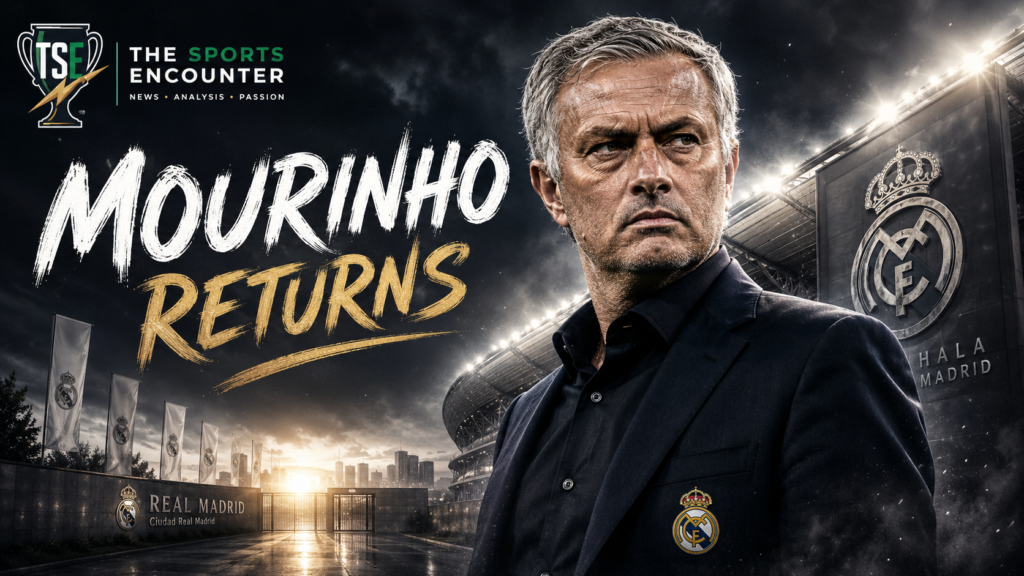
Real Madrid finally made José Mourinho’s return official on Tuesday, but the most revealing part of the occasion was not the contract, the photographs, or the familiar presence of Florentino Pérez alongside him.
It was how quietly Madrid chose to do it.
Mourinho signed a contract through June 2029 at Ciudad Real Madrid, with Pérez and honorary president José Martínez Pirri present, in a ceremony held away from supporters and the wider media circus that normally surrounds major appointments at the club.
For Real Madrid, understatement can sometimes say more than spectacle.
This was not a homecoming designed to celebrate the past. It was the formal beginning of a second Mourinho era carrying far more immediate pressure than nostalgia. Madrid have gone two consecutive seasons without a trophy, Pérez faces growing scrutiny, the squad has been heavily reinforced, and the club now expects its returning coach to turn investment into results.
Mourinho may be back home, as he described it, but there is very little room to hide.
Mourinho returns to a very different Real Madrid
Mourinho’s first spell from 2010 to 2013 belonged to another football era.
He arrived then as the reigning Champions League winner with Inter Milan, facing a Barcelona side built around Lionel Messi, Xavi, Andrés Iniesta, Sergio Busquets and a footballing identity that had become the dominant force in Spain and Europe.
Madrid needed someone capable of challenging that dominance psychologically as much as tactically. Mourinho did it.
His team won the 2010-11 Copa del Rey, then produced a historic 100-point LaLiga campaign in 2011-12 before adding the Spanish Super Cup. His Madrid scored heavily, counterattacked brutally and refused to accept Barcelona’s superiority as inevitable.
The period was also combustible. Relationships deteriorated, confrontations became regular, and Mourinho eventually left after three intense seasons.
More than a decade later, Madrid are not asking him to fight the same war.
They are asking him to restore standards.
The closed-door presentation felt deliberate
Real Madrid are usually comfortable turning major arrivals into events. Mourinho’s formal presentation was different.
The club kept the occasion private even though few managerial appointments in European football carry more public interest than Mourinho returning to the Bernabéu.
That choice fits the wider mood surrounding Madrid entering the 2026-27 season.
There has already been plenty of noise. Mourinho’s comeback has been discussed for weeks. The club has undergone one of its most significant summer rebuilds in years. Major players have arrived, established stars have been secured, and expectations have risen with every move.
Another extravagant unveiling would have added little.
Madrid need football now.
Mourinho appeared to understand that distinction when speaking to the club’s own media after signing his contract. He described the return as emotionally stronger than his first arrival and spoke about the responsibility attached to representing Real Madrid.
Those words matter because the Mourinho of 2026 cannot survive on the reputation built by the Mourinho of 2010.
Real Madrid have given Mourinho a squad built to win now
The strongest reason there are few excuses available to Mourinho is the squad Madrid have assembled around him.
The club has strengthened almost every major area.
Marc Cucurella was one of Mourinho’s first significant reinforcements, giving Madrid additional aggression, movement and tactical flexibility on the left.
Ibrahima Konaté has arrived to strengthen central defense, while Denzel Dumfries provides power and attacking range from the opposite flank.
Bernardo Silva adds another layer of intelligence and control to midfield, particularly in matches where Madrid need possession rather than transition.
Then came one of the summer’s biggest moves.
Real Madrid completed the €125 million signing of Yan Diomande, another clear indication that the club is investing for immediate success rather than entering a cautious rebuilding cycle.
Madrid also removed uncertainty surrounding one of their most important attacking players when Vinícius Júnior agreed a contract extension through 2032.
That renewal mattered after months in which Vinícius had become one of football’s biggest transfer stories, with speculation surrounding his future creating an unnecessary distraction around the club.
The message entering Mourinho’s first competitive season is difficult to misread.
Madrid have backed him.
This cannot become a long rebuilding project
Many managers arrive at elite clubs asking for patience.
Mourinho does not have that luxury.
He has inherited a squad containing established world-class talent alongside expensive new additions. Several positional weaknesses have already been addressed. The club has secured important contracts and given him preseason preparation time.
That changes how his work will be judged.
Madrid supporters will not necessarily demand perfection in August, but they will expect evidence of direction almost immediately.
Does the team defend transitions better?
Does the midfield control difficult matches more consistently?
Can Madrid press as a collective rather than through individual bursts?
Can Mourinho create clear roles for a squad containing several players who naturally want the ball?
Can he turn enormous attacking talent into a coherent system rather than a collection of brilliant individuals?
Those questions will matter long before the trophies are handed out.
Preseason offered some encouraging early signs
Mourinho has already been working with the squad since preseason began in July, meaning Tuesday’s presentation was administrative confirmation rather than the real beginning of his second spell.
The competitive work has been underway for weeks.
Madrid completed their preparations with a convincing win over Schalke 04 in Germany, a useful final examination before LaLiga begins. Konaté and Cucurella both collected important minutes as Mourinho continued integrating the new arrivals.
The result followed other encouraging preseason performances, including Madrid’s victory over Deportivo in the Teresa Herrera Trophy.
Preseason results should never be exaggerated, particularly at a club judged almost exclusively by what happens in competitive football, but there is value in Mourinho entering the league campaign with several weeks of tactical work already completed.
He will need that preparation immediately.
Espanyol provides the first real test
Mourinho’s second competitive era begins away from the Bernabéu.
Real Madrid face Espanyol at the RCDE Stadium on Saturday, August 22, in what will be their first league match of the campaign after their original opening fixture was rearranged.
The official Real Madrid schedule lists the Espanyol match as Madrid’s first competitive fixture of the new season.
On paper, Mourinho will be expected to win.
In reality, the match offers something more useful than three points. It provides the first glimpse of what this Madrid side intends to become.
That matters because Mourinho’s best teams have historically possessed a recognizable competitive identity very quickly. Opponents understood where the danger came from. Players understood their responsibilities. Matches usually had a clear tactical logic.
Modern Real Madrid cannot simply recreate his 2011-12 formula. The squad is different, football has evolved, pressing structures have changed and Madrid now possess players whose strengths demand a more flexible approach.
The challenge is not whether Mourinho can rebuild his old Madrid.
It is whether he can build a new one.
Mourinho’s own record makes the pressure greater
The return also places Mourinho’s recent career under the microscope.
He remains one of the defining managers of the modern era, with league titles in England, Spain, Italy and Portugal, two Champions League triumphs and an extraordinary collection of domestic and European honors.
Yet reputation and recent momentum are not the same thing.
Mourinho returns to Madrid after years in which his career has included strong individual periods but fewer major league successes than during his peak years. He has now gone more than a decade without winning a domestic league title.
That is precisely why this job is so compelling.
If Mourinho succeeds, the story becomes much larger than a famous manager returning to a former club. It would represent one of the most significant late-career reinventions in modern coaching.
If he fails, Madrid will have to confront an uncomfortable question about whether they attempted to solve a contemporary football problem by turning toward their own past.
Florentino Pérez is taking a gamble too
Mourinho will receive most of the attention, but Florentino Pérez has attached his own credibility to this appointment.
Bringing Mourinho back is not a conservative decision.
There were safer managerial options available. There were younger coaches, less polarizing personalities and appointments that would have generated fewer headlines.
Pérez chose familiarity combined with confrontation, experience and authority.
That suggests Madrid’s hierarchy believes the squad requires more than tactical improvement. It may also need stronger accountability.
Mourinho emphasized precisely that during his return, speaking about creating a culture built around hard work, responsibility and ambition.
Those ideas sound obvious at a club such as Real Madrid. Implementing them inside a dressing room filled with major personalities is considerably harder.
The biggest question is whether Mourinho has evolved
Mourinho’s tactical intelligence has never really been the issue.
The more important question concerns adaptation.
His greatest teams were shaped around outstanding organization, control of space, transition efficiency, emotional intensity and an ability to make players fully commit to a collective purpose.
Some elements remain completely relevant in 2026.
Others require adjustment.
The elite European game increasingly rewards teams capable of controlling possession, pressing high, defending large spaces and rotating positions without losing structure. Madrid also possess attacking players who are most dangerous when given freedom rather than locked into rigid patterns.
Mourinho therefore faces a balancing act.
Too little structure and Madrid risk repeating previous inconsistencies. Too much control and he risks limiting some of the most gifted players in world football.
The successful version probably sits somewhere between the two.
Real Madrid need more than Mourinho nostalgia
There will inevitably be memories of 2010.
Supporters will remember the record-breaking league season, the battles with Barcelona, Cristiano Ronaldo scoring relentlessly, Mourinho sprinting down touchlines, and a team that seemed permanently charged by confrontation.
Those memories belong where they belong.
In history.
This Madrid team cannot live through them.
Mourinho’s second spell should ultimately be judged by whether he can solve the current side’s problems, integrate the summer signings, restore competitive consistency and return trophies to the Bernabéu.
That is why Tuesday’s quiet presentation felt appropriate.
The ceremony lasted a short time. The emotional reunion was acknowledged. The photographs were taken.
Now comes the difficult part.
TSE analysis: Madrid have removed most of Mourinho’s excuses
The overlooked part of Mourinho’s return is how aggressively Real Madrid have reduced the number of explanations available if things go wrong.
The squad has been reinforced.
Major positional needs have been addressed.
Vinícius Júnior’s future has been secured.
Mourinho has had preseason time with the team.
The club has publicly committed to him through 2029.
There will still be injuries, tactical problems, difficult opponents and moments where adaptation takes time. No football project develops perfectly.
But Madrid have not appointed Mourinho to manage decline or supervise transition.
They have appointed him to win.
His first era at Real Madrid was defined partly by a battle against perhaps the greatest Barcelona team ever assembled. His second begins under very different circumstances. This time, the biggest argument will not be about what stands across the field.
It will be about what Mourinho can build with what he has been given.
The Special One has returned to Madrid.
The welcome is over.
Now there is nowhere to hide.