


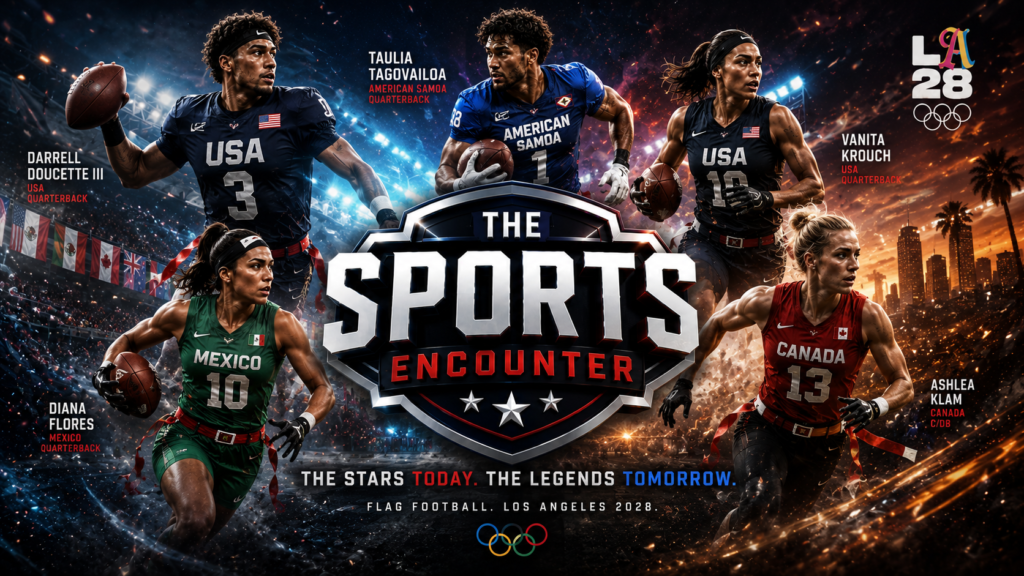
NFL stars will bring attention to Olympic flag football.
The players already inside the sport are giving it an identity.
That distinction became much clearer at the 2026 IFAF Flag Football World Championships in Düsseldorf.
The United States men’s team recovered from a historic group-stage defeat to win another world championship. Canada’s women ended the American title run. Mexico secured an Olympic place in the women’s competition. Italy reached the men’s final. American Samoa produced the result that shook the tournament when Taulia Tagovailoa threw five touchdown passes in a 38-32 victory over Team USA.
Suddenly, the road to Los Angeles 2028 has faces attached to it.
Some are established flag football champions. Others arrived through tackle football. Several have spent years playing a version of football that much of the wider sports audience is only beginning to understand.
That matters because the Olympic conversation will increasingly attract NFL names over the next two years.
Fans should know the flag football names too.
This fifth article in The Sports Encounter’s Flag Football LA28 series introduces some of the athletes who are already shaping the sport before its Olympic debut.
Flag Football Players to Know on the Road to LA28
| Player | Country | Position/Role | Why Fans Should Know Them |
|---|---|---|---|
| Darrell “Housh” Doucette III | United States | QB/Athlete | Multiple-time world champion and face of the dominant U.S. men’s program |
| Vanita Krouch | United States | QB | Quarterback of the U.S. women’s dynasty entering the 2026 cycle |
| Ashlea Klam | United States | C/DB | Versatile two-way player representing the new generation of U.S. flag talent |
| Diana Flores | Mexico | QB | One of flag football’s most recognizable global ambassadors |
| Taulia Tagovailoa | American Samoa | QB | Threw five TDs in the historic 38-32 upset of Team USA |
| Chihiro Iwata | Japan | QB | Key figure in Japan’s technically strong women’s program |
| Italy’s emerging men’s core | Italy | Multiple | European champions who reached the 2026 world final |
| Canada’s championship generation | Canada | Multiple | Women’s world champions and men’s bronze medalists in Düsseldorf |
The list will evolve before 2028.
That is part of the attraction.
Olympic flag football does not yet have a settled global celebrity hierarchy. The next two years will help create one.
Darrell Doucette Has Already Built the Résumé NFL Stars Will Be Chasing
Any discussion about current men’s flag football should begin with Darrell “Housh” Doucette III.
Doucette is not waiting for the Olympics to validate his career.
He has already quarterbacked the United States at the highest level of international flag football and helped establish the American men as the sport’s dominant national program.
USA Football lists him as a quarterback and athlete from New Orleans. He was already a two-time world champion before the 2026 cycle, and the U.S. men’s team had won six of the previous seven world championships entering Düsseldorf.
That résumé matters as NFL players begin looking toward LA28.
The assumption that professional tackle-football players will automatically move ahead of established flag specialists ignores what players such as Doucette have spent years learning.
Five-on-five spacing.
Flag-specific timing.
International rules.
Compressed throwing windows.
Short-field decision-making.
Tournament chemistry.
The Sports Encounter examined those differences in our comparison of NFL football and Olympic flag football. The two games share the football, end zones and passing concepts, but the decisions happen differently.
Doucette already speaks that language.
Why Doucette Could Become the Center of America’s Biggest Selection Debate
The United States has an unusual Olympic problem.
It possesses the deepest pool of tackle-football talent on Earth.
It also possesses the strongest established men’s flag football program.
NFL participation creates obvious possibilities.
An elite professional quarterback brings extraordinary arm talent, processing experience and athleticism. Yet Olympic flag football offers only 10 roster places, making every selection consequential.
Doucette represents the other side of that decision.
He has already won world championships in the format.
USA Football’s 2026 roster listed him alongside another quarterback, Nico Casares, within a team dominated by athletes capable of playing multiple positions.
That versatility reflects what Olympic roster construction demands.
The eventual question may not be whether an NFL quarterback is talented enough for Team USA.
Of course he is.
Selectors must determine whether replacing an experienced championship quarterback actually improves the team.
Taulia Tagovailoa Changed His Flag Football Story in One Afternoon
Taulia Tagovailoa arrived in Düsseldorf with a surname football fans already recognized.
He left with a result that belonged entirely to him.
American Samoa defeated the United States 38-32 during the group stage, ending America’s 14-year unbeaten run in World Championship competition.
Tagovailoa completed 29 of 36 passes for 213 yards and five touchdowns.
Those numbers explain the performance.
The opponent explains its importance.
Team USA had dominated international men’s flag football for more than a decade. American Samoa had never occupied the same place in the global hierarchy.
For one game, none of that mattered.
Tagovailoa repeatedly solved the American defense and gave the Olympic cycle its first truly disruptive individual performance.
Taulia Tagovailoa Gives Flag Football a Familiar Bridge
Tagovailoa also offers the sport something commercially useful.
Recognition.
He is the younger brother of NFL quarterback Tua Tagovailoa and played college tackle football at Alabama and Maryland before pursuing professional opportunities.
That background gives casual football fans an immediate point of entry.
His Düsseldorf performance then does the rest.
He is not interesting to the flag football audience simply because of his brother.
He became interesting because he beat Team USA.
That difference is important.
Olympic flag football will inevitably use NFL familiarity to attract new viewers. Players such as Tagovailoa can help bridge the two football worlds without making the international game feel like an NFL exhibition.
Diana Flores Was a Flag Football Star Before LA28 Had a Tournament
Few athletes have done more to put a recognizable face on women’s flag football than Diana Flores.
The Mexican quarterback became one of the sport’s leading international ambassadors well before Olympic qualification began.
Mexico’s competitive record gives that visibility substance.
The Mexican women won the 2025 World Games and entered Düsseldorf among the leading teams in the world. They then secured an Olympic quota by reaching the medal stage and defeated Great Britain 20-19 for bronze.
Flores has been central to Mexico’s rise and to flag football’s broader public profile.
That combination makes her particularly important to LA28.
Olympic sports need great competitors.
New Olympic sports also benefit enormously from athletes who can explain why people should care.
Flores has been doing both.
Mexico’s Olympic Qualification Gives Flores a Bigger Stage
The bronze medal in Düsseldorf carried more value than its color suggested.
Mexico secured its place at Los Angeles 2028.
That means one of women’s flag football’s most recognizable athletes now has a national-team pathway to the sport’s first Olympic tournament.
For Mexico, the opportunity is substantial.
The women’s team has already demonstrated that it can beat the United States in major international competition, including its gold-medal run at the 2025 World Games.
Canada’s world championship victory in Düsseldorf has made the women’s hierarchy even more interesting.
Mexico now enters the next phase with a recent major title, a World Championship medal and Olympic qualification.
Flores will remain one of the players around whom that story develops.
Vanita Krouch Has Been at the Center of an American Dynasty
The 2026 World Championship ended painfully for the U.S. women.
Canada won the final 27-20 and prevented the Americans from claiming a fourth consecutive title.
That defeat should not erase what came before it.
Quarterback Vanita Krouch has been one of the central figures in the American women’s rise.
USA Football reported that its women’s national team had compiled a 33-1 record dating back to the 2018 IFAF World Championships under Krouch before the latest cycle. She entered 2026 as a three-time world champion.
That kind of sustained success makes her one of the defining players of the pre-Olympic era.
LA28, however, creates a new challenge.
The United States is no longer entering the next major championship as reigning women’s world champion.
Canada took that status in Düsseldorf.
Krouch Now Faces a Different Kind of Road to Los Angeles
Dominance creates one form of pressure.
Responding to defeat creates another.
The U.S. women now have two years to study what happened against Canada while continuing to manage competition for Olympic roster places.
USA Football’s initial 2026 player pool showed how deep that competition has become.
Krouch was joined by quarterbacks Valentina Fanetti and Akemi Higa among a 24-athlete initial roster before the team was reduced for Düsseldorf.
That depth is healthy for the program.
It also means nobody should assume that previous championships guarantee an Olympic place.
Krouch’s experience gives her a powerful case.
The selection process will ultimately decide whether she gets the chance to add an Olympic chapter.
Ashlea Klam Represents Where Women’s Flag Football Is Going
Ashlea Klam is worth watching for a different reason.
She represents the generation growing alongside flag football’s rapid expansion.
USA Football lists Klam as a center and defensive back, exactly the kind of positional flexibility that becomes valuable in five-on-five football.
Olympic rosters will contain only 10 athletes.
That makes versatility more than a useful extra.
It can become a selection advantage.
A player capable of contributing on both sides of the ball gives coaches more tactical combinations without consuming another roster place.
Klam’s profile also illustrates why comparing flag football positions directly with NFL positions can be misleading.
A “center” in flag football does not occupy the same physical or tactical role as an NFL center.
The body type is different.
The movement demands are different.
The player may become a receiving option immediately after snapping the ball.
Watching players such as Klam helps new fans understand the sport on its own terms.
Chihiro Iwata Gives Japan a Player Around Whom to Build
Japan did not leave Düsseldorf with the headline result it wanted, but its women’s program remains one of Asia’s most important flag football projects.
Quarterback Chihiro Iwata entered the World Championship cycle as one of the country’s leading players, with Japan positioned among the highly ranked women’s programs internationally.
Japan matters to the Olympic story for reasons extending beyond one tournament.
Flag football’s future depends on whether it can establish genuine competitive depth outside North America.
A technically sophisticated Japanese program gives Asia a potential medal-level pathway.
The next qualification stages will show whether that promise can become an Olympic berth.
For Iwata, that means the road to Los Angeles remains unfinished.
Canada’s Biggest Star May Be the Team Itself
Canada created an interesting editorial problem in Düsseldorf.
Which individual should receive the headline?
The women’s team beat the United States 27-20 to become world champion.
The men’s team took bronze.
Both Canadian teams secured Olympic qualification for LA28.
The easiest response would be to force one player into a superstar narrative.
The more accurate response is to recognize what Canada has built collectively.
Its women arrived in Düsseldorf ranked behind several prominent rivals and left as world champions.
That result ended a 12-year wait for another Canadian women’s world title and placed Canada alongside the United States at the top of the historical women’s championship count.
Over the next two years, individual Canadian names will become more familiar internationally.
For now, the team’s strength is part of the story.
Italy’s Men’s Team Has Created Its Own Olympic Audition
Italy entered the 2026 cycle with credibility.
The Italians won the 2025 European men’s championship by defeating Austria 27-19.
Düsseldorf showed that European success could travel.
Italy reached the World Championship final before losing 46-26 to the United States.
That result did two things.
It established Italy as a genuine global contender and gave its players experience against the standard every men’s program is chasing.
The next step is individual recognition.
If Italy continues producing results through the Olympic cycle, several of its players should move from European flag football names to athletes followed by a much larger global audience.
That transformation is exactly what Olympic inclusion can do for a developing sport.
The NFL Names Are Coming, but They Should Not Own the Story
The temptation over the next two years will be enormous.
Every time a prominent NFL quarterback, receiver or defensive back expresses interest in LA28, the headline will travel.
That attention helps flag football.
It can also distort the sport.
The Olympic tournament is not being created from scratch for NFL players.
International flag football already has champions, rivalries, specialists, systems and athletes who have invested years in the format.
Doucette has won world titles.
Flores has helped turn Mexico into a women’s power.
Krouch helped quarterback an American dynasty.
Canada just became women’s world champion.
Tagovailoa has already produced one of the most important upsets of the Olympic cycle.
Those stories deserve to survive the arrival of celebrity.
Why Specialists Could Become More Valuable as LA28 Gets Closer
The closer teams get to the Olympics, the less useful theoretical talent becomes.
Coaches need combinations that work.
A receiver may be exceptionally fast, but can that player understand spacing within the international format?
A quarterback may have an NFL-caliber arm, but can he process the flag rush and release the ball within the required rhythm?
A defensive back may have elite coverage ability, but can that player consistently pull flags without relying on contact?
Established specialists already possess answers to many of those questions.
That does not mean crossover athletes cannot overtake them.
It means they have to earn it.
TSE Analysis: Flag Football Needs Its Own Stars Before the NFL Arrives
The biggest opportunity facing Olympic flag football is also one of its biggest risks.
NFL involvement can make the sport enormous.
Famous players bring television audiences, sponsors, social-media attention and curiosity.
But a new Olympic sport becomes stronger when viewers discover athletes they did not already know.
That is what Düsseldorf began to provide.
Someone who watched American Samoa beat the United States now knows Taulia Tagovailoa for something beyond his surname.
Someone following Mexico’s Olympic qualification encounters Diana Flores within a national program capable of winning medals.
Anyone studying American dominance eventually reaches Darrell Doucette and Vanita Krouch.
Canada’s championship creates an entirely new group of athletes for fans to discover.
By 2028, those names should not require introductions.
The Women’s Game Could Produce the First True Global Flag Football Superstars
Women’s flag football deserves particular attention here.
There is no NFL equivalent dominating its talent narrative.
That gives the women’s Olympic competition room to build stars entirely through flag football.
Flores already has international visibility.
Krouch carries championship history.
Klam belongs to a younger American generation.
Canada now owns the world title.
Mexico owns recent World Games success.
Japan, Great Britain, Germany and other programs continue developing.
If LA28 produces a close women’s gold-medal game in front of a large global audience, the athletes who decide it could become the first generation of flag football players known primarily because of Olympic performance.
That would represent a major step for the sport.
Düsseldorf Was the Beginning of the Olympic Audition
The 2026 World Championships settled medals and Olympic quota places.
They also created evidence.
Coaches saw who handled pressure.
Selectors saw which athletes could perform against elite opposition.
Fans saw new personalities.
Opponents collected film.
Every major tournament between now and Los Angeles will add another layer.
Some of today’s stars will make Olympic rosters.
Some will lose their places to emerging players.
NFL athletes will enter the U.S. selection conversation.
New international names will appear during continental competition and the final qualification process.
That uncertainty should make the next two years fascinating.
Frequently Asked Questions
Who is Darrell “Housh” Doucette?
Darrell Doucette III is a United States flag football quarterback and athlete who has helped Team USA win multiple men’s world championships. USA Football lists him as one of the leading quarterbacks in its national program.
Who is Diana Flores?
Diana Flores is a Mexican flag football quarterback and one of the sport’s most prominent international ambassadors. She has helped Mexico establish itself among the leading women’s national teams.
Who is Taulia Tagovailoa?
Taulia Tagovailoa is a former Alabama and Maryland college quarterback who represented American Samoa at the 2026 Flag Football World Championships. He threw five touchdown passes as American Samoa beat the United States 38-32.
Who is Vanita Krouch?
Vanita Krouch is a U.S. women’s flag football quarterback and three-time world champion who has played a central role in Team USA’s recent international success.
Who is Ashlea Klam?
Ashlea Klam is a U.S. flag football player listed by USA Football as a center and defensive back. Her two-way versatility reflects the type of skill set that can become particularly valuable on small Olympic rosters.
Which countries have already qualified for LA28 flag football?
The United States is qualified as host. The 2026 World Championships also produced Olympic quota places, with Canada qualifying both its men’s and women’s teams, while other World Championship results determined additional qualifiers under the LA28 qualification system.
Will NFL players compete at LA28?
NFL players are permitted to pursue Olympic participation, but they still have to satisfy the relevant national selection process. Their eligibility does not guarantee selection.
Will current flag football stars automatically make the Olympics?
No. National federations will select their Olympic rosters under their respective procedures. Previous international success strengthens a player’s case but does not guarantee an LA28 place.
Remember These Names, Then Expect More
Two years before flag football’s Olympic debut, the sport is still introducing itself to much of the world.
That will change quickly.
Doucette has championship history.
Flores has helped carry women’s flag football into a wider public conversation.
Krouch has been part of an American dynasty.
Klam represents a generation developing with the Olympic opportunity already visible.
Tagovailoa produced the upset that told everyone Team USA could be beaten.
Canada has created an entire championship team worth discovering.
Italy has turned European progress into a world final.
There will be more.
That may be the most exciting part of this Olympic cycle.
Los Angeles will eventually give flag football its first Olympic medalists.
The journey there is giving the sport its first truly global generation of stars.