


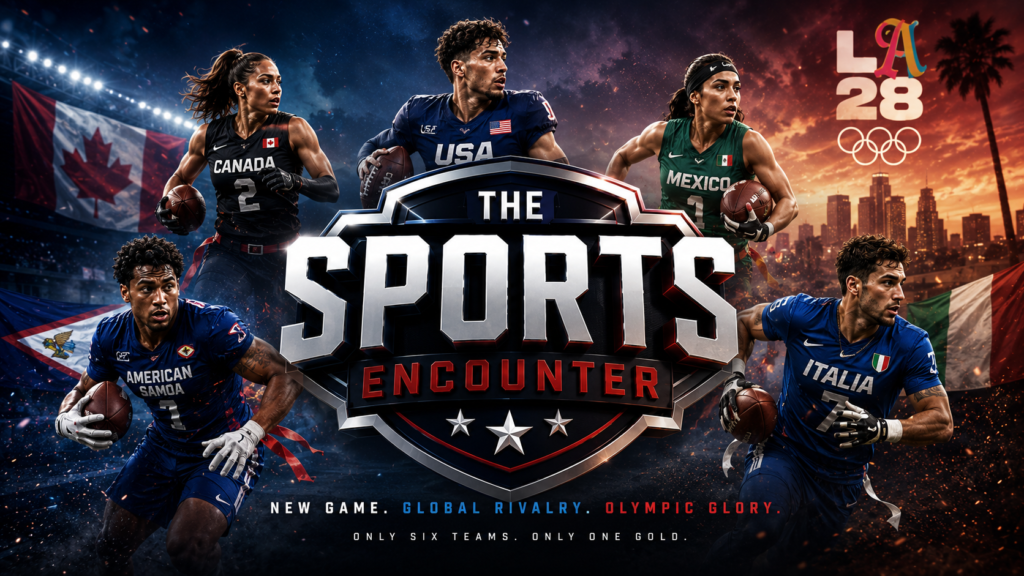
For anyone who assumed the first Olympic flag football gold medals were already destined for the United States, Düsseldorf delivered a warning.
The American men are still world champions. They survived an extraordinary tournament, beat Italy 46-26 in the final and will arrive at Los Angeles 2028 carrying the strongest pedigree in men’s international flag football.
The American women will arrive with a different memory.
Canada beat the defending world champions 27-20 in the women’s final of the 2026 IFAF Flag Football World Championships, taking gold and providing the clearest evidence yet that the United States can be beaten when Olympic medals are eventually at stake.
There were warning signs elsewhere.
American Samoa stunned the U.S. men 38-32 in group play. Mexico pushed them to within two points in the men’s semifinal. Italy reached the men’s world championship game. Canada took men’s bronze. Mexico finished third in the women’s competition.
Flag football’s Olympic debut suddenly looks less predictable.
That matters because LA28 will feature only six men’s teams and six women’s teams. There will be little room for weak opposition, easy preliminary games or slow starts.
The United States will have home advantage and an extraordinary athlete pool, potentially including NFL players.
It will also have opponents who have already demonstrated that the American flag can be pulled.
The LA28 Contender Picture After Düsseldorf
| Team | Competition | Düsseldorf 2026 Result | Why They Matter |
|---|---|---|---|
| United States | Men | Gold | Five consecutive world titles |
| Italy | Men | Silver | Reached world final and earned LA28 qualification |
| Canada | Men | Bronze | Beat Mexico for bronze and secured an Olympic berth |
| Mexico | Men | Fourth | Lost 42-40 to USA in semifinal |
| American Samoa | Men | Fifth | Beat USA 38-32 in group play |
| Canada | Women | Gold | Beat USA 27-20 in world final |
| United States | Women | Silver | Three-time defending champions entering Düsseldorf |
| Mexico | Women | Bronze | Established international power |
| Great Britain | Women | Fourth | Reached world semifinals |
| Germany | Women | Fifth | Lost only 35-34 to USA in knockout play |
The results tell us something the rankings alone could not.
The gap is narrowing.
Canada Has Already Answered the Question
If the question is whether someone can beat Team USA in elite women’s flag football, there is no longer anything hypothetical about the answer.
Canada just did it.
And it happened in the biggest international game before the Olympic cycle moves toward Los Angeles.
The Canadians defeated the United States 27-20 in the Düsseldorf gold-medal game, ending the Americans’ run of three consecutive women’s world championships.
That result immediately changes the LA28 conversation.
Canada is no longer simply one of several countries capable of troubling the United States.
It is the reigning world champion.
Why Canada’s Victory Matters Beyond One Final
International flag football can produce volatile results because possessions are limited, scoring happens quickly and one defensive takeaway can alter an entire game.
It would therefore be easy to dismiss an upset as one bad American performance.
Canada’s broader record makes that explanation harder to sustain.
The Canadian women won bronze at the 2025 World Games in Chengdu. Mexico won that tournament, while the United States finished second.
One year later, Canada climbed another two places and became world champion.
That progression suggests development rather than accident.
Canada now possesses something every future opponent wants before facing Team USA: proof.
Its players know the Americans can be beaten in a championship game.
Mexico Remains a Serious Women’s Threat
Canada’s rise should not erase Mexico from the conversation.
Mexico won women’s gold at the 2025 World Games, completing the tournament unbeaten at 6-0. The United States took silver and Canada bronze.
At Düsseldorf, Mexico reached the semifinals before eventually taking bronze.
Put those results together and the women’s international hierarchy looks increasingly competitive.
The United States has championship history.
Canada has the current world title.
Mexico has recent World Games gold.
That is already enough to make the LA28 women’s competition one of the most intriguing tournaments on the Olympic program.
The U.S. Women Nearly Went Out Before the Final
Canada was not the only team that exposed American vulnerability.
Germany came within a single point of eliminating the United States earlier in the tournament.
The Americans escaped their knockout meeting 35-34.
Then Great Britain pushed Team USA in the semifinal before losing 27-21.
Neither result looks particularly alarming in isolation.
Together with the Canadian defeat, they show that several international programs can remain within one possession of the Americans.
That is significant in five-on-five football.
One interception, one failed conversion or one missed flag can decide a game.
At LA28, there may be no opportunity to recover from that mistake.
The American Men Survived Their Own Warning
The men’s tournament produced an even more startling result.
American Samoa beat the United States 38-32 during group play.
It was not enough to stop the Americans from winning another world championship.
It was enough to destroy the idea of invincibility.
Team USA responded like a champion.
The Americans beat Australia 40-7, survived Japan 45-38 in the playoffs, edged Mexico 42-40 in the semifinal and then defeated Italy 46-26 for gold.
The recovery reinforced America’s status as the men’s benchmark.
The route to the trophy, however, was far less comfortable than the final score might suggest.
American Samoa Produced the Tournament’s Biggest Warning
American Samoa’s victory deserves more than a footnote.
The United States had entered Düsseldorf having dominated men’s international flag football for more than a decade.
American Samoa broke through anyway.
Taulia Tagovailoa led the upset as the island nation defeated Team USA 38-32. The result ended a U.S. competitive winning run stretching back to 2012.
American Samoa ultimately finished fifth, which makes the result even more interesting.
The team that beat the world champion did not even reach the medal podium.
That tells us something about the depth developing underneath the established powers.
Italy Has Earned Its Place in the Olympic Conversation
Italy’s run to the men’s final may prove to be one of the most important developments of Düsseldorf.
The Italians did more than win a silver medal.
They demonstrated that a European program can navigate a world championship field and reach the final against the United States.
The 46-26 championship defeat showed that a gap remains.
But reaching the final matters enormously.
Italy has now experienced the pressure of playing Team USA for a world title.
That experience cannot be replicated in training.
With two years remaining before LA28, Italy has time to study exactly where that final was lost and build around a team that already knows it can reach the biggest stage.
Mexico Came Within Two Points of the U.S. Men
The closest call in America’s knockout run came against Mexico.
Team USA won the semifinal 42-40.
Two points.
That is the difference between playing for a world championship and playing for bronze.
For Mexico, the result will hurt.
For the rest of the international field, it provides evidence.
The United States can be forced into a possession-by-possession fight.
An Olympic tournament with only six teams makes that particularly dangerous.
There will be fewer opportunities for a dominant nation to build rhythm against weaker opposition.
Canada Is Building on Both Sides of the Game
No country improved its LA28 position more dramatically in Düsseldorf than Canada.
The women became world champions.
The men won bronze.
That makes Canada one of the few countries that can enter the Olympic cycle with genuine medal expectations in both competitions.
The men’s bronze also came under considerable pressure.
Canada defeated Mexico 34-26 to claim third place, strengthening its position among the world’s leading programs.
When the sport arrives in Los Angeles, Canada’s presence should no longer be treated as an underdog story.
It is becoming part of the establishment.
Japan Remains More Dangerous Than Its Finish Suggests
Japan finished sixth in the men’s standings, but the number that matters is 45-38.
That was the score of Japan’s playoff defeat against the United States.
Seven points separated the teams.
Flag football rewards technical precision, timing and disciplined spacing, qualities that have helped Japan become competitive across several international sports that require speed and tactical coordination.
Japan did not leave Düsseldorf with a medal.
It did leave with evidence that it can stay within striking distance of the world’s best men’s team.
Two years of development can change a great deal.
Why LA28 Could Be Harder Than Düsseldorf for Team USA
The United States will possess one enormous advantage in Los Angeles.
Home support.
It may also possess another advantage that no international opponent can realistically replicate: access to the NFL’s talent pool.
NFL owners approved a framework allowing league players to pursue Olympic participation, creating the possibility of elite quarterbacks, receivers and defensive backs joining Team USA.
The Sports Encounter explored that transition in our previous analysis of flag football versus NFL football, because selecting famous NFL players will not automatically create the strongest Olympic team.
Düsseldorf strengthens that argument.
Team USA’s established flag specialists just won another men’s world title.
Replacing too many of them with newcomers would carry risk.
The U.S. women, meanwhile, have just discovered how small the margin has become internationally.
NFL Talent Could Raise the Ceiling and Disrupt the Chemistry
Imagine adding an elite NFL receiver to a world championship flag offense.
The athletic upside is obvious.
Now consider the other side.
That receiver needs to understand five-on-five spacing, compressed timing, flag-specific movement, unfamiliar formations and teammates with whom he may have relatively little competitive experience.
The Olympic roster contains only 10 players.
Every selection matters.
USA Football’s preliminary Olympic selection notice says athletes being considered for LA28 may be evaluated through events including the 2026 World Championships, the 2027 Americas Continental Championships and 2028 trials and training camps.
That indicates the Olympic roster will emerge through a process, not simply an NFL popularity contest.
Düsseldorf should make selectors even more protective of international flag experience.
Men’s Contenders: The Emerging LA28 Hierarchy
United States
Still the team everyone has to beat.
Five consecutive world championships outweigh one group-stage defeat.
But American Samoa proved the Americans can lose, while Mexico and Japan showed they can be pushed deep into competitive games.
Italy
The new European benchmark after reaching the Düsseldorf final.
The next challenge is closing the gap that appeared against the United States in the championship game.
Canada
A bronze medal and an increasingly credible international program.
Canada’s broader football culture gives the country a strong foundation for continued development.
Mexico
Perhaps the most dangerous team outside the medalists based on the semifinal.
Losing 42-40 to Team USA leaves very little imagination required to picture a different outcome in Los Angeles.
American Samoa
The wildcard.
Beating the United States changes how every future opponent will view them, even after a fifth-place finish.
Japan
Technically disciplined and competitive enough to push Team USA to 45-38.
The medal breakthrough has not arrived yet, but the gap is manageable.
Women’s Contenders: There Is No Longer One Favorite
Canada
The reigning world champion deserves to be treated accordingly.
Beating Team USA for gold changes the entire hierarchy.
United States
Still one of the strongest programs in the world and now armed with motivation.
Losing at the final World Championships before LA28 may ultimately sharpen the American preparation.
Mexico
World Games champion in 2025 and world bronze medalist in 2026.
That is sustained evidence across major competitions.
Great Britain
A semifinalist in Düsseldorf that stayed within six points of Team USA.
Britain has earned a place in the conversation.
Germany
The 35-34 loss to the Americans may be one of the most painful results of the tournament.
It also showed exactly how close Germany is capable of getting to the elite.
TSE Analysis: The Women’s Gold Medal Race May Be More Open Than the Men’s
The two Olympic tournaments are beginning to develop different identities.
The men’s side still has a clear ruler.
The United States lost a game in Düsseldorf but recovered to win another world title.
Until someone beats the Americans when a championship is on the line, Team USA remains the standard.
The women’s picture has already crossed that threshold.
Canada beat the United States for the world championship.
Mexico had already beaten the field at the 2025 World Games.
Germany nearly eliminated the Americans.
Great Britain reached the semifinal.
That is not theoretical parity.
Those results happened.
If the same trajectory continues through 2027 and 2028, the women’s Olympic tournament could arrive without an overwhelming favorite.
The Six-Team Olympic Format Makes Upsets More Dangerous
The small LA28 field deserves more attention.
Only six teams will compete in each tournament.
The Sports Encounter explained the qualification structure in our previous guide to how teams qualify for Olympic flag football at LA28.
That exclusivity should produce a concentrated field of strong teams.
There may be no easy game.
A favorite that starts slowly could immediately find itself under qualification pressure.
The United States experienced exactly that kind of warning in Düsseldorf when American Samoa beat the men during group play.
At a World Championship, there was room to recover.
At the Olympics, the mathematics may be less forgiving.
Home Advantage Will Also Bring Home Pressure
Flag football will make its Olympic debut in Los Angeles.
For Team USA, that means enormous attention.
The NFL connection will attract viewers who have never watched an IFAF World Championship.
American stars may become some of the most recognizable athletes in the tournament.
Anything short of gold could therefore be perceived domestically as failure.
International opponents will carry a different burden.
Canada has already won the women’s world championship.
Italy has already reached the men’s final.
Mexico has already pushed the American men to two points.
American Samoa has already beaten them.
Those teams will enter Los Angeles knowing the pressure belongs primarily to the hosts.
That psychological imbalance could matter.
Düsseldorf Gave LA28 Something It Needed
Olympic flag football needed competitive uncertainty.
A tournament in which everyone simply waited for the United States to collect two gold medals would have limited appeal beyond the novelty of the sport’s Olympic debut.
Düsseldorf changed that narrative.
The American men remain dominant, but not untouchable.
The American women are no longer world champions.
Canada has emerged as a two-sided medal power.
Italy has broken through.
Mexico remains dangerous.
American Samoa has produced a result that will be remembered throughout this Olympic cycle.
Japan, Germany and Great Britain have shown they can stay close to elite opposition.
The Olympic tournament now has opponents.
More importantly, it has tension.
Frequently Asked Questions
Who won the 2026 men’s Flag Football World Championship?
The United States defeated Italy 46-26 in the final to win men’s gold in Düsseldorf.
Who won the 2026 women’s Flag Football World Championship?
Canada defeated the United States 27-20 to win the women’s world championship.
Did Team USA lose at the 2026 Flag Football World Championships?
Yes. The U.S. men lost 38-32 to American Samoa during group play, while the U.S. women lost 27-20 to Canada in the championship game.
Who finished second in the men’s tournament?
Italy won the silver medal after reaching the final against the United States.
Who won men’s bronze?
Canada finished third, ahead of Mexico.
Who won women’s bronze?
Mexico finished third, with Great Britain fourth.
Which countries look capable of challenging Team USA at LA28?
Based on recent international results, Canada, Mexico and Italy have particularly strong cases, while American Samoa, Japan, Great Britain and Germany have all produced performances showing they can challenge elite opposition.
Can NFL players compete for Team USA at LA28?
Yes. NFL players have been cleared to pursue Olympic participation, although selection will remain subject to the U.S. national-team process.
Will NFL players automatically replace current Team USA flag football players?
No. The Olympic roster has not been selected, and USA Football’s preliminary process includes evaluation through international competition, trials and training camps.
The World Has Two Years to Close the Remaining Gap
Düsseldorf did not dethrone the American men.
It did something more useful for the Olympic story.
It showed where the cracks might be.
American Samoa found one.
Mexico nearly found another.
Japan stayed close enough to make the Americans uncomfortable.
Italy reached the final.
On the women’s side, Canada went further and finished the job.
The next two years will determine whether these results were the high point of an emerging international challenge or the beginning of a genuine redistribution of power.
Team USA will get stronger.
NFL involvement could expand its options dramatically.
Its rivals now have something equally valuable.
Evidence.
When flag football makes its Olympic debut in Los Angeles, nobody will need to ask whether the United States can be beaten.
Düsseldorf already answered that question.
The only question left is who can do it when an Olympic gold medal is waiting at the end.