


Cameroon were not supposed to be here.
They had failed to qualify for the 2026 Women’s Africa Cup of Nations and only entered the tournament after CAF expanded the field from 12 teams to 16.
Three weeks later, the Indomitable Lionesses are champions of Africa.
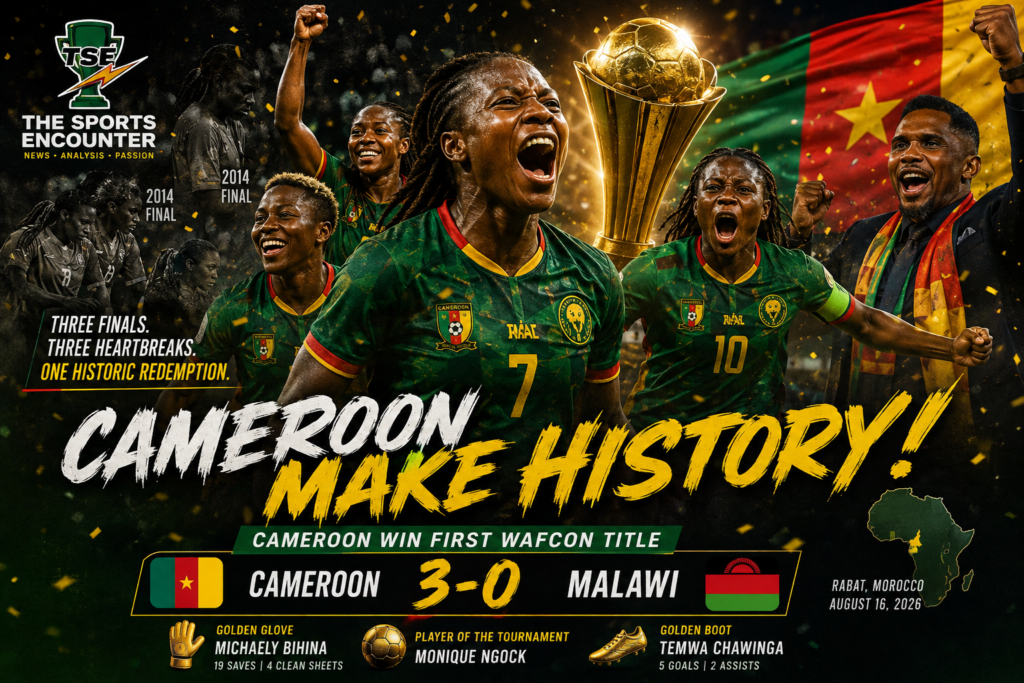
Cameroon completed one of the most extraordinary redemption stories in WAFCON history on Sunday night, overwhelming Malawi 3-0 at the Moulay El Hassan Stadium in Rabat to win their first continental title.
Marie Ngah Manga scored twice and Naomi Ndjoah Eto added another as Cameroon produced all three goals before halftime, ending decades of frustration that included defeats in the 2004, 2014 and 2016 finals.
The final also closed a remarkable tournament in which Malawi reached the championship match on their WAFCON debut, qualified for their first FIFA Women’s World Cup and produced the tournament’s Golden Boot winner in Temwa Chawinga.
The Sports Encounter had followed that rise through Malawi’s historic run to their first WAFCON final. The final ultimately belonged to a Cameroon side whose second chance became something much bigger.
Cameroon vs Malawi WAFCON 2026 Final: Key Facts
| Competition | CAF Women’s Africa Cup of Nations 2026 |
| Final | Cameroon vs Malawi |
| Date | August 16, 2026 |
| Venue | Moulay El Hassan Stadium, Rabat, Morocco |
| Result | Cameroon 3-0 Malawi |
| Cameroon scorers | Marie Ngah Manga 20’, 45+3’; Naomi Ndjoah Eto 30’ |
| WAFCON champion | Cameroon, first title |
| Player of the Tournament | Monique Ngock |
| Golden Boot | Temwa Chawinga, 5 goals |
| Golden Glove | Michaely Bihina |
Ngah Gives Cameroon the Start Every Final Demands
The final brought together two teams chasing their first WAFCON title, but Cameroon looked far more comfortable with the occasion from the opening exchanges.
Malawi had built their historic run around fearless attacking football. They entered the final having scored 12 goals, with Temwa and Tabitha Chawinga giving the Scorchers an attacking threat capable of troubling any defense in the tournament.
Cameroon took that threat away by scoring first.
Ngah broke the deadlock in the 20th minute, immediately forcing Malawi into a type of contest they had largely avoided during their extraordinary debut campaign.
The Scorchers now had to chase a final against one of WAFCON 2026’s most disciplined defensive teams.
Ten minutes later, the challenge became much larger.
Naomi Ndjoah Eto Turns Pressure Into a Two-Goal Cushion
Myriam Nyadjou created Cameroon’s second goal, finding Ndjoah Eto before the forward converted in the 30th minute.
At 2-0, Cameroon had control of both the scoreboard and the emotional rhythm of the final.
Malawi made a first-half substitution as Lovemore Fazili attempted to change the direction of the match, but Cameroon had already found the spaces they wanted.
Another arrived in stoppage time.
Ndjoah Eto turned provider, setting up Ngah for her second goal in the 45+3 minute.
Cameroon went into halftime 3-0 ahead.
The title was already within touching distance.
Three Goals Erase Three Painful Final Defeats
There was a historical symmetry in Cameroon scoring three times.
The Indomitable Lionesses had previously reached three WAFCON finals and lost every one.
Nigeria defeated them in 2004, again in 2014, and then broke Cameroonian hearts on home soil in the 2016 final.
Cameroon did not score in any of those three championship matches.
Against Malawi, they scored three before halftime.
That is what made this victory feel larger than one dominant performance. A generation of near misses, frustration and declining results had been building behind it.
Cameroon subsequently failed to qualify for consecutive WAFCON tournaments before receiving an unexpected route back into the 2026 competition when CAF expanded the tournament.
The team that needed a second chance ended the tournament holding the trophy.
Cameroon’s Route to the Trophy Was Brutal
There was very little luck in what happened after Cameroon entered the tournament.
The Indomitable Lionesses beat Ghana during the group stage before their knockout path became considerably harder.
Defending champions Nigeria stood between Cameroon and a semifinal place.
Cameroon won 1-0.
That result also secured qualification for the 2027 FIFA Women’s World Cup and contributed to one of the biggest changes in African women’s football during this tournament. The Sports Encounter examined the wider qualification picture when Malawi secured their own historic first Women’s World Cup appearance.
Hosts Morocco came next.
Cameroon survived 120 goalless minutes before winning the semifinal shootout 3-1, with goalkeeper Michaely Bihina producing another extraordinary performance.
Then came Malawi.
Cameroon completed all three knockout matches without conceding a goal.
Michaely Bihina Built the Defensive Foundation
Ngah’s two goals will remain among the enduring images of the final, but Cameroon’s championship was built just as much at the other end of the field.
Bihina finished WAFCON 2026 with 19 saves and four clean sheets.
Her quarterfinal performance against Nigeria was exceptional. She made nine saves as Cameroon eliminated the 10-time champions 1-0.
The semifinal provided an even greater pressure test.
Bihina kept Morocco scoreless across 120 minutes and then saved three penalties in the shootout as Cameroon won 3-1.
Another clean sheet against Malawi completed the tournament.
CAF awarded the 22-year-old the Golden Glove, recognition of a campaign in which Cameroon repeatedly survived difficult periods because their goalkeeper refused to concede.
Anyone following The Sports Encounter’s wider soccer coverage will recognize the importance of goalkeeper performances in tournament football. One outstanding save can alter an entire knockout bracket. Bihina produced those moments across consecutive rounds.
Monique Ngock Became the Midfield Heart of the Champions
Cameroon’s individual awards did not stop with Bihina.
Monique Ngock was named Player of the Tournament after becoming the connective force between the defensive structure and Cameroon’s attacking transitions.
Her influence often appeared away from the final action.
Ngock won duels, controlled tempo, protected space and helped move Cameroon from defensive phases into attack. Against Morocco in the semifinal, she contested 33 duels and won 20, more than any other player in the match.
Her story also gave Cameroon’s title an unusual generational dimension.
Ngock was only 12 when Cameroon lost the 2016 final to Nigeria. She later recalled how deeply that defeat affected her at a time when she was struggling to convince people around her that football could become her future.
Ten years later, she helped deliver the trophy that had once seemed unreachable.
Temwa Chawinga Leaves Morocco With the Golden Boot
Malawi lost the final, but their tournament did not end without recognition.
Temwa Chawinga won the WAFCON Golden Boot after scoring five goals and providing two assists.
Marie Ngah Manga’s final brace took her to five goals as well, while Zambia’s Barbra Banda and Côte d’Ivoire’s Ines Konan also finished on five.
Chawinga took the scoring award because her two assists gave her the advantage in the tiebreak.
Her contribution needs to be viewed through the scale of Malawi’s achievement.
The Scorchers were playing their first WAFCON.
They opened the tournament by beating defending champions Nigeria 3-2, finished top of their group and then defeated Ghana in the quarterfinal to secure a first Women’s World Cup qualification.
The Sports Encounter documented that breakthrough when Malawi beat Ghana to book their place at Brazil 2027.
They then defeated Algeria 3-1 to reach the final, extending a run that had already moved beyond the description of a surprise.
Our WAFCON final preview argued that Malawi had reached the point where repeated victories against established opponents represented evidence rather than luck.
That assessment still stands after defeat.
Malawi Lost the Final but Changed Their Football Future
Three first-half goals made the championship match painful.
The larger tournament remains transformative.
Before WAFCON 2026, Malawi had never appeared at the continental finals.
They will now travel to Brazil for the 2027 FIFA Women’s World Cup.
Malawi and Algeria will both make their tournament debuts there, while Cameroon and Morocco also secured automatic African qualification places.
The Sports Encounter previously examined how Algeria made history and Morocco secured another Women’s World Cup appearance, part of a qualification cycle that has dramatically changed Africa’s representation at the global tournament.
For Malawi, reaching the WAFCON final has accelerated expectations around the national program.
The Chawinga sisters give the country elite attacking quality. Younger players now have a World Cup to prepare for. The federation has a visible international platform around which development, sponsorship and investment can grow.
The silver medal therefore represents the beginning of a much bigger challenge.
WAFCON 2026 Changed African Women’s Football
Cameroon winning the tournament is only one part of what made this edition significant.
The competition expanded to 16 teams for the first time.
A team that originally failed to qualify became champion.
A debutant reached the final.
Nigeria, the 10-time champion and historical superpower of African women’s football, failed to reach the semifinals and missed automatic qualification for the 2027 Women’s World Cup.
Malawi and Algeria qualified for their first World Cups.
Morocco reinforced the progress already visible from their breakthrough 2023 campaign.
The changing qualification map had already become clear when Algeria and Morocco booked their Brazil 2027 places. Cameroon’s championship adds another layer to that shift.
Official results, tournament records and competition information are available through the CAF Women’s Africa Cup of Nations, while FIFA provides continuing information on the FIFA Women’s World Cup Brazil 2027.
Samuel Eto’o Joins a Celebration Years in the Making
Cameroon Football Federation president Samuel Eto’o joined the post-match celebrations as players, staff and supporters marked the country’s first WAFCON championship.
The presence of one of Cameroon’s most recognizable football figures connected the women’s team’s achievement with the country’s wider football identity.
The moment belonged primarily to the players who had turned an unexpected invitation into a continental championship.
Several entered the tournament carrying the memory of previous Cameroonian generations that had come close without ever lifting the trophy.
This group finished the job.
TSE Verdict: Cameroon’s Second Chance Became African Football History
The easiest way to describe the final is that Cameroon scored three first-half goals and controlled Malawi from there.
The deeper story began months earlier.
Cameroon failed to qualify.
CAF expanded the tournament.
The Indomitable Lionesses received another opportunity and responded by beating Ghana, eliminating Nigeria, surviving Morocco and dismantling Malawi.
Ngah supplied the goals in the final. Bihina protected the journey. Ngock controlled the midfield. Ndjoah Eto delivered a goal and an assist on the biggest night.
Those contributions turned a second chance into Cameroon’s first African championship.
Malawi leave without the trophy, yet they return home with a World Cup place, a Golden Boot winner and a debut campaign that altered how the continent will view them from this point forward.
For more international football, tournament analysis and emerging stories from across the game, follow The Sports Encounter’s soccer coverage.
Frequently Asked Questions
Who won WAFCON 2026?
Cameroon won the 2026 Women’s Africa Cup of Nations after defeating Malawi 3-0 in the final in Rabat.
Is this Cameroon’s first WAFCON title?
Yes. Cameroon won the Women’s Africa Cup of Nations for the first time after previously losing the finals in 2004, 2014 and 2016.
Who scored in the Cameroon vs Malawi final?
Marie Ngah Manga scored in the 20th and 45+3 minutes, while Naomi Ndjoah Eto scored Cameroon’s second goal in the 30th minute.
Who won the WAFCON 2026 Golden Boot?
Malawi forward Temwa Chawinga won the Golden Boot after finishing with five goals and two assists.
Who was WAFCON 2026 Player of the Tournament?
Cameroon midfielder Monique Ngock was named Player of the Tournament.
Who won the WAFCON 2026 Golden Glove?
Cameroon goalkeeper Michaely Bihina won the Golden Glove after an outstanding tournament that included four clean sheets and 19 saves.
Have Malawi qualified for the 2027 Women’s World Cup?
Yes. Malawi qualified for their first FIFA Women’s World Cup by reaching the WAFCON 2026 semifinals. The Sports Encounter has the full story of Malawi’s historic qualification for Brazil 2027.
Which African teams qualified directly for the 2027 Women’s World Cup?
Cameroon, Malawi, Algeria and Morocco secured Africa’s four automatic places at the FIFA Women’s World Cup Brazil 2027.