


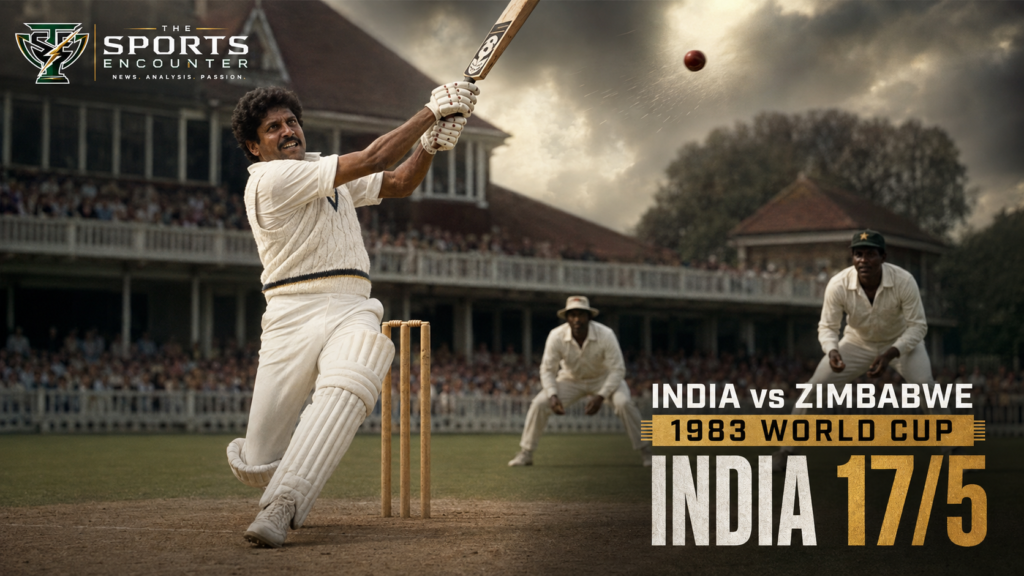
Zimbabwe had India exactly where they wanted them. Sunil Gavaskar and Kris Srikkanth were gone without scoring. Mohinder Amarnath, Sandeep Patil and Yashpal Sharma soon followed. Five wickets had fallen for 17 runs, and India’s World Cup campaign was sliding toward a defeat that could have ended their tournament before the semifinal stage.
Kapil Dev walked into that wreckage and produced an innings nobody could watch again.
No complete television recording exists of his unbeaten 175 at Tunbridge Wells, leaving scorecards, eyewitness memories and cricket folklore to carry one of the greatest ODI recoveries ever played. Kapil turned 17 for five into 266 for eight, then bowled economically as India resisted Kevin Curran’s counterattack and beat Zimbabwe by 31 runs.
Seven days later, Kapil lifted the World Cup at Lord’s.
This is Match No. 4 in A Celebration of 5000 ODIs, The Sports Encounter’s series revisiting 100 matches that explain how one-day cricket creates pressure, individual brilliance and consequences that survive generations.
TL;DR
- India recovered from 17 for five to score 266 for eight at Tunbridge Wells on June 18, 1983.
- Kapil Dev made an unbeaten 175 from 138 balls, hitting 16 fours and six sixes.
- Kapil and Syed Kirmani added an unbroken 126 for the ninth wicket.
- Peter Rawson and Kevin Curran took three wickets each during India’s collapse.
- Curran later scored 73, but Zimbabwe were dismissed for 235 in 57 overs.
- India won by 31 runs and kept alive the campaign that ended with their first World Cup title.
India vs Zimbabwe 1983: Match Information
| Detail | Information |
|---|---|
| Match | India vs Zimbabwe, 20th Match, 1983 World Cup |
| Date | June 18, 1983 |
| Venue | Nevill Ground, Tunbridge Wells |
| Toss | India won the toss and batted |
| India | 266/8 in 60 overs |
| Zimbabwe | 235 all out in 57 overs |
| Result | India won by 31 runs |
| Player of the Match | Kapil Dev, 175* and 1/32 |
| Leading Zimbabwe performer | Kevin Curran, 73 and 3/65 |
| Turning point | Kapil Dev and Syed Kirmani’s unbeaten 126-run ninth-wicket partnership |
| Tournament impact | India earned four points and remained in contention for the semifinals |
Complete Match Scorecard
India innings: 266/8 in 60 overs
| Batter | Dismissal | Runs | Balls | 4s | 6s |
|---|---|---|---|---|---|
| Sunil Gavaskar | lbw b Rawson | 0 | 2 | 0 | 0 |
| Kris Srikkanth | c Butchart b Curran | 0 | 13 | 0 | 0 |
| Mohinder Amarnath | c Houghton b Rawson | 5 | 20 | 1 | 0 |
| Sandeep Patil | c Houghton b Curran | 1 | 10 | 0 | 0 |
| Yashpal Sharma | c Houghton b Rawson | 9 | 28 | 1 | 0 |
| Kapil Dev | Not out | 175 | 138 | 16 | 6 |
| Roger Binny | lbw b Traicos | 22 | 48 | 2 | 0 |
| Ravi Shastri | c Pycroft b Fletcher | 1 | 6 | 0 | 0 |
| Madan Lal | c Houghton b Curran | 17 | 39 | 1 | 0 |
| Syed Kirmani | Not out | 24 | 56 | 2 | 0 |
| Balwinder Sandhu | Did not bat | ||||
| Extras | 9 leg byes, 3 wides | 12 | |||
| Total | 8 wickets, 60 overs | 266 |
Zimbabwe bowling
| Bowler | Overs | Maidens | Runs | Wickets |
|---|---|---|---|---|
| Peter Rawson | 12 | 4 | 47 | 3 |
| Kevin Curran | 12 | 1 | 65 | 3 |
| Iain Butchart | 12 | 2 | 38 | 0 |
| Duncan Fletcher | 12 | 2 | 59 | 1 |
| John Traicos | 12 | 0 | 45 | 1 |
Zimbabwe innings: 235 all out in 57 overs
| Batter | Dismissal | Runs | Balls | 4s | 6s |
|---|---|---|---|---|---|
| Robin Brown | Run out | 35 | 66 | 2 | 0 |
| Grant Paterson | lbw b Binny | 23 | 35 | 4 | 0 |
| Jack Heron | Run out | 3 | 8 | 0 | 0 |
| Andy Pycroft | c Kirmani b Sandhu | 6 | 15 | 0 | 0 |
| Dave Houghton | lbw b Madan Lal | 17 | 35 | 2 | 0 |
| Duncan Fletcher | c Kapil Dev b Amarnath | 13 | 23 | 0 | 0 |
| Kevin Curran | c Shastri b Madan Lal | 73 | 93 | 8 | 0 |
| Iain Butchart | b Binny | 18 | 43 | 1 | 0 |
| Gerald Peckover | c Yashpal Sharma b Madan Lal | 14 | 18 | 0 | 0 |
| Peter Rawson | Not out | 2 | 6 | 0 | 0 |
| John Traicos | c and b Kapil Dev | 3 | 7 | 0 | 0 |
| Extras | 17 leg byes, 7 wides, 4 no-balls | 28 | |||
| Total | All out, 57 overs | 235 |
India bowling
| Bowler | Overs | Maidens | Runs | Wickets |
|---|---|---|---|---|
| Kapil Dev | 11 | 1 | 32 | 1 |
| Balwinder Sandhu | 11 | 2 | 44 | 1 |
| Roger Binny | 11 | 2 | 45 | 2 |
| Madan Lal | 11 | 2 | 42 | 3 |
| Mohinder Amarnath | 12 | 1 | 37 | 1 |
| Ravi Shastri | 1 | 0 | 7 | 0 |
Peter Rawson and Kevin Curran Reduced India to 17 for Five
Zimbabwe’s opening burst created the crisis that made the match famous.
Rawson removed Gavaskar with the score still at zero and later dismissed Amarnath and Yashpal. Curran accounted for Srikkanth and Patil. Zimbabwe bowled accurately, used the early conditions well and forced India’s top order into defensive uncertainty.
India had lost four wickets for nine when Kapil arrived. Yashpal’s dismissal made it 17 for five. Zimbabwe could see a path toward dismissing India below 100 and moving closer to another major upset after already beating Australia earlier in the tournament.
The mistake came after earning that position. Zimbabwe could not maintain the same control against Kapil, and every failed attempt to remove him made their opening spell less valuable.
Kapil Dev Played the Innings That Kept India’s World Cup Alive
Kapil’s 175 came from 138 balls and accounted for almost 66 percent of India’s total. His 16 fours and six sixes brought a level of counterattacking power that the Zimbabwe bowlers had not faced during the top-order collapse.
The innings developed in stages. Kapil initially rebuilt with Binny, whose 22 helped add 60 for the sixth wicket. After Shastri fell at 78 and Madan Lal departed at 140, India still faced the risk of being dismissed for a modest total.
Kirmani gave his captain the support he needed. The wicketkeeper scored only 24 from 56 balls, but his restraint allowed Kapil to control the strike and attack as the innings entered its closing overs.
Their unbeaten 126-run partnership remains one of the most important lower-order stands in World Cup history. Kapil’s 175 was also India’s first ODI century and, at the time, the highest individual score in the format.
His wider influence on Indian cricket is explored in The Sports Encounter’s tribute to Kapil Dev, the all-rounder who made India believe.
Kevin Curran Nearly Completed Zimbabwe’s Fightback
Curran refused to let Kapil’s innings settle the result.
Zimbabwe’s chase repeatedly lost wickets after promising starts. Brown made 35, Paterson contributed 23 and the score reached 103 for five before Curran began rebuilding.
His 73 from 93 balls included eight fours. Partnerships with Butchart and the lower order kept Zimbabwe close enough to make India nervous, particularly after the earlier failure of India’s top order.
Curran’s dismissal at 230 for nine ended Zimbabwe’s realistic hopes. His all-round contribution of three wickets and 73 runs would have decided many matches. Kapil’s intervention was simply larger.
Madan Lal Led India’s Defensive Response
India required discipline after posting 266. Madan Lal provided the wickets that stopped Zimbabwe’s middle and lower order from completing the chase.
He dismissed Houghton, Curran and Peckover to finish with 3 for 42. Binny took two wickets, while Kapil completed his day by conceding only 32 from 11 overs and taking the final wicket.
The bowling performance lacked the drama of the first innings, but India’s ability to share responsibility mattered. Kapil had already carried the batting. His teammates ensured the rescue produced a victory.
Why This Match Was Included in A Celebration of 5000 ODIs
The 31-run margin hides the scale of India’s danger.
At 17 for five, their World Cup campaign could have broken apart. Defeat would have strengthened Australia’s path toward the semifinals and deprived India of the momentum that later carried them through the tournament.
Kapil responded with an innings that combined survival, tactical judgment and sustained hitting. The lack of complete broadcast footage has strengthened its mystery, but the official ICC history of the 1983 World Cup confirms what followed: India reached Lord’s and defeated the two-time champion West Indies.
The series began with West Indies’ one-wicket escape against Pakistan before revisiting Gary Gilmour’s extraordinary semifinal against England. Every episode is available through the dedicated A Celebration of 5000 ODIs hub and The Sports Encounter’s broader Cricket coverage.
India still needed to beat Australia, England and West Indies to lift the trophy. Tunbridge Wells ensured they would have that chance.