


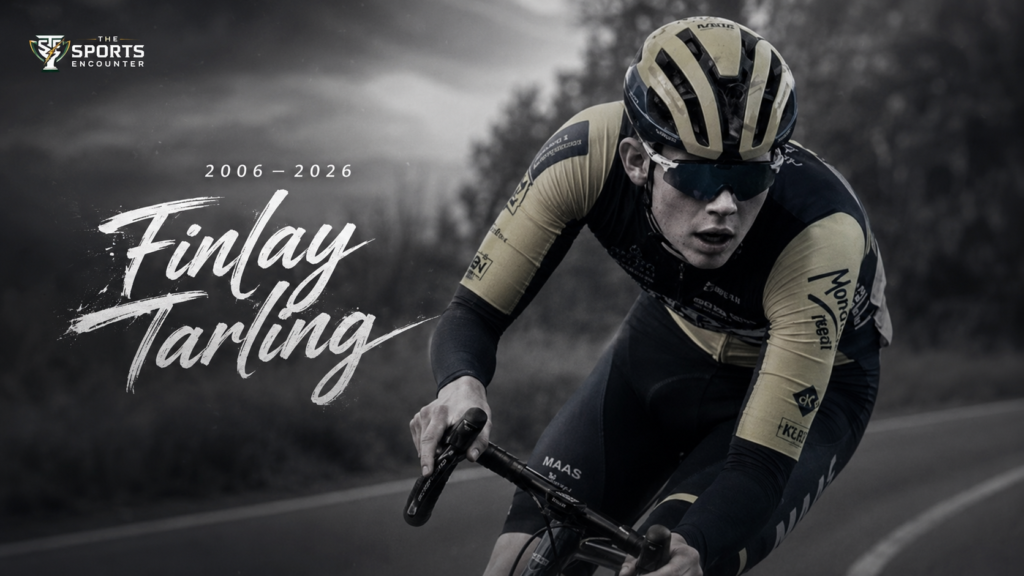
British cycling is mourning Finlay Tarling, a 19-year-old rider whose death during the Volta a Portugal has turned a developing career into a moment of grief for a sport built on courage, speed and risk.
Tarling died after a serious accident during Stage 8 of the 87th Volta a Portugal, race organizers said. He was riding for NSN Development Team, a Swiss-registered development squad, in one of the biggest early tests of his young road-racing career.
The details of the accident remain limited at this stage, and that matters. This story should not be reduced to speculation, crash mechanics or dramatic assumptions. The confirmed fact is devastating enough: a 19-year-old British cyclist lost his life while competing in a professional road race.
For his family, teammates, coaches and friends, this is not only a sports story. It is a life cut short before it had the chance to fully unfold.
Finlay Tarling Death: Key Facts
| Detail | Information |
|---|---|
| Rider | Finlay Tarling |
| Age | 19 |
| Nationality | British |
| Team | NSN Development Team |
| Race | 87th Volta a Portugal |
| Stage | Stage 8 |
| Confirmed cause context | Race organizers said he died following a serious accident during the stage |
| Official rider record | Listed by the Union Cycliste Internationale |
A Young Rider Lost During One of Cycling’s Hardest Tests
The Volta a Portugal is not a gentle race for developing riders. It demands long days, heat, concentration, positioning, climbing strength and constant awareness inside a moving peloton where danger can arrive in seconds.
For a 19-year-old rider, entry into a race of that level is a sign of trust. It means a team sees potential. It means coaches believe the rider can absorb the intensity of senior racing. It means a young athlete has earned a place in an environment where every stage teaches something.
Tarling was at that stage of his career.
According to his official UCI rider profile, he was registered with NSN Development Team in 2026 after being connected with the Israel-Premier Tech setup in 2025. His career was still being shaped, still being tested, still moving toward whatever version of the future his talent might have allowed.
That is why this news lands with such force.
Fans often see young riders through results sheets, start lists and team announcements. Families see something different. They see early mornings, recovery rides, sacrifice, missed weekends, broken routines and the quiet belief required to chase a place in professional cycling.
Tarling’s death freezes all of that in the most painful way.
The Official Statement Leaves a Sport in Shock
The organization of the Volta a Portugal confirmed that Tarling died following a serious accident during the eighth stage of the race.
The race organization and the Portuguese Cycling Federation expressed condolences to his family, teammates, team, friends and loved ones.
Those words are formal, but behind them sits the hardest truth in sport: no race, no stage classification, no result and no ranking can carry meaning in the same way after a rider dies.
Road cycling asks athletes to accept danger as part of the job. Riders descend at high speed, fight for position on narrow roads, navigate roadside furniture, race through changing surfaces and react to decisions made by dozens of people around them. That danger is familiar to the sport, but familiarity should never make it feel normal.
A tragedy like this forces everyone to stop.
Finlay Tarling Had Already Shown Promise on the Track
Tarling was not an unknown name inside British cycling’s development structure.
At the 2024 UCI Junior Track World Championships in Luoyang, he was part of a strong British group that helped Team GB top the medal standings. The UCI’s report from those championships noted that Tarling won bronze in the men’s team pursuit and also took bronze in the Madison with William Salter.
He also finished third in the points race, another sign of range, endurance and race intelligence.
Those results matter because they show a rider with more than one path available. Track cycling rewards precision, timing and repeated effort. Road cycling tests positioning, patience, fatigue resistance and tactical awareness across hours rather than minutes.
Tarling was young enough for both worlds to remain open.
That is part of the heartbreak. At 19, a rider is still becoming. The body is still developing. The racing identity is still forming. The best events, best roads, best teammates and best memories may still be ahead.
Why This Tragedy Connects Beyond Cycling
Every sport has moments when the scoreboard becomes secondary. The Sports Encounter has covered those moments across different games because they reveal why sport matters beyond results, medals and trophies.
Cricket felt that kind of silence when fans mourned a legend in our Sir Garfield Sobers tribute. Football carries its own painful memories, including the emotional weight explored in our feature on Andrés Escobar. Even when circumstances differ completely, the reader response often comes from the same place: a reminder that athletes are not characters in a show. They are people with families, futures, fears and private lives outside the arena.
Tarling’s story belongs in that human category.
He was not a finished champion being remembered after a full career. He was a young rider still climbing toward possibility.
That makes the loss feel different.
The Development-Team Reality Makes the Story Even More Painful
Development teams exist for a simple reason: to help talented young riders survive the leap between promise and professionalism.
That leap is brutal.
Junior success does not automatically turn into a senior career. Riders have to learn how to position themselves in faster pelotons, handle longer stages, recover between hard days, understand team roles, and accept that progress often comes through anonymous labor rather than personal glory.
For young cyclists, development teams become more than employers. They are training environments, travel communities, support systems and pressure chambers all at once.
Tarling’s NSN Development Team teammates now face a grief that no young squad should ever have to process during a race.
A team bus can feel like a workplace one day and a family space the next. When tragedy enters that space, the impact goes far beyond sport.
Road Cycling’s Beauty and Danger Live Too Close Together
Road cycling has always carried a difficult contradiction.
Its beauty comes from the open road. The landscape changes. The climbs punish. The descents thrill. The peloton moves like a living organism. The race unfolds across towns, mountains, villages and exposed roads rather than inside a controlled stadium.
That same openness creates risk.
Unlike many sports, cycling cannot fully separate competition from the outside world. Roads have turns, barriers, parked vehicles, road furniture, surface changes, spectators and unpredictable race conditions. Organizers can manage risk. They cannot remove it completely.
That is why official bodies such as the Union Cycliste Internationale and race organizers carry such responsibility around course design, safety protocols, convoy management, medical response and rider protection.
It is also why every serious accident brings a difficult question back to the surface: what more can be done without changing the essence of the sport?
What We Know and What Should Still Be Treated Carefully
At this stage, responsible coverage matters.
What is confirmed is that Finlay Tarling died after a serious accident during Stage 8 of the Volta a Portugal. He was 19. He was British. He rode for NSN Development Team. Race organizers and Portuguese cycling authorities expressed condolences.
What should not be added without official confirmation is the exact sequence of the incident, responsibility, fault, medical details or any claim about preventability.
This distinction matters because tragedy creates a vacuum, and that vacuum often fills with rumor. Sports journalism should resist that. Families deserve accuracy. Teams deserve care. Readers deserve facts rather than emotional guesswork.
The Sports Encounter’s wider editorial approach has always tried to explain the bigger picture without losing fairness. That same discipline applies here.
A Reminder That Young Athletes Carry Adult Risks
Tarling’s age is the detail that stops readers cold.
Nineteen is young in any sport. In cycling, it is almost impossibly young when measured against the demands of international road racing.
At 19, many riders are still learning how their bodies respond to back-to-back race days. They are learning how to handle pressure from teams, sponsors, coaches and their own ambition. They are also learning how to live with the strange emotional rhythm of the sport: one day full of suffering, another day full of hope.
That is the hidden cost of elite development.
Fans see the race number.
Families see the child who left home to chase a dream.
British Cycling Loses Another Young Name From a Promising Generation
British cycling has produced a deep pool of road and track talent in recent years, with young riders emerging through junior and under-23 pathways before stepping into elite racing.
Tarling was part of that wider development stream.
His 2024 junior track medals placed him inside a successful British generation that had already shown strength at world level. Those performances did not guarantee a future, but they offered evidence of a rider with competitive instinct and versatility.
That is why his death will be felt not only by his immediate team, but also by those who followed the junior pathway, British cycling’s development environment and the riders who shared track sessions, road races and hotel corridors with him.
For readers who follow athlete development across sports, the emotional thread is familiar. The promise of youth creates a different kind of attachment. We saw that in major-event stories like Glasgow 2026 Day 4 and Glasgow 2026 Day 5, where breakthrough performances carried meaning because they hinted at what might come next.
Tarling’s story hurts because that next chapter will never arrive.
The Race Continues, But the Meaning Changes
Stage races usually move forward quickly.
The schedule does not wait. Riders recover, eat, sleep, attend briefings and return to the start line. Teams make plans. Mechanics prepare bikes. Organizers manage roads, television windows and logistics.
After a death, that machinery feels different.
Every rider in the race knows the same roads that create opportunity can also create danger. Every teammate understands how fragile the normal rhythm of racing can be. Every young cyclist watching from home sees both the dream and the risk more clearly.
This is where major-event organization matters. The Sports Encounter has often explored how logistics, safety, pressure and fan expectations shape major competitions, including in our analysis of the biggest organizer challenges facing FIFA World Cup 2026. Different sport, different context, but the underlying truth remains the same: athletes perform inside systems, and those systems carry responsibility.
The Human Memory Should Come Before the Safety Debate
There will be time to ask the hard questions.
There will be time for official reviews, race reports, procedural scrutiny and conversations about road safety, convoy discipline, course conditions and emergency response.
Those conversations matter.
But the first response should be human.
A family has lost a son. Teammates have lost a friend. A development team has lost one of its young riders. British cycling has lost a teenager who had already reached international podiums and was still trying to build his future.
That is where this story begins.
Why Finlay Tarling’s Name Should Be Remembered Properly
Some athletes are remembered through long careers, records and defining victories.
Others are remembered through the ache of what remained unfinished.
Tarling’s name now belongs painfully to the second category.
He had already shown enough to be noticed. He had represented British cycling on the junior world stage. He had earned a development-team place. He had started the process of learning what kind of senior rider he might become.
That process ended far too early.
The best tribute sports coverage can offer is not exaggeration. It is accuracy, care and context.
Tarling was a young British cyclist with international junior medals, a professional development-team opportunity and a future that still had room to grow. His death during the Volta a Portugal should be remembered as a personal tragedy first, and as a serious moment for cycling second.
TSE Analysis: Cycling Cannot Afford to Treat Tragedy as Routine
Road cycling’s history includes too many days when celebration has stopped and mourning has started.
Every time it happens, the sport grieves. Every time, riders talk about risk. Every time, organizers face questions. Then the calendar keeps moving.
The uncomfortable challenge is making sure the sport does not mistake movement for resolution.
Cycling will always contain danger. That is true. But danger should never become a shield against review. The sport can respect its road-racing identity while still asking whether routes, barriers, traffic separation, medical access, descent management, weather protocols and convoy procedures can improve.
Those questions should come from care, not blame.
Tarling’s death does not need dramatic language to feel devastating. The facts are enough.
He was 19.
He was racing.
He had already stood on junior world podiums.
He was still building his future.
And now British cycling, NSN Development Team, the Volta a Portugal and the wider cycling community are left with grief instead of promise.
That is why this story will stay with people.
Frequently Asked Questions
Who was Finlay Tarling?
Finlay Tarling was a 19-year-old British cyclist who rode for NSN Development Team. He had previously won medals for Great Britain at the 2024 UCI Junior Track World Championships.
What happened to Finlay Tarling?
Race organizers said Tarling died after a serious accident during Stage 8 of the 87th Volta a Portugal.
Which team did Finlay Tarling ride for?
Tarling was listed as a rider for NSN Development Team on his official UCI profile.
How old was Finlay Tarling?
He was 19 years old.
What is the Volta a Portugal?
The Volta a Portugal is one of Portugal’s major road cycling stage races, held across multiple stages and followed closely within European road cycling.
Was Finlay Tarling a track cyclist as well?
Yes. Tarling had competed successfully on the track at junior level, winning bronze medals at the 2024 UCI Junior Track World Championships.
What has been officially confirmed?
It has been confirmed that Tarling died after a serious accident during Stage 8 of the Volta a Portugal. Further details should be treated carefully unless released by official sources.
Why does this story matter beyond cycling?
Tarling’s death is a reminder that young athletes carry real risks while chasing elite careers. It is also a moment for cycling to mourn first, then reflect carefully on rider safety.
The Sports Encounter extends its condolences to Finlay Tarling’s family, friends, teammates, coaches and everyone affected by his death.
For official cycling information, readers can follow the Union Cycliste Internationale, the UCI road cycling section, and the official Volta a Portugal website. For broader major-event and athlete-story coverage, The Sports Encounter has also covered Sir Garfield Sobers’ legacy, Andrés Escobar’s tragedy, the numbers behind sporting greatness, Zinedine Zidane’s 2002 injury story, Glasgow 2026 Day 4, Glasgow 2026 Day 5, and major-event safety and organizer challenges.