


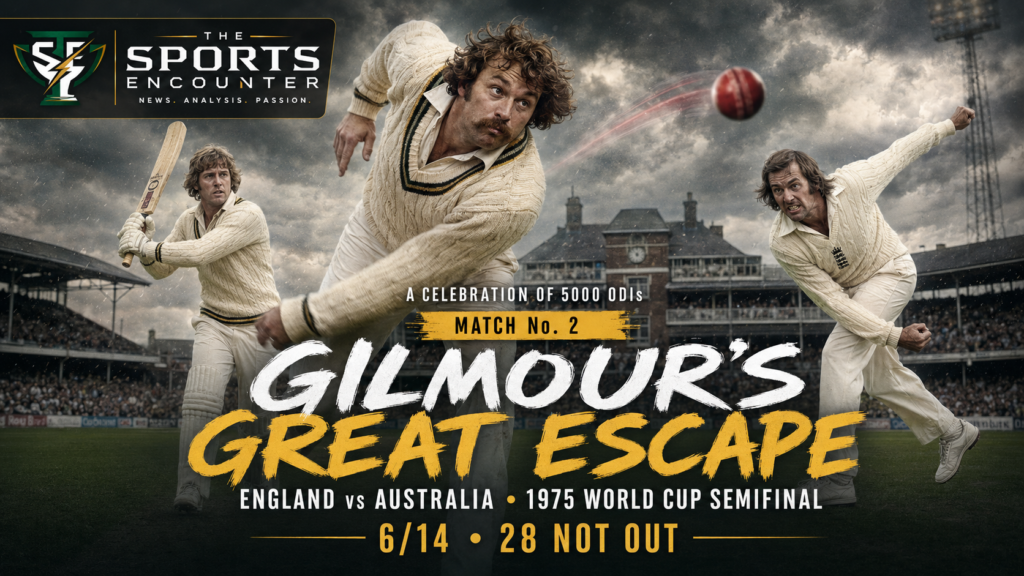
Australia needed 94 runs to reach the first men’s Cricket World Cup final. By the time half their batting lineup had disappeared for 39, that modest target had become a trap.
England’s bowlers sensed an escape. Headingley responded to every wicket. Australia, having dismissed the hosts for 93, suddenly faced the possibility of wasting one of the most devastating bowling performances the young ODI format had witnessed.
Gary Gilmour had already taken six wickets for 14 runs. Now he had to save the chase with his bat.
His unbeaten 28, supported by Doug Walters’ 20 not out, carried Australia through a frightening collapse and into the final. The semifinal became a rare international match in which the same player tore apart one innings and then repaired another.
This is Match No. 2 in A Celebration of 5000 ODIs, The Sports Encounter’s series revisiting 100 matches that reveal why one-day cricket continues to command attention across generations.
TL;DR
- Australia defeated England by four wickets at Headingley on June 18, 1975.
- England were bowled out for 93 after Gary Gilmour claimed 6 for 14 from 12 overs.
- England fought back and reduced Australia to 39 for six while defending only 94.
- Gilmour scored 28 not out and added an unbeaten 55 with Doug Walters.
- Gilmour received the Player of the Match award for one of World Cup cricket’s finest all-round performances.
- Australia advanced to the inaugural World Cup final against West Indies.
England vs Australia 1975 Match Information
| Detail | Information |
|---|---|
| Match | England vs Australia, first semifinal, Prudential World Cup 1975 |
| Date | June 18, 1975 |
| Venue | Headingley, Leeds |
| Toss | Australia won the toss and fielded |
| England | 93 all out in 36.2 overs |
| Australia | 94/6 in 28.4 overs |
| Result | Australia won by four wickets with 188 balls remaining |
| Player of the Match | Gary Gilmour, 6/14 and 28 not out |
| Top England batter | Mike Denness, 27 |
| Best England bowler | Chris Old, 3/29 |
| Turning point | Gilmour survived an early chance and added an unbeaten 55 with Doug Walters |
| Tournament impact | Australia advanced to the inaugural men’s World Cup final |
Complete England Scorecard
| Batter | Dismissal | Runs | Balls | 4s | 6s |
|---|---|---|---|---|---|
| Dennis Amiss | lbw b Gilmour | 2 | 7 | 0 | 0 |
| Barry Wood | b Gilmour | 6 | 19 | 1 | 0 |
| Keith Fletcher | lbw b Gilmour | 8 | 45 | 0 | 0 |
| Tony Greig | c Marsh b Gilmour | 7 | 25 | 1 | 0 |
| Frank Hayes | lbw b Gilmour | 4 | 6 | 1 | 0 |
| Mike Denness | b Walker | 27 | 60 | 1 | 0 |
| Alan Knott | lbw b Gilmour | 0 | 5 | 0 | 0 |
| Chris Old | c Greg Chappell b Walker | 0 | 3 | 0 | 0 |
| John Snow | c Marsh b Lillee | 2 | 14 | 0 | 0 |
| Geoff Arnold | not out | 18 | 30 | 2 | 0 |
| Peter Lever | lbw b Walker | 5 | 13 | 0 | 0 |
| Extras | 14 | ||||
| Total | All out in 36.2 overs | 93 |
Australia Bowling
| Bowler | Overs | Maidens | Runs | Wickets | Economy |
|---|---|---|---|---|---|
| Dennis Lillee | 9 | 3 | 26 | 1 | 2.88 |
| Gary Gilmour | 12 | 6 | 14 | 6 | 1.16 |
| Max Walker | 9.2 | 3 | 22 | 3 | 2.35 |
| Jeff Thomson | 6 | 0 | 17 | 0 | 2.83 |
Complete Australia Scorecard
| Batter | Dismissal | Runs | Balls | 4s | 6s |
|---|---|---|---|---|---|
| Alan Turner | lbw b Arnold | 7 | 20 | 0 | 0 |
| Rick McCosker | b Old | 15 | 50 | 0 | 0 |
| Ian Chappell | lbw b Snow | 2 | 19 | 0 | 0 |
| Greg Chappell | lbw b Snow | 4 | 9 | 1 | 0 |
| Doug Walters | not out | 20 | 43 | 2 | 0 |
| Ross Edwards | b Old | 0 | 3 | 0 | 0 |
| Rod Marsh | b Old | 5 | 8 | 0 | 0 |
| Gary Gilmour | not out | 28 | 28 | 5 | 0 |
| Extras | 13 | ||||
| Total | Six wickets in 28.4 overs | 94 |
Did not bat: Dennis Lillee, Max Walker, Jeff Thomson
England Bowling
| Bowler | Overs | Maidens | Runs | Wickets | Economy |
|---|---|---|---|---|---|
| Geoff Arnold | 7.4 | 2 | 15 | 1 | 1.95 |
| John Snow | 12 | 0 | 30 | 2 | 2.50 |
| Chris Old | 7 | 2 | 29 | 3 | 4.14 |
| Peter Lever | 2 | 0 | 7 | 0 | 3.50 |
Gary Gilmour Turns Headingley Into His Stage
Gilmour entered Australia’s lineup for the semifinal after spending the group stage outside the XI. Conditions at Headingley rewarded swing bowling, and the left-armer exploited them with exceptional control.
He removed England’s first six dismissed batters, reducing the hosts to 36 for six. His 12-over spell contained six maidens and cost only 14 runs. England struggled to distinguish between deliveries that would hold their line and those that would swing late into the pads or stumps.
The International Cricket Council’s account of the 1975 tournament records that Gilmour was playing only his third ODI. The scale of the performance becomes even clearer in that context. He entered a World Cup semifinal with almost no international one-day experience and controlled it from his opening spell.
Gilmour later finished the tournament with 11 wickets from only two matches, making him its leading wicket-taker.
Mike Denness Gives England Something to Defend
England’s captain could not reverse the collapse, but his 27 from 60 balls prevented the innings from ending before it had acquired any substance.
Denness watched wickets fall throughout the top and middle order before building small partnerships with the tail. Geoff Arnold’s unbeaten 18 also proved valuable, helping England recover from 37 for seven to 93.
That total appeared hopeless on paper. In the damp, bowler-friendly conditions, however, every run carried unusual weight.
England’s response showed why low-scoring ODIs can create a different kind of pressure. Recent power-hitting feats, including Toby Albert’s six consecutive sixes, illustrate how far one-day batting has developed. Headingley offered the opposite spectacle. Survival, movement and defensive technique shaped every passage.
Chris Old Brings England Back From 32 for Three
Geoff Arnold began the resistance by removing Alan Turner. John Snow then trapped Ian and Greg Chappell lbw, leaving Australia at 32 for three.
Chris Old pushed the chase toward genuine crisis. He dismissed Rick McCosker and Ross Edwards without another run being added, then bowled Rod Marsh at 39.
Old finished with 3 for 29, while Snow claimed 2 for 30. England had transformed a target of 94 into a semifinal emergency.
The collapse exposed Australia’s technical problems against the moving ball. Several batters became trapped on the crease, uncertain whether to play forward or wait. England attacked the stumps and refused to let the small target weaken their intensity.
Doug Walters Provides the Control Australia Needed
Walters’ unbeaten 20 lacked the drama of Gilmour’s performance, but his judgment held the partnership together.
Australia could not afford another reckless stroke. Walters defended carefully, rotated the strike when possible and allowed Gilmour to attack loose deliveries. Their roles complemented each other. Walters reduced risk while Gilmour prevented England from dictating every over.
The pair added 55 without separation, more than half the target. That partnership remains the match’s decisive passage.
The Turning Point: England Miss Their Chance at Gilmour
According to the ICC’s historical review, Gilmour survived an early dropped chance after arriving at 39 for six.
Had England completed it, Australia would have been seven wickets down with 55 still required. Lillee, Walker and Thomson remained, but none offered the same combination of composure and attacking ability.
The missed opportunity changed the emotional balance. Gilmour began finding boundaries, Walters settled, and England’s belief gradually weakened as the target came within reach.
Why This Match Belongs in A Celebration of 5000 ODIs
This semifinal earned its place because it turned 94 into a dangerous chase and asked one cricketer to win the match twice.
Gilmour’s 6 for 14 appeared sufficient to decide the contest. England’s bowlers then created a second match inside the first, reducing Australia to 39 for six and placing the semifinal back in doubt.
The structure resembles the remarkable recovery explored in Match No. 1, West Indies vs Pakistan. Both contests showed that early ODI cricket already possessed the uncertainty and pressure that would later define the format.
Readers can follow every installment through the A Celebration of 5000 ODIs series hub and explore current reports, historical features and analysis through The Sports Encounter’s cricket coverage.
What Happened Next
Australia advanced to face West Indies at Lord’s, where Gilmour took another five wickets. Clive Lloyd’s century and West Indies’ sharp fielding ultimately delivered a 17-run victory in the inaugural World Cup final.
The semifinal still belongs to Gilmour. Across 12 overs and 28 balls, he produced a performance that rescued Australia from both sides of the contest.
More than five decades later, England’s 93 and Australia’s 39 for six remain enough to restore the tension. That is precisely why this match deserves another telling.
Frequently Asked Questions
Who won the England vs Australia 1975 World Cup semifinal?
Australia won by four wickets after reaching 94 for six in 28.4 overs at Headingley.
Who was the Player of the Match?
Gary Gilmour received the award after taking 6 for 14 and scoring an unbeaten 28.
What was the decisive partnership?
Gilmour and Doug Walters added an unbeaten 55 for the seventh wicket after Australia had collapsed to 39 for six.
Why was the match historically significant?
It sent Australia into the first men’s Cricket World Cup final and produced one of the finest all-round performances in ODI history.