


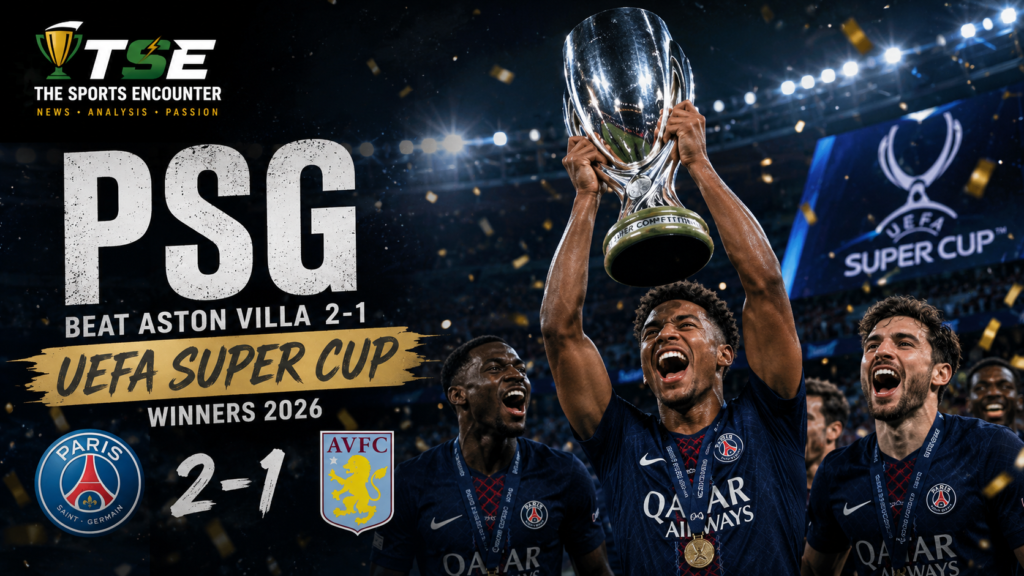
Paris Saint-Germain defeated Aston Villa 2-1 in Salzburg to win the 2026 UEFA Super Cup, with Désiré Doué scoring the decisive second-half goal after 17-year-old Brian Madjo had briefly threatened to turn his Aston Villa debut into one of the great European underdog stories.
Khvicha Kvaratskhelia opened the scoring for PSG in the 20th minute before Madjo stunned the European champions with an equalizer shortly before halftime.
Then came the intervention that changed the final.
Luis Enrique introduced Ousmane Dembélé at halftime. Sixteen minutes later, the French forward released Doué behind Aston Villa’s defense and the teenager curled his finish beyond Marco Bizot. An offside flag initially threatened to wipe out the goal, but VAR overturned the decision and confirmed PSG’s 2-1 lead.
Villa pushed for another response. PSG had to defend rather than simply control possession, and Unai Emery’s depleted team continued creating opportunities deep into the second half.
The equalizer never arrived.
PSG therefore begin another European season with silverware and become consecutive UEFA Super Cup winners after also lifting the trophy in 2025.
For Villa, defeat came with a remarkable consolation. Madjo, aged 17 years and 212 days, became the youngest scorer in UEFA Super Cup history on his competitive Aston Villa debut.
PSG vs Aston Villa: 2026 UEFA Super Cup at a Glance
| Match Detail | Information |
|---|---|
| Competition | 2026 UEFA Super Cup |
| Match | Paris Saint-Germain vs Aston Villa |
| Date | August 12, 2026 |
| Venue | Stadion Salzburg, Salzburg |
| Result | PSG 2-1 Aston Villa |
| PSG scorers | Khvicha Kvaratskhelia 20′, Désiré Doué 61′ |
| Aston Villa scorer | Brian Madjo 45′ |
| PSG coach | Luis Enrique |
| Aston Villa coach | Unai Emery |
| Historic moment | Brian Madjo became the youngest scorer in UEFA Super Cup history |
| Trophy significance | PSG won the UEFA Super Cup for a second consecutive year |
Official competition information and historical records are available through UEFA’s Super Cup hub.
PSG Start With Familiar Control but Villa Carry a Threat
The final arrived with both teams carrying unusual preparation problems.
PSG’s summer had been compressed by another long European season and the FIFA World Cup, while several first-team players had only recently returned to Luis Enrique’s group.
Aston Villa had their own problems.
Emery entered the final without several established players and was forced into a lineup that looked very different from the one supporters might have expected for a major European final.
That included a remarkable decision at center forward.
Madjo started up front.
PSG lined up with Matvey Safonov in goal behind Achraf Hakimi, Marquinhos, Willian Pacho and Nuno Mendes. João Neves, Vitinha and Warren Zaïre-Emery formed the midfield, while Kvaratskhelia, Maghnes Akliouche and Doué started in attack.
Villa used Marco Bizot in goal with Matty Cash, Victor Lindelöf, Pau Torres and Ian Maatsen across the defense. João Gomes and Boubacar Kamara provided the midfield base, with John McGinn, George Hemmings and Emiliano Buendía supporting Madjo.
The contrast was clear.
PSG had the greater share of possession and the more familiar European-winning structure. Villa were willing to defend compactly and attack quickly when opportunities appeared.
Kvaratskhelia Produces the First Moment of Quality
Twenty minutes were enough for Kvaratskhelia to leave his mark on another European final.
The Georgian received the ball with room to attack and produced the type of explosive action that has made him one of PSG’s most dangerous forwards.
His finish gave PSG a 1-0 lead and appeared to put the match on a familiar path.
Kvaratskhelia had already become central to Luis Enrique’s European machine. His ability to carry the ball at defenders creates a different problem from PSG’s more possession-oriented midfield play.
Villa could protect central spaces for long periods and still find themselves exposed when Kvaratskhelia accelerated.
The goal also continued an extraordinary period for PSG’s younger attacking core.
Doué and Kvaratskhelia have increasingly become players who do more than decorate matches. They decide them.
That distinction became even clearer before the night was over.
Villa Refuse to Follow the Expected Script
PSG’s opening goal did not produce the procession their supporters might have expected.
Villa became increasingly dangerous.
Madjo was central to almost everything.
The teenager went close with a header in the 28th minute. Seven minutes later, another attempt curled wide.
He headed another opportunity off target in the 41st minute.
Then, immediately before his goal, he came within inches of scoring when he powered into the area and struck the post from a difficult angle.
A young striker making his competitive debut in a European final could easily have disappeared after missing that many chances.
Madjo kept attacking.
Brian Madjo Makes UEFA Super Cup History
The breakthrough arrived in the 45th minute.
John McGinn attacked down the right and delivered into the penalty area. Madjo battled Pacho for position and stretched to meet the ball from a difficult angle.
His left-footed finish flew into the net.
PSG 1. Aston Villa 1.
The goal carried much greater significance than the scoreline.
According to UEFA’s official record, Madjo was 17 years and 212 days old, making him the youngest player ever to score in the UEFA Super Cup.
Patrick Kluivert had held the previous record after scoring for Ajax in 1996 at 19 years and 220 days.
| Player | Age | Club | Year |
|---|---|---|---|
| Brian Madjo | 17 years, 212 days | Aston Villa | 2026 |
| Patrick Kluivert | 19 years, 220 days | Ajax | 1996 |
| Marco Asensio | 20 years, 201 days | Real Madrid | 2016 |
| David Fairclough | 20 years, 321 days | Liverpool | 1977 |
| John Arne Riise | 20 years, 334 days | Liverpool | 2001 |
Madjo achieved the record on his Aston Villa debut.
That makes the moment even more remarkable.
Halftime Changes the Mood in Salzburg
At 1-1, the final suddenly felt very different.
Villa had created enough opportunities to make their equalizer feel earned rather than accidental.
PSG still controlled more of the ball, but possession was no longer translating automatically into control of the dangerous moments.
By the early stages of the second half, Villa had produced considerably more attempts than PSG.
That was the tactical warning Luis Enrique needed.
His response came immediately.
Akliouche, making his competitive PSG debut, was withdrawn at halftime.
Dembélé entered.
The substitution altered PSG’s attacking rhythm.
Dembélé provided direct running, movement behind Villa’s defensive line and another player capable of forcing defenders to turn toward their own goal.
Sixteen minutes later, the change produced the winning goal.
Dembélé Creates, Doué Finishes
PSG’s decisive attack came in the 61st minute.
Dembélé found Doué running beyond the Villa defense.
The timing was extremely tight.
Doué moved into the penalty area, allowed Bizot to commit and curled a left-footed finish into the net.
The assistant referee raised the flag.
For a moment, Villa had survived.
Then VAR intervened.
The review determined Doué had remained onside.
The goal stood.
PSG led 2-1.
The sequence captured exactly why Enrique’s halftime change mattered. Dembélé did not need to score to alter the final. His pass opened the defense, and Doué supplied the finish.
Doué Delivers Another Big-Game Moment
Doué’s performance extended his reputation as one of Europe’s most consequential young players.
He had already assisted Kvaratskhelia’s opener.
He then scored the winner.
Two PSG goals. Direct involvement in both.
That is the type of contribution that separates an exciting prospect from a player capable of determining major finals.
Doué operated from the right but repeatedly moved into positions where Villa’s defensive structure had to make uncomfortable decisions.
Stay narrow and PSG could circulate possession outside.
Step toward him and spaces appeared behind the line.
When Dembélé entered, that problem became harder because Villa suddenly had another elite runner attacking those spaces.
Aston Villa Still Had Chances
The winning goal did not finish the contest.
Villa continued attacking.
McGinn had already forced Safonov into a save shortly after halftime following good work from Madjo.
George Hemmings tested the PSG goalkeeper moments after Doué’s goal.
João Gomes later saw a powerful effort blocked.
Villa continued looking for spaces around PSG’s defensive line, while Emery introduced Tammy Abraham for Madjo as the match entered its final phase.
There was still one more opportunity deep into stoppage time.
Buendía reached a near-post delivery but could not direct his header on target.
That was effectively Villa’s final chance.
PSG survived.
The Numbers Explain Why Villa Can Leave Frustrated
The result suggests PSG controlled the final.
The underlying match numbers tell a more complicated story.
| Statistic | PSG | Aston Villa |
|---|---|---|
| Possession | 68% | 32% |
| Total shots | 10 | 14 |
| Shots on target | 5 | 4 |
| Touches in opposition box | 26 | 24 |
PSG dominated possession with 68%, but Villa attempted 14 shots compared with PSG’s 10.
That difference captures Emery’s plan.
Villa were prepared to let PSG have more of the ball as long as they could protect dangerous central areas and attack quickly after regaining possession.
For long periods, it worked.
The problem was efficiency.
Madjo alone had several opportunities before finally scoring. Villa reached threatening positions after halftime as well, but Safonov and PSG’s defense repeatedly prevented the second goal.
At the other end, PSG turned two moments of elite attacking execution into the goals that won the trophy.
PSG’s Starting XI Shows How Quickly the Squad Reassembled
The Super Cup also offered a useful glimpse into PSG’s post-World Cup transition.
Several major players had been fitness concerns during the buildup.
Hakimi, Zaïre-Emery and Doué ultimately started.
Dembélé began on the bench before becoming the game’s decisive substitute.
Fabián Ruiz was also available and entered later.
That matters because PSG had entered the summer with an unusual workload after another Champions League-winning campaign and the expanded international calendar.
Enrique did not have the luxury of a conventional preseason.
Winning the Super Cup under those circumstances provides another indication of the squad’s depth.
Villa’s Depleted Team Deserves Context
Emery also had significant selection problems.
Emiliano Martínez, Ezri Konsa and Ollie Watkins were unavailable, removing Villa’s established goalkeeper, an important central defender and their leading striker from the spine of the team.
Marco Bizot therefore started in goal.
Victor Lindelöf partnered Pau Torres in central defense.
Madjo was trusted to lead the attack.
The teenager responded by producing one of the stories of the night.
Villa lost the trophy, but their performance under those circumstances will give Emery considerably more encouragement than the final score alone suggests.
PSG Make It Back-to-Back UEFA Super Cups
The victory gives PSG their second UEFA Super Cup.
Their first arrived in 2025, when they defeated Tottenham Hotspur on penalties.
One year later, Kvaratskhelia and Doué delivered another victory.
That makes PSG consecutive winners and reinforces the transformation of a club that spent years chasing continental legitimacy.
European trophies have now started arriving in clusters.
The significance extends beyond another piece of silverware.
Successful teams eventually develop an expectation that finals should end with them lifting trophies.
PSG increasingly carry that mentality.
Turning Points in PSG vs Aston Villa
1. Kvaratskhelia breaks the deadlock
PSG needed one individual action to break through Villa’s defensive structure. Kvaratskhelia supplied it in the 20th minute and immediately forced Emery’s team to chase the match.
2. Madjo refuses to disappear after missed chances
The 17-year-old had several opportunities before scoring. His persistence mattered. Instead of becoming hesitant, he continued attacking Pacho and PSG’s defensive line until McGinn’s delivery gave him another chance.
3. Madjo scores immediately before halftime
The timing transformed the final. PSG went from carrying a 1-0 advantage into the interval to facing a Villa side with belief and momentum.
4. Luis Enrique introduces Dembélé
This was the decisive tactical move. Dembélé replaced Akliouche at halftime and immediately gave PSG greater vertical threat.
5. VAR overturns Doué’s offside decision
Doué’s 61st-minute finish was initially disallowed. The review showed he had timed his run correctly, restoring PSG’s lead.
6. Safonov protects the advantage
Villa continued creating opportunities after falling behind. Safonov dealt with efforts from McGinn and Hemmings as PSG defended a much tighter final than their possession share suggested.
7. Buendía’s stoppage-time header goes wide
Villa still had one final opportunity to force penalties. Buendía could not direct the near-post header on target, and PSG’s second consecutive Super Cup was effectively secured.
What PSG’s Victory Tells Us
The most interesting conclusion from Salzburg is that PSG did not need to produce their most dominant football to win.
Villa created more shots.
Madjo caused genuine problems.
PSG’s preparation had been disrupted.
Dembélé did not start.
Yet the European champions still found the decisive moments.
Kvaratskhelia produced the first.
Enrique produced the key substitution.
Dembélé produced the pass.
Doué produced the finish.
That is often what separates champions from teams still learning how to navigate major finals.
What Aston Villa Can Take From Salzburg
The defeat will hurt because Villa were close enough to imagine a different ending.
They produced 14 attempts despite having only around one-third of possession.
They created genuine danger against the Champions League holders.
They did so without several established starters.
Most importantly, they may have discovered another serious first-team attacker.
Madjo entered the evening as an exciting teenager trusted with an enormous assignment.
He leaves Salzburg as the youngest goalscorer in UEFA Super Cup history.
That does not turn defeat into victory.
It gives Villa something potentially much more valuable for the season ahead.
TSE Verdict: PSG’s New Habit Is Winning Finals
Paris Saint-Germain have reached the stage where trophies are beginning to feel connected rather than isolated.
That is the real significance of Salzburg.
Winning one European trophy can represent a breakthrough.
Winning repeatedly begins to define an era.
PSG were challenged here.
Villa created more attempts. A 17-year-old debutant unsettled their defense. The match was level at halftime. Their most dangerous established forward began among the substitutes.
PSG still found the solution.
Kvaratskhelia supplied the first piece of individual brilliance. Enrique recognized the need for greater penetration and introduced Dembélé. Doué then turned the tactical adjustment into the winning goal.
Aston Villa will return home without the trophy but with considerably more than regret.
Emery’s weakened side stood toe-to-toe with the reigning European champions and nearly forced the match to penalties. Madjo’s emergence may ultimately become the most important Villa story to come out of the evening.
For PSG, however, another final ends with another trophy.
The European champions have started 2026-27 exactly where they left the previous season.
On top.
Follow The Sports Encounter’s soccer coverage for European football results, tactical analysis, transfers and major tournament stories.
Frequently Asked Questions
Who won the 2026 UEFA Super Cup?
Paris Saint-Germain won the 2026 UEFA Super Cup by defeating Aston Villa 2-1 in Salzburg on August 12, 2026.
Who scored for PSG against Aston Villa?
Khvicha Kvaratskhelia opened the scoring in the 20th minute before Désiré Doué scored PSG’s winning goal in the 61st minute.
Who scored Aston Villa’s goal against PSG?
Brian Madjo scored Aston Villa’s equalizer in the 45th minute on his competitive debut for the club.
How old was Brian Madjo when he scored in the UEFA Super Cup?
Madjo was 17 years and 212 days old, making him the youngest goalscorer in UEFA Super Cup history.
Who previously held the record as the youngest UEFA Super Cup scorer?
Patrick Kluivert held the previous record. He was 19 years and 220 days old when he scored for Ajax in the 1996 Super Cup.
Who assisted PSG’s winning goal?
Ousmane Dembélé assisted Désiré Doué’s 61st-minute winner after coming on as a halftime substitute.
Was Désiré Doué’s goal initially ruled offside?
Yes. The assistant referee initially flagged Doué offside, but VAR reviewed the play and confirmed that he was onside. The goal was awarded.
How many UEFA Super Cups have PSG won?
PSG have now won two UEFA Super Cups, taking the trophy in 2025 and successfully defending it in 2026.
How many shots did Aston Villa have against PSG?
Aston Villa recorded 14 attempts compared with PSG’s 10 despite having only 32% possession.
Where was the 2026 UEFA Super Cup played?
The match was played at Stadion Salzburg in Salzburg, Austria.