


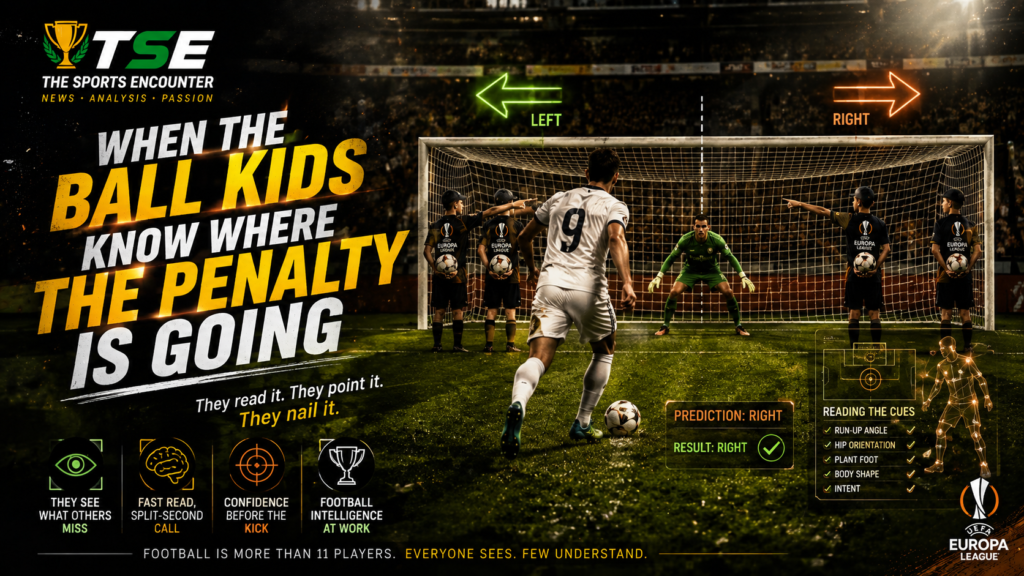
Sometimes the smartest people around a penalty shootout are not standing on the goal line.
A short clip shared by UEFA Europa League has attracted attention for a wonderfully simple reason: the ball kids positioned behind the goal appear to predict where the penalty takers are going to shoot before the ball is struck.
The official Europa League account posted the video on August 11 with the caption “Ball kids IQ,” and the footage quickly became the kind of moment fans want to replay several times. The fun is not in a spectacular save or an outrageous miss. It is in watching the kids behind the goal make their calls before the kick and then seeing the ball travel toward the side they anticipated.
At first glance, it looks almost supernatural.
It probably is not.
The more interesting explanation is that the ball kids may simply be reading the penalty takers extremely well.
Ball kids IQ 🧠 pic.twitter.com/ZkqDdfzMom
— UEFA Europa League (@EuropaLeague) August 11, 2026
What the Ball Kids Appear to Be Doing
In the UEFA clip, the children behind the goal gesture toward the side they expect the shot to go before contact is made.
That timing is what makes the sequence so entertaining.
If they were pointing after the kick, there would be nothing unusual about it. Instead, their predictions appear to come during the run-up or immediately before the striker reaches the ball.
Then the shot follows.
And their choice looks remarkably accurate.
UEFA clearly noticed the same thing, which explains the playful “Ball kids IQ” caption attached to the post.
Can You Actually Predict Where a Penalty Is Going?
To a degree, yes.
Penalty takers can reveal information through their body position before making contact with the ball.
Research into penalty anticipation has repeatedly examined visual cues such as the angle of the run-up, hip orientation, movement of the kicking leg and, especially, the position of the non-kicking or plant foot.
Studies have found that the orientation of the planted foot and the angle of the hips can provide useful clues about shot direction before contact occurs.
That does not mean every penalty can be decoded like a mathematical formula.
Elite players deliberately disguise their intentions. Some slow their approach and wait for the goalkeeper to move. Others change the angle of the foot late or strike across their body specifically to defeat anticipation.
Still, the body has to organize itself somehow to send the ball toward a particular part of the goal.
That movement can leave clues.
The Plant Foot Can Give Away More Than You Think
One of the most useful things to watch is the foot that does not kick the ball.
A striker’s plant foot helps establish balance and provides the platform from which the kicking leg swings.
Its position and orientation can therefore correlate with where the shot eventually travels.
Research on goalkeeper behavior has found that keepers coordinate the start of their dive partly with the placement of the kicker’s non-kicking leg.
That is important because a goalkeeper cannot simply wait until the ball is halfway toward the corner.
From 12 yards, a well-struck penalty travels too quickly.
The keeper has to gather information before or around the moment of contact and make a decision almost immediately.
The ball kids in the clip have no obligation to dive, of course.
That may actually make their little prediction game easier.
Why the Ball Kids May Have a Great Viewing Angle
Their position behind the goal is worth considering.
A television viewer usually watches a penalty from a camera positioned behind the kicker or at an angle from the side.
The goalkeeper looks directly at the approaching player but also has to think about positioning, balance, timing and whether the striker is reacting to his own movement.
The ball kids have a simpler job.
They can watch.
From behind or beside the goal, they may get a particularly clear view of the striker’s approach, shoulders, hips and supporting foot.
They also face none of the consequences of being wrong.
There is no need to commit their body weight, cover several meters of goal or worry about being embarrassed by a Panenka down the middle.
They can simply point.
Goalkeepers Have a Much Harder Problem
This is why the amusing comparison with the goalkeeper needs some context.
Seeing the likely direction and saving the penalty are completely different tasks.
A goalkeeper may correctly identify the intended side and still concede.
The shot could be too powerful, too close to the corner or too high to reach.
The keeper may also recognize a directional cue too late for the body to respond.
Research into penalty stopping emphasizes that anticipation is intertwined with physical action. Goalkeepers have to decide when enough information is available while still leaving themselves sufficient time to move across the goal.
The ball kids only have to win the prediction.
The goalkeeper has to win the duel.
Could It Simply Be Coincidence?
Of course.
A short viral clip is not a controlled experiment.
We do not know how many predictions the children made before the sequence shown by UEFA, whether incorrect guesses were omitted, or whether some of them knew the penalty takers’ habits beforehand.
That matters.
There is also a roughly 50-50 starting point if the only prediction being made is left versus right, especially if nobody is calling a central shot.
A few correct guesses in succession can happen by chance.
Still, the timing of the gestures makes the video interesting because it mirrors a real part of penalty-taking science: people can sometimes extract directional information from a kicker’s movement before the ball leaves the foot.
Experienced Eyes Can Pick Up Patterns Quickly
There may also be something simpler at work.
Ball kids spend a lot of time very close to football matches.
They watch professional players warm up, strike balls, cross, shoot and take set pieces from distances most supporters never experience.
That exposure can build visual familiarity.
You do not necessarily need to consciously think, “his supporting foot is pointing six degrees to the left.”
The brain can recognize movement patterns without turning them into words.
That is a big part of sporting anticipation.
A goalkeeper, defender or experienced fan may sometimes feel where an action is going before being able to explain exactly what gave it away.
The kids in UEFA’s clip may be doing something similar.
TSE Verdict: Maybe Stop Watching the Goalkeeper
The best thing about the video is that it changes where you look.
Normally, every eye during a penalty is fixed on two people.
The taker.
The goalkeeper.
UEFA’s clip gives the supporting cast the spotlight.
Watch the ball kids instead and suddenly there is another contest happening behind the main one.
They study the run-up.
They choose a side.
The striker hits the ball.
Then everybody checks whether the prediction was right.
There may be biomechanics behind it. There may be instinct. There may be a healthy amount of luck.
Probably all three.
Either way, it makes for one of those small football moments that reminds us how much is happening around a match beyond the players everybody came to watch.
Next time there is a penalty shootout, it might be worth checking the people standing behind the goal.
They may already know where the ball is going.
Follow The Sports Encounter’s soccer coverage for football stories, tactical analysis and the moments that can easily be missed during the action.