


Editor’s Note: The author, Liu Xiyun, works on international editorial content for DHgate. This relationship is disclosed for transparency. The article contains no paid product placement, commercial backlink, seller recommendation, or product endorsement. The Sports Encounter has independently reviewed and edited the article and its external sources in accordance with our Editorial Policy.
A sports-equipment page can look comprehensive while leaving out information that matters once the equipment reaches a field, court, road, gym, or training ground.
A product may carry a familiar name, attractive photographs, detailed dimensions, and a long specification list, yet still be unsuitable for a particular athlete, venue, climate, age group, or training routine.
For buyers, the more useful question is whether they can verify how the equipment is intended to be used, whether it fits correctly, which safety instructions apply, how it should be maintained, and when it should be repaired or replaced.
That requires reading beyond the headline specifications.
Consider a parent helping a child join a community soccer club, a coach replacing worn training equipment, or a school ordering gear for a shared field. The decisive detail may have little to do with the advertised material or dimensions.
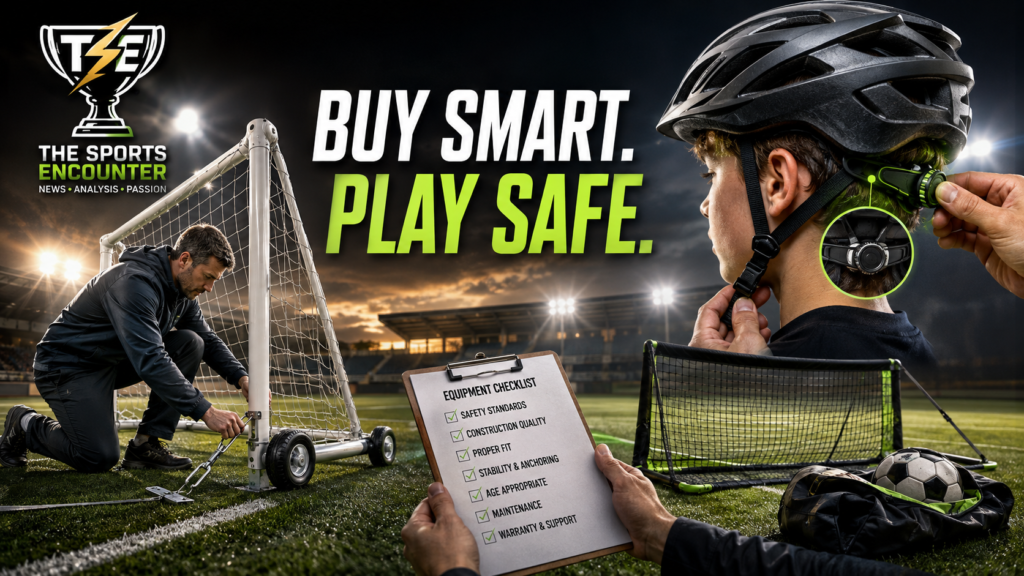
Can a movable goal be anchored correctly on that field? Does a helmet fit the athlete properly and adjust securely? Does a portable net or frame carry warnings that affect how or where it should be used?
Those questions belong in a serious sports-equipment comparison, particularly when equipment will be used by children, teams, schools, clubs, or other organized sports groups.
Start With Intended Use
Begin with the activity, athlete, environment, and expected level of use.
Equipment designed for occasional recreation may face very different demands from gear used repeatedly by a school, club, academy, or competitive athlete. Products carrying the same category label can also be designed for different surfaces, weather conditions, body sizes, age groups, or levels of intensity.
For families involved in organized sport, equipment is also part of a larger practical commitment. The Sports Encounter has previously examined the hidden coordination burden surrounding youth sports, where equipment, travel, scheduling, communication, meals, and family availability can all affect participation.
Before comparing products, identify:
- the sport or activity;
- the athlete’s age and experience;
- the playing or training surface;
- likely weather and environmental conditions;
- frequency and intensity of use; and
- whether the equipment will be shared.
Then compare those requirements with the manufacturer’s instructions.
If a product page provides only general descriptions while leaving important operating limits unclear, the buyer may need more information before making a decision.
Consumer-safety guidance in both the United States and Australia demonstrates why context matters. The U.S. Consumer Product Safety Commission’s sports, fitness and recreation guidance and the Australian Competition and Consumer Commission’s guidance on sport, exercise and play equipment show why installation, use, maintenance, and operating conditions matter when assessing sports equipment.
Three Sports Examples That Expose Missing Information
Movable Soccer Goals
Movable soccer goals illustrate why installation and storage deserve as much attention as dimensions and netting material.
The U.S. Consumer Product Safety Commission’s guidelines for movable soccer goals are designed to help reduce the risk of goals tipping over. The recommendations address anchoring or counterweighting, hardware inspection, level playing surfaces, safety labels, and securing or storing goals when they are not being used.
These are safety guidelines rather than a mandatory federal U.S. standard, an important distinction for buyers comparing requirements across markets.
Australia provides another useful example. The ACCC Product Safety guide to moveable soccer goals explains safety considerations involving anchoring, anchor points, warning labels, installation, and storage. In Australia, certain moveable soccer goals weighing 28 kilograms or more are covered by a mandatory safety standard.
A product listing that provides only width, height, weight, and net material may therefore leave a club or school without information it needs to determine whether the goal is suitable for its particular setup.
For readers following the sport more broadly, The Sports Encounter’s soccer coverage includes match reports, analysis, player stories, tournament coverage, explainers, and major developments across global football.
Bicycle Helmets
Bicycle helmets show why a size label and a proper fit are different things.
The U.S. Consumer Product Safety Commission’s bicycle helmet guidance covers performance requirements as well as instructions, labeling, fit, retention systems, impact warnings, certification, and cleaning.
Helmets must include information explaining how they should fit and be worn correctly. The requirements also address warnings following significant impacts. A helmet that has sustained an impact may suffer damage that is not immediately visible, which is why manufacturer instructions concerning inspection and replacement matter.
A responsible comparison should therefore consider more than shell material, appearance, or ventilation.
Useful information includes:
- the stated head-size range;
- the adjustment system;
- strap and retention guidance;
- applicable certification information;
- manufacturer fitting instructions; and
- instructions concerning impact, cleaning, and replacement.
Portable Sports Nets and Small Goals
Portable nets and smaller goals show why model-specific warnings deserve their own check.
In a product safety warning issued in December 2024, the U.S. Consumer Product Safety Commission warned consumers to stop using certain Sport Nets 4×8 portable soccer goals because exposed metal tips on the vertical poles created an impalement hazard.
The warning followed a fatal April 2023 incident involving a high school student in Washington State. According to the CPSC, the manufacturer declined to conduct a recall.
The example demonstrates why buyers should search the exact model, manufacturer information, and relevant regulator databases for safety warnings or recalls before equipment is put into service.
A photograph may show the general structure of a product. Small components, exposed edges, assembly details, and operating limitations can be much harder to identify from an ordinary listing.
Treat Fit and Sizing as Evidence
Size labels are rarely enough on their own.
Buyers should record the actual measurement system, the body or equipment dimensions being measured, the adjustment range, and any manufacturer-specific fit instructions.
That becomes particularly important for helmets, footwear, protective equipment, supports, and other gear where fit affects use or protection.
When comparing products sold in different markets, preserve the manufacturer’s original measurement information rather than relying entirely on automatic conversion.
Check whether a measurement refers to the athlete, the finished item, or an internal component.
For adjustable equipment, identify the manufacturer’s permitted adjustment range and follow any instructions relating to fit, positioning, or use.
Fit should also be considered under realistic conditions. Clothing, footwear, temperature, and athletic movement can all affect how equipment feels and performs.
Where fit has significant safety implications, manufacturer guidance and appropriate professional or specialist advice should take priority over assumptions based on photographs or generic size labels.
Separate a Specification From a Safety Claim
A specification describes a measurable or identifiable characteristic of a product.
A safety claim goes further. It says something about how the product is expected to perform under particular conditions.
Buyers should distinguish between the two.
Before relying on certification or standards language, check:
- the exact product or model;
- the relevant issuing or certification body;
- the standard being claimed;
- the scope of that standard;
- the date of the documentation; and
- the market or jurisdiction in which it applies.
A certification-style logo shown without supporting information provides less evidence than traceable documentation linked to the exact product or model.
Official regulatory databases can help with this process.
The European Commission’s Safety Gate provides information about dangerous non-food products identified through the European product-safety system, while the UK government’s Product Safety Alerts, Reports and Recalls service provides searchable information about product warnings, safety reports, and recalls.
These resources can help identify known problems. They do not replace product-specific manufacturer instructions.
Buyers should also check for warnings involving age, assembly, playing surface, weather, impact, maximum load, batteries, maintenance, and prohibited uses where those factors are relevant to the equipment concerned.
For gear used by children, schools, clubs, or organized teams, retaining the manufacturer’s instructions can also make future inspections and maintenance easier.
Check Maintenance and the End of Useful Life
Sports equipment changes with use.
Wear, impact, moisture, heat, sunlight, contamination, damaged fasteners, and poor storage can all affect condition over time.
Before purchasing equipment, find out how the manufacturer says it should be:
- cleaned;
- dried;
- stored;
- inspected;
- transported;
- repaired; and
- replaced.
Identify consumable or replaceable components where applicable.
A low purchase price can become less attractive if replacement parts are unavailable or a minor component failure makes the entire product unusable.
Teams, schools, clubs, and other organizations can also benefit from a simple inspection routine for frequently used shared equipment.
The purpose is practical: identify obvious damage or deterioration before the item is used again and follow the manufacturer’s instructions when something requires attention.
Delivery, warranty, and returns remain relevant, particularly for equipment bought across borders, but they should remain secondary to suitability and safety.
Buyers may still want to record the return window, return location, responsibility for shipping costs, replacement-part availability, and evidence required when making a claim.
A warranty has limited practical value when the buyer cannot realistically use it.
Verify Information Before Relying on It
A simple source hierarchy can make equipment comparisons more reliable.
For product-specific instructions, begin with the manufacturer and the manual supplied for the exact model.
For regulations, recalls, warnings, and broader product-safety information, consult the relevant regulator, governing authority, recognized standards body, or official database.
Independent reviews and community discussions can reveal recurring concerns or useful questions, but they should not replace primary documentation for safety-critical claims.
For an important claim, ask:
- Does it apply to this exact product or model?
- What authoritative or manufacturer documentation supports it?
- Does that documentation explain relevant conditions or limitations?
- Is the information current?
- Is there a regulator warning, recall, updated manual, or replacement notice that changes the picture?
For significant purchases, keeping the order record, instructions, model information, photographs, and relevant product documentation can make future warranty, recall, return, or support issues easier to resolve.
A Practical Checklist for Athletes, Families and Sports Organizations
Intended Use
What sport, athlete, surface, environment, and level of use is the equipment designed for?
Fit
Which measurements and adjustment instructions determine whether it fits correctly?
Safety Information
Which warnings, standards, certifications, recalls, or operating limitations are relevant?
Maintenance
How should the equipment be cleaned, stored, inspected, repaired, or replaced?
Support
Are replacement parts, manufacturer support, warranty service, and realistic return options available in the buyer’s market?
Long-Term Cost
What maintenance, replacement, return, and disposal costs may arise?
Evidence
Which important claims can be traced to the manufacturer, regulator, governing authority, recognized standard, or another authoritative source?
When several important answers remain unavailable, delaying the purchase can be a perfectly rational decision.
It turns uncertainty into a specific list of questions that can be resolved before money is spent or equipment is put into use.
Better Information Makes for Better Sports Decisions
Good sports-equipment information should ultimately help people make better decisions in the environment where the equipment will actually be used.
For one athlete, that could mean finding a helmet that fits correctly. For a parent, it could mean spotting an important warning before a child uses a piece of equipment. For a coach, it may involve inspecting shared gear. For a school or club, the biggest issue could be anchoring, maintenance, replacement, or storage.
A useful specification sheet therefore goes beyond measurements and materials.
It helps the reader understand whether the equipment is appropriate for the athlete, the sport, and the conditions in which it will actually be used.