


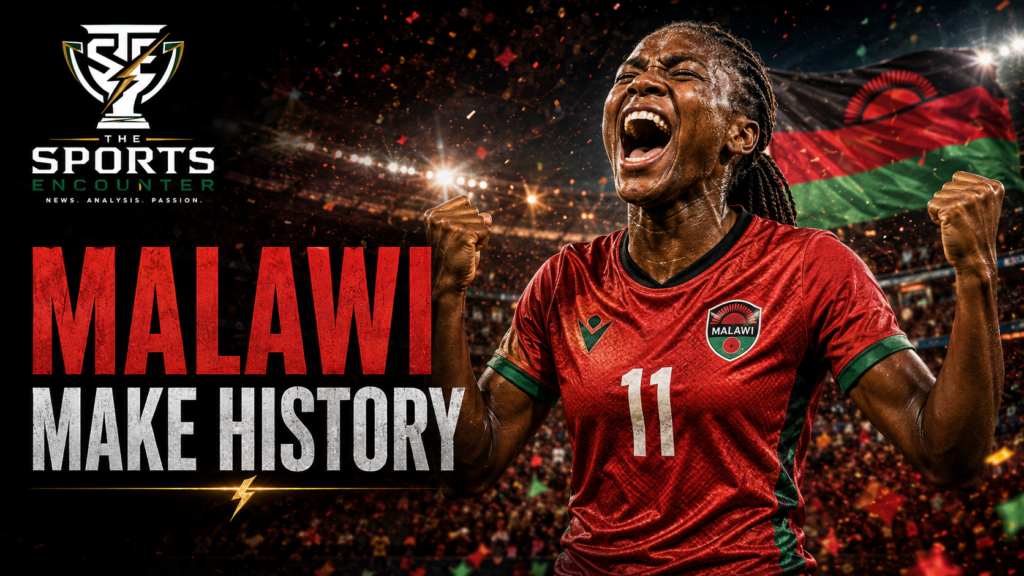
Malawi arrived at the 2026 Women’s Africa Cup of Nations without a single previous appearance in the tournament. Two weeks later, the Scorchers are heading to their first FIFA Women’s World Cup.
That transformation became official in Rabat on Sunday night when Malawi came from behind to defeat Ghana 2-1 in the final WAFCON quarter-final and secure one of Africa’s four automatic places at the FIFA Women’s World Cup Brazil 2027.
Chantelle Boye-Hlorkah gave Ghana the lead after only seven minutes, briefly threatening to end the tournament’s most remarkable debut campaign.
Malawi answered almost immediately.
Temwa Chawinga equalized in the 12th minute before Rose Kadzere delivered the decisive moment in the 79th, finishing inside the penalty area to send the Scorchers into the WAFCON semifinals and, for the first time in their history, onto the biggest stage in women’s football.
The result completed Africa’s four automatic qualifiers for Brazil 2027.
Malawi join Algeria, Cameroon and Morocco in qualifying directly through WAFCON 2026.
For Malawi, though, the story has developed with astonishing speed.
They entered Morocco as first-time WAFCON participants.
They beat defending champions Nigeria in their opening match.
They defeated Egypt.
They topped Group C despite losing their final group fixture to Zambia.
Now they have beaten one of Africa’s historically established women’s national teams in a knockout match with World Cup qualification on the line.
This is no longer simply an underdog run.
Malawi have changed their place in African women’s football.
Malawi vs Ghana: WAFCON 2026 Quarter-Final at a Glance
| Match Detail | Information |
|---|---|
| Competition | Women’s Africa Cup of Nations 2026 |
| Round | Quarter-final |
| Venue | Al Medina Stadium, Rabat |
| Date | August 9, 2026 |
| Ghana Scorer | Chantelle Boye-Hlorkah, 7′ |
| Malawi Scorers | Temwa Chawinga, 12′; Rose Kadzere, 79′ |
| Final Score | Malawi 2-1 Ghana |
| World Cup Impact | Malawi qualify for FIFA Women’s World Cup for first time |
| WAFCON Impact | Malawi reach semifinals on tournament debut |
| Next Match | Malawi vs Algeria, WAFCON semifinal |
Ghana Strike First and Put Malawi Under Immediate Pressure
The quarter-final began in a way that should have favored experience.
Ghana entered the contest with decades of WAFCON history behind them.
They had previously qualified for three Women’s World Cups, in 1999, 2003 and 2007.
Malawi were playing only their fourth knockout-level match at a senior continental tournament because this was their first appearance at WAFCON.
The Black Queens took advantage almost immediately.
Boye-Hlorkah struck in the seventh minute, giving Ghana a 1-0 lead and forcing Malawi to respond before nerves or the scale of the occasion could settle in.
That moment could easily have changed the entire match.
Instead, Malawi’s reaction revealed why this team has repeatedly survived difficult situations during the tournament.
Temwa Chawinga Needs Only Five Minutes to Restore Belief
Temwa Chawinga has been the attacking force at the heart of Malawi’s tournament.
She responded to Ghana’s opener in the 12th minute.
Five minutes after falling behind, Malawi were level.
The speed of that answer mattered enormously.
Ghana never received the opportunity to settle into a defensive structure with the lead.
Malawi avoided spending half the match chasing.
The quarter-final reset almost immediately.
CAF described Chawinga’s equalizer as the moment that reignited Malawi after Ghana’s fast start.
Her influence throughout the tournament has been substantial.
Before the quarter-final, CAF statistics credited Temwa with three group-stage goals and an assist, including two goals against defending champions Nigeria.
She had already become the first Malawian to score and assist in the same WAFCON match.
Her performance against Ghana added the most valuable goal yet.
The Chawinga Sisters Have Given Malawi a World-Class Attack
Few debuting tournament teams arrive with two forwards as internationally established as Temwa and Tabitha Chawinga.
The sisters have become the foundation of Malawi’s attacking identity.
Temwa plays at the highest level in the United States.
Tabitha has established herself in elite European football.
CAF described their understanding as almost telepathic before the tournament began.
That may sound promotional until Malawi start attacking in transition.
The sisters stretch defensive lines differently.
Temwa’s acceleration creates space behind defenders.
Tabitha can carry, hold possession and attack central areas.
Opponents must account for both simultaneously.
Ghana experienced that problem repeatedly after the equalizer.
Ghana Thought They Had Retaken the Lead
The quarter-final’s biggest moment before Kadzere’s winner may have arrived shortly after halftime.
Doris Boaduwaa put the ball into the net for Ghana.
The Black Queens celebrated what appeared to be a second goal.
VAR intervened.
The effort was ruled out.
CAF identified the decision as one of the defining moments of the match.
That is easy to understand.
A 2-1 Ghana lead would have changed Malawi’s tactical problem completely.
The Scorchers would have needed to open the field.
Ghana could have countered into space.
Instead, the match remained level.
Malawi were still one goal from history.
Rose Kadzere Produces Malawi’s Biggest Goal Yet
The decisive breakthrough came in the 79th minute.
Rose Kadzere found space inside the penalty area and kept her composure.
Her finish beat the Ghana goalkeeper and gave Malawi the lead for the first time.
There were still more than 10 minutes to survive.
The significance of the goal was already impossible to ignore.
At 2-1, Malawi were heading to both the WAFCON semifinals and Brazil 2027.
Kadzere had already played an important creative role earlier in the competition.
CAF statistics showed she made five key passes against Egypt, more than any player in that match, and also registered three shots on target.
Against Ghana, she became the scorer of the most consequential goal in Malawian women’s football history.
Malawi Defend Their Lead Instead of Retreating Into Panic
Ghana pushed forward after Kadzere’s goal.
Fresh attackers were introduced.
Numbers moved higher up the pitch.
The Black Queens needed only one goal to force extra time.
Malawi held their shape.
That closing phase is important because inexperienced tournament teams often lose matches after reaching the moment they have dreamed about.
Players begin protecting the result rather than playing the situation.
Clearances become rushed.
Possession disappears.
Distances between defensive lines grow.
The Scorchers avoided that collapse.
They defended the final minutes and completed the 2-1 victory.
From WAFCON Debutants to World Cup Qualifiers in Two Weeks
The speed of Malawi’s rise is what makes this story extraordinary.
Before July 2026, they had never played a match at the Women’s Africa Cup of Nations.
Now they are one of Africa’s four confirmed representatives at the 2027 Women’s World Cup.
CAF described the run as one of the greatest stories in WAFCON history.
The description is difficult to challenge.
Malawi have achieved in one tournament what several more established national programs have spent years trying to accomplish.
Malawi’s Road to the 2027 Women’s World Cup
| Stage | Opponent | Result | Significance |
|---|---|---|---|
| Group Stage | Nigeria | Won 3-2 | Historic opening victory over defending champions |
| Group Stage | Egypt | Won 3-1 | Second straight win and major step toward knockouts |
| Group Stage | Zambia | Lost | Still finished top of Group C |
| Quarter-final | Ghana | Won 2-1 | Qualified for first Women’s World Cup |
The Nigeria Victory Changed Malawi’s Tournament Before Anyone Realized It
Malawi’s opening game now looks even more important.
Nigeria entered WAFCON as defending champions and the most successful nation in the history of the competition.
Malawi were debutants.
Temwa Chawinga scored twice.
Tabitha Chawinga added another.
Malawi won 3-2.
CAF noted that the result ended Nigeria’s record of never losing to a WAFCON debutant since the competition began in 1998.
At the time, it looked like an enormous upset.
It now looks like the first evidence that Malawi were capable of something much bigger.
Malawi Did Not Stop After Beating Nigeria
Tournament surprises often fade in the next match.
That did not happen.
Malawi beat Egypt 3-1 and moved to six points.
They eventually finished top of Group C after three teams ended the section with six points.
Malawi progressed because of their superior head-to-head goal difference.
That detail mattered.
Finishing first gave them Ghana rather than a different quarter-final opponent and allowed the Scorchers to maintain momentum from a remarkable group campaign.
Malawi Set Several Debutant Records Before Even Facing Ghana
The numbers already showed how unusual their campaign had become.
CAF confirmed that, excluding the inaugural 1998 competition, Malawi became the first WAFCON debutants to win two group matches.
They were also the first debutants outside that inaugural edition to collect six group-stage points.
Their seven group-stage goals were the most by WAFCON newcomers since Côte d’Ivoire also scored seven in 2012.
Malawi scored in all three group matches.
They also became only the second tournament debutants to reach a WAFCON quarter-final since the last-eight format was introduced.
By defeating Ghana, Malawi moved beyond those records into a much more exclusive category.
The First WAFCON Debutants in 26 Years to Reach the Semifinals
Before Malawi, the last debuting side to reach the WAFCON semifinals was Zimbabwe in 2000.
That gap tells its own story.
Twenty-six years passed.
Numerous new participants entered the tournament.
None managed what Malawi have done in Morocco.
The Scorchers have now broken that run.
They have also become only the second Southern African nation to reach the semifinals on debut after Zimbabwe’s 2000 campaign.
Why Ghana Entered the Match as the Historical Favorite
Ghana’s record against debutants made Malawi’s victory even more striking.
Before Sunday, the Black Queens had played nine WAFCON matches against debuting nations.
They had won eight.
The only defeat came against Nigeria in the 1998 final, when every team involved in the inaugural tournament was technically making its first appearance.
Ghana had scored 27 goals and conceded only six across those nine meetings.
They had won their previous five games against WAFCON debutants.
Malawi did not care about the history.
Ghana’s World Cup Absence Will Continue Unless They Survive the Play-Off Route
The Black Queens were chasing their first Women’s World Cup appearance since 2007.
Ghana previously reached the global tournament in 1999, 2003 and 2007.
Sunday’s defeat means they have missed the direct qualification route again.
Their World Cup hopes are not over.
Under the CAF qualification structure, the four losing WAFCON quarter-finalists enter African play-offs.
The two winners then progress to FIFA’s inter-confederation play-off tournament.
Ghana will face Côte d’Ivoire in that African play-off.
How Africa Qualifies for the 2027 FIFA Women’s World Cup
The WAFCON quarter-finals carried an unusual level of pressure because each winner qualified automatically for Brazil 2027.
FIFA confirmed before the tournament that all four semifinalists would claim Africa’s four direct World Cup places.
| Qualification Route | Places |
|---|---|
| WAFCON semifinalists | 4 direct Women’s World Cup places |
| WAFCON losing quarter-final play-offs | 2 teams advance to inter-confederation play-offs |
| Total potential African representation | Up to 6 teams |
Malawi no longer need to worry about the play-off route.
Their place in Brazil is secure.
Africa’s Four Automatic Qualifiers Are Now Confirmed
| Team | World Cup Status | Qualification Significance |
|---|---|---|
| Malawi | Qualified | First Women’s World Cup appearance |
| Algeria | Qualified | First Women’s World Cup appearance |
| Morocco | Qualified | Second consecutive World Cup |
| Cameroon | Qualified | Return to global tournament |
Two first-time qualifiers among Africa’s four direct places represent a significant shift.
Malawi and Algeria will both make their global debuts in Brazil.
The Sports Encounter has already examined Algeria’s historic qualification and Morocco’s return to the Women’s World Cup, creating a wider picture of how African women’s football is changing.
Cameroon’s Win Over Nigeria Created Another Huge Shock
Malawi’s qualification was not the only major development on Sunday.
Cameroon defeated defending champions Nigeria 1-0 in Casablanca.
Nineteen-year-old Myriam Nyadjou scored the decisive goal with a long-range free kick.
The result sent Cameroon to Brazil and forced Nigeria into the play-off route.
Nigeria had previously qualified for every Women’s World Cup.
That streak is now under serious threat.
The quarter-final round has therefore reshaped Africa’s hierarchy on two fronts.
Malawi have arrived.
Nigeria have been pushed out of the automatic qualification places.
A New WAFCON Champion Is Guaranteed
Nigeria’s elimination also guarantees a new continental champion.
The Super Falcons entered the tournament as defending champions and record winners.
Their defeat removes the most decorated team from the competition before the semifinals.
Malawi, Algeria, Cameroon and Morocco are the four remaining sides.
Three of those four have never won WAFCON.
The tournament is therefore heading toward a final few days that could redefine the continental order.
Malawi vs Algeria Is Now Much Bigger Than Anyone Expected
Malawi will face Algeria in the first semifinal on Wednesday.
Neither team entered WAFCON as an obvious favorite to reach this stage.
Both have now qualified for the World Cup for the first time.
One of them will play for the African championship.
That creates one of the most unexpected semifinal pairings in recent WAFCON history.
There is also an interesting tactical contrast.
Malawi have played with attacking directness and transition speed, particularly through the Chawinga sisters.
Algeria have shown resilience, defensive structure and the ability to recover from difficult match situations.
The semifinal could become a battle between Malawi’s explosive forward movement and Algeria’s control.
The Chawinga Sisters Will Now Arrive at a World Cup Together
This may be one of the most compelling human stories attached to Malawi’s qualification.
Temwa and Tabitha Chawinga have built successful international club careers largely away from home.
Their national team had never reached the global stage.
That gap is now closed.
Brazil 2027 will give the sisters the opportunity to represent Malawi at the highest level of women’s football.
For a country making its first appearance, having two established elite forwards offers an enormous advantage.
Malawi will not arrive with anonymous attacking talent.
Opponents will already understand the threat.
Temwa Chawinga Has Become the Face of Malawi’s Breakthrough
Temwa’s tournament has been exceptional.
Her two goals against Nigeria created the first statement.
Her attacking contribution against Egypt helped maintain momentum.
Her equalizer against Ghana came at exactly the moment Malawi needed it.
World Cup qualification guarantees that her rise will now be seen by a much larger global audience.
This is important for Malawi’s profile as well.
International tournaments often transform national-team players into domestic sporting figures.
Temwa already has international recognition.
Brazil could turn her into the face of Malawian football globally.
Rose Kadzere Deserves Her Own Place in the Story
The Chawinga sisters naturally dominate headlines.
Kadzere’s contribution demonstrates that Malawi’s breakthrough is not based on only two players.
She has created chances.
She has competed physically.
She has provided attacking support around the sisters.
Then, with a World Cup place on the line, she scored the winner.
That is the type of contribution successful tournament teams need.
Star players attract defensive attention.
Other players must exploit the spaces that attention creates.
Kadzere did exactly that.
Coach Lovemore Fazili Has Built Belief Without Overcomplicating the Moment
Malawi are coached by former men’s international Lovemore Fazili.
CAF noted before the quarter-final that Fazili had repeatedly emphasized approaching the tournament one step at a time.
That mentality appears simple.
It has been effective.
Debutants can easily become consumed by historical significance.
First appearance.
First knockout game.
First World Cup opportunity.
Fazili’s team has repeatedly played the immediate match rather than the occasion surrounding it.
That may be one of the strongest explanations for their calmness against Ghana.
Malawi Have Already Changed Expectations for Smaller African Programs
The wider significance extends beyond Malawi.
WAFCON’s expansion has created more opportunities for developing women’s national teams.
Qualification alone does not guarantee competitiveness.
Malawi have demonstrated what can happen when a new participant arrives with elite players, a clear identity and enough confidence to attack established powers.
Other federations will notice.
A national team does not necessarily need decades of tournament history before competing meaningfully.
Development can accelerate rapidly when the correct generation arrives together.
Brazil 2027 Could Transform Women’s Football in Malawi
World Cup qualification brings consequences beyond the tournament itself.
Visibility increases.
Sponsorship interest can grow.
Federation funding becomes more valuable.
Young players gain reference points.
Families can see a realistic pathway from local football to the world stage.
Domestic leagues gain attention.
Players become more attractive to international clubs.
The challenge is converting those opportunities into long-term structures.
First-Time Qualification Is Only Valuable if Malawi Build on It
The celebration is deserved.
The work begins almost immediately.
Brazil 2027 will expose Malawi to a different competitive level.
The Scorchers will face teams with greater depth, more professional infrastructure and years of World Cup experience.
Preparation must therefore begin long before the tournament.
Malawi need strong international friendlies.
Squad depth must improve.
Players outside the starting group need meaningful minutes.
Defensive organization will require testing against elite attacks.
Sports science and recovery support will matter.
World Cup qualification has given Malawi access.
The next goal should be arriving prepared enough to compete.
The 2027 Women’s World Cup Will Be Staged in Brazil
The FIFA Women’s World Cup Brazil 2027 will feature 32 teams.
Brazil will become the first South American nation to host the Women’s World Cup.
For Malawi and Algeria, it will also be the first appearance at the tournament.
Morocco will return after reaching the knockout stage on debut in 2023.
Cameroon restore themselves to the global field after missing the previous edition.
The African contingent already looks very different from the one many expected before WAFCON began.
Ghana Still Have One More Route to Brazil
Sunday’s defeat was devastating, but not final.
Ghana now face Côte d’Ivoire in the CAF play-off round.
A victory would send the Black Queens to FIFA’s inter-confederation play-offs.
From there, qualification remains possible.
The route is significantly harder than the one Malawi have secured.
Ghana must now survive two separate stages rather than simply prepare for Brazil.
Nigeria Face the Same Uncomfortable Reality
Nigeria’s loss to Cameroon means the defending champions also fall into the play-off route.
That may become one of the biggest stories of the tournament.
The Super Falcons have appeared at every Women’s World Cup to date.
Missing Brazil would represent a historic failure for the continent’s most successful women’s national team.
The quarter-final results demonstrate how quickly African women’s football is becoming less predictable.
TSE Analysis: Malawi’s Biggest Achievement Is That Their Run No Longer Feels Accidental
One upset can happen.
A favorable draw can happen.
A tournament can occasionally reward a team for one extraordinary night.
Malawi have moved beyond that explanation.
They beat Nigeria.
They beat Egypt.
They topped their group.
They responded to conceding early against Ghana.
They survived a VAR scare.
They found a late winner.
They defended the lead under pressure.
That sequence demonstrates repeatable qualities rather than luck.
The Scorchers possess pace.
They have elite forwards.
They can recover from setbacks.
Their supporting players have contributed decisive moments.
They believe they belong.
That last quality may explain more than any statistic.
The World Cup Qualification Changes Malawi’s Identity
Before WAFCON, Malawi were a developing women’s national team entering their first continental finals.
They leave the quarter-final stage with an entirely different identity.
World Cup qualifiers.
WAFCON semifinalists.
A team that has beaten Nigeria and Ghana in the same tournament.
A team built around two globally recognized attackers.
A national program that now has proof it can compete with Africa’s traditional powers.
That psychological shift can last much longer than one tournament.
What Happens Next?
Malawi’s historic qualification does not end their WAFCON campaign.
The Scorchers face Algeria in the semifinals.
Hosts Morocco meet Cameroon in the other last-four match.
The final will be staged in Rabat.
Malawi now have the freedom to chase the continental title without the burden of World Cup qualification hanging over every decision.
That could make them even more dangerous.
The pressure has changed.
They are no longer playing for access to Brazil.
They are playing for a trophy.
Malawi’s WAFCON 2026 Story So Far
| Milestone | Achievement |
|---|---|
| First WAFCON appearance | 2026 |
| Opening match | Beat defending champions Nigeria 3-2 |
| Group position | 1st in Group C |
| Group-stage wins | 2 |
| Quarter-final | Beat Ghana 2-1 |
| First WAFCON semifinal | Qualified |
| First Women’s World Cup | Brazil 2027 |
Final Verdict: Malawi Have Already Won Something Bigger Than One Quarter-Final
The final whistle against Ghana confirmed a scoreline.
Its consequences stretch much further.
Malawi have reached their first Women’s World Cup.
They have reached the WAFCON semifinals on debut.
They have beaten the defending champions and one of the continent’s historically strongest women’s teams in the same tournament.
Temwa Chawinga has reinforced her status as one of Africa’s elite forwards.
Tabitha Chawinga will finally have the opportunity to represent her country on the World Cup stage.
Rose Kadzere has written her name into Malawian football history.
The country now has a national-team achievement capable of changing what young girls believe is possible.
Algeria await in the semifinal.
Malawi may still go further.
Even if the run ends there, the tournament has already altered the program permanently.
The Sports Encounter’s assessment: Malawi’s qualification is one of the defining stories of WAFCON 2026 because it has grown beyond the language of surprise. The Scorchers have repeatedly beaten established teams, responded to pressure and found different match-winners. Brazil 2027 is no longer a dream or a future target. Malawi earned it.
Fans can follow official tournament updates through the CAF Women’s Africa Cup of Nations and the FIFA Women’s World Cup Brazil 2027.
For continuing international football coverage, qualification stories and tournament analysis, visit The Sports Encounter’s Soccer section.
Readers can also explore how Algeria and Morocco secured their places at Brazil 2027 as Africa’s qualification picture continues to take shape.
Frequently Asked Questions
Did Malawi qualify for the 2027 FIFA Women’s World Cup?
Yes. Malawi qualified for their first FIFA Women’s World Cup by defeating Ghana 2-1 in the WAFCON 2026 quarter-finals.
Who scored for Malawi against Ghana?
Temwa Chawinga scored Malawi’s equalizer in the 12th minute and Rose Kadzere scored the winning goal in the 79th minute.
Who scored for Ghana?
Chantelle Boye-Hlorkah gave Ghana the lead in the seventh minute.
Was Ghana’s second goal disallowed?
Yes. Doris Boaduwaa put the ball in the net after halftime, but the goal was ruled out following a VAR review.
Is this Malawi’s first Women’s World Cup?
Yes. Brazil 2027 will be Malawi’s first appearance at the FIFA Women’s World Cup.
Is this Malawi’s first WAFCON?
Yes. Malawi are competing at the Women’s Africa Cup of Nations for the first time in 2026.
Who did Malawi beat in the group stage?
Malawi defeated defending champions Nigeria 3-2 and Egypt 3-1 before losing their final group match to Zambia.
How did Malawi finish top of Group C?
Malawi, Nigeria and Zambia all finished with six points, but Malawi progressed as group winners because of their superior head-to-head goal difference.
Who will Malawi play in the WAFCON semifinal?
Malawi will face Algeria in the semifinals.
Which African teams have qualified directly for the 2027 Women’s World Cup?
Malawi, Algeria, Morocco and Cameroon have secured Africa’s four automatic qualification places.
Can Ghana still qualify for the Women’s World Cup?
Yes. Ghana will enter the African play-off round against Côte d’Ivoire. The winner will advance to FIFA’s inter-confederation play-off tournament.
Can Nigeria still qualify for Brazil 2027?
Yes. Nigeria must now use the play-off route after losing their quarter-final to Cameroon.
Who are Malawi’s biggest stars?
Temwa Chawinga and Tabitha Chawinga are Malawi’s most internationally established players, but Rose Kadzere and several supporting players have also made decisive contributions during WAFCON 2026.
Who coaches Malawi?
Malawi are coached by former men’s international Lovemore Fazili.
Why is Malawi’s qualification historic?
The Scorchers have qualified for a Women’s World Cup for the first time while also reaching the WAFCON semifinals during their tournament debut.