


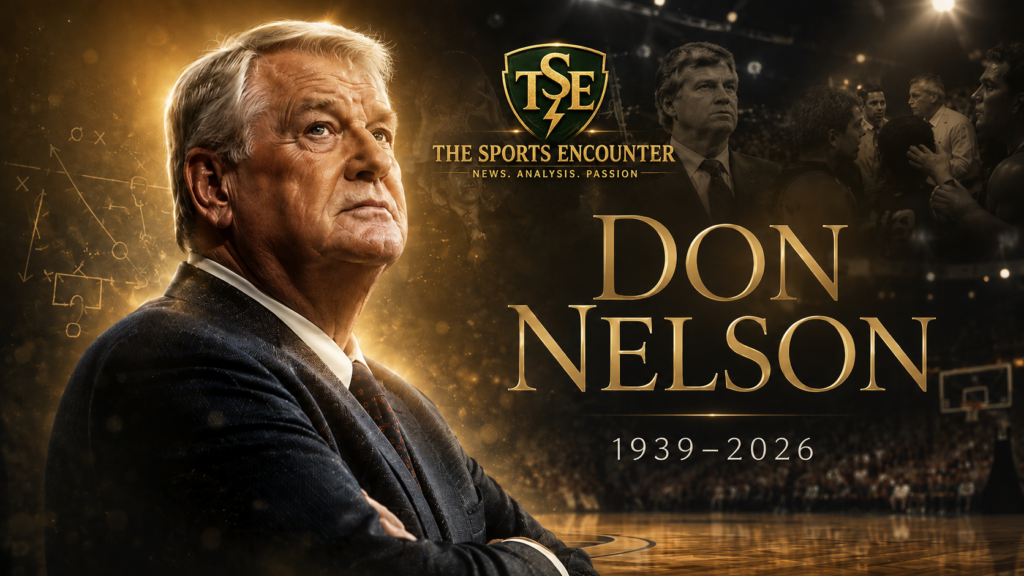
Don Nelson, the Hall of Fame coach whose unconventional ideas helped reshape NBA basketball long before small-ball lineups, positionless players and pace-and-space offenses became normal, has died at the age of 86.
Nelson’s family said he died peacefully on Sunday morning surrounded by loved ones.
Basketball loses one of its most unusual and influential figures.
He won five NBA championships as a player with the Boston Celtics.
He later spent 31 seasons as a head coach and accumulated 1,335 regular-season victories, second only to Gregg Popovich in NBA history.
Nelson coached the Milwaukee Bucks, Golden State Warriors, New York Knicks and Dallas Mavericks.
He won NBA Coach of the Year three times.
He reached the playoffs 18 times.
He was inducted into the Naismith Memorial Basketball Hall of Fame in 2012.
Yet numbers explain only part of the reason “Nellie” mattered.
Nelson saw possibilities other coaches considered mistakes.
He used forwards as playmakers.
He willingly played without conventional centers.
He encouraged pace when the league still revolved heavily around structured half-court basketball.
He searched relentlessly for mismatches instead of forcing players into traditional positional roles.
Long before the modern NBA began talking about positionless basketball, Nelson was already experimenting with it.
NBA Commissioner Adam Silver described him as a coach whose fearlessness and ingenuity changed the sport.
“Don Nelson revolutionized NBA basketball through his fearlessness, ingenuity and deep conviction.”
Golden State called him a basketball visionary whose influence continues through generations of coaches and players.
Current Warriors coach Steve Kerr offered perhaps the clearest explanation of Nelson’s place in basketball history.
“So much of what is now commonplace in the modern NBA can be traced back to the way Nellie approached the game.”
That may ultimately be Nelson’s greatest accomplishment.
He never won an NBA championship as a coach.
Basketball still ended up playing increasingly like him.
Don Nelson: Career at a Glance
| Category | Don Nelson |
|---|---|
| Age at Death | 86 |
| NBA Playing Seasons | 14 |
| Boston Celtics Championships | 5 |
| Celtics Jersey | No. 19 retired |
| NBA Coaching Seasons | 31 |
| Regular-Season Coaching Wins | 1,335 |
| All-Time Coaching Wins Rank | 2nd |
| NBA Coach of the Year Awards | 3 |
| Playoff Appearances as Coach | 18 |
| Hall of Fame Induction | 2012 |
| Chuck Daly Lifetime Achievement Award | 2025 |
Don Nelson’s Family Announces His Death
Nelson’s family confirmed his death through NBA reporter Marc Stein.
“On Sunday morning our beloved husband, dad, grandfather and great-grandfather Don Nelson peacefully went to be with the Lord, surrounded by his loving family.”
No detailed cause of death was immediately announced.
Tributes quickly arrived from around the NBA.
The Warriors remembered him as one of the most innovative figures in franchise history.
The Boston Celtics emphasized that Nelson’s extraordinary coaching career should never obscure how valuable he had been as a player.
Milwaukee, Dallas and New York also honored a coach who left a different kind of imprint everywhere he worked.
Before Nellie Ball, Nelson Was a Five-Time NBA Champion
Younger fans may primarily know Nelson as the eccentric coach associated with oversized shirts, small lineups and the “We Believe” Warriors.
His basketball education began inside one of the greatest dynasties professional sports has ever produced.
Nelson played 14 NBA seasons and spent 11 of them with the Boston Celtics.
He joined an organization defined by Bill Russell, Red Auerbach and a culture where understanding the game mattered as much as individual statistics.
Nelson won five championships with Boston.
He was never the biggest star on those teams.
That was part of what made him valuable.
He understood spacing.
He understood roles.
He understood how stars and complementary players fit together.
Those lessons later became central to his coaching philosophy.
His Most Famous Shot Helped Win the 1969 NBA Finals
Nelson also owns one of the strangest and most memorable shots in NBA Finals history.
Boston faced the Los Angeles Lakers in Game 7 of the 1969 Finals.
Late in the fourth quarter, Nelson took a jumper that struck the back rim.
Instead of bouncing away, the ball shot almost vertically upward before dropping through the basket.
The improbable shot gave Boston additional breathing room in a game the Celtics eventually won 108-106.
It became the final championship of the Russell era.
Nelson’s contribution remains part of one of the defining Game 7s in NBA history.
Boston Retired No. 19
Nelson retired as a player in 1976.
Two years later, Boston retired his No. 19 jersey.
The honor reflected something that would follow Nelson throughout basketball.
He rarely fit neatly into conventional categories.
He was neither superstar nor ordinary role player.
His value came through intelligence, toughness, adaptability and an instinct for understanding what a team needed.
The same instincts soon appeared on the sideline.
Milwaukee Was Where Don Nelson Became Don Nelson
Nelson entered coaching as an assistant with the Milwaukee Bucks.
He became head coach during the 1976-77 season after Larry Costello resigned.
Over the next 11 seasons, Milwaukee became one of the NBA’s most consistently successful franchises.
The Bucks won seven consecutive division titles under Nelson.
They reached the conference finals three times.
Nelson won Coach of the Year in 1983 and 1985.
His Milwaukee teams also provided the laboratory for ideas that would eventually define his career.
Nelson did not believe basketball positions needed to function as rigid job descriptions.
If a forward could handle the ball, Nelson wanted him initiating offense.
If a smaller lineup created an advantage, he used it.
If speed exposed a bigger opponent, he accelerated the game.
The NBA later gave those ideas familiar labels.
Nelson was already using them.
The Point Forward Was One of His Most Important Innovations
Nelson is widely credited with helping popularize the concept of the point forward.
The idea sounds ordinary in the modern NBA.
LeBron James organizes offense.
Draymond Green initiates possessions.
Nikola Jokic functions as an offensive hub despite technically being a center.
Large players routinely bring the ball up the court.
Forty years ago, basketball positions were far more restrictive.
Point guards handled.
Shooting guards scored.
Small forwards worked from the wing.
Power forwards and centers generally operated closer to the basket.
Nelson kept asking why.
If a taller player could pass and make decisions, giving him playmaking responsibility could distort conventional defensive matchups.
That philosophy became one of the foundations of modern positionless basketball.
Nellie Ball Was About Finding the Advantage
Nelson’s offensive philosophy eventually became known as “Nellie Ball.”
The term is sometimes reduced to playing fast or using small lineups.
The deeper idea was flexibility.
Nelson cared less about whether a lineup looked conventional than whether the five players created an advantage.
He wanted pace.
He wanted passing.
He wanted players capable of attacking mismatches.
He wanted defenders making uncomfortable decisions.
A traditional center could become less valuable if he could not defend in space.
A forward became more valuable if he could handle, pass and shoot.
A guard could become devastating if surrounded by enough spacing.
These principles now sit at the center of NBA roster construction.
Golden State Became His Perfect Basketball Laboratory
Nelson first coached Golden State from 1988 through 1995.
The Warriors gave him exactly the kind of roster on which experimentation could flourish.
Tim Hardaway.
Mitch Richmond.
Chris Mullin.
Together they became known as Run TMC.
Golden State played quickly.
Its stars could shoot.
They could handle.
They could score in transition.
The Warriors became one of the most entertaining teams of their era.
They never won a championship.
Their influence exceeded their trophy cabinet.
Run TMC Was an Early Preview of Modern NBA Offense
Hardaway, Richmond and Mullin did not function like a conventional championship core built around a dominant low-post center.
The offense flowed through skill.
Tempo created opportunities.
Perimeter players attacked before defenses could organize.
Nelson used unconventional lineups and was willing to trade size for offensive creativity.
The style anticipated many of the ideas that later became standard throughout the league.
Chris Mullin’s Jersey Ceremony Showed Nelson’s Golden State Connection
Nelson remained closely associated with the Warriors long after his coaching career.
In 2012, he appeared during Golden State’s ceremony retiring Chris Mullin’s No. 17 jersey.
That relationship mattered because Mullin became one of the clearest examples of Nelson’s trust in versatile offensive players.
Golden State’s modern dynasty eventually elevated shooting, passing and smaller lineups to championship level.
Nelson had been experimenting with similar principles decades earlier.
His Knicks Experiment Lasted Less Than One Season
Nelson’s career was not a straight line of successful innovation.
His stint with the New York Knicks in 1995-96 lasted only 59 games.
The roster and Nelson’s preferred style never fitted comfortably.
The Knicks were built around the physical identity associated with Patrick Ewing and the bruising Eastern Conference basketball of the era.
Nelson wanted more movement and flexibility.
The relationship failed quickly.
That chapter remains useful when evaluating his career.
Innovative ideas still require the correct personnel and organizational support.
Dallas May Have Been Nelson’s Most Important Long-Term Project
Nelson took control of a struggling Mavericks organization in the late 1990s.
Dallas had spent much of the decade far away from championship relevance.
Nelson helped transform the franchise.
Two players became central to that transformation.
Steve Nash.
Dirk Nowitzki.
Nelson understood both before the basketball world fully understood either.
He Saw Something Different in Dirk Nowitzki
Nowitzki entered the NBA as a 20-year-old German forward in 1998.
At 7 feet tall, conventional basketball thinking could easily have pushed him toward the post.
Nelson saw his shooting and ball skills differently.
He wanted Nowitzki operating in space.
He wanted him shooting from distance.
He wanted defenders deciding whether to send a slow big man toward the perimeter or sacrifice size by switching a smaller player onto him.
That sounds completely normal today.
In the late 1990s, it was radical.
Nowitzki eventually became an NBA MVP, NBA champion and Hall of Famer.
His career permanently changed perceptions of what a 7-footer could do offensively.
Nelson helped recognize the possibility early.
Steve Nash Flourished Under Nelson Too
Nash arrived in Dallas after two relatively quiet seasons in Phoenix.
Nelson gave him a larger platform.
His passing, shooting and ability to create tempo became central to an increasingly dangerous Mavericks offense.
Nash eventually left Dallas and won consecutive MVP awards in Phoenix.
Yet his evolution into one of the league’s best offensive point guards accelerated during Nelson’s tenure.
The combination of Nash and Nowitzki also foreshadowed the pick-and-pop, five-out and perimeter-oriented basketball that would become central to the modern NBA.
Nelson Turned the Mavericks Into Contenders
Dallas gradually transformed from one of the NBA’s weakest franchises into a consistent playoff team.
The Mavericks reached the Western Conference finals under Nelson in 2003.
He never took Dallas to the NBA Finals.
The infrastructure he helped create endured.
The Mavericks eventually won the 2011 championship around Nowitzki.
Nelson was no longer coaching the team by then, but his role in changing the trajectory of the franchise was impossible to separate from what followed.
Then Nelson Returned to Golden State and Beat the Team He Had Built
Basketball history occasionally creates storylines too neat for fiction.
The 2007 playoffs produced one of them.
Nelson was back coaching Golden State.
The Warriors entered the postseason as the eighth seed.
Dallas entered as the No. 1 seed after winning 67 games.
The Mavericks had been built around Nowitzki and many of the principles Nelson had helped install years earlier.
Golden State upset them in six games.
It remains one of the most famous first-round upsets in NBA history.
The “We Believe” Warriors Became Nelson’s Signature Playoff Team
Golden State had not reached the playoffs since 1994.
The 2006-07 Warriors barely qualified.
Then Baron Davis, Stephen Jackson, Jason Richardson and their teammates attacked Dallas with speed, aggression and switching.
Nelson understood the Mavericks intimately.
He also possessed the kind of roster capable of forcing them into uncomfortable matchups.
Golden State played smaller.
They attacked transition.
They spread the floor.
They removed some of Dallas’ preferred structures.
The upset became the defining playoff achievement of Nelson’s coaching career.
He Never Won a Championship as a Coach
That remains the biggest missing line on Nelson’s résumé.
Thirty-one seasons.
1,335 victories.
Three Coach of the Year awards.
Numerous contenders.
No NBA title from the bench.
Judging Nelson only through championships, however, would misunderstand his historical importance.
Some coaches perfect an existing system.
Nelson spent much of his career inventing alternatives.
1,335 Wins Once Made Him the Winningest Coach in NBA History
Nelson retired with 1,335 regular-season victories.
For years, that stood as the NBA record.
Gregg Popovich eventually passed him and finished the 2025-26 season with 1,390 wins.
Nelson remains second on the official NBA career list.
| Rank | Coach | Regular-Season Wins |
|---|---|---|
| 1 | Gregg Popovich | 1,390 |
| 2 | Don Nelson | 1,335 |
| 3 | Lenny Wilkens | 1,332 |
| 4 | Jerry Sloan | 1,221 |
| 5 | Pat Riley | 1,210 |
Nelson also remains one of only two NBA coaches to record at least 250 victories with three different franchises.
He accomplished that with Milwaukee, Dallas and Golden State.
Three Coach of the Year Awards Confirmed His Influence Across Eras
Nelson won NBA Coach of the Year in 1983, 1985 and 1992.
The spread matters.
His awards were not concentrated within one short championship window.
They reflected his ability to build successful teams across changing eras and different organizations.
The league evolved.
Nelson kept experimenting.
He Also Coached Team USA to World Championship Gold
Nelson’s influence was not limited to the NBA.
He coached the United States at the 1994 FIBA World Championship in Toronto.
That roster included NBA stars and became known as Dream Team II.
The United States won the gold medal.
International success added another dimension to Nelson’s coaching résumé.
Stephen Curry’s Rookie Season Created One More Link to the Modern Warriors
Nelson coached Stephen Curry during Curry’s rookie season in 2009-10.
That creates an almost perfect historical bridge.
The coach who spent decades pushing NBA basketball toward smaller, more skilled and more perimeter-oriented lineups had a direct role in the first professional season of the player who would help push those principles to their championship extreme.
Curry said Nelson gave him an opportunity immediately despite Nelson’s reputation for being tough on rookies.
“From Day 1 he challenged me and gave me an opportunity to be my best self on the court.”
Nelson retired after that season.
Golden State’s dynasty had not begun.
The philosophical groundwork already existed.
How Much of Today’s NBA Looks Like Don Nelson?
A surprising amount.
| Modern NBA Trend | Nelson Connection |
|---|---|
| Small-ball lineups | Nelson regularly traded conventional size for speed and skill |
| Point forwards | He helped popularize forwards functioning as primary playmakers |
| Positionless basketball | Nelson valued ability over traditional positional labels |
| Stretch big men | He encouraged Dirk Nowitzki to use perimeter skills rather than remain near the basket |
| Fast pace | Nellie Ball emphasized transition and early offense |
| Mismatch hunting | Nelson built offenses around exploiting unusual matchups |
| Skill-heavy lineups | He routinely prioritized shooting, handling and passing |
Modern Coaches Inherited Questions Nelson Was Asking Decades Earlier
Can your center defend guards?
Can your power forward initiate offense?
Why keep a traditional big man on the floor if a smaller lineup creates five offensive threats?
Why wait for the defense to organize?
Why define a player by height rather than skill?
These are ordinary NBA questions in 2026.
Nelson spent much of his career asking them when they were anything but ordinary.
Steve Kerr’s Tribute Captures His Coaching Legacy
Kerr knows the connection better than most.
His Warriors teams turned shooting, movement, switching and smaller lineups into a dynasty.
He described Nelson as someone who continually challenged conventional thinking and saw possibilities others missed.
That is a useful way to understand innovation in sports.
The innovator is rarely the person who eventually perfects the idea.
Often, he is the one willing to look strange first.
Nelson’s Personality Was Part of the Package
Nellie was never an anonymous tactician.
He was opinionated.
He could be stubborn.
He enjoyed unconventional ideas on and off the court.
He later settled in Hawaii, where his post-basketball life became almost as distinctive as his coaching career.
That personality helped explain why former players remembered him so vividly.
Basketball was serious.
Nelson rarely treated convention with the same seriousness.
His 2025 Lifetime Achievement Award Became a Final Major NBA Honor
In June 2025, the National Basketball Coaches Association awarded Nelson the Chuck Daly Lifetime Achievement Award.
The honor recognized decades of contributions to professional coaching.
It arrived less than 14 months before his death.
Nelson used the occasion characteristically, mixing memories, humor and strong opinions rather than treating the ceremony like a conventional retirement tribute.
His connection to the league remained intact decades after his first coaching experiments.
The Hall of Fame Eventually Recognized a Career Bigger Than Championships
Nelson entered the Naismith Memorial Basketball Hall of Fame as part of the Class of 2012.
The Hall describes him as the rare figure whose playing success and coaching longevity combine at extraordinary scale.
He won multiple championships as a player and more than 1,000 games as a coach.
Very few basketball careers have contained that range.
Five Championships as a Player Still Matter
Nelson’s coaching fame sometimes overwhelms his playing résumé.
That would be a mistake.
Five championship rings place him inside Boston’s extraordinary 1960s dynasty.
He played alongside some of the most important figures in NBA history.
He learned directly from Red Auerbach.
Nelson later credited Auerbach’s fast-break teaching as foundational to Nellie Ball.
The modern offensive innovator did not emerge from nowhere.
He carried lessons from basketball’s first great dynasty into a completely different era.
Nelson Was a Bridge Between Several Versions of the NBA
This may be the most remarkable aspect of his life in basketball.
He played during the Russell era.
He coached against Kareem Abdul-Jabbar and Magic Johnson.
He coached through the Michael Jordan era.
He developed Nowitzki and Nash.
He coached Curry.
Think about that span.
Nelson’s NBA life connected Bill Russell to Stephen Curry.
Few careers offer a better view of how profoundly basketball changed.
The 2007 Warriors Ensure His Name Will Always Have a Playoff Story
Great coaches often become attached to one postseason moment.
Nelson’s is the Dallas upset.
The Mavericks had 67 wins.
Nowitzki was about to be named league MVP.
Golden State entered as the eighth seed.
Nelson understood Dallas and attacked precisely where the favorite was uncomfortable.
“We Believe” became bigger than a first-round series.
It became part of Warriors identity.
Years before Curry’s championship teams changed the franchise globally, Nelson’s Warriors reminded Oakland what playoff electricity felt like.
He Built Winners Without Ever Becoming a Conventional Coach
There is a temptation after someone dies to smooth the edges of his career.
Nelson’s edges are part of the point.
Some experiments failed.
Some player relationships deteriorated.
The Knicks tenure collapsed.
His teams sometimes sacrificed too much defensively for offense.
He never reached the NBA Finals as a head coach.
Innovation carries mistakes.
Nelson kept experimenting anyway.
TSE Analysis: Don Nelson’s Greatest Victory Came After He Retired
Consider what the NBA looks like now.
Centers initiate offense.
Seven-footers shoot threes.
Teams willingly finish games without traditional big men.
Five players may all handle the ball.
Coaches hunt switches deliberately.
Transition opportunities are treated like premium offensive possessions.
Front offices prioritize versatility.
“Positionless basketball” appears in scouting reports as if it were always obvious.
It was not.
Nelson spent decades challenging the assumptions that made those ideas unusual.
He did not personally invent every modern concept.
No single coach did.
His fingerprints appear across too many of them to ignore.
Why Nelson Matters to Basketball Fans Who Never Watched Him Coach
A younger fan may never have seen Run TMC.
They may only know the 2007 Warriors through highlights.
They may associate Dallas with Nowitzki’s 2011 title rather than Nelson’s rebuild.
They may know Curry as a four-time champion without remembering his rookie coach.
They are still watching basketball Nelson helped make possible.
That is the strange nature of tactical influence.
Once an idea wins acceptance, people forget it was once controversial.
NBA Coaching Wins Put His Longevity Into Perspective
Reaching 1,335 victories requires more than innovation.
It requires survival.
NBA coaches lose jobs quickly.
Strategies become outdated.
Players change.
Front offices change.
Rules change.
Nelson kept winning across more than three decades.
He adapted without abandoning the curiosity that defined him.
He Won With Three Different Franchises at Historic Scale
NBA records show Nelson became one of only two coaches to record at least 250 victories with three separate franchises.
Milwaukee.
Golden State.
Dallas.
That matters because coaching success can sometimes depend heavily on one superstar or one organization.
Nelson repeatedly rebuilt his influence somewhere else.
Milwaukee, Golden State and Dallas Each Remember a Different Nellie
Bucks fans remember the division titles.
Golden State fans remember Run TMC and “We Believe.”
Dallas fans remember the franchise transformation and Nowitzki.
Boston remembers the championships.
Those are almost separate careers.
They belonged to the same basketball mind.
The Celtics Connection Completed the Circle
Boston’s tribute after his death emphasized Nelson’s ability to “think the game.”
That phrase fits both halves of his career.
As a player, intelligence helped him survive and win among Hall of Famers.
As a coach, questioning accepted basketball wisdom became his defining trait.
Red Auerbach taught Nelson basketball.
Nelson spent the next several decades arguing with basketball about what it could become.
Don Nelson’s Career Timeline
| Period | Milestone |
|---|---|
| 1962 | Begins NBA playing career |
| 1965-1976 | Plays 11 seasons with Boston Celtics |
| 1966-1976 | Wins five NBA championships with Boston |
| 1976 | Retires as a player and enters coaching |
| 1976-1987 | Coaches Milwaukee Bucks |
| 1983 | Wins first NBA Coach of the Year award |
| 1985 | Wins second Coach of the Year award |
| 1988-1995 | First Golden State Warriors coaching stint |
| 1992 | Wins third Coach of the Year award |
| 1994 | Coaches USA to FIBA World Championship gold |
| 1995-96 | Coaches New York Knicks |
| 1997-2005 | Coaches and helps rebuild Dallas Mavericks |
| 2006-2010 | Returns to Golden State |
| 2007 | “We Believe” Warriors upset 67-win Dallas Mavericks |
| 2010 | Retires from NBA coaching |
| 2012 | Inducted into Basketball Hall of Fame |
| 2025 | Receives Chuck Daly Lifetime Achievement Award |
| 2026 | Dies at age 86 |
What Don Nelson Leaves Behind
Five championship rings.
A retired Celtics jersey.
1,335 coaching victories.
Three Coach of the Year trophies.
A Hall of Fame plaque.
Those are permanent.
The tactical legacy may be even harder to measure.
Every coach who plays a small lineup because skill creates more value than size is operating in territory Nelson helped explore.
Every offense using a forward as its primary creator reflects a question he helped normalize.
Every skilled 7-footer allowed to shoot, dribble and pass from the perimeter exists in a league far more receptive to the idea than the one Nelson inherited.
Final Verdict: Don Nelson Saw Tomorrow’s NBA Before Most of Basketball Was Ready for It
Don Nelson’s career contains a fascinating contradiction.
He won five championships when he was a player.
He never won one when he became one of basketball’s most influential coaches.
That does not diminish his legacy.
It helps explain it.
Nelson’s coaching career was about experimentation more than perfection.
Some teams came close.
Some ideas failed.
Some lineups looked strange.
Some decisions infuriated traditionalists.
Then the rest of basketball gradually moved toward many of the same ideas.
Golden State later built championships around shooting, versatility, movement and small-ball combinations.
Skilled big men became playmakers.
Position labels weakened.
Speed became a weapon rather than a luxury.
Nelson had been pushing against those boundaries for decades.
The Sports Encounter’s assessment: Don Nelson’s 1,335 victories make him one of the greatest winners in NBA coaching history, but the stronger measure of his influence is visible every night across the modern league. He challenged basketball’s positional rules, trusted skill over convention and saw advantages others initially dismissed. The NBA eventually caught up with Nellie.
For official league history, career records and tributes, visit the NBA.
For continuing basketball news, historical features and analysis, visit The Sports Encounter’s NBA coverage.
Frequently Asked Questions
How old was Don Nelson when he died?
Don Nelson was 86.
When did Don Nelson die?
Nelson died on Sunday, August 9, 2026, according to his family and the NBA.
What was Don Nelson’s cause of death?
His family said he died peacefully surrounded by loved ones. A specific cause of death was not immediately announced.
How many NBA championships did Don Nelson win?
Nelson won five NBA championships as a player with the Boston Celtics.
Did Don Nelson win an NBA championship as a coach?
No. Nelson never won the NBA title as a head coach despite reaching the playoffs 18 times and several conference finals.
How many games did Don Nelson win as an NBA coach?
Nelson won 1,335 regular-season games.
Where does Don Nelson rank in NBA coaching wins?
He ranks second in NBA history behind Gregg Popovich.
Which NBA teams did Don Nelson coach?
Nelson coached the Milwaukee Bucks, Golden State Warriors, New York Knicks and Dallas Mavericks.
How many times was Don Nelson NBA Coach of the Year?
He won the award three times, in 1983, 1985 and 1992.
Was Don Nelson in the Basketball Hall of Fame?
Yes. Nelson was inducted into the Naismith Memorial Basketball Hall of Fame in 2012.
What was Nellie Ball?
Nellie Ball was the nickname given to Nelson’s unconventional style emphasizing pace, skill, flexible positions, smaller lineups and attacking mismatches.
Did Don Nelson invent the point forward?
Nelson is widely credited with helping popularize the point-forward role by giving larger forwards primary ball-handling and playmaking responsibilities.
What were the Run TMC Warriors?
Run TMC was the high-scoring Golden State Warriors trio of Tim Hardaway, Mitch Richmond and Chris Mullin coached by Nelson around the turn of the 1990s.
What were the “We Believe” Warriors?
The 2006-07 Golden State Warriors became known as “We Believe” after entering the playoffs as the eighth seed and upsetting the 67-win, top-seeded Dallas Mavericks in the first round.
What was Don Nelson’s connection to Dirk Nowitzki?
Nelson helped bring Nowitzki to Dallas and encouraged the 7-footer to use his shooting and perimeter skills rather than forcing him into a traditional interior role.
Did Don Nelson coach Stephen Curry?
Yes. Nelson coached Curry during his rookie NBA season with Golden State in 2009-10.
Did Don Nelson’s Celtics jersey get retired?
Yes. Boston retired Nelson’s No. 19 jersey in 1978.
What was Don Nelson’s famous 1969 Finals shot?
Late in Game 7 against the Lakers, Nelson hit a jumper that bounced high off the back rim before falling through, helping Boston secure the 1969 NBA championship.
What lifetime achievement award did Don Nelson receive?
Nelson received the National Basketball Coaches Association’s Chuck Daly Lifetime Achievement Award in June 2025.