


TL;DR
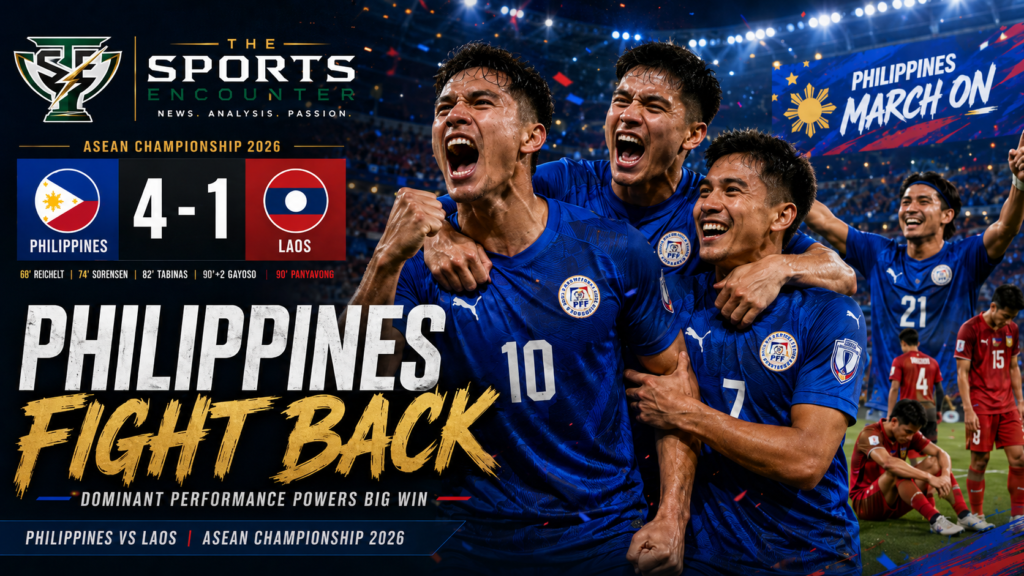
- The Philippines beat Laos 4-1 at Lao National Stadium KM16 in Vientiane.
- Laos scored first through Damoth Thongkhamsavath in the seventh minute.
- Phetdavanh Somsanid’s 14th-minute red card changed the match.
- John Lucero, Jarvey Gayoso, Daisuke Sato, and a Viengxay Sydavong own goal shaped the Philippines’ comeback.
- Cole Mrowka was named Hyundai Player of the Match.
- The Philippines moved to three points, while Laos stayed bottom of Group B with three defeats.
Match Information
| Detail | Information |
|---|---|
| Match | Laos vs Philippines |
| Competition | ASEAN Hyundai Cup 2026, Group B |
| Result | Laos 1-4 Philippines |
| Venue | Lao National Stadium KM16, Vientiane |
| Date | Saturday, August 1, 2026 |
| Laos Scorer | Damoth Thongkhamsavath 7’ |
| Philippines Scorers | John Lucero 47’, Viengxay Sydavong 52’ OG, Jarvey Gayoso 60’ pen, Daisuke Sato 88’ |
| Top Performer | Cole Mrowka, Hyundai Player of the Match |
| Turning Point | Phetdavanh Somsanid’s 14th-minute red card |
| Red Cards | Phetdavanh Somsanid, Laos, 14’ |
| Yellow Cards | Initial yellow shown to Phetdavanh before the pitch-side review upgraded the decision to red |
| Group Impact | Philippines revived their semifinal hopes; Laos moved closer to elimination |
Updated Group B Table After Laos 1-4 Philippines
| Position | Team | Played | Won | Drawn | Lost | Goals For | Goals Against | Goal Difference | Points |
| 1 | Malaysia | 2 | 2 | 0 | 0 | 6 | 1 | +5 | 6 |
| 2 | Thailand | 1 | 1 | 0 | 0 | 5 | 0 | +5 | 3 |
| 3 | Myanmar | 2 | 1 | 0 | 1 | 5 | 3 | +2 | 3 |
| 4 | Philippines | 2 | 1 | 0 | 1 | 5 | 5 | 0 | 3 |
| 5 | Laos | 3 | 0 | 0 | 3 | 1 | 13 | -12 | 0 |
Table calculated before Thailand vs Malaysia later on August 1.
Philippines Needed a Reset. Laos Gave Them a Scare First.
The Philippines arrived in Vientiane carrying the weight of a poor opening night. Their 4-1 defeat to Myanmar had left Carles Cuadrat’s side with no margin for another slow start. Seven minutes into this match, that pressure got heavier.
Laos took the lead through Damoth Thongkhamsavath, whose long-range shot slipped through Quincy Kammeraad’s hands and crossed the line. For a few minutes, it looked as if the Philippines were drifting toward another uncomfortable evening.
Then the match turned.
Phetdavanh Somsanid slid into Jarvey Gayoso from behind in the 14th minute. Referee Kim Hee-gon first showed yellow, but after a pitch-side review, the decision became a red card. Laos were down to 10 men before the match had reached its first real rhythm.
From there, the Philippines had to show patience, not panic. They did not score before halftime, but they kept pressing, kept asking questions, and eventually broke Laos open after the interval.
The result brings the Philippines back into the Group B race and gives their campaign some much-needed life after the disappointment covered earlier in The Sports Encounter’s report on Myanmar’s 4-1 win over the Philippines.
Laos Started With Belief, Then Lost Their Shape
Laos deserved credit for the opening goal. They attacked with speed, used transition well, and punished a goalkeeper error. Damoth’s strike may not have looked unstoppable, but his willingness to shoot early gave Laos exactly the kind of start an underdog needs.
The red card changed their night completely.
With 10 men, Laos had to defend deeper and give up more space. That made the game less about their attacking plan and more about survival. For a while, they survived well. The Philippines thought they had equalized through Kenji Nishioka, but the goal was ruled out for an infringement in the build-up. Cole Mrowka also came close with a free kick that bounced just wide of Kop Lokphathip’s left post.
Still, Laos could not keep pushing back forever. The energy required to defend with 10 men caught up with them after halftime. Once the Philippines found the equalizer, Laos lost the one thing that had kept them alive: scoreboard pressure.
Their tournament position now looks bleak. Three matches, zero points, 13 goals conceded, and only one scored leave Laos needing a near-miracle to reach the semifinals.
John Lucero Opens the Door
The Philippines finally got level two minutes into the second half.
Daisuke Sato crossed from the left, Laos failed to clear, and John Lucero reacted sharply. His first-time right-footed finish went across goal and into the bottom corner. It was the kind of finish the Philippines had missed against Myanmar: clean, early, and decisive.
That goal changed the mood. Laos could no longer sit on their early lead. The Philippines could attack with freedom rather than anxiety.
Five minutes later, they were ahead. Mrowka combined with Javier Mariona, received the return pass, and fired toward goal. Viengxay Sydavong stretched to intervene but only redirected the ball past Kop. The own goal made it 2-1 and confirmed that Laos’ defensive resistance had started to crack.
The Sports Encounter’s Soccer coverage has followed how group-stage momentum can shift quickly in short tournaments. This was another clear example. One red card, one equalizer, and suddenly the entire match looked different.
Gayoso and Sato Finish the Job
Jarvey Gayoso had already played a central role in the key disciplinary moment. In the 60th minute, he added his name to the scoreline.
Referee Kim awarded the Philippines a penalty after Gayoso’s strike hit Phoutthavong Saangvitay on the arm. Gayoso took the kick himself and calmly sent the ball down the middle. At 3-1, the match no longer felt fragile for the visitors.
Daisuke Sato then sealed the win two minutes from time. Nishioka delivered from the left, and Sato stayed onside before heading home. It was a strong finish from a senior player who had already contributed to the equalizer.
For the Philippines, those two goals mattered beyond the final score. Goal difference can become decisive in Group B, especially with Malaysia, Thailand, Myanmar, and the Philippines all fighting for position. Turning a tense 2-1 into a 4-1 win gave Cuadrat’s side a cleaner table recovery.
Cole Mrowka Was the Connector
Cole Mrowka earned the official Hyundai Player of the Match award, and his influence was easy to understand.
He threatened with a first-half free kick, helped create the second goal through his combination with Mariona, and gave the Philippines control between midfield and attack. On a night when the team had to break down a reduced opponent without becoming frantic, Mrowka supplied tempo and clarity.
Lucero gave the finish that changed the match. Gayoso gave the penalty and attacking edge. Sato brought leadership and the late goal. Still, Mrowka’s rhythm tied the performance together.
That matters for the Philippines’ next challenge. They now face Thailand, and they will not get the same time or space. If they want to trouble the group favorite, they need Mrowka, Gayoso, Sato, and Lucero to turn this comeback into a platform.
What the Result Means for the Philippines
The Philippines are alive again, but not safe.
They have three points from two matches, with a neutral goal difference after scoring four against Laos and conceding four against Myanmar. That is a much healthier position than they had at halftime in Vientiane, but the schedule remains demanding.
Thailand are next. Malaysia still wait at the end of the group. That means the Philippines probably need at least one major result from those two matches to reach the top two.
The win does give them emotional oxygen. After the heavy Myanmar defeat, a second loss would have left them almost out of the race. Instead, they now move into the next round of fixtures with a real, if difficult, qualification route.
For comparison, Malaysia already strengthened their case with a commanding result discussed in The Sports Encounter’s report on Malaysia’s 4-0 win over Laos, while Myanmar remain part of the same crowded race.
What the Result Means for Laos
Laos are running out of road.
They have lost 5-0 to Thailand, 4-0 to Malaysia, and now 4-1 to the Philippines. The pattern is difficult to ignore. They have competed in spells, but collapses after pressure moments have damaged every match.
Against the Philippines, they had the perfect early setup: a goal, home crowd energy, and an opponent carrying pressure. The red card changed everything, but Laos still had to manage the game better after halftime. They could not.
Their remaining match against Myanmar now looks more like a pride test than a realistic qualification route. Mathematically, hope may remain until the table closes around them. Practically, three defeats and a minus-12 goal difference leave very little room.
The wider ASEAN Hyundai Cup picture can be followed through The Sports Encounter’s World Cup 2026 and international football hub, where qualification formats and tournament pressure are recurring themes.
Final Takeaway
The Philippines got the win they had to get, but Laos made them feel the danger first.
Damoth’s early goal exposed Philippine nerves. Phetdavanh’s red card changed the contest. Lucero’s equalizer opened the door. Mrowka’s control helped the Philippines walk through it. Gayoso and Sato made sure the scoreline carried real value.
The Philippines are back in the Group B race, but the hard part starts now. Thailand and Malaysia will ask much sharper questions than 10-man Laos could manage.
For Laos, the tournament is slipping away fast. For the Philippines, Vientiane may be remembered as the night their campaign finally started.