


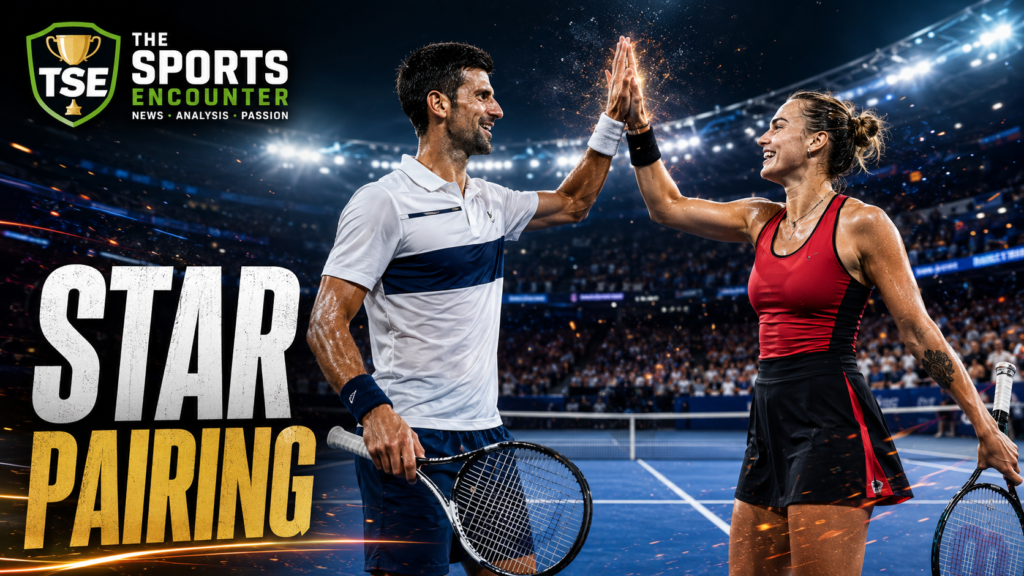
Novak Djokovic and Aryna Sabalenka playing mixed doubles together at the US Open sounds like something fans would create for a tennis video game.
Yet this is real, and it immediately changes the energy around the event.
TL;DR
Novak Djokovic and Aryna Sabalenka are set to play together in the US Open mixed doubles championship, creating one of the most marketable pairings tennis could offer. The team brings Djokovic’s tactical control and Grand Slam experience together with Sabalenka’s power, hard-court dominance, and doubles background. Their entry also highlights the US Open’s bigger push to turn mixed doubles into a star-driven event during Fan Week.
Djokovic remains one of the most accomplished players in tennis history, a 24-time Grand Slam singles champion whose career has been defined by problem-solving, returning, movement, and mental control. Sabalenka brings a different force. She is one of the most explosive players in the women’s game, a hard-court heavyweight, and a singles star whose power can change the mood of a match in a few swings.
Put them together and the US Open gets exactly what its reimagined mixed doubles championship wants: attention before the main singles drama fully takes over.
This is no ordinary side event now. The official US Open mixed doubles championship has been reshaped into a shorter, sharper, star-led competition designed to attract bigger names and more casual viewers.
For The Sports Encounter’s wider tennis coverage, visit our Tennis hub.
Why This US Open Mixed Doubles Format Matters
The US Open has changed the way mixed doubles is presented.
Instead of treating it as a quieter Grand Slam draw that runs in the background, the tournament has pushed the event into Fan Week. That gives it a cleaner spotlight. Fans arrive early, broadcasters get a simple story to promote, and singles stars can play without carrying a full traditional doubles workload through the main tournament.
The format is also built for speed. Shorter sets, no-ad scoring, and match tiebreaks create faster pressure points. That matters because it helps the tournament attract elite singles players who may otherwise avoid doubles before a major singles campaign.
That is the central business idea behind this version of mixed doubles.
Tennis wants stars on court. Fans want rare combinations. Broadcasters want matchups that can be explained in one sentence. Djokovic and Sabalenka give everyone that.
For another recent tennis angle, read our coverage of major tennis storylines shaping the season.
Why Djokovic and Sabalenka Make Tactical Sense
This pairing works because their strengths do not overlap in a lazy way.
Djokovic gives the team control. His return game remains one of the greatest weapons tennis has seen. In mixed doubles, where one loose service game can decide a short set, return pressure becomes a huge advantage. Djokovic can take pace, redirect angles, and force opponents to play one extra ball under pressure.
Sabalenka gives the team violence from the first shot.
Her serve, forehand, and ability to attack short balls can instantly tilt points. If Djokovic creates a neutral ball with his return, Sabalenka can turn it into an attacking position. If Sabalenka lands a heavy serve, Djokovic can step forward and read the next exchange.
That combination gives them a clear identity: Djokovic organizes the point, Sabalenka damages it.
For fans who enjoy player comparisons and tactical debate, our feature on how elite greatness is ranked across sports offers a similar performance-driven lens.
Sabalenka’s Doubles Background Should Not Be Ignored
Some fans may see this only as a superstar singles pairing. That misses an important part of Sabalenka’s profile.
Before she became one of the most feared singles players in the world, Sabalenka had serious doubles success. She won major doubles titles with Elise Mertens and reached the top of the doubles rankings earlier in her career.
That background matters in mixed doubles.
Doubles is not only about hitting harder. It requires positioning, fast decisions, court coverage, net reactions, and trust between partners. Sabalenka understands those patterns better than many singles-first players. She knows when to attack the net, when to hold position, and how quickly doubles points can turn.
Djokovic may not be a doubles specialist, but he sees the court better than almost anyone. That gives the team a real tactical base.
Why Djokovic’s Role Could Be More Subtle Than Fans Expect
Djokovic does not need to dominate this partnership by hitting winners from everywhere.
His best role may be quieter: return well, place the ball intelligently, protect positioning, and make the other team uncomfortable. In mixed doubles, the smartest player on court often controls the match without looking flashy.
That suits Djokovic perfectly.
He can slow the pace when needed. He can change direction. He can cover the middle. He can recognize which opponent is under pressure and keep sending the ball there. In a short format, that kind of judgment can be more valuable than raw shotmaking.
Sabalenka can supply the blunt force. Djokovic can supply the map.
For more coverage of high-pressure athletes and legacy debates, explore The Sports Encounter’s NBA hub, where similar questions around age, greatness, and late-career performance often appear.
The Star-Power Question: Is This Good for Mixed Doubles?
This pairing also brings a serious debate.
The US Open’s new mixed doubles approach gives fans bigger names, but it also raises questions about doubles specialists. Traditional mixed doubles players have spent years building that craft. Now, the event’s biggest spotlight may go to singles stars entering for a short, high-profile run.
That tension is real.
On one side, Djokovic and Sabalenka bring attention that mixed doubles rarely receives. More viewers may discover the format because two global stars are playing together. That could help the event grow.
On the other side, doubles specialists may feel the sport is borrowing their event to promote singles celebrities. Mixed doubles has its own rhythm and skill set. It deserves respect as competition, not only as entertainment.
The US Open appears to be making a clear bet: attention first, tradition second.
Whether that bet helps mixed doubles long term depends on what fans do after watching Djokovic and Sabalenka. If they stay interested in the format, the gamble works. If they only watch the famous names and disappear, the debate will become louder.
Why Fans Will Watch Anyway
Even with the debate, this pairing is impossible to ignore.
Djokovic brings history into every match. Sabalenka brings intensity. Together, they create contrast, personality, and a sense that something unusual could happen.
New York crowds respond to that kind of energy. The US Open has always loved theatre: night sessions, loud reactions, celebrity presence, big personalities, and emotional tennis. A Djokovic-Sabalenka mixed doubles match fits that environment almost too well.
Fans will watch for the tennis, but they will also watch for the body language.
How will they communicate? Who takes the middle ball? How will Sabalenka react if Djokovic calmly redirects a point instead of finishing it? How will Djokovic respond to Sabalenka’s full-power first-strike game beside him?
That is what makes the pairing fun. It has sporting value and social curiosity.
For more fan-first sports storytelling, read our analysis on why fan-voted teams create such powerful debate.
Could Djokovic and Sabalenka Win the Title?
Yes, they can win it.
Short-format tennis rewards players who handle pressure quickly. Djokovic has built his career around decisive points. Sabalenka has become far more composed in big matches than she was earlier in her career. That combination should travel well in no-ad games and match tiebreaks.
Their biggest weapon may be psychological pressure.
Opponents will know every loose service game matters. They will know Djokovic can punish weak second serves. They will know Sabalenka can end points quickly if given time. That creates tension before the ball is even struck.
Still, mixed doubles can expose unfamiliar teams. Communication errors, positioning gaps, and unclear net coverage can punish even great singles players. Teams with stronger doubles rhythm may trouble them, especially if they serve well and force Djokovic and Sabalenka into rushed decisions.
That uncertainty makes the event more watchable.
For readers who enjoy ranking title contenders, our feature on how all-time athletes are evaluated through different metrics shows how context often changes the answer.
What This Says About Modern Tennis
The Djokovic-Sabalenka pairing says something bigger about tennis in 2026.
The sport is trying to package more moments. Grand Slams still carry history, but tennis also competes for attention in a crowded entertainment market. Shorter formats, special events, mixed pairings, and star-driven showcases help tournaments reach casual fans who may not follow every ranking movement.
That can be healthy when done carefully.
Tennis needs tradition, but it also needs entry points. A casual viewer may not start by studying doubles formations. They may start because Djokovic and Sabalenka are on court together. If the match is sharp, emotional, and competitive, that viewer may come back.
The challenge is keeping the sport honest.
If mixed doubles becomes only a celebrity product, it loses depth. If it uses celebrity power to introduce fans to real doubles skill, it gains a new audience.
That is why this US Open event matters beyond one pairing.
The Final Verdict
Novak Djokovic and Aryna Sabalenka teaming up at the US Open is exactly the kind of story modern tennis knows how to sell.
It has names. It has contrast. It has tactical intrigue. It has commercial value. It also carries a legitimate debate about what mixed doubles should become in a sport increasingly shaped by attention economics.
Djokovic gives the team control, return quality, and unmatched experience. Sabalenka gives it force, hard-court authority, and doubles instincts from an earlier stage of her career. Together, they may become one of the most watched mixed doubles teams the US Open has ever placed on court.
Will they win the title? They have the tools.
Will they make people care? That answer already feels clear.
For more tennis stories and Grand Slam coverage, follow The Sports Encounter’s latest tennis updates.